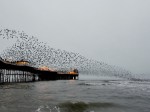
Crepundicide – 3rd Feb 2016

On my way home from work last night I came across a Santa toy disfigured by multiple burns. Most of his face had gone, leaving a nightmarish wound, the mutilation made more ghoulish by the jolly swagger the plastic would otherwise have embodied.

From time to time I come across similar things on my wanderings: decapitated soft toys with the stuffing ripped out of them, limbless Barbie dolls, My Little Ponies scalped of mane and tail… All of us have carried out comparable acts of abuse at some point in our lives. It’s no use denying it, even if once as a toddler you demanded the head of the jelly rabbit, or watched with fascination as the features of the Christmas candle figurine slowly liquefied at it burned down, you are guilty to a degree. Perhaps it’s a way of saying “I have put away childish things, I am bigger than this now”? Or maybe it’s just that children really can be murderous.

Anyway, on arriving home I decided there had to be a term for these ritual killings. Yet, despite a lot of searching I came up with nothing. It’s too significant a practice to not have a name so I’ve decided on:

‘Crepundicide’.

From the latin: ‘Crepundia’: rattle, plaything, toy. And ‘-cide’. Word-forming element meaning “killer,” from French -cide, from Latin -cida “cutter, killer, slayer,” from -cidere, comb. form of caedere “to strike down, chop, beat, hew, fell, slay… [or] from Latin -cidium “a cutting, a killing.”*

*Online Etymology Dictionary http://www.etymonline.com/

Rabbits – 1st Feb 2016

“Chris!”
“Hello Alex!”
“How are you?”
“Good, fine, you?”
“Ok, been really busy, work”
“Me too, up to my eyeballs”
“How’s things there?”
“Oh, the usual, you couldn’t make it up… That’s a fine looking dog you’ve got there. Yours?”
“Yes, had him for a couple of months. He’s really friendly.”
“Why the muzzle then?”
“Retired greyhound, raced for 6 years. Keeps mistaking small dogs for rabbits, got to be a bit careful”
“Ah”

Strange Lights – 30th Jan 2016

“These nymphs, I would perpetuate them.
                                                                                So bright
Their crimson flesh that hovers there, light
In the air drowsy with dense slumbers.
                                                                           Did I love a dream?
My doubt, mass of ancient night, ends extreme
In many a subtle branch, that remaining the true
Woods themselves, proves, alas, that I too
Offered myself, alone, as triumph, the false ideal of roses.

Let’s see…”

Stéphane Mallarmé, ‘L’Apres-midi d’un Faune’ 1876
Translated by A. S. Kline

Portents – 28th Jan 2016

“Slowly, shakily, with unnatural and inhuman movements a human form, scarlet in the firelight, crawled out on to the floor of the cave. It was the Un-man, of course: dragging its broken leg and with its lower jaw sagging open like that of a corpse, it raised itself to a standing position. And then, close behind it, something else came up out of the hole. First came what looked like branches of trees, and then seven or eight spots of light, irregularly grouped like a constellation. Then a tubular mass which reflected the red glow as if it were polished. His heart gave a great leap as the branches suddenly resolved themselves into long wiry feelers and the dotted lights became the many eyes of a shell-helmeted head and the mass that followed it was revealed as a large roughly cylindrical body. Horrible things followed-angular, many jointed legs, and presently, when he thought the whole body was in sight, a second body came following it and after that a third. The thing was in three parts, united only by a kind of wasp’s waist structure- three parts that did not seem to be truly aligned and made it look as if it had been trodden on”.

Voyage to Venus (Perelandra) C. S. Lewis 1943

Marie Celeste – 27th Jan 2016

Not long after I started this project I came across this scene in one of the closed-up units opposite Brighton pier. The building that houses it is entirely glass-walled, somewhat reminiscent of a fish tank. I photographed it at the time and included it in my contact sheet for that day*.

A year later I’m looking at it again. Originally there were 5 chairs, now there is only one, but the newspaper hasn’t moved a millimetre. It still lies there, considerably more yellowed, and over time has become moulded to the round surface of the table; a fossilised exhibit in a fly-specked museum vitrine.

* ‘The Dark Side – Mon 16th Feb’ (2015)

Thingness – 26th Jan 2016

“We see the things themselves, the world is what we see: formulae of this kind express a faith common to the natural man and the philosopher — the moment he opens his eyes; they refer to a deep-seated set of mute “opinions” implicated in our lives. But what is strange about this faith is that if we seek to articulate it into theses or statements, if we ask ourselves what is this we, what seeing is, and what thing or world is, we enter into a labyrinth of difficulties and contradictions.”

Opening lines of: Maurice Merleau-Ponty ‘The Visible and the Invisible’ Translated by Alphonso Lingis, Northwestern University Press 1968

All the other ends of the world – 25th Jan 2016

And then there are other more commonplace ends of the world. Shorelines and on the edges of deserts of course, but also industrial estates on the peripheries of towns, the corners of warehouses, inside wardrobes in children’s rooms, beyond stage doors, behind curtains, and nestling by the lowest rungs of fire escapes. And in all these places things accumulate; not exactly rubbish but almost always without purpose, waiting for someone to remember what they were for.

Fog (part 2) – 24th Jan 2016

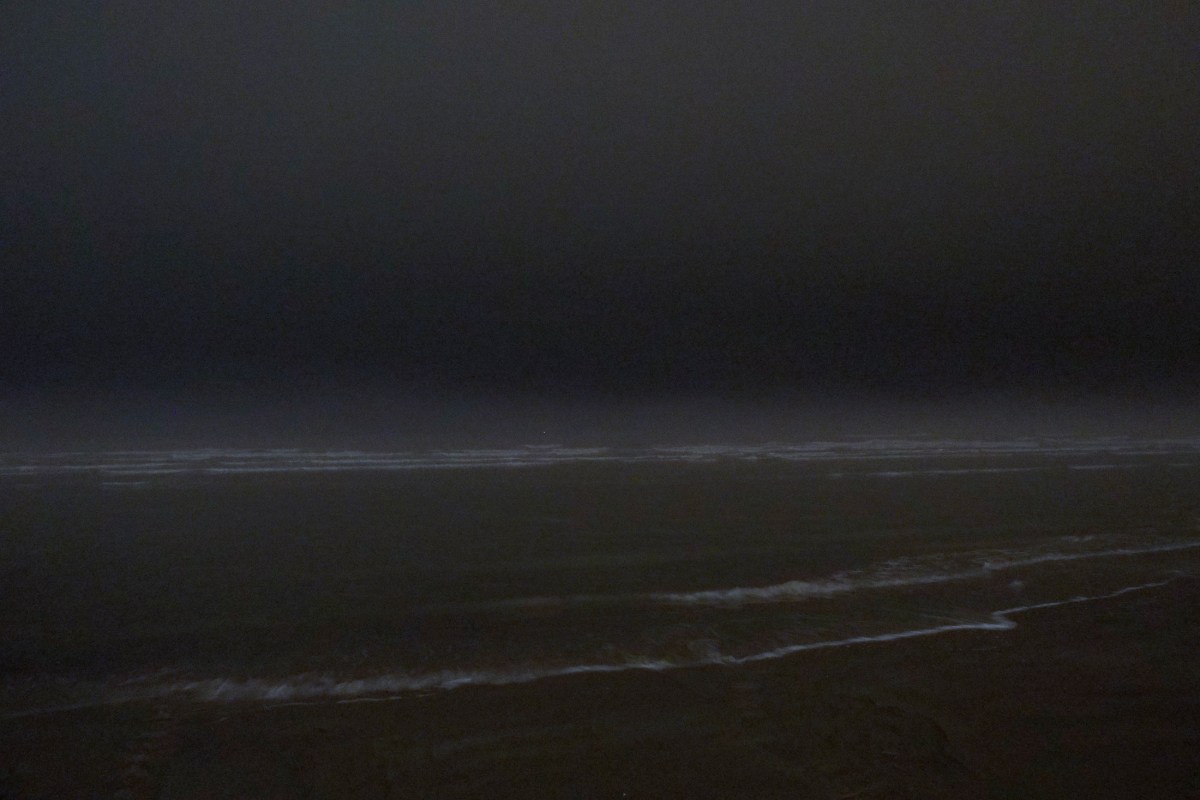
By the time the starlings had finished it was almost dark and it felt like the whole of Brighton had gone home too. Indeed as I wandered homewards along the shore the world itself to my left seemed to have disappeared. I scrabbled across the pebbles toward the sea to have a look.

When nowadays we say things like “It’s the end of the world” we think of apocalypse and Armageddon, nuclear war, ecological disaster… it’s always an ending in time, but before the discovery (by Europeans at least) of the Americas, the ends of the world were an actual place where sea monsters dwelled and from which sailors rarely returned. Tonight, looking out into the soft, dense darkness, I wondered if such a place still existed.

Fog (part 1) – 24th Jan 2016

Another truly dismal day largely spent trying to catch up on work. Even though it was only mid afternoon, the light was already fading as I reached the sea front and I half toyed with the idea of just stopping by the café and abandoning any further plans for the day. Then I noticed the fog beginning to creep in from the horizon.

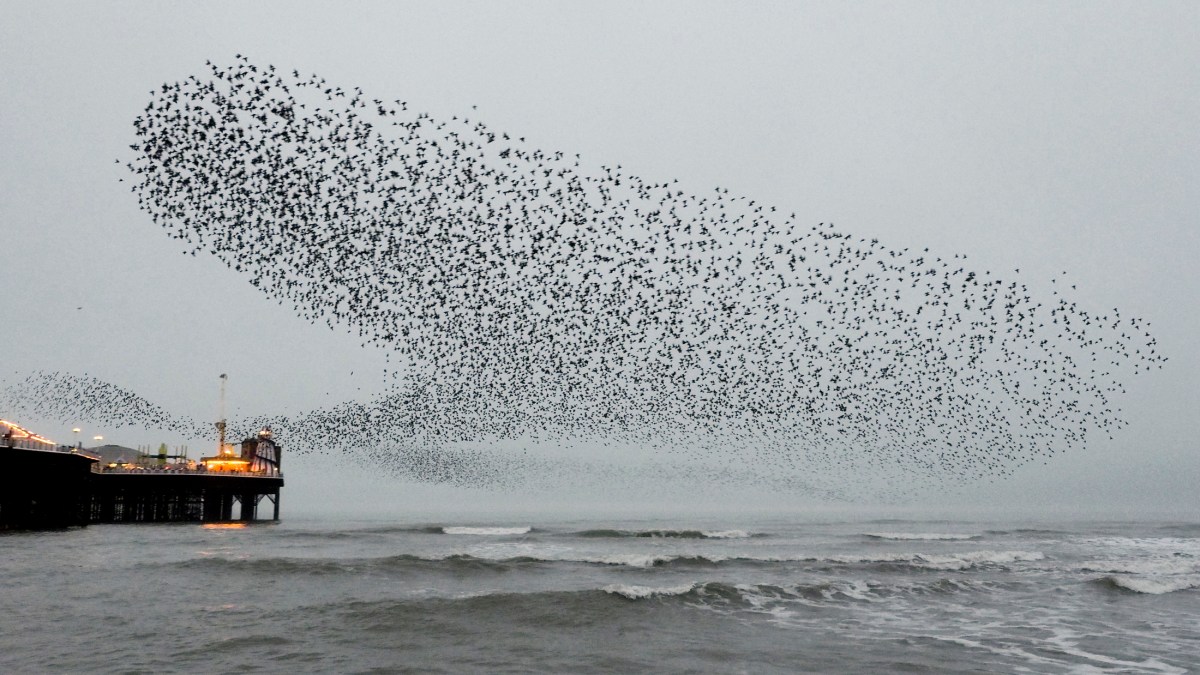
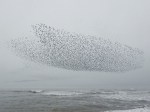
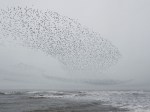
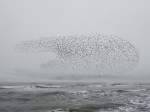
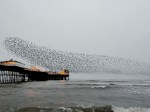
The thing about photographing starling murmurations is that (rather obviously) they are always set against a backdrop of the sky, and if the sky is filled with clouds, then at sunset these can be a rather too beautiful distraction from the spectacle. I’ve never seen starlings gather in fog before, and have always wondered if these weather conditions might actually be the most perfect, where every other element would be pared down to the barest minimum, just the birds, not even a horizon. I didn’t even know if starlings flocked in these conditions. Would I be able to see them? Would they be able to see each other? I set off for the pier to find out.

When I arrived I realised that at least the setting was perfect. Not enough mist to obscure the pier structure, but the sky had become a complete blank and the horizon was almost lost. The birds themselves arrived soon enough, in small groups at first, then in bigger flocks than I’ve seen for many years. Silent as always, the only sounds the wash of insignificant waves against the shore, just enough to cover the traffic sounds already muffled by the mist; even the piped music from the pier seemed more distant than usual.

The spectacle was not only magnificent but eerie. Great swarms appeared and receded in the fog forming shapes that would have been familiar if they hadn’t been so huge: for a moment a spoon hanging implausibly in the air, then a writhing caterpillar; on more than one occasion swooping past like some monstrous composite bird with giant slowly beating wings, while in the distance, other, barely visible shapes appeared and dissolved against the whited sky like sentient smoke.

I was surprised to see them flying so high; the murmurations we see in Brighton tend towards the horizontal, often hugging the waves, but these seemed to disappear vertically as well as towards the horizon. I’ve read somewhere among the theories that attempt to explain this spectacle (no one really knows why) is one suggesting that doing so makes them a beacon for other starlings to aim for, a broadcast to all, that here is somewhere safe to spend the night. If this is true then perhaps the size of the display was a direct response to the fog itself, creating a need in each bird to become even more flamboyant to counter the obscurity of the weather.