Dead – 30th May 2016

Today I got final confirmation that one of my external hard drives has died. It was the one with all my photographs on it for the last 15 months. All of them. I know I should have backed up, I thought I had, but it was a relatively new drive, so I felt safe, and it’s been another ridiculous year at work, a new demand every week, always coming from a faceless person in an unnumbered office deciding wheels would be better square, or asking you to write another report on why you need four of them.

On one side the should-haves, on the other the excuses; I know it’s better to avoid going down either road, and I’m trying not to. I thought I’d backed it up more recently, but the last time turns out to be February 2015.

It was a long process finding out. Ironically, the thing gave up the ghost the evening, about ten days ago, when I’d decided to start backing it up. It had been a good day and I was finally ahead of things. But when I turned the external hard drive on, it didn’t appear on the desktop. All I could hear was a repeated ‘nik, nik, nik’ sound. I rebooted. Once again, the ‘nik, nik, nik’ sound. I rebooted again, and again the ‘nik, nik, nik’ sound, then a pause, followed by one of those helpful messages you periodically get on computers, this one reading: ‘The disc you have inserted is unreadable, do you want to: Format / Eject / Ignore?’

It’s a bit like coming home to find your most beloved dog lying, almost dead, on the carpet. There is the sheer horror, heavily laced with feelings of guilt, stupidity and self-reproval. The immediate need for action: can I save it? The scrabble through a dozen data retrieval websites and software providers confirming I can’t. So who can? The facebook plea for help, the gratefully received responses providing at least straws to clutch at, set against the mounting wave of fear: have I really lost fifteen months of work? Of course I have the images on this blog, but these represent a tiny fraction of the total and are all low-resolution versions for the web.

I spent most of that evening staring at the computer screen, as if sheer concentration might bring my photographs back.

First thing the next day I set off to one of the repair shops I’d been recommended by kind friends responding to my facebook SOS. Jamie, the man behind the counter was reassuring. It’d probably be ok, he said, and then talked about other more expensive options if it wasn’t… But the day after, he called me to say it wasn’t, and that the hard drive would have to be sent off to a specialist in Newcastle. He reassured me they do amazing things, about 90% chance of getting my work back, but it wouldn’t be cheap –£700 upwards. The cost was eye watering, but of course I said I’d pay. What price do you put on saving the life of your beloved animal? But only 90%? That left a 10% uncertainty.

I’ve been living with that uncertainty for just over a week. During that time I’ve been manically backing up everything else on all the other hard drives. The process is still continuing and I know it’s worth it, for the rest of the work (although I’m getting tired of trying to sleep at night listening to the whirr of computer fans) but it was ok, I was doing something useful. Indeed while waiting for the new hard drives to fill up I’d even begun to write a piece about making the best of things – seeing the incident as an opportunity to interrogate why I’ve been undertaking this project, what you could get out of even bad situations. I couldn’t understand why I was having so much difficulty getting my thoughts in order as I was feeling surprisingly positive about the whole thing. I really saw it as a challenge. But of course at that point the death wasn’t actually real, there was still hope, even though the wait was excruciating. Indeed, up until today, I was almost wishing it was irreparable just to get the suspense over, but then Jamie phoned to give me the final prognosis.

The reality of how I felt when I heard was quite different to what I’d imagined, even though I was pretty sure I’d lost it. It physically hurt. I did my best to reply normally but I could hardly get the words out. I confess I was a little comforted to hear the silence at the other end of the phone. Jamie did me the service of not trying to cheer me up. Then as soon as I put the phone down, I got another email from work with the latest command so I’ve spent the rest of the day trying to get through that. Maybe that was a good thing, something to do, but now it’s past midnight and I’ve finally got time to think.

Maybe I will still write that piece about creating value out of difficulty, but I know now that to do so at this moment in time would be dishonest. The best I can come up with, is the thought that by living with this for a bit, what comes out of this situation might be more authentic.

Until then, bear with me, as my posts might be thin on the ground for a while.
Big people – 27th April 2016

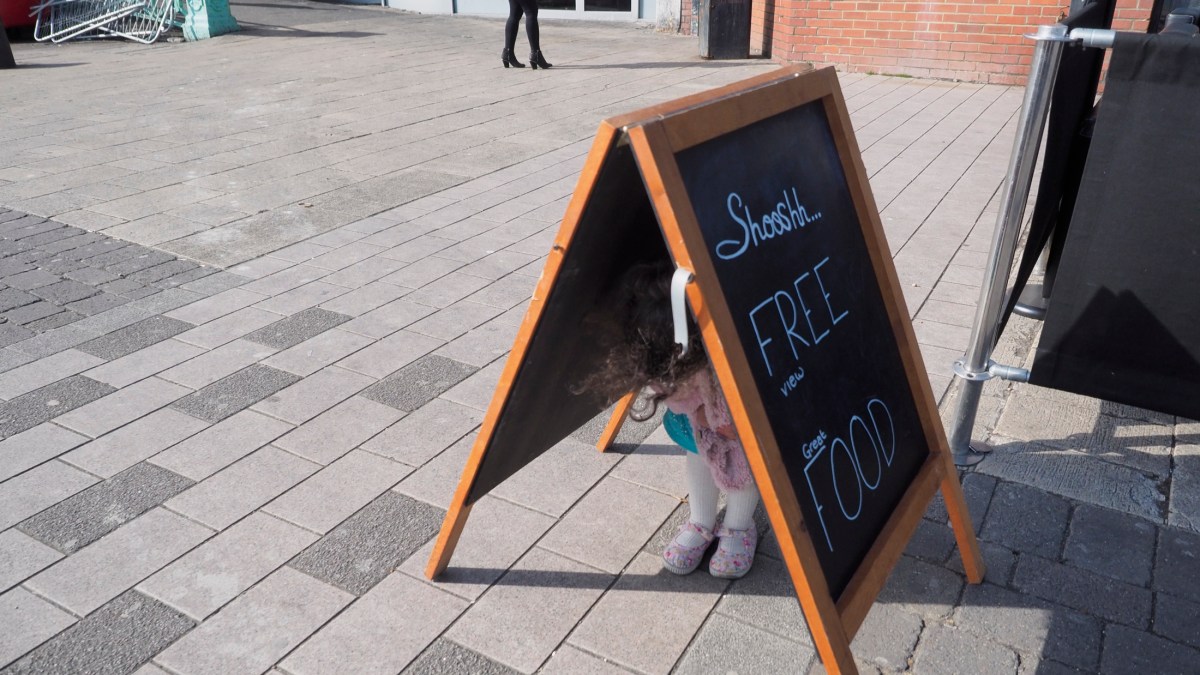
Further to my entry: ‘Intrepid – 18th April 2016’ I’ve been thinking of the possibilities of a theme park for adults: a specially created environment in which all the furniture, fittings and props would be three times normal size, to allow people to re-experience some of the possibilities of childhood –to make dens out of oversized tables, grapple with gigantic cutlery you can hardly lift, find plug sockets you can almost get your fingers into, and rediscover the magic of the undersides of everyday things.

But then I realised that to make the experience real, you’d also need to populate it with 20 foot tall ‘adults’ who’d occasionally leer into view, completely filling your field of vision while booming “Aww…” And then at some point there would be the handkerchief produced from a cavernous woollen sleeve, licked, and prodded at your face with the words “Keep still!” reducing you to a bawling bundle of uncontrollable emotions.

Maybe not such a good idea then.

One Way Street – 23rd April 2016

“The furniture style of the second half of the nineteenth century has received its only adequate description, and analysis, in a certain type of detective novel at the dynamic centre of which stands the horror of apartments. The arrangement of the furniture is at the same time this site plan of deadly traps, and the suite of rooms prescribes the fleeing victim’s path. That this kind of detective novel begins with Poe – at a time when such accommodation hardly yet existed – is no counter-argument. For without exception the great writers perform their combinations in a world that comes after them, just as the Paris streets of Baudelaire’s poems, as well as Dostoyevsky’s characters, only existed after 1900. The bourgeois interior of the 1860s to the 1890s, with its gigantic sideboards distended with carvings, the sunless corners where palms stand, the balcony embattled behind its balustrade, and the long corridors with their singing gas flames, fittingly houses only the corpse. “On this sofa the aunt cannot but be murdered.” The soulless luxuriance of the furnishings becomes true comfort only in the presence of a dead body. Far more interesting than the Oriental landscapes in detective novels is that rank Orient inhabiting their interiors: The Persian carpet and the Ottoman, the hanging lamp and the genuine Caucasian dagger. Behind the heavy, gathered Khilim tapestries The master of the house has orgies with his share certificates, feels himself the eastern merchant, the indolent Pasha in the caravanserai of otiose enchantment, until that dagger in its silver sling above the divan puts an end, one fine afternoon, to his siesta and himself. This character of the bourgeois apartment, tremulously awaiting the nameless murderer like a lascivious old lady her gallants, has been penetrated by a number of authors who, as writers of “detective stories” – and perhaps also because in their works part of the bourgeois pandemonium is exhibited – have been denied the reputation they deserve. The quality in question has been captured in isolated writings by Conan Doyle and in a major production by A. K. Green; and with The Phantom of the Opera, one of the great novels about the 19th century, Gaston Leroux has brought the genre to its apotheosis.

‘Manorially Furnished Ten-Room Apartment’ in ‘One Way Street’, Walter Benjamin, written 1925-26

Alabaster – 20th April 2016

“Titanium dioxide, also known as titanium(IV) oxide or titania, is the naturally occurring oxide of titanium, chemical formula TiO2. When used as a pigment, it is called titanium white, Pigment White 6 (PW6), or CI 77891. Generally it is sourced from ilmenite, rutile and anatase. It has a wide range of applications, from paint to sunscreen to food colouring. When used as a food colouring, it has E number E171…

The most important application areas are paints and varnishes as well as paper and plastics, which account for about 80% of the world’s titanium dioxide consumption. Other pigment applications such as printing inks, fibers, rubber, cosmetic products and foodstuffs account for another 8%. The rest is used in other applications, for instance the production of technical pure titanium, glass and glass ceramics, electrical ceramics, catalysts, electric conductors and chemical intermediates. It also is in most red-coloured candy…

Titanium dioxide is the most widely used white pigment because of its brightness and very high refractive index, in which it is surpassed only by a few other materials. Approximately 4.6 million tons of pigmentary TiO2 are used annually worldwide, and this number is expected to increase as utilization continues to rise. When deposited as a thin film, its refractive index and colour make it an excellent reflective optical coating for dielectric mirrors and some gemstones like “mystic fire topaz”. TiO2 is also an effective opacifier in powder form, where it is employed as a pigment to provide whiteness and opacity to products such as paints, coatings, plastics, papers, inks, foods, medicines (i.e. pills and tablets) as well as most toothpastes. In paint, it is often referred to offhandedly as “the perfect white”, “the whitest white”, or other similar terms. Opacity is improved by optimal sizing of the titanium dioxide particles. Some grades of titanium based pigments as used in sparkly paints, plastics, finishes and pearlescent cosmetics are man-made pigments whose particles have two or more layers of various oxides – often titanium dioxide, iron oxide or alumina – in order to have glittering, iridescent and or pearlescent effects similar to crushed mica or guanine-based products. In addition to these effects a limited colour change is possible in certain formulations depending on how and at which angle the finished product is illuminated and the thickness of the oxide layer in the pigment particle; one or more colours appear by reflection while the other tones appear due to interference of the transparent titanium dioxide layers. In some products, the layer of titanium dioxide is grown in conjunction with iron oxide by calcination of titanium salts (sulfates, chlorates) around 800 °C or other industrial deposition methods such as chemical vapour deposition on substrates such as mica platelets or even silicon dioxide crystal platelets of no more than 50 µm in diameter. The iridescent effect in these titanium oxide particles (which are only partly natural) is unlike the opaque effect obtained with usual ground titanium oxide pigment obtained by mining, in which case only a certain diameter of the particle is considered and the effect is due only to scattering.”

From:
https://en.wikipedia.org/wiki/Titanium_dioxide

The Frog Prince – 19th April 2016

The next day when she had seated herself at table with the king and all the courtiers, and was eating from her little golden plate, something came creeping splish splash, splish splash, up the marble staircase, and when it had got to the top, it knocked at the door and cried, “Princess, youngest princess, open the door for me.” She ran to see who was outside, but when she opened the door, there sat the frog in front of it. Then she slammed the door to, in great haste, sat down to dinner again, and was quite frightened. The king saw plainly that her heart was beating violently, and said, “My child, what are you so afraid of? Is there perchance a giant outside who wants to carry you away?” “Ah, no,” replied she. “It is no giant but a disgusting frog.”

“What does a frog want with you?” “Ah, dear father, yesterday as I was in the forest sitting by the well, playing, my golden ball fell into the water. And because I cried so, the frog brought it out again for me, and because he so insisted, I promised him he should be my companion, but I never thought he would be able to come out of his water. And now he is outside there, and wants to come in to me.”

In the meantime it knocked a second time, and cried, “Princess, youngest princess, open the door for me, do you not know what you said to me yesterday by the cool waters of the well. Princess, youngest princess, open the door for me.”

‘The Frog Prince’, Brothers Grimm

Staring games – 17th April 2016

As children, we’ve all played games involving out-staring a friend, these usually ending with a cry of “You blinked!” “No, I didn’t, you blinked first!” “No, you did!” etc… Why this is such a good game when you’re young I’m not sure. It has limited application in adult life, where there are limits on how long you can look at a fellow human being who is also discovered to be looking back. Try it on a train with a complete stranger and anything more than a micro second could get you punched, or slapped. Even the romance attached to: ‘their eyes met across a crowded room’ is only underlined by the briefness of these rare moments.

But these latter are not really staring games, more like glancing games. If, as an adult, you want to play a staring game and you can’t find any friends interested in playing, we all know the game works on animals too. Admittedly with dogs it’ll only last a few seconds before the dog looks away and you suddenly feel ashamed you could even think of putting your beloved companion through this torture. But cats, on the other hand, are much more fun. A cat will keep up the contest for quite a while, sometimes even winning the match, and if it is you who outlasts the cat, the feline indignation as it looks away at least partially makes up for your minor cruelty. Indeed the knowledge that cats will stare at each other for hours serves as confirmation that they place a great deal of importance on staring.

However, the real masters of staring games are sheep. If you don’t believe me, go and stand in the same field as a flock of these ruminants and wait. It won’t be long before you find one of them staring at you, and when you do, try staring back. The sheep will happily carry on looking at you directly in the eyes for what will seem like an age. In this time you will find yourself wondering what on earth it can possibly hope to accomplish by this contact, after all, sheep are not predators, nor are they territorial. You will also find yourself trying to fathom the expression on the sheep’s face. The gaze of the sheep goes well beyond ‘unconcerned’ to your realization that if there are any emotions or thoughts present, that these are of the absolute right the animal considers itself to have in looking at you. You will find yourself reminded of the time you accidentally stumbled into a yoga class full or pregnant women, or perhaps memories of school when, having accomplished some small act of drollery, you find the gaze of your teacher locked onto yours with the full force of a blowtorch. No one can survive these kinds of looks for more than a few seconds.

Yet at this moment, with your confidence reduced to a pulp and with the full knowledge that the sheep has won before you have even begun to tire, the sheep will then turn it’s head and look somewhere else. And this will actually make your defeat worse, because you will know that whatever the sheep is now staring at, the stare will be just as intense and self-righteous as it has been when the quadruped had been looking at you, that you are no more important than a tree, or a gate, or the water-trough, and with this you will recognise that your humiliation is now complete.

Sittin on top of the world – 13th April 2016

No need ‘a runnin’, holdin’ up your hand,
I can get me a woman, quick as you can a man,
But now she’s gone, and I don’t worry,
‘Cause I’m sittin’ on top of the world.

I’m on top of the world, with my leg hanging down,
My baby done quit me, gone out ‘a this town.
But now she’s gone, and I don’t worry,
‘Cause I’m sittin’ on top of the world.

Work all the summer and all the fall,
Now, they wanna take my Christmas, and my overalls.
But now she’s gone, and I don’t worry,
‘Cause I’m sittin’ on top of the world.

Bye, bye, baby, honey if you call it gone,
It may worry me some, baby, but it won’t last long.
But now she’s gone, and I don’t worry,
‘Cause I’m sittin’ on top of the world.

‘Sittin’ On Top Of The World’
Originally written by Walter Vinson / Lonnie Chapmon. This version as recorded by Sonny Terry & Brownie McGhee

Lithographs – 10th April 2016

The seven embellished pebbles shown in the photograph bottom left are, to my mind, some of the best examples of this peripatetic artform I’ve come across to date. Also, they raise several questions: Do they all have the same author or is this a group work? I suspect the latter as there is a difference, both in content and manner of execution. Three are decorative and quite beautifully drawn plant forms. Another resembles a stylised mediaeval comet; this suggests at least one of the authors has a sophisticated knowledge of early European manuscripts. Lastly, there are my favourites: the three in the top row, the ones I can’t fathom the meaning of. Why do I feel such a fondness for these? Probably because I can’t fathom their meaning.

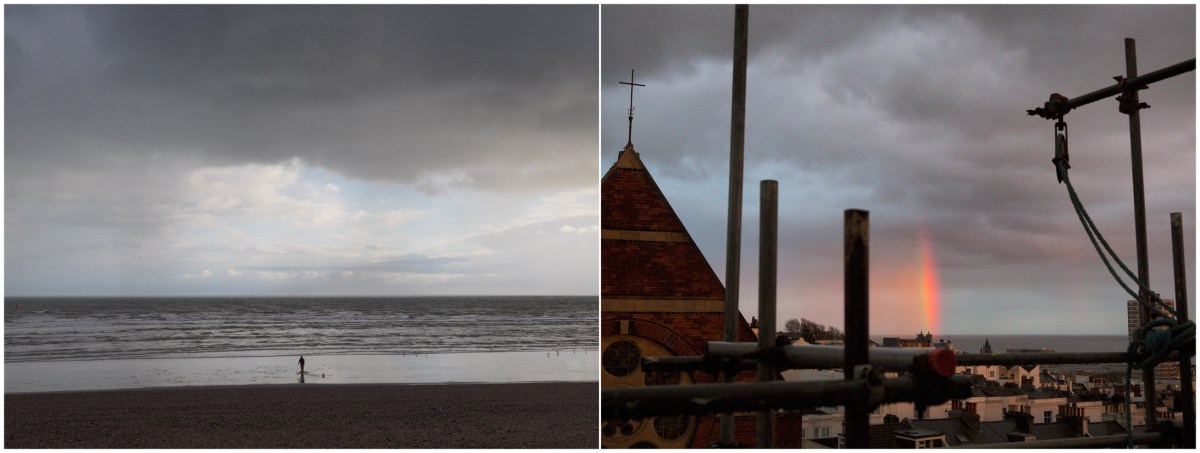
End of the rainbow – 7th April 2016

“But, in truth, it had not exactly been gold, or even the promise of gold, but more like the fantasy of gold, the fairy dream that the gold is there, at the end of the rainbow, and will continue to be there forever – provided, naturally, that you don’t go and look. This is known as finance.”

‘Going Postal’ Terry Pratchett