Strategic Planning – Tues 4th Aug

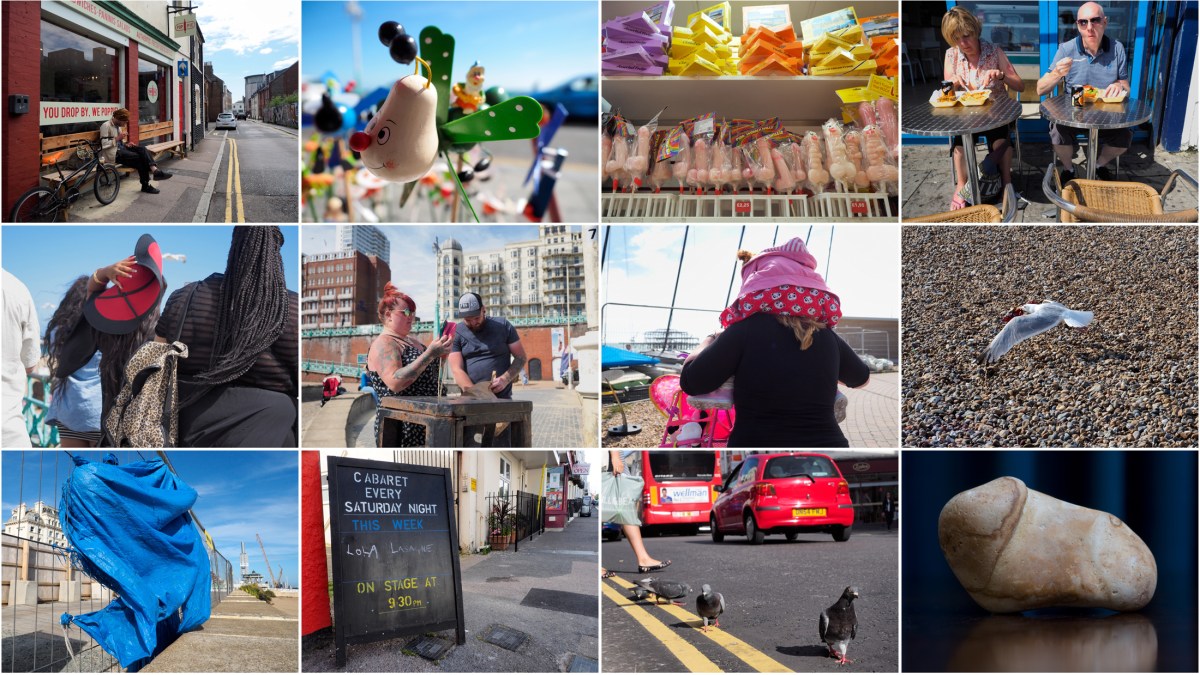
You find yourself in a room with several of your managers. The room also contains a very large, smelly elephant and a lot of flies. It should also be noted that, judging by the state of the carpet, the elephant seems to have an upset stomach. Your managers want you to do something about the flies and, to deal with the problem, you have been given a rolled up newspaper. What do you do next?

Move along now, move along – Mon 3rd Aug

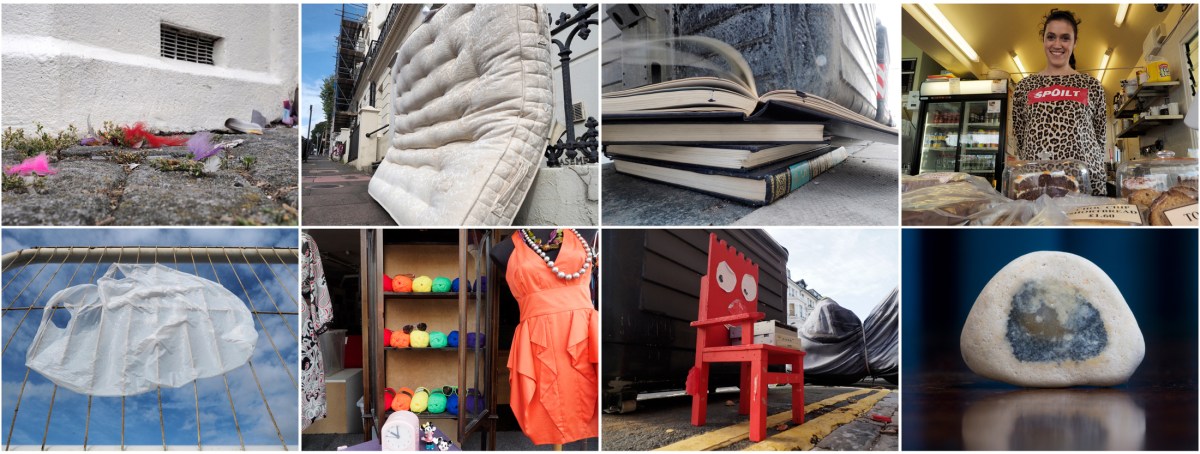
Only a day later and the only signs of Pride having happened are a few leftover shop displays and a larger number of multicoloured feathers than usual to be found in gutters around town. The ordinariness is something of a relief, though it’s taking me a while to adjust from photographing human carnage to refocusing on quieter things. Mattresses continue to come and go, but most worthy of note, alongside the broken furniture left by the bins, I’m now beginning to find piles of school textbooks. Is this something to do with the approaching A-Level results, due to be released in only a few days?

Anyone leaving school would have done so a few weeks ago and I was surprised not to see more of this paraphernalia appear in the streets then, but maybe it takes the impending receipt of a grade to trigger this desire to put away childish things? Go and get a proper job, or not; have a family, or not; go to university, or not, what are you going to make of yourself? It seems unfair that people who are still only children are pushed to answer these impossible questions. Perhaps it’s because so many adults cannot, that we demand it of them instead.

Dave The Map – Sun 2nd Aug

When I was a student, there was this pub in Brighton called the Norfolk. It was a market pub and, as a result, had a special licence, allowing it to stay open right through the night if the owners wanted. Ken the landlord didn’t want, but he did let people stay a bit longer to finish up their drinks. Because of that, and because it was right next to the art college, inevitably it was full of art students, those teaching staff who considered that working beyond lunchtime was uncivilised, one or two of the hardier old market traders, and a representative sample of the Brighton punk/mod/whatever subculture.

There was also Dave The Map. Dave was pretty popular, especially on Fridays and Saturdays when there was usually a party somewhere that someone had heard of from a friend of a friend’s brother’s next door neighbour. These parties could be anywhere in town, usually in a street no-one had heard of, and it was Dave’s job to consult his A-Z and tell us how to get there. All he needed in return was the slenderest of promises that he’d be let in too, and then off would troupe the whole pub (including the teaching staff and the old regulars) in search of after-hours entertainment. I don’t think it ever occurred to any of us that we might not be wanted. All you needed to say when you got to the door was “I’m a friend of Michael” (everyone knows at least one Michael) and the bemused hosts would let us in (unless it turned out to be an intimate dinner party, on which occasions the several scores of pond-life gathered around the front door would quickly evaporate leaving the people at the front of the hoarde to explain why Michael didn’t seem to know any of us). But aside from these exceptions, we thought that, after all, parties were places where you got to meet lots of new people so we were doing the community a service. Equally, I don’t think it ever occurred to anyone to buy their own map. That would have made Dave redundant and, in the first couple of years of Thatcher’s reign people still remembered what it was to be part of a society. We had responsibilities.

Wandering around town during the Pride celebrations this weekend, I heard several people mention that the festival itself is now overrun with kids just looking to get off their faces. As a result, a number of alternative parties have sprung up around St James’s st. Someone else told me these parties were ticketed events but, well, old habits die hard.

When the mood changes – Sat 1st Aug

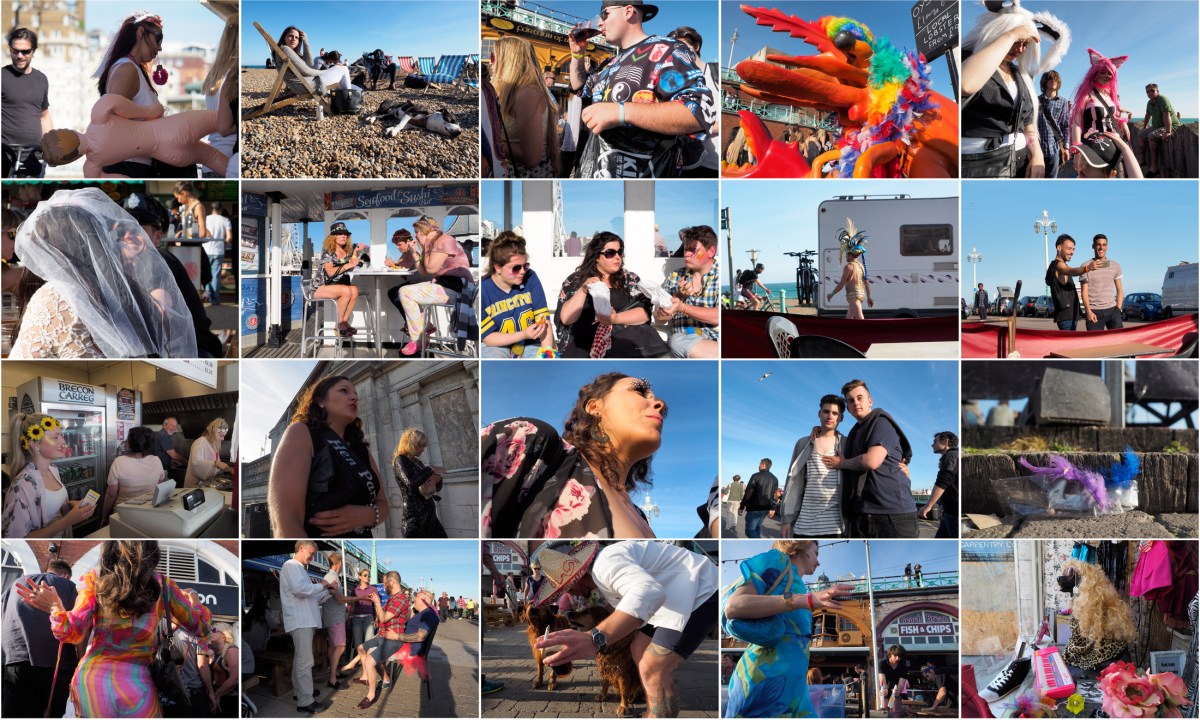
It’s lovely to return from abroad the same weekend as the Pride Festival. Everywhere is so colourful! There’s a big arch of multicoloured balloons outside Robert Dyas hardware, the Metropole Hotel is festooned with rainbow flags, the giant fibreglass prawn outside the whelk stall has been given a festive feather boa for the weekend and the charity shops have all done their bit with colour-coordinated junk in their window displays.

Of course alongside Pride there are the usual hen and stag parties, plus other people down for the weekend in the hope of prolonging that Ibiza spirit for just a little longer, so the promenade is a real sight to behold. And, because everyone seems to be wearing costumes within a limited number of themes: cowboys, policemen, princesses, nurses, kittens, Brazilian carnival dancers, fairies, lumberjacks (perhaps this narrow range is to preserve tradition and promote a sense of belonging?) it makes it quite difficult to spot who’s here for which reason.

By the time I passed the Palace Pier I was due for a mug of tea so I decided to stop off at the Madeira: Greg’s chip shop and café, where I was delighted to see his daughters had also put on a bit of a show for the customers. Greg and I soon fell into conversation. He told me it had already been a good weekend for him and, though they were all tired, it was worth going the extra mile. Plenty of people would be coming off the beach soon and a lot of the parties were still going strong up the road. I asked him when he thought he might stay open till. “On a night like this? If and when the mood changes…” he replied.

Given where his restaurant is located, and the many different comings and goings he must have seen, I had this sudden vision of a man as able to read the changing faces of the crowd every bit as well as a sea captain could read the changing nuances in the weather.

Dubrovnik special – 2

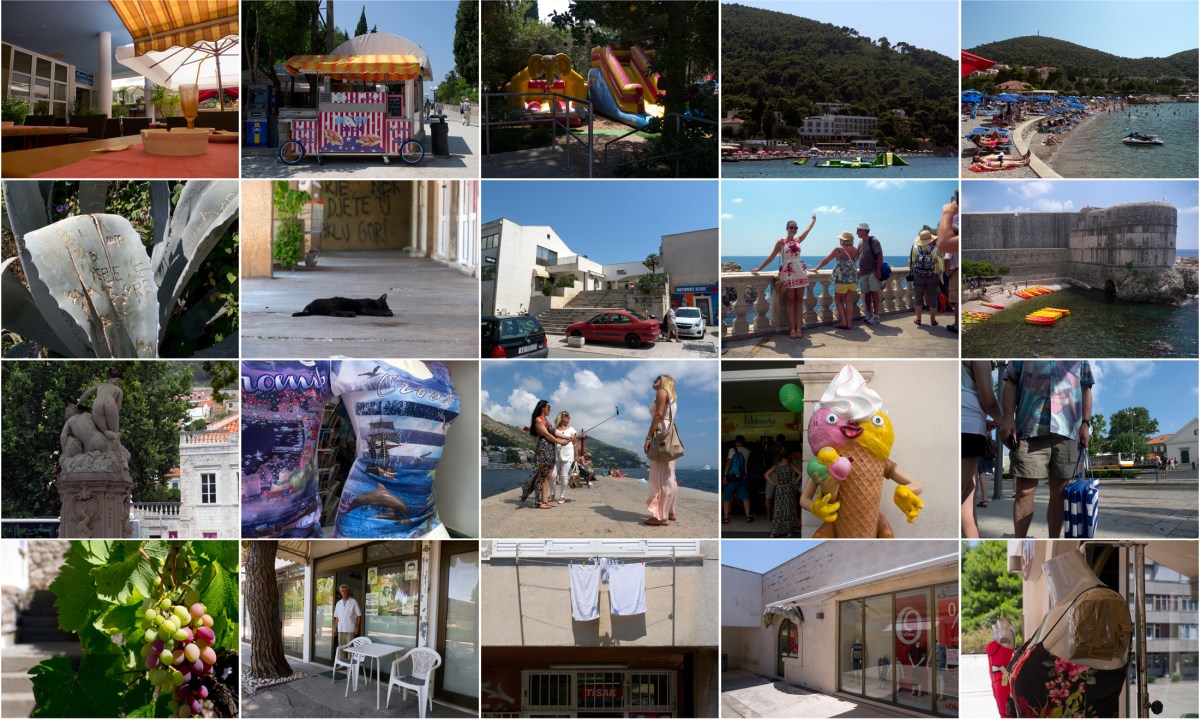
After a few days, we began to wonder where all the junk shops were. Stopping in a bookshop to get a better map of the city, we asked the owner if he could point us in the right direction, extending the question to include flea markets, antique dealers; anything of that kind really? He replied that he’d never come across them in the city. I have several theories about this but I’m not airing them here. It’s not a good idea to make assumptions about a country you have such limited experience of. Nevertheless, the absence seems significant.

La-la-la-la – Weds 22nd July

I met her in a club down in old Soho
Where you drink champagne and it tastes just like cherry-cola
See-oh-el-aye cola
She walked up to me and she asked me to dance
I asked her her name and in a dark brown voice she said Lola
El-oh-el-aye Lola la-la-la-la Lola

Well I’m not the world’s most physical guy
But when she squeezed me tight she nearly broke my spine
Oh my Lola la-la-la-la Lola
Well I’m not dumb but I can’t understand
Why she walked like a woman and talked like a man
Oh my Lola la-la-la-la Lola la-la-la-la Lola

Well we drank champagne and danced all night
Under electric candlelight
She picked me up and sat me on her knee
And said dear boy won’t you come home with me
Well I’m not the world’s most passionate guy
But when I looked in her eyes well I almost fell for my Lola
La-la-la-la Lola la-la-la-la Lola
Lola la-la-la-la Lola la-la-la-la Lola
I pushed her away
I walked to the door
I fell to the floor
I got down on my knees
Then I looked at her and she at me

Well that’s the way that I want it to stay
And I always want it to be that way for my Lola
La-la-la-la Lola
Girls will be boys and boys will be girls
It’s a mixed up muddled up shook up world except for Lola
La-la-la-la Lola

Well I left home just a week before
And I’d never ever kissed a woman before
But Lola smiled and took me by the hand
And said dear boy I’m gonna make you a man

Well I’m not the world’s most masculine man
But I know what I am and I’m glad I’m a man
And so is Lola
La-la-la-la Lola la-la-la-la Lola
Lola la-la-la-la Lola la-la-la-la Lola

Ray Davies
(Published by Hill & Range Songs)

Tight – Sun 19th July

Following one of those less than fulfilling conversations down the pub a few nights ago, I’ve been pondering the phrase: ‘couldn’t get a word in edgeways’ and came up with a theory that I was really quite pleased with:

Words have two kinds of existences: utterances, those disembodied things that fly about in verbal exchanges, and the written kind: assembled characters that exist on pieces of paper. Though these latter have physical substance, they add neither noticeable bulk nor thickness to the page they appear on. Words in this context seem entirely two-dimensional.

Based on this reasoning, I’d decided that ‘couldn’t get a word in edgeways’ must apply to mediaeval (and later) masonry and joinery practices whereby, master craftsmen would check to see if a join was good by trying to insert a piece of paper, parchment etc. edgeways into the crack between two abutting surfaces of whatever material. A really good join would be one where, even without the paper, you still couldn’t insert something as lacking in mass as a paperless written word, and therefore if you ‘couldn’t get a word in edgeways’ it meant the join was impervious to outside influence. I reasoned that the phrase as transferred to other situations must have originally been a sarcastic quip based on not being able to penetrate the conversation. Other linguistic metaphors such as ‘watertight alibi’ seemed to back up this idea.

Before publishing this theory I thought I’d better do a bit of online research to check, and immediately came up with the following:

‘A word in edgeways’, or as it is sometimes written ‘a word in edgewise’, is a 19th century expression that was coined in the UK. ‘Edgeways/edgewise’ just means ‘proceeding edge first’. The allusion in the phrase is to edging sideways through a crowd, seeking small gaps in which to proceed through the throng. The phrase ‘edging forward’ exactly describes this inch-by-inch progress. It was first used in the 17th century, typically in nautical contexts and referring to slow advance by means of repeated small tacking movements, as here in Captain John Smith’s The generall historie of Virginia, New-England and the Summer Isles 1624:

After many tempests and foule weather, about the foureteenth of March we were in thirteene degrees and an halfe of Northerly latitude, where we descried a ship at hull; it being but a faire gale of wind, we edged towards her to see what she was.

This practice of ‘edging’ was used with reference to the spoken word by David Abercromby, in Art of Converse, 1683:

“Without giving them so much time as to edge in a word”. (1)

Damn…

(1) http://www.phrases.org.uk/meanings/word-in-edgeways.html