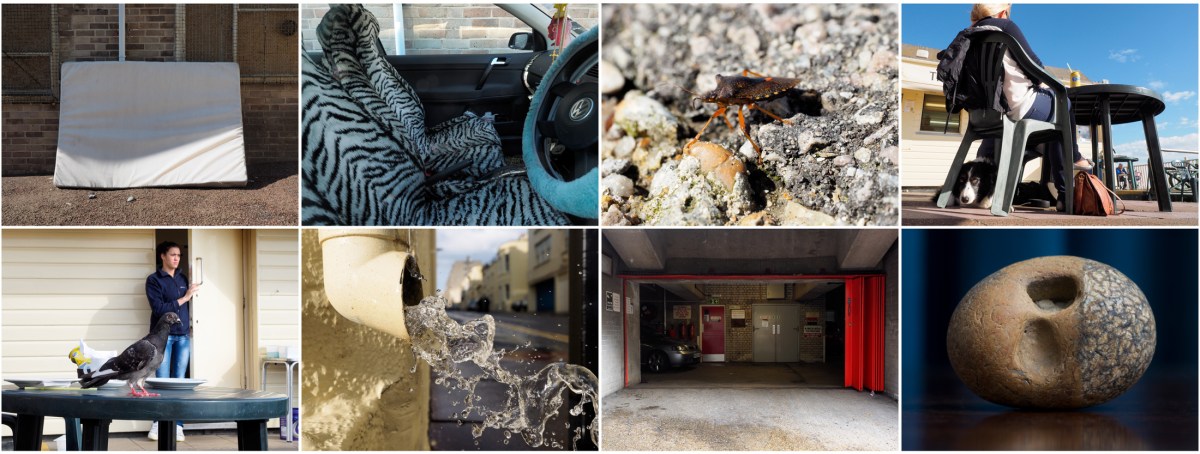
Forgotten – Thurs 24th Sept

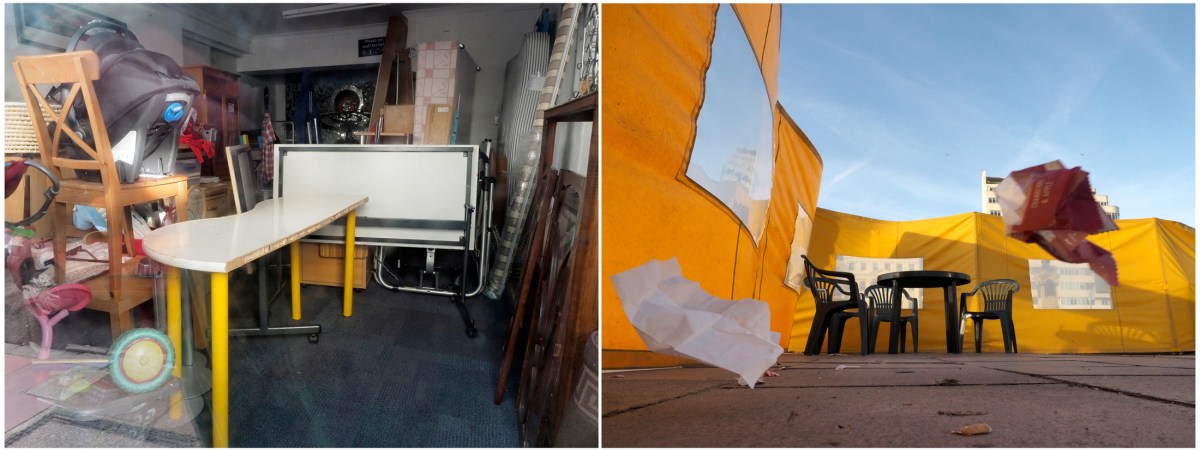
Scirocco: the hot dry wind from the desert, also known elsewhere in the Mediterranean as Ghilbi, Jugo, and La Calima; Mistral: the hard winds from the north, said to drive Frenchmen mad by their relentlessness; the Meltemi, though springing from the same northern regions has a kinder demeanour, bringing clear air and relief from the summer heat. Zephyr is not only a breeze but a god. These are a very few of the winds considered so important they are named, and carry distinct personalities, myths, histories. So then, where are the names for the English winds? All I can think of are the Roaring forties and the Trade Winds, both of which have nothing to do with our own shores and were named by seamen far away from home. Sou’wester is not so much a name as a direction.

Have these old names been forgotten? And is this why there is also no word for the wind that collects rubbish in corners, and piles abandoned possessions in the farthest recesses of junk shops?

Space invaders – Weds 23rd Sept

Dominion of the skies is not really something you think about if you’re ground based, as we humans all are. It might be a phrase we’ve used in relation to the Battle of Britain, or in adverts for commercial airlines, but in these contexts the concept is entirely anthropocentric. Besides, aircraft are too big to relate to as living beings so, really, the rulers of the skies are still the birds. Well, that is, until the invention of small commercially available drones. I saw this one being flown between the piers today, followed closely by a flock of seagulls. Airborne but entirely novel, and small enough for the gulls to relate to, it was evident that they saw this loudly buzzing machine as an insult to their space, and therefore something to be figured out and possible dealt with. How long will it be before they develop a strategy for mobbing these new interlopers, the way they would a hawk?

If a singer falls in a forest – Weds 23rd Sept

The music bar on the seafront has not failed in its promise to put on live music every day this summer (apart from days when it’s really pissing it down). It hasn’t always been great music, most of the content being cover songs sung to backing tracks by young hopefuls. Nevertheless it’s quite an accomplishment. The venue has also been a boon for my own content, being a magnet for most of the visiting hen parties, stag do’s, drunks and, occasionally, the police.

One of the regular performers, someone who’s appeared in the background of several of my previous posts, is a woman in her mid twenties. She’s got a good voice and belts out all the standards with great enthusiasm and aplomb. But now it’s the end of the season and on a bleak day like today, the sea front is deserted. Yet there she is still, singing at the top of her amplified voice as ever, to absolutely no one.

Or do I count? I tried smiling sympathetically at her as I walked past, in a gesture of camaraderie for those of us who still loiter by the deserted shore, but she looked straight through me, perhaps to the sequinned crowds of her minds eye.

The encounter brought to mind George (Bishop) Berkeley’s famous quote: “If a tree falls in a forest and no one is around to hear it, does it make a sound?” Since thinking of this I have wondered if the same might apply to nightclub singers.

Get it while you can – Sun 20th Sept (part 2)

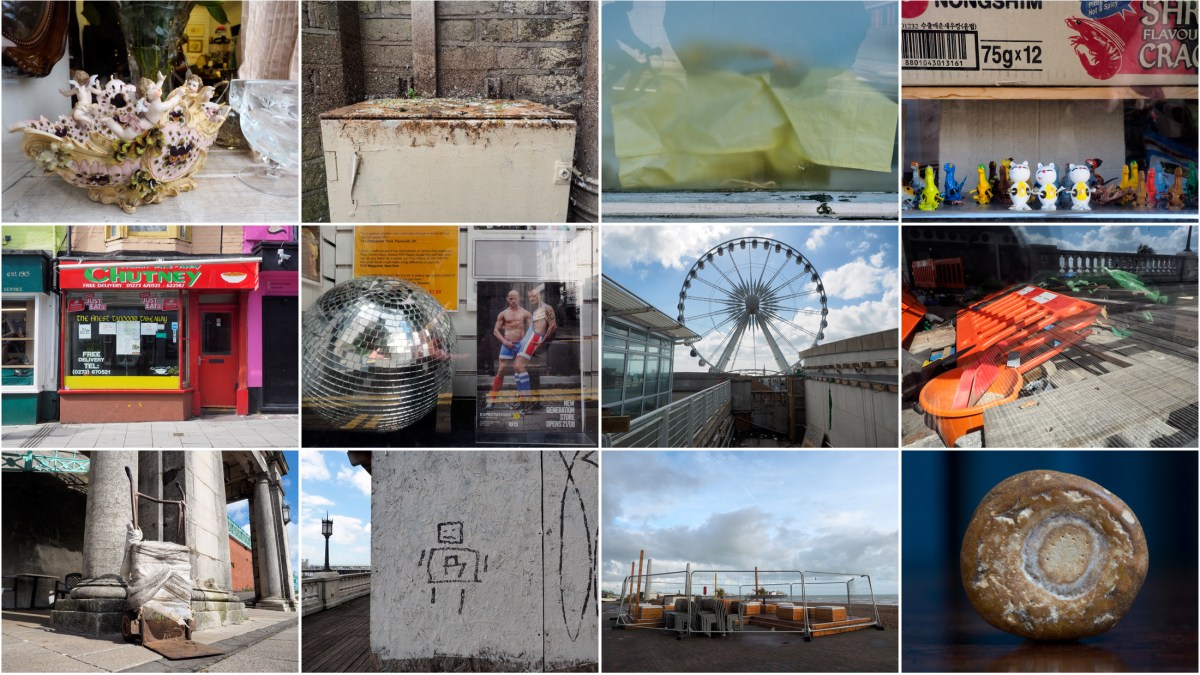
And this is the widescreen version… This set of photographs run parallel with those presented in my previous post, rather than as a continuation of it. I’m curious as to whether changing the format in any way alters the narrative?

Anyway…

On the other hand, while the tourist season is nearly over, the student migration is almost upon us: more than 35,000 of them arriving next weekend. Bars and clubs formerly filled to overflowing with hen parties and stag do’s, will find their populations replaced with would-be hipsters and existentialists, computer nerds, trainee doctors nurses and pharmacists… all sampling the delights of fresher’s week in the sure knowledge that for the first time they can get as drunk as the like without their parents finding out. There will be carnage. There always is.

Get it while you can – Sun 20th Sept (part 1)

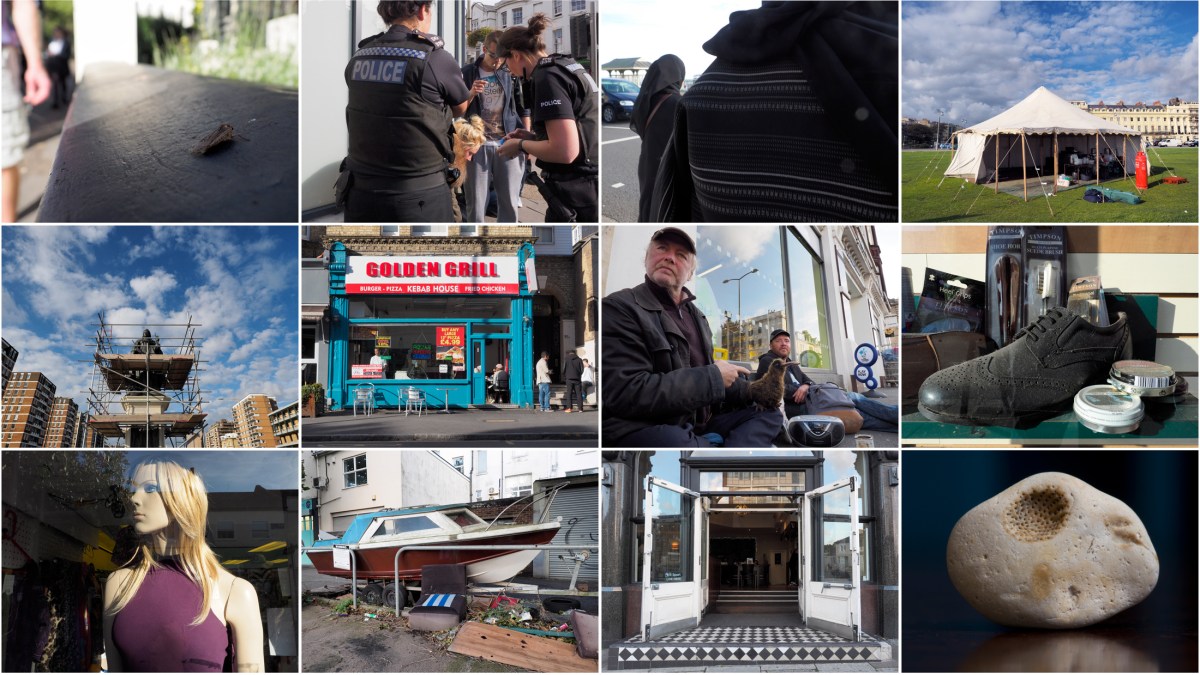
The long-range forecast is for a blazingly hot October, but everyone knows you can’t predict the weather even three days ahead, and tomorrow we are promised a deluge. Further fuelled by the knowledge that the autumn really is upon us, there’s a sense of triumphal urgency to the activities of today’s day-trippers, whether it be in tackling ice creams and plates of chips (while fighting off the seagulls) looking at souvenirs, going on fairground rides, or just walking up and down staring at things. We are the lucky ones; if you aren’t here today you might have missed the party.

I’m no different. Knowing full well that when the weather goes, so will they, I’ve spent all day outside, trying to squeeze the last pips out of the summer (while simultaneously hoping the long range forecast is true). As a result of which I’ve ended up with enough photographs for two contact strips.

Ok, I could have combined them into one big one, but for a change I’ve decided to post two in different formats. This one is in 4×3 ratio, the next one will be exclusively wide-screen…

Likenesses of God – Fri 18th Sept

“I have checked my memory with Doris, who also knew Haldane well, and what he actually said was: “God has an inordinate fondness for beetles.” J.B.S.H. himself had an inordinate fondness for the statement: he repeated it frequently. More often than not it had the addition: “God has an inordinate fondness for stars and beetles.” …Haldane was making a theological point: God is most likely to take trouble over reproducing his own image, and his 400,000 attempts at the perfect beetle contrast with his slipshod creation of man. When we meet the Almighty face to face he will resemble a beetle (or a star) and not Dr. Carey [the Archbishop of Canterbury].”
(Kenneth Kermack discussing one of the most famous quotes of his friend, the geneticist and evolutionary biologist: J. B. S. Haldane, as requoted by Stephen Jay Gould in his article: ‘A Special Fondness for Beetles’ in the January 1993 issue of Natural History (Issue 1, Volume 2), again reprinted on p. 377 of his book ‘Dinosaur in a Haystack: Reflections in Natural History’)

Actually, the above line of reasoning only works if we assume God is a narcissist. Otherwise, for all we know, he (or she, it, or they) may well look like Dr. Carey the (then) Archbishop of Canterbury. J. B. S. Haldane himself was a bit of a dandy.

Kiwi – Thurs 17th Sept

“Hey! Come here, come here”
“Yes?”
“Come here, come here. You should take a picture of me and my mate”
“Ok”
“It’ll cost you a pound”
“50p”
“Pound”
“50p”
“All right then”
“Here we go. Lets find some change.”
“Ah you’re a man of your word. My name’s (unintelligible) and this is (slur) and this is my little friend”
“Is it a duck?”
“Don’t be stupid, it’s a kiwi”
“Oh”
“Kiwi’s a very special bird”
“Yeah, unique among all birds”
“Why’s that?”
“Size of its egg see. Biggest egg, weight for weight, of any bird in the world. Practically the same size as the kiwi its eggs are”
“Very special birds Kiwis are. Imagine laying something that big”
“Ouch”
“And that’s why this kiwi is my mate”
“Unique”
“Well thank you boys, you’ve given me something to be grateful for”
“Wossat?”
“That I’m not a kiwi”

Forgetting – Weds 16th Sept

If you ask any child, up to the age of about six, to paint you a picture of rain, they’ll have no problem doing so. The patterns of slashes and spots they will give in response are almost as much a part of infant iconography as lollipop trees and houses with chimney smoke like springs. But I was thinking today, while trying to avoid getting soaked, that I couldn’t remember much in the way of examples of grown ups painting downpours.

Ok, I’m going to have to qualify this a bit. Japanese art has a rich tradition of representing rain, but what about the west? Looking back through our own art history, most only show rain as either atmospheric (Turner, Monet, impressionism) or in terms of its effects and paraphernalia: rainbows, dark threatening clouds, umbrellas, puddles, shiny streets, etc. storm damage and thrashing trees (Ruisdael, Dutch painters). but not much in terms of depictions of recognisably distinct drops. The only exceptions I can find are a few mediaeval paintings showing rains of fire and blood as part of the apocalypse or in the wake of Hailey’s comet (and I don’t think blood and fire counts). Even representations of Noah’s flood seem to be absent of actual falling droplets.

I can only think of three artists: Sickert, Hockney and Alex Katz, who’ve done so. All of these painters worked relatively recently, a long time after Japanese woodblocks had become widely known in the west, and also, after the development of photography to a point of technical advancement able to capture at least streaks of water in its fall downwards.

So how come children have no problem with painting and drawing rain, but adults, at least in the west, do? Is there a point in our development when we forget how to do such simple things?

Escape Velocity – Tues 15th Sept

“Keys that jingle in your pocket, words that jangle in your head,
Why did summer go so quickly? Was it something that you said?
Lovers walk along a shore and leave their footprints in the sand,
Is the sound of distant drumming just the fingers of your hand?
Pictures hanging in a hallway or the fragment of a song,
Half-remembered names and faces but to whom do they belong?
When you knew that it was over you were suddenly aware,
That the autumn leaves were turning to the colour of her hair”

The Windmills of Your Mind (1968)
Marilyn and Alan Bergman