Collected stones – page 11

“The last resort of kings, the cannonball. The last resort of the people, the cobblestone.”

Victor Hugo

Translated from the French: “La dernière raison des rois, le boulet. La dernière raison des peuples, le pavé.” in, ‘Oeuvres Illustrees de Victor Hugo’ (édition 1855)

Rights of passage – 4th Nov 2015

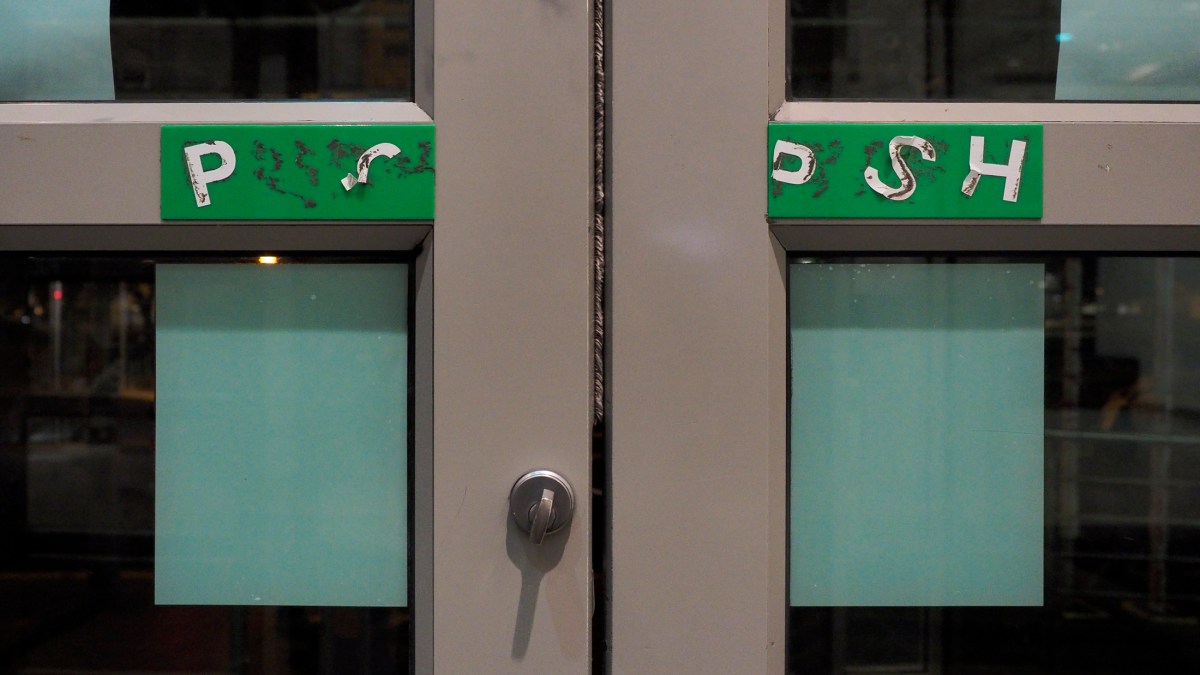
On each door is a green plastic plate inscribed, in white lettering, with the word ‘push’. Telling us the doors open out rather than in is useful, though the absence of handles on the side facing us might alone have been a sufficient indicator of direction.

Of course, with most doors that require pushing rather than pulling, where one decides to push, or even what to push with, is largely optional. While most of us understand it is better not to apply pressure to the glass panels (we all know glass can break) there is enough laminated metal door frame to allow for a wide degree of choice in accomplishing your passage over the threshold.

In older styles of architecture, doors demanding regular use have vertical brass plates attached to their ‘push’ side. This not only indicates the tacit instruction: to push, but also protects the wooden frames from being corroded by acids present in human sweat. The green plastic plates on these doors not only acknowledge their architectural antecedents, but also, by adding the word ‘push’ to them, reinforces the message. So much so in fact that the majority of users only push where it says ‘push’. This you can easily tell because the letters forming the words have, over time, been pushed beyond the point of legibility by the action of numerous hands. An additional factor in their migration is that the glue used to attach the lettering to the green plastic is of a kind partially soluble in organic grease, acids, and the various cleaning fluids used to keep the doors looking fresh.

On several occasions I have considered mentioning this to the powers that be. However, I must confess I take great enjoyment that, in this instance, Walter Gropius’s dictum: ‘form follows function’, comes truly alive, the form of the words certainly following the functional results of all this pushing. I also find it appropriate that this pronouncement from the founder of the Bauhaus is embodied so clearly on the main entrance to a modern institute of art and design.

Crabs – 2nd Nov 2015

I’m not usually interested in fridge magnets, but the tourist shops have had some pretty good ones in this year. My favourites are the plastic lobsters with claws on springs that waggle alarmingly every time the toy crustacean is moved. I’ve bought a couple for friends and, with Christmas now approaching (you can tell, the Halloween shop displays are coming down already) I thought I’d better buy a few more just in case. You never know when you might need a present at a moment’s notice and I like them so everyone else should too…

Anyway, so I go into the shop down by the Madeira café to look for lobsters but it seems I’m too late; they’ve all gone. However, I’m thinking there might still be a couple left in a cupboard somewhere, so, I go up to the lady behind the counter and ask, and she has a bit or a root around in her drawers, but comes up from behind the counter to tell me:

“I’m sorry dear, all I can give you is crabs.”

Catching the expression on my face, hers dropped too, and at some speed she started saying:

“Oh dear, oh no, oh my…”

Well, we did have a laugh about it, I mean this is the seaside isn’t it, and now whenever we see each other she winks at me.

It’s true: the old ones really are the best.

Solo – 1st Nov 2015

“A solitary, unused to speaking of what he sees and feels, has mental experiences which are at once more intense and less articulate than those of a gregarious man. They are sluggish, yet more wayward, and never without a melancholy tinge. Sights and impressions which others brush aside with a glance, a light comment, a smile, occupy him more than their due; they sink silently in, they take on meaning, they become experience, emotion, adventure. Solitude gives birth to the original in us, to beauty unfamiliar and perilous – to poetry. But also, it gives birth to the opposite: to the perverse, the illicit, the absurd.”

Thomas Mann, ‘Death in Venice’

Late transformation – 31st Oct 2015

“Once upon a time, I, Chuang Chou, dreamt I was a butterfly, fluttering hither and thither, a veritable butterfly, enjoying itself to the full of its bent, and not knowing it was Chuang Chou. Suddenly I awoke, and came to myself, the veritable Chuang Chou. Now I do not know whether it was then I dreamt I was a butterfly, or whether I am now a butterfly dreaming I am a man.”

Zhūangzi (莊子 also transliterated as Chuang Chou) c. 369 BC – c. 286 BC, China

Translated by James Legge

Absalom – 30th Oct 2015

“James Denton, not yet inclined for bed, sat him down in an arm-chair and read for a time. Then he dozed, and then he woke, and bethought himself that his brown spaniel, which ordinarily slept in his room, had not come upstairs with him. Then he thought he was mistaken: for happening to move his hand to which hung down over the arm of the chair within a few inches of the floor, he felt on the back of it just the slightest touch of a surface of hair, and stretching it out in that direction he stroked and patted a rounded something. But the feel of it, and still more the fact that instead of a responsive movement, absolute stillness greeted his touch, made him look over the arm. What he had been touching rose to meet him. It was in the attitude of one that had crept along the floor on its belly, and it was, so far as could be recollected, a human figure. But of the face which was now rising to within a few inches of his own no feature was discernible, only hair.”

M. R. James, ‘The Diary of Mr Poynter’, in, ‘M. R. James Collected Ghost Stories’ 1931

Aeolian – 29th Oct 2015

“The phrase pathetic fallacy is a literary term for the attributing of human emotion and conduct to all aspects within nature. It is a kind of personification that is found in poetic writing when, for example, clouds seem sullen, when leaves dance, or when rocks seem indifferent.” [1] It was introduced by John Ruskin to critique what he believed to be the over-sentimentality of the British poets (including Burns, Blake, Shelly, Keats, and Wordsworth) in ascribing emotion to the world around us. “Wordsworth supported this use of personification based on emotion by claiming that “objects … derive their influence not from properties inherent in them … but from such as are bestowed upon them by the minds of those who are conversant with or affected by these objects.” [2]

‘Pathetic’, is an awkward phrase. Having shifted in meaning over the years, it is now more likely to imply someone being ridiculous or inadequate (e.g. ‘you’re pathetic!’) but at the time of Ruskin’s writing, the word was associated more with ideas of pity or poignancy (hence: ‘[sym]pathetic’). Nevertheless, it is clear from Ruskin coupling ‘pathetic’ with the word ‘fallacy’, that he was against the idea he coined the phrase for.

Was Ruskin right? I’m not so sure. Wordsworth’s ideas are powerful and show his recognition of the way we all reflect ourselves onto the world around us. Psychoanalysis seems to support Wordsworth’s ideas, inasmuch as our perceptions of the world are what they are because of what and how we are, while Buddhism goes beyond Freud to suggest that every moment we create our surroundings as a reflection of ourselves, and that to change the world we must change ourselves.

Of course the opposite, that we are affected by our surroundings, is a truism. We even have medical conditions like ‘seasonal affective disorder’ to confirm this, but I wonder if really what we have is a symbiotic relationship with our surroundings, where we are at once affected by and affect the world around us; that we are all part of the same system.

This certainly seemed true today. As soon as I stepped out the door, the autumn gales at once hit me, and at the same time (metaphorically) lifted me into a kind of excitement I’ve always felt in high winds. The leaves really were dancing and within a few feet of the end of my street two young bucks screeched their car into a parking space, not so much in anger and aggression, as in testosterone fuelled exuberance.

On the beach, packs of teenagers ran, almost feral, away from the home hearth-sides of half term to congregate in groups, maybe up to no good, but certainly partaking fully of a world that seemed altogether as fast as the wind.

That all this activity was set against a backdrop of a sea-front now more or less closed for the winter (or at least until the sun might come out again one last, last time this season) seemed only to highlight the sense that there was something in the air, and whatever it was, it seemed to call everyone to be a part of it. While café signs were stowed and beach umbrellas trussed like turkeys to prevent them being stolen by the wind, gulls raced with the skies and the beach was dotted with solitaries who, for whatever motive, all seemed to want to lift their arms in the hope of flying too.

We have always sought to personalize the forces around us, sometimes elevating them to the status of Gods. Is it that we need to give them life, or is it that they indeed live and we simply give homage in naming them? And does it matter if this is true or not? The point is more our extraordinary delight as a species to create stories with whatever we find around ourselves, and in so doing to belong to the world rather than be isolated from it, something neither pathetic nor false.

[1] wikipedia, https://en.wikipedia.org/wiki/Pathetic_fallacy -requoting from:
Encyclopedia Britannica; Ruskin, John (1856). “Of the Pathetic Fallacy”. Modern Painters,. volume iii. pt. 4; The Penguin Dictionary of Philosophy Second Edition (2005). Thomas Mautner, Editor. p. 455; Abrams, M.H.; Harpham, G.G. (2011) [1971]. A Glossary of Literary Terms. Wadsworth, Cengage Learning. p. 269; Princeton Encyclopedia of Poetry and Poetics, Alex Preminger, Ed.

[2] ibid, -requoting from: ‘Wordsworth, William. Knight, William Angus, editor. The Poetical Works of William Wordsworth, Volume 4. W Paterson (1883) page 199’
Up, up and away! – 28th Oct 2015

On the 19th of September 1783 the brothers Montgolfier gave their first demonstration of Balloon flight bearing passengers. While originally humans were proposed for this experiment, because of uncertainty regarding what might happen, it was instead decided to test the flight using 3 animals: a sheep, chosen because they were supposed to have the closest physiology to humans; a duck (being able to fly, ducks were considered unlikely to suffer any problems with altitude) and a cockerel as a kind of halfway control, i.e. chickens, despite being birds, don’t have much experience of high altitudes. The only one of these passengers to be named was the sheep, called Montauciel (“Climb-to-the-sky”). The flight lasted approximately eight minutes and reached an altitude of around 460 metres. All passengers returned to earth unharmed.

Somewhat less than 200 years later, the first living beings not only to leave the ground but also to leave our atmosphere were again animals. Contrary to popular belief this first pioneering mission was carried out by two fruit flies, aboard a U.S.-launched V-2 rocket on 20 February 1947. In 1949 the fruit flies were followed into space by two rhesus monkeys named, somewhat dynastically: Albert I and Albert II (though unrelated). Due to rocket problems, Albert I met his end on the way up, at about 30-39 miles above ground. Albert II got a lot higher – about 83 miles – but didn’t survive the return because of parachute failure. Numerous other monkeys ‘gave’ their lives in pursuit of beyond-world travel in the 1940s – 50s, the death rate for these missions being about 60-70%.

Further attempts at space flight by both the Russians and Americans involved additional monkeys (rhesus and squirrel species) several mice, the Russian dogs: Tsygan, Dezik, and Laika (none of which survived). In 1959 two monkeys, Able and Baker did actually make it back to Earth alive, Baker surviving until 1984. Following them, more dogs, a rabbit (in 1959) some frogs, copious numbers of mice, rather fewer rats, 15 more flasks of fruit flies and a Guinea pig.

The role of animals as space pioneers was finally eclipsed by the flight of the first human: Yuri Gagarin, on April 12th 1961, but even since then, many different species, including fish, spiders, birds, tree frogs, crickets, stick insects, newts and sea urchins, have continued to be launched into space for various reasons. However, as far as I am aware, not one cat has, as yet, ever been sent into orbit.