Say it with fish – Weds 19th Nov

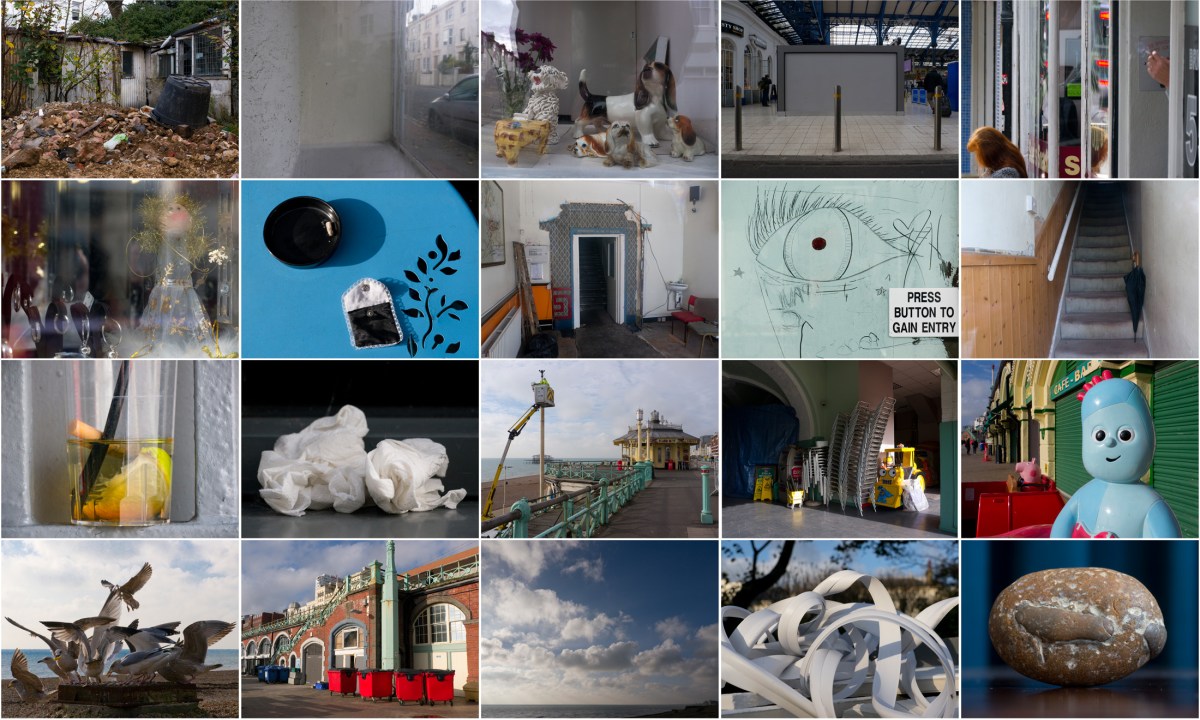
Apparently, Herring Gulls have now reached an evolutionary crossroads from which two distinct species will, in time, emerge. It seems to be all to do with diet. Traditionally, seagulls live on the coast and do the things we would expect them to do: catch and eat fish, plus crabs and so on stranded on the beach, nest in cliffs etc. However, many seagulls have found rich pickings on café tables, and in rubbish bins and dumps. These gulls nest on the tops of houses and, even if their young fallout of the nest, they are big enough to be a scary challenge for all but the most hungry of predators. Thus, urban gulls have adapted highly successfully to built up environments and their numbers grow.

The trouble is, seagull courtship rituals are centred around tasty morsels of food regurgitated during their mating displays (yes, they do a lot of regurgitating, see entry for 15th Nov) and when an advance is made between a town gull and a country gull, things go wrong. Country gulls have no idea what to do with the proffered hot dogs, buns, chips and half-eaten sandwiches that form the staple diet of urban gulls, while, frankly, town gulls are crap at fishing. The result is that there are now hardly ever any successful liaisons between the two avian branches and, while at present they remain genetically identical, in terms of behaviour, two distinct tribes have emerged with little or no chance of amorous relations in the future. Evolutionary divergence is only a matter of time.

Bummer.

Fossil Fuel – Tues 18th Nov

I’m having to modify my views on the existence of fossils on Brighton beach. True, the place is not littered with them the way you might find in other parts of the country, and what you come across is often smashed almost beyond recognition, but I’m seeing more and more of them. Apart from the Fairy Loaf I discovered a few days ago (11th Nov) other stones of the day (e.g. 26th & 29th Oct, 15th & 16th Nov) have shown telltale signs of something that couldn’t just have happened as a result of a purely geological process. After all, the Weald, not so very far away, has a reputation for turning up some remarkable pieces and the chalk cliffs all the way through the Seven Sisters are made up from the remains of countless billions of ancient shellfish.

Today’s stone of the day is a bivalve of some kind (actually you’ll have to take my word for it as it doesn’t photograph well but, seen in 3 dimensions you can much more readily discern that one end is spatulate while the other shows evidence of the suture joining the two valves; in short, it’s mussel-shaped). While its overall form suggests that it was fossilised whole, in its current condition, because of the relentless grinding caused by the tides over innumerable years, only about 50% of the shell survives, and yet these few fragments, because they are so battered, evoke as much their journey over time, as the creatures original appearance, and what is no longer there is suggested by what remains.

Giorgio de Chirico once noted that a vase only has meaning once it has been broken. There is a tradition in Vietnam of repairing ceramics with elaborate inlays of gold wire, to emphasise rather than conceal the fracture lines. We should all gild our wrinkles, but it’s easier said than done.

Il Pleut. Moi non plus – Mon 17th Nov

When I was at school we had this French textbook. ‘La Famille Marsaud’ featured prominently in it. They were, according to my French teacher Mrs Clay (of whom I will write about more in due course) a typical French family who lived in a beautiful suburban chateau with a walled garden. Monsieur Marsaud worked in a bank (or some other important managerial post), Mme Marsaud was an extraordinarily competent and rather elegant housewife with a tiny waist who endlessly cooked delights for the long family dinners, and the two children, one boy, one girl (whose names I have successfully blocked from my memory) were both beautifully turned out, of a sunny disposition and exceptionally well behaved. I seem to remember them crying ‘Maman, maman!’ a lot while squealing around the garden with Bruno (une belle chien). I think ‘un jolie ballon rouge’ was involved in these proceedings.

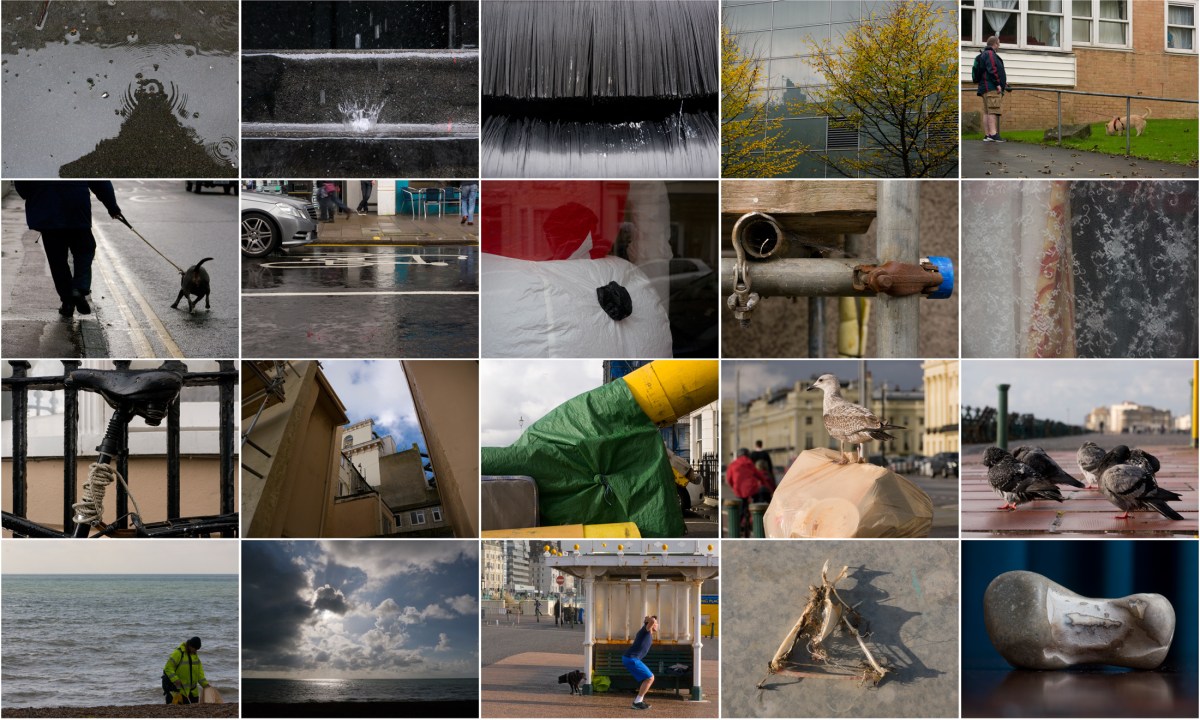
Typical French family eh? Clearly the whole point of the book was to humiliate us as uncouth, woad-daubed barbarians by presenting this utopian ideal of the family unit in cartoon form for British children to learn that elsewhere in the world things were better. Even the bloody French weather was always: ‘En France il fait du soleil beaucoup, mais en Engleterre il pleut et il fait mauvais’. So what if this particular observation was true? (I admit, it was today, I got soaked again.) There was no need to rub it in.

Whoever wrote that book should have been shot for engendering anti-European feelings. I’m sure key members of the UK Independence Party all had to read it at school too.

I failed my French O-level.

Take out – Sun 16th Nov

On another occasion, I had just started climbing the metal stairs to get to my studio, when there was a great rush as hundreds of starlings took off all at once from the terrace above me. Startling though this was, it was only a prelude to what I saw when I got to the top of the steps. The entire roof terrace was covered in little pieces of what I took for flamingo coloured foam, shot through with red and brown flecks. Perplexed, I kicked a couple of pieces tentatively with the toe of my shoe. They moved soggily. Then I began to register the excited clicks and whistles of more starlings coming from next door. Creeping towards the parapet to avoid frightening them I peered over the ledge into the yard belonging to the Indian restaurant. My eyes were greeted by the spectacle of a multitude of flapping wings engaged in a wild frenzy to get the best pickings out of the uncovered bins below. On spotting me, and all at once, every single bird flew into the air, simultaneously crapping and dropping tasty orange morsels in wild unison, further covering the roof and myself in tandoori chicken.

Later on that day I had words with the restaurant owners.

Gullet – Sat 15th Nov

Some years ago I had a studio above one of the shops on St James’s st. To get to the door you had to go down a side street, along an alleyway, up a flight of metal steps and across a flat terrace. It made getting paintings in and out of the building a nightmare, but the terrace was a real bonus and, being south facing, wonderful for growing plants on.

Several seagulls also thought it wonderful and every year nested on the roof above the terrace. They did not take kindly to having to share it. As a result, every day there would be a lot of squawking whenever I crossed the terrace. One day I decided to squawk back. This certainly got a reaction so I carried on doing so. After several weeks, I got quite good at mimicking indignant seagulls.

Things escalated. One gull in particular became very bold, bombing me on some days, and on others landing right in front of me where we would try to face each other down, squawking furiously.

What I didn’t know about seagulls at the time, is that when finding themselves in a fight or flight situation, they evacuate their stomach contents. This is, apparently, to allow them to take off quicker, unburdened by any surplus weight. One day I found out about this trait first-hand, when, during a particularly long and spirited volley of avian abuse the gull paused, began to heave and, after a long moment, threw up an entire hot dog, still encased in its ketchup-tinted bun. We both looked at this prize as it lay glistening on the roof. Somehow, it said it all. From then on we kept a wary but respectful distance from each other.

Witches cottages – Fri 14th Nov

In fairy stories, you will always find witches cottages in the middle of the woods, at a crossroads, or on a mountainside, places that are out of the way, but also, importantly, places you need to go close to in order to accomplish a task. They are always sited on the lonely route from A to B.

Magic always takes place on the borders of things: the threshold between life and death, coming and going, doorways, portals, mirrors…

So where might you find witches cottages if they existed today? The woods are full of picnic tables, the mountains are filled with skiers, and few of us still live the pastoral ways, yet have we not created our own woods out of our endless streets – the urban equivalent of the scary forest full of bad things that might waylay you?

They would have to be on or near somewhere we have to pass each day, most likely still the traditional crossroads, and also be sited at a border, a liminal space which is neither one thing or the other. And while unnoticeable except to trained eyes, passing them would be made difficult.

The fact is, they do still exist and one is sited quite close to where I live, near the viaduct at the point where the railway crosses New England Hill. This might explain the daily traffic snarl ups on this route and the constant train delays in and out of Brighton. I wouldn’t go so far as to say it is actually lived in, but it is inhabited. I know of several others around the city. Maybe there is one near where you live?

Grey – Thurs 13th Nov

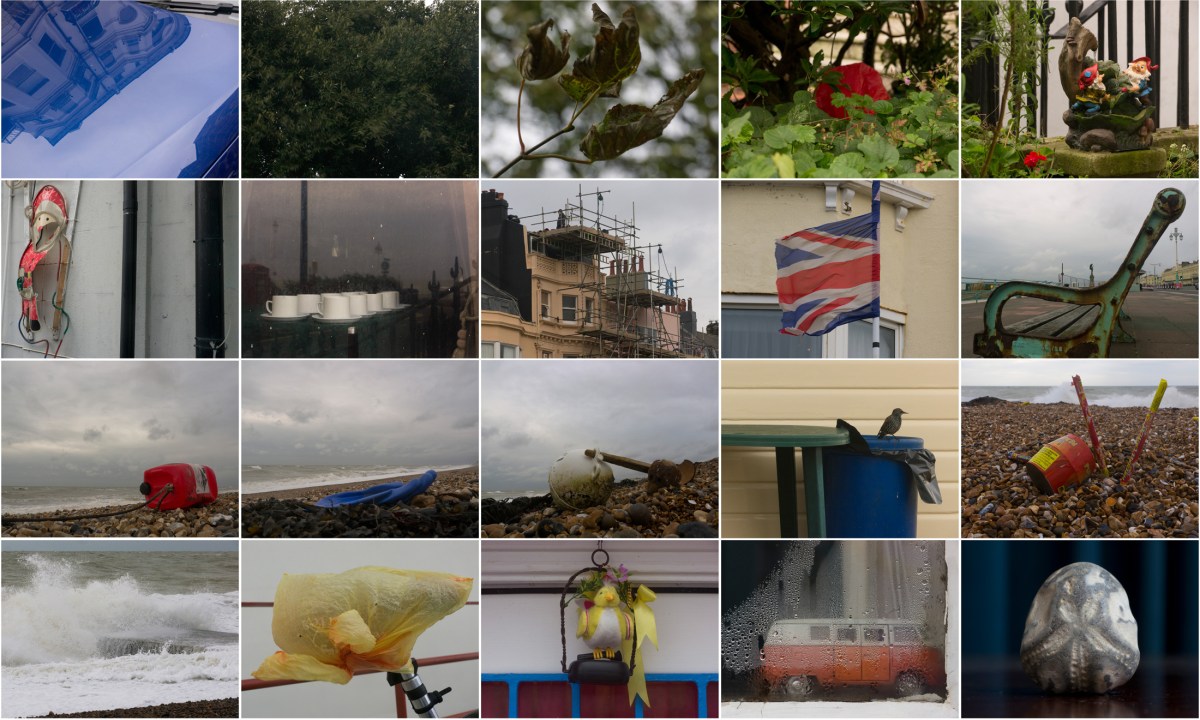
As a country, we English do grey very well. We’ve had the grey man for a prime minister, backed up by the men in grey suits; plenty of grey areas in our legal system; our film industry was probably at its pinnacle when movies were made predominantly in black and white (all right, I know, Hammer Horror films… but the colour in those was all so magnificently artificial) and women in grey populate our haunted homes. Is it bloody surprising? I mean where was the colour today? I looked and I looked and in the end all I can say is thank heavens for the Cheeky Chicken take away in West Street. I’m not saying I was hungry, but I was desperate for a bit of colour. There certainly wasn’t any up there in the sky.

On a more structural note, have a close look at the penultimate image in today’s contact strip. Now look again. Someone didn’t read the instructions properly did they?

Meringue de mer – Weds 12th Nov

When the wind is right and the sea is at a certain stage in the cycle of the tides, you get foam. Not just the bubbly stuff that is part of every wave, but great piles of suds, as if an overloaded washing machine has leaked its load, drift up the beach, bouncing and rolling with the breeze in great lumps. They last a surprisingly long time too, accumulating like yellowing special effects from a cheap sci-fi movie.

Fairy loaves – Tues 11th Nov

The practice across England of collecting fairy loaves and placing them in burial mounds and graves, dates back as far as the Palaeolithic era and persisted up until Anglo Saxon times. Indeed within local lore they have been seen as protection from witchcraft, this belief even continuing today in certain circles.

But what are fairy loaves? Small stones with five-point symmetry shaped remarkably like a small loaf of bread, they are in fact the fossilized remains of sea urchins, pre-dating our own species by millions of years. The chances of finding one on a seashore covered entirely with pebbles, so that the beach here acts like an enormous grinder, are about as likely as finding hens teeth. Are they magic? I do hope so since I’ve now got one, found on my search for today’s stone of the day.

I was going to tell you a story about a flock of starlings and some tandoori chicken but that’ll have to wait till another time.

Cuttlefish – Mon 10th Nov

When I was a kid, whenever we were taken to the seaside and my mum would see a cuttlebone she’d pick it up and pocket it, proclaiming knowingly “it’s good for the budgie”. Come to think of it, most of these occasions happened after the budgie had died… but I suppose she gave it to my nan or someone else with a pet bird. Anyway, cuttlebones, as you probably know, are the porous internal shells of cuttlefish, used as a buoyancy aid. They often get washed up on the beach, especially after storms. But what I want to know is, how come if they are so common you never see whole cuttlefish washed up too? What happens to the rest of the body? I mean I suppose they all get eaten but this makes me wonder, do all the fish in the sea get together before a gathering storm and say ‘hey lads, storm’s a gatherin’, its cuttlefish for supper tonight’? Or for that matter, if cuttlebones are so good for budgies then how come these bits don’t get eaten by the fish too? Maybe what’s good for budgies isn’t so good for fish?