“Why must I feel like that?
Why must I chase the cat?
Nothin’ but the dog in me”
George Clinton, ‘Atomic Dog’

“Why must I feel like that?
Why must I chase the cat?
Nothin’ but the dog in me”
George Clinton, ‘Atomic Dog’
“In ancient societies the consumption of cyclical time was consistent with the actual labour of those societies. By contrast, the consumption of pseudo-cyclical time in developed economies is at odds with the abstract irreversible time implicit in their systems of production. Cyclical time was the time of a motionless illusion authentically experienced; spectacular time is the time of a real transformation experienced as illusion.”
Guy Debord: ‘The Society of the Spectacle’. Paragraph 155

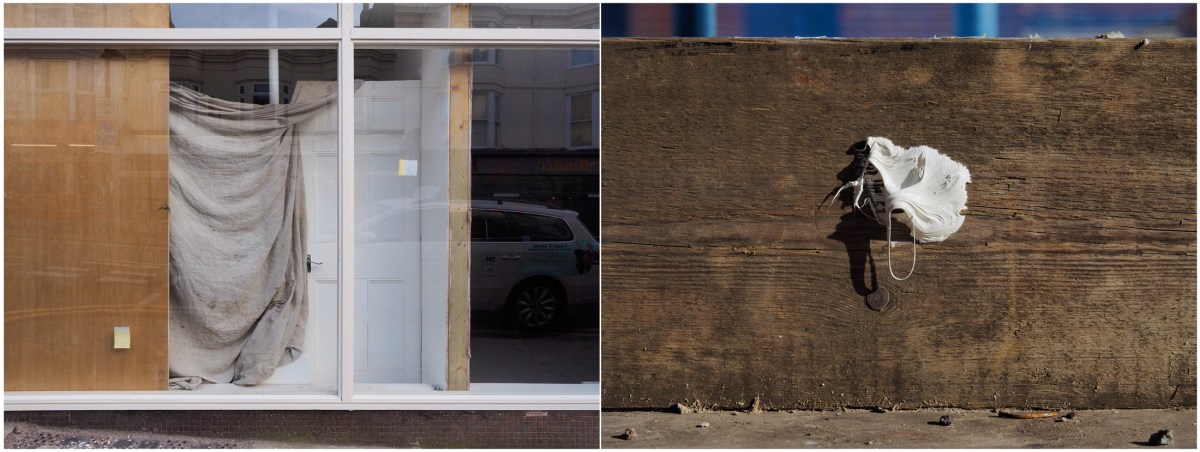
Today I walked past this shop and noticed it had closed down. Then I realised that I couldn’t remember ever seeing it open, or what it sold, and now I’m beginning to wonder if it was ever a shop at all.

Young males preparing their courtship displays in readiness for the 2016 tourist season
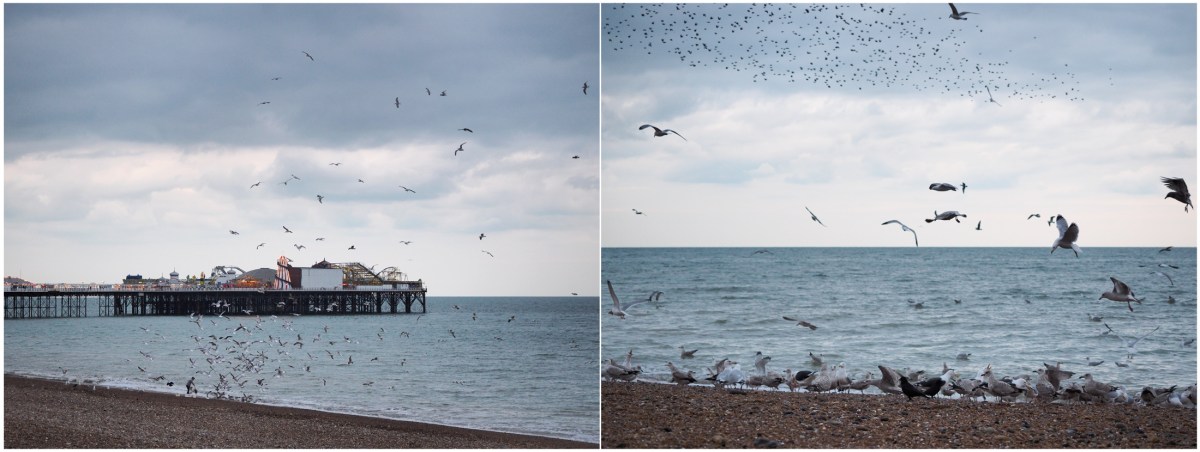
Every day as sunset draws near the starlings gather. Recently I’ve also noticed that the seagulls are doing so too, in larger and larger flocks. I have begun to wonder why? Is this another remarkable example of interspecies learning? Seagulls are intelligent birds and, in addition to their extraordinary adaptability to take on the diet of the average tourist (sandwiches, hot dogs, chips, cake and buns) I’ve seen them stamping the ground to attract worms in imitation of other birds who have found out how to imitate rain, drawing small invertebrates to the surface. And indeed young fledgling seagulls will poke and peck at anything, seemingly to see how it works. So why shouldn’t they have noticed how starlings gather together every day, and decided to do so too? Ok, they haven’t quite got the hang of close formation, but the results still look pretty spectacular. This has been going for a while now, and I’ve been in poetic rapture at the thought of a new sunset teeming with aerial displays in glorious pan-species exultation.
So much for poetry. I found out today that due to the time of year and it being off-season, sunset is about the time when the seafood stall dumps all its remaining fish bits, guts and mollusc scraps into the sea, to clean out the buckets before closing for the night.
“Many years ago, as I was glancing through a catalogue of jokes for parties and weddings, I saw an item, ‘An object difficult to pick up’. I haven’t the slightest idea what that ‘object’ is or what it looks like, but I like knowing that it exists and I like thinking about it.”
‘Cocteau on the film’ conversations with Jean Cocteau recorded by Andre Fraigneau

Every so often you see an item on the news, or social media, with a caption something like ‘best selfie of 2015’ showing a picture of someone simultaneously wrestling a shark while extending their arm in that telltale gesture, or being photo bombed by dancing Chihuahuas, or maybe five world leaders showing they can be spontaneous and goofy while taking time off from discussing important plans to appear to do something about global warming or, or…
In all of these cases, it’s the content of the photo that earns the caption. This is all fine and well, but in placing so much emphasis on what’s in the picture we overlook one of the defining characteristics of the selfie, that of pose. To me, this is where the true quality of the new artform lies.
Therefore, I propose that from now on, any awards for best selfie of the year should take into consideration the following criteria:
Facial expression: this does not need to convey happiness, but should reflect the intentions of the photographer/subject, plus the relationship between knowingness and sincerity
Stance: very important, you are not only conveying a self-image, but are also acting as steady support for the camera – all blurring for whatever reason should be penalised
Nuance: this comprising detail in relation to the entire concert of gestures, props and clothing.
Context: highly important, but should always be subordinated to the photographer’s ideas, so kiss goodbye to the photo-bombing Chihuahuas, they weren’t intended.
Inanity: this is a difficult concept to define positively, but in the case of the selfie I think it has something to do with evidence of ‘really meaning it’ despite the banality of the form.
This is only my first attempt at distilling these key elements and will doubtless need amending. However, I believe today’s photograph exemplifies the above qualities to a conspicuous degree.

“Wabi-sabi is ambivalent about separating beauty from non-beauty or ugliness. The beauty of wabi-sabi is in one respect, the condition of coming to terms with what you consider ugly. Wabi-sabi suggests that beauty is a dynamic event that occurs between you and something else. Beauty can spontaneously occur at any moment given the proper circumstances, context, or point of view. Beauty is thus an altered state of consciousness, an extraordinary moment of poetry and grace.”
Leonard Koren, ‘Wabi-Sabi: for Artists, Designers, Poets & Philosophers’

Things to do when you’re bored

In a manner not entirely dissimilar to hermit crabs who, rather than creating their own exoskeletons, rely on empty mollusc shells to provide them with protection, some trees and plants have evolved to take advantage of the small pottery containers that are now so much a part of our gardens. Of course trees and plants do not generally create armoured exteriors, relying instead on the sheer amount of ground around them to bulwark their roots. Nevertheless, evolving to take advantage of pots has given them a distinct advantage over other more stationary species, allowing them greater mobility and therefore enhanced opportunity to seek out sunlight and the more sheltered spots away from the wind.
However, like hermit crabs, this developmental ‘choice’ is not entirely free of danger: as individual plants grow they will need to change their pot from time to time. This is always a tricky moment, and like hermit crabs, not all of them make it through that moment of extreme vulnerability between shells.
 Umbrellage