Appropriation – Mon 26th Jan

The rats dropped the rolling-pin, and listened attentively.
“We are discovered and interrupted, Anna Maria; let us collect our property––and other people’s,––and depart at once.”
“I fear that we shall be obliged to leave this Pudding.”

The Tale of Samuel Whiskers
or
The Roly-Poly Pudding
Beatrix Potter

Shoreham on Sea – Sun 25th Jan

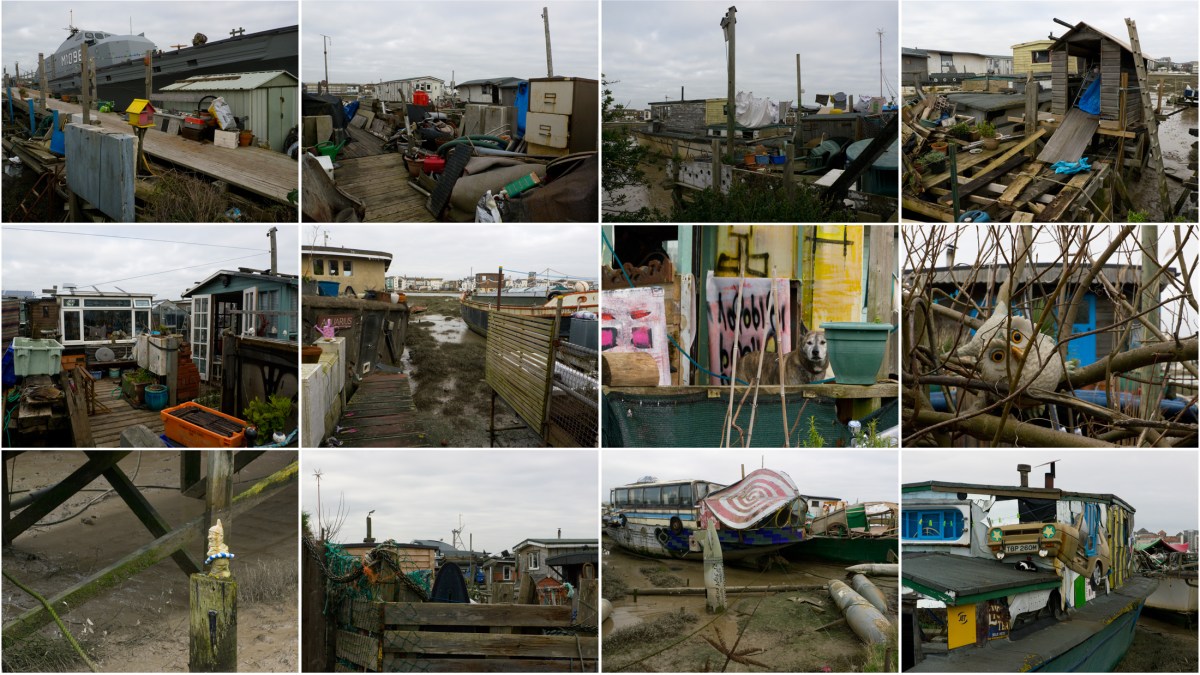
A few miles out of Brighton travelling west is a place called Shoreham on Sea. Cross the bridge south onto the Brighton Road, take a left more or less immediately, and you will find the Shoreham houseboats. Given that one is actually an old minesweeper, another has a top deck made out of two halves of a bus, and that most of the others are cobbled together out of old cars, sheds, garden conservatories and any other conceivable kinds of scrap, the words ‘house’ and ‘boat’ might not immediately spring to mind when looking at them. Nevertheless, people have lived here in these extraordinary ramshackle dwellings for decades, in a small local community that is still resisting the standardisation and gentrification that infects so much of the rest of the world. I hope they survive for many years to come.

Viscous – Thurs 22nd Jan

Whenever I remember to, and I do so often enough, I try to see that the sheet of glass I am looking at, or through or am reflected in, is a liquid. And this fact still amazes me.

Later…

Well, it did until I put out the above an hour or so ago, whereupon I was contacted more or less immediately by a friend telling me that glass is in fact a viscous solid. (Actually, having checked this, I find out it’s an amorphous solid but who’s quibbling?) So, tomorrow, as I am sure to remember to, I will see any sheet of glass I am looking at, or through or am reflected in, as an amorphous solid. And I probably won’t be amazed by this.

The following morning… (the tomorrow I mentioned yesterday) I’m sent a link from another friend (see comments) with more information on the nature of glass. Here’s an extract from the page:

There is no clear answer to the question “Is glass solid or liquid?”. In terms of molecular dynamics and thermodynamics it is possible to justify various different views that it is a highly viscous liquid, an amorphous solid, or simply that glass is another state of matter that is neither liquid nor solid. The difference is semantic. In terms of its material properties we can do little better. There is no clear definition of the distinction between solids and highly viscous liquids. All such phases or states of matter are idealisations of real material properties. Nevertheless, from a more common sense point of view, glass should be considered a solid since it is rigid according to everyday experience. The use of the term “supercooled liquid” to describe glass still persists, but is considered by many to be an unfortunate misnomer that should be avoided…

http://math.ucr.edu/home/baez/physics/General/Glass/glass.html

So now, the day after the tomorrow I mentioned a couple of days ago, as I am sure to remember to, I will see (and have seen) any sheet of glass I am looking at, or through or am reflected in, as emblematic of an ongoing discussion on borderline states of matter, and it will remind me to avoid bad and rushed attempts at poetry.

(But it still knocks me out that so many of the things we perceive are seen through something else, and that includes windows, screens, camera lenses and our own eyeballs)

Gargoyle – Weds 21st Jan

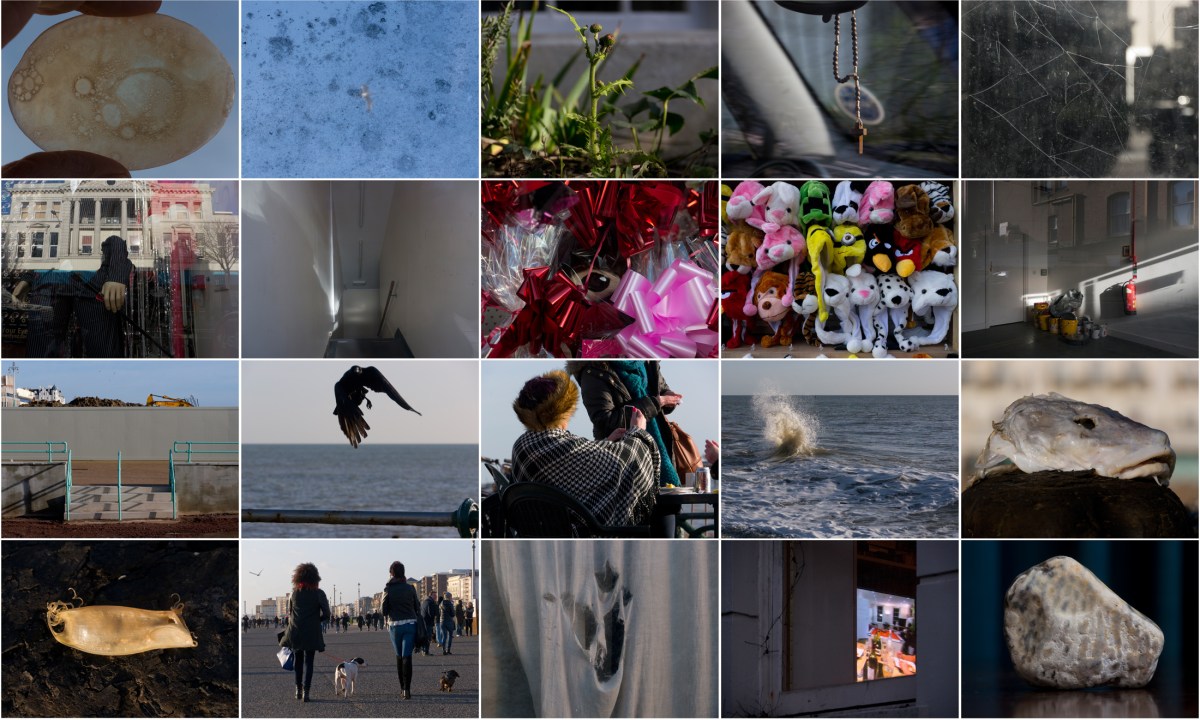
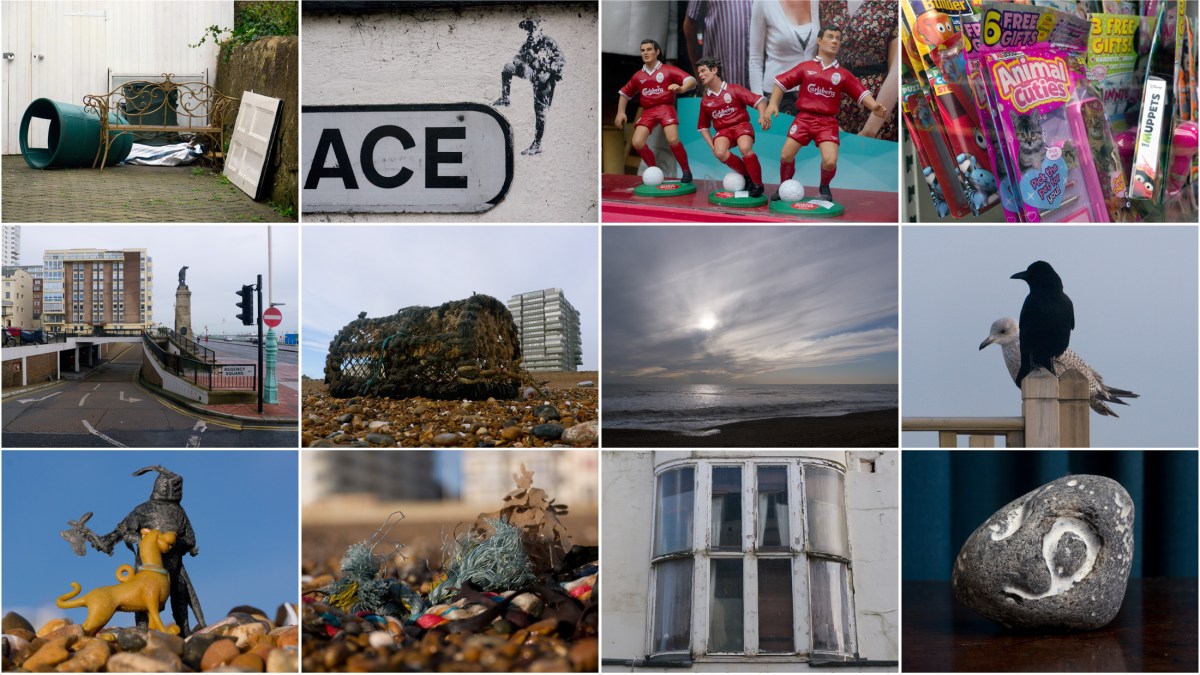
Over the past few months I’ve visited the beach on most days to look for interesting stones. I’ve found quite a few, including ones that look like a severed finger, a gaping jaw with teeth, a shop mannequin, a pigs snout… I’ve even stumbled upon a fairy loaf – something which would have been prized by our Neolithic antecedents – but none of these finds prepared me for what I came across a few weeks ago.

Most of the pieces I’ve selected have been relatively easy to photograph. Their charm has been apparent in one particular angle revealing the likeness that attracted me to them. Others have been more problematic, losing something in a two-dimensional representation because their objectness has gone beyond one facet. However, even these have succumbed to the camera, allowing one select image to sum them up, rather in the same way that a single photograph out of many, of an unwilling relative or loved one, will be able to capture them. For several weeks now I have re-photographed it from a number of angles. I even made a short video, turning it this way and that for the lens, but without success. I finally gave up selecting one particular viewing point and here instead have opted for a composite of several images to best display its appearance, but even these do not truly convey the experience of holding it.

About the size of a hens egg, it can sit in the palm of my hand as if made for it. Indeed it does seem made, more than developed through some obscure geological process, and while crude, it is perfect in its likeness of a small head; not just a mask, and not just any head, but that of a shrunken effigy, devil or gargoyle; a laughing satyr, something that would truly earn the appellation of a grotesque.

Yet I have no doubt it is naturally formed. There are no marks to suggest any kind of human intervention in its manufacture and I have come across other stones of the same composition, if not likeness. It happened, but how? Why? Is there any reason? Should there be one? It has sat on my desk for over a month now, looking back at me with the same wide smile whenever I glance at it. It delights, but also disconcerts me.

Simulacra and Simulations (part 2) Tues 20th Jan

Baudrillard heads his essay: ‘Simulacra and Simulations’ (already quoted from on 5th Jan) with these lines from Ecclesiastes:

The simulacrum is never what hides the truth – it is truth that hides the fact that there is none. The simulacrum is true.

This powerful introduction, not so much header as headstone, sets the tone for the whole piece, an excoriation of the 20th century consumer dream made reality, that in Baudrillard’s view:

Disneyland is presented as imaginary in order to make us believe that the rest is real, when in fact all of Los Angeles and the America surrounding it are no longer real, but of the order of the hyperreal and of simulation. It is no longer a question of a false representation of reality (ideology), but of concealing the fact that the real is no longer real.

It is therefore appropriate that this quote from Ecclesiastes is a fake. Even the word simulacrum was only first recorded as being used in the English language in the 16th Century.

Here’s some genuine verses from Ecclesiastes:

To every thing there is a season, and a time to every purpose under the heaven:
a time to be born, and a time to die; a time to plant, and a time to pluck up that which is planted;
a time to kill, and a time to heal; a time to break down, and a time to build up;
a time to weep, and a time to laugh; a time to mourn, and a time to dance;
a time to cast away stones, and a time to gather stones together…
(Ecclesiastes 3: 1-5, King James Version)

Given my current interests, I particularly like the last line of this quote.

Atlantis – Mon 19th Jan

They say that somewhere out in the middle of the Atlantic, lies a vast floating island made out of millions of tons of the plastic bags, bottles, bin liners, nylon ropes, nets and all the disposable containers we have jettisoned over the years. Gaily coloured and rotating slowly with the currents that gathered its component pieces, it is both a death trap to myriads of marine creatures and a monument to our unsupportable lifestyles. And yet if someone said to me, let’s go and see it, I’d jump at the chance. In my imagination I am already there.

Does this make me a monster?

Murmuration – Sun 18th Jan

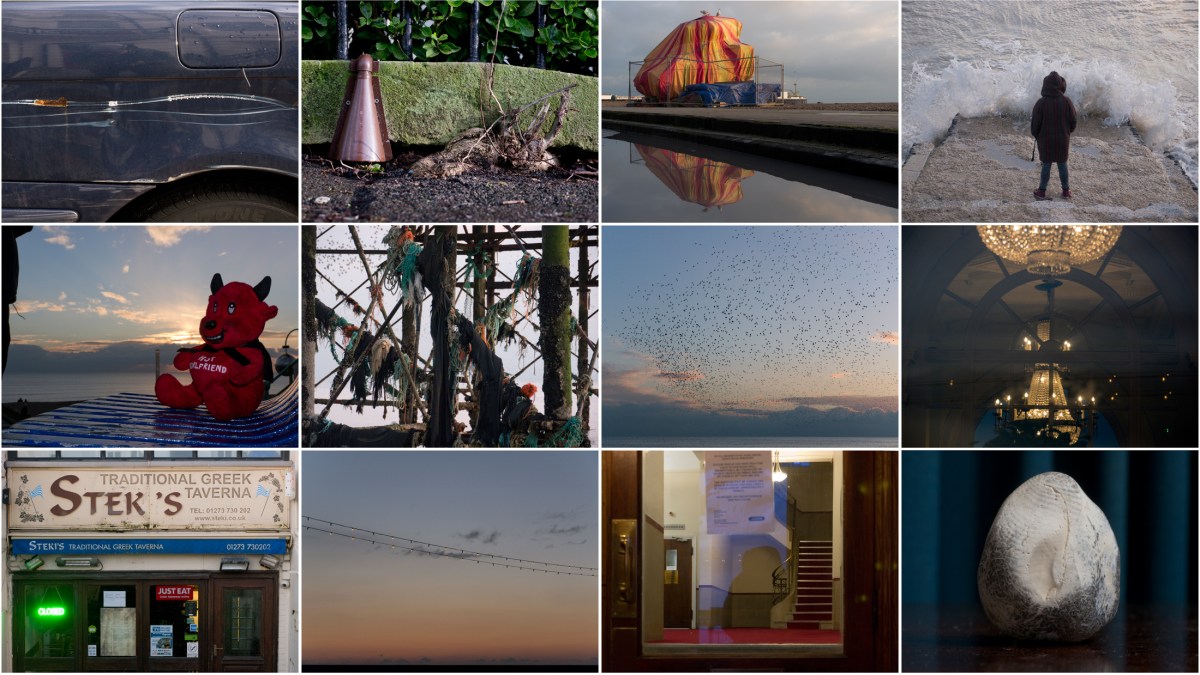
Murmuration is the specific name given to a flock of Starlings. Why not just flock? Only when you see them massed in their thousands, tens of thousands, turning in unison with no perceptible hesitation, do you realise that ‘flock’ is inadequate for this most remarkable phenomenon. The sound of their amassed wing-beats as they fly overhead is as much felt as heard.

How do they create such extraordinary, evolving, three-dimensional shapes in the sky without ever crashing into each other? Apparently someone has worked out a computer program that creates nearly identical formations, simply by inputting optimal maximum and minimum wingtip distances, alongside flight speed. So much for the how. The why is not answered there, but even this can probably be accounted for via Dawkins’s theories on the extended phenotype. And maybe he’s right, but the poet inside me howls and rebels at such a thought. Just go and look at one of their extravagant displays and tell me there is no joy unaccounted for by biological imperatives. I am not a believer in intelligent design, but neither am I a reductionist.

Perch (part 2) – Sat 17th Jan

Yesterdays post caused quite a stir, eliciting several responses. Among these were two from regular readers, both of whom pointed out that being in a bar ‘with someone three or more times your size and a completely different shape’ was not supposition but fact, if you live in either Glasgow or Plymouth.

This discovery gives rise to the following questions:

  1. What kind of bars were they hanging around in?
  2. How much had they had to drink?
  3. Am I getting out enough?

Of course, this reported phenomenon might actually be based on an incomplete grasp of the laws of perspective. Since I used to teach this subject, I am aware of a number of teaching resources which might help clear up any possible misconceptions and I append one of the finest lectures I know of, dealing with just this matter. Please don’t be confused by the Father Ted preamble, it is well worth watching till the end:

Perch – Fri 16th Jan

At the café on the sea front where I seem to end up on most days, there are the following: one wagtail, one starling, a family of four crows, around ten pigeons and a population of herring gulls (mainly juveniles) whose number is hard to estimate because they are so mobile. I’m therefore not sure they count as you’d have to see them as passing through rather than truly resident, although there seems to be at least two who have claimed the location as actual territory. These take it in turns to sit on the roof of the café, regularly making more noise than all the other birds put together.

Sometimes the seagulls mob the crows, sometimes the crows mob the gulls. Indeed the gulls often mob each other, seemingly just for the hell of it – and these altercations can, at times, be quite vicious. The pigeons just edge and barge persistently regardless of any other species (including human) or sit on the ground, waiting, like docile cattle, for more food to show up. The starling appears out of nowhere and then vanishes just as mysteriously, while the wagtail spends the majority of its time on the ground, darting hither and thither like a demented clockwork micro-hoover, cleaning crumbs from the cracks between the paving stones.

What gets me though is that despite the fact that they are all after food, when they aren’t actively engaged in foraging they just hang out together, any past misdemeanours seemingly forgotten. And what gets me even more is the disparity in scale between species. This’d be like standing at the bar or waiting at the bus stop with someone three or more times your size and a completely different shape.