Plymouth Bites (part two)

I’m sitting outside the café at Jennycliff. A poodle paces slowly into view. It’s one of those big black ones, coat not shaved but cropped close all over except its head which sports an outrageous quiff. The muzzle underneath this coiffure seems to be razor thin, beak-like. Dogs of course do not have arms, let alone hands, but the way it carries its ball in its jaws implies holding something at arm’s length, gracefully, but with a hint of distain, perhaps in the manner of a dowager aunt handling the sugar tongs.

After a few yards the poodle drops the ball and walks off. Shortly after, its master appears, picks up the ball and throws it a few feet away from where the dog is now standing. The dog walks over to the ball, looks at it, picks it up and drops it again on the same spot. This ritual is repeated a few more times and then the man, having picked up the ball once more, heads slowly uphill to the car park. After a while the dog follows, occasionally pausing to look at its master from beneath it’s towering bouffant.

There’s a woman talking to the bus driver. The conversation is involved and I assume she’s a relative. This exchange goes on for some time and every so often she makes a sort of lunge for something on the shelf below the windscreen. ‘Sort of’ because she seems to be reaching out but at the same time not able to touch it. At first I assume its because its out of reach and the bus is moving, but when the bus stops, this act of reaching/withdrawing continues. As the engine cuts out, I hear the conversation better:
“I’m telling you the truth!”
“I don’t care madam, there are rules”
“But it’s mine I tell you!”
“Then tell me what’s inside”
“That’s not the point”
“Madam you have to tell me what’s inside the bag so I know its yours”
“I don’t know what’s inside!”
“Then how do I know it’s your bag?”
“I’m not interested in the contents, they aren’t mine, but it’s my bag I tell you!”

It’s a beautiful day, sunlight bouncing off every surface under a hazy blue sky and I’m sitting on the balcony of my sister’s place. The view is across a small green by the banks of the Plym estuary towards Cattedown where a huge ship is being loaded. I hear someone shouting: “come here you bugger!” so I look down to the grass below and see a man, one hand encased in a plastic bag, chasing a bull terrier who is just keeping out of reach, always facing the man. Every time the man tries to get round behind the animal it turns to once again face him. The dog appears to have two stumpy tails, both of which seem to be wagging, one below the other. The man shouts: “oh that’s really disgusting!” I can’t help but agree, but I’m enjoying the spectacle as he makes another unsuccessful grab for the second tail with his polythene-gloved hand.
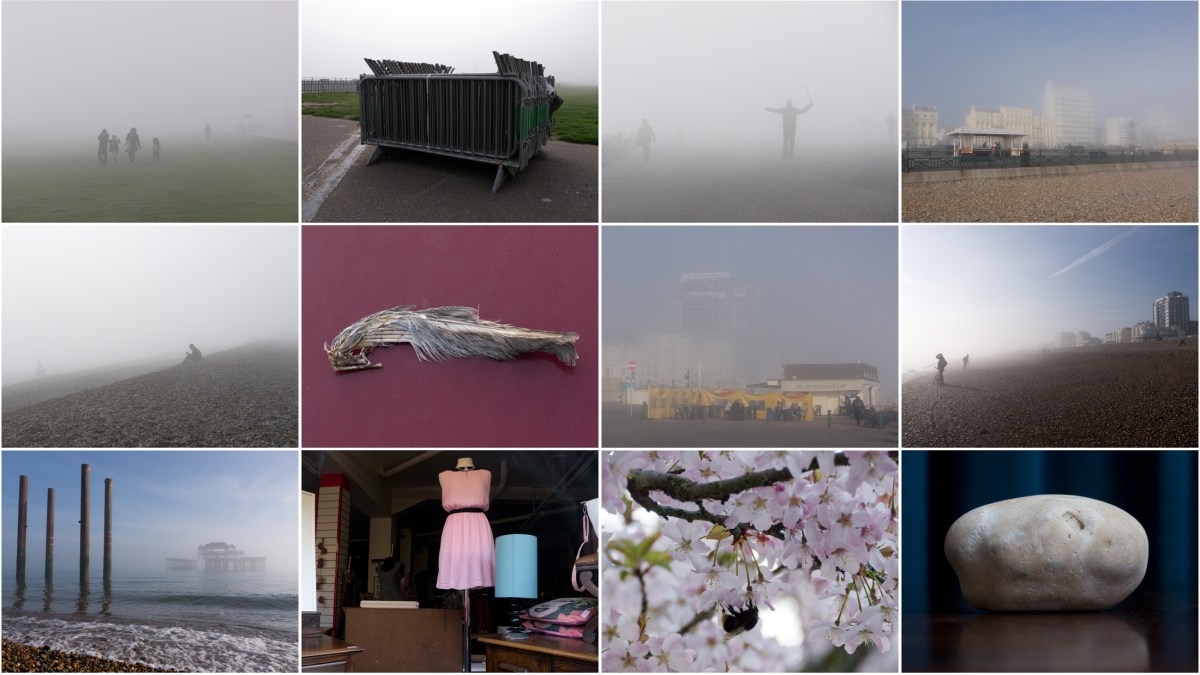
Shoreham Fret – Thurs 9th April

‘Fret’ is one of those interesting words with a number of very different meanings. There are the familiar definitions: to worry, both in terms of being worried, but also to ‘worry’ something else, the way a dog might worry a flock of sheep; the metal strips inlaid across the neck of certain types of stringed musical instruments; to adorn or form a pattern on, hence fretwork: the carving or cutting of panels of wood into elaborate shapes. But fret can also mean to eat, fray or corrode; agitate or ripple; an ornamental network (apparently, especially a medieval metallic or jewelled net for a woman’s headdress)…

And today I was reminded of a further meaning of the word as I headed out for a walk. The skies outside my window were a clear and piercing blue, but as I descended to the sea front, only about a mile away, the fog thickened until it enveloped everything in a white refractive glare. You see ‘fret’ is also the name for a particular kind of sea mist, one that Brighton is prone to during the spring and summer. It even has its own local name: the Shoreham Fret.

I’m sorry the word isn’t used much these days in this context, because the sound of the name is so perfect, encompassing the notion all at once of worrying the land, adorning it with tendrils of mist that curl across the ground, fraying the edges of things and dissolving all boundaries.

Plymouth Bites (part one)

The history of the Cornish Pasty is intimately linked to tin mining in Cornwall and Devon, one of the oldest industries of our shores, dating back beyond 2500 BC. The pasty itself evolved as a packed lunch for the miners; a nourishing and hearty meal of beef and root vegetables wrapped up in a pastry case to make them easier to carry down the pit. Also, given that the miners would have had to eat their food in dusty confined spaces and in complete darkness, having your dinner encased in an edible wrapping would have been vital. To get an idea of the importance of this for yourself, try eating your dinner blindfold while hunched up in a cupboard under the stairs (no tables or forks allowed either). For full effect, empty the contents of your vacuum cleaner bag into the space just before starting to eat. Dishes like Salade niçoise or Tagliatelle carbonara aren’t practical in these conditions.

Plymouth’s origins too are closely tied up with the tin mining industry. Plympton, now a district within the city, was one of the key ports for exporting the metal until the river Plym became so silted up with mining debris that it was no longer navigable and boats had to moor south of this original destination. This ecological disaster probably contributed to the development of Plymouth as a major port.

At the time of Christ, the tin mining industry was already venerable and there was significant trade between the south west of England and the Mediterranean countries as far as the Middle East. Indeed legend has it that Joseph of Arimathea, Jesus’ uncle, regularly visited these parts on business as a tin trader and that Jesus, while a boy, once accompanied him. William Blake’s poem (later the anthem): ‘Jerusalem’ celebrates this expedition and I like to think that, while not mentioned in any of the lines, our saviour and his uncle would have stopped off in Plympton for a pasty or two during their time here.

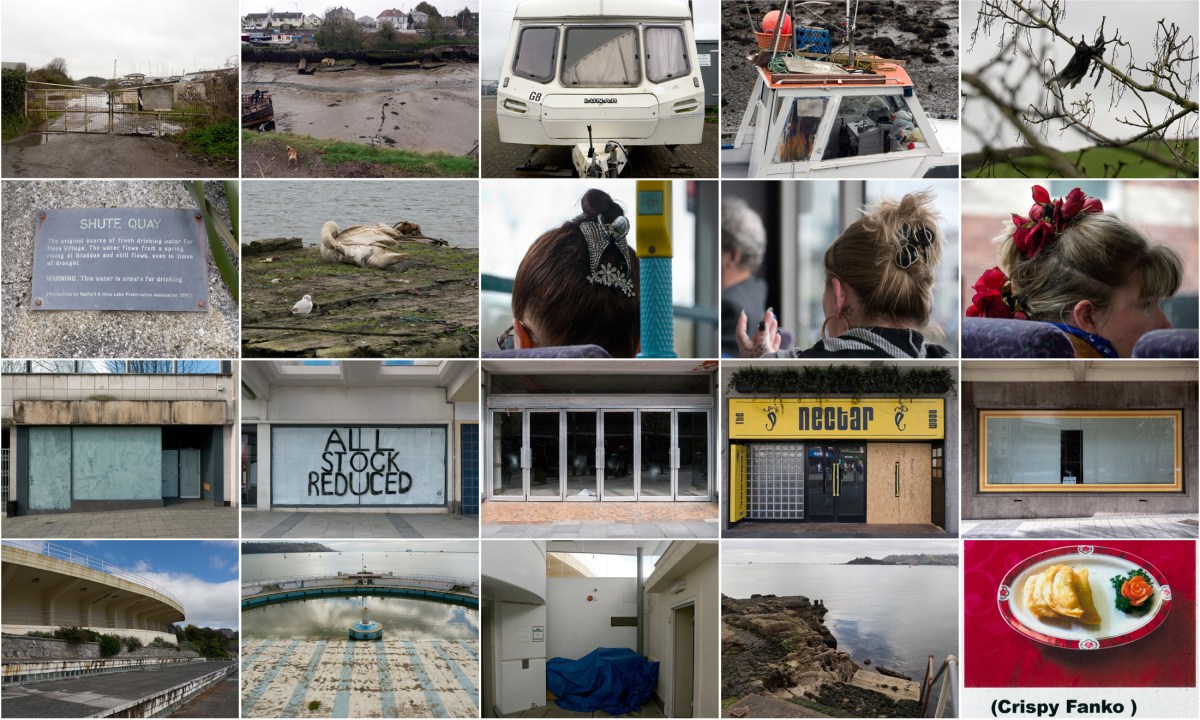
While the tin mining industry in the West Country has now collapsed, the pasty continues as a filling tribute to one of the earliest of British industries. Cornish Pasties are one of a select list of foods produced in the British Isles that have been awarded the status of protected designation of origin (like champagne but so much more satisfying) and justifiably so, you just can’t get a good one outside the region. Locally there are heated debates as to who makes the best ones and the competition between bakers is so fierce (there are even annual championships) that this ensures high standards. However, I was surprised to find that even the packaged ones are good. On a tipoff from the woman in the corner shop (who’d just sold out of hot ones) I tried out one from her fridge and indeed it turned out to be just as good as the freshly cooked versions. It therefore seems appropriate that I should begin my three-part journey through Plymouth with the label from this product.

Further thoughts on concealment – Sat 28th March

One of the many apocryphal stories about the US military relates to their attempts to develop a camouflage effective against thermal imaging devices. As you’ll probably be aware from wildlife programmes, infra-red detection can be used to identify a living being by the heat given off from its body. If the hot spots are rabbit shaped, it’s pretty likely you’re looking at a rabbit; by the same token, if they are man shaped it’ll probably be a man you’re looking at.

Anyone who’s seen ‘Predator’ will also have some idea of what infra-red vision looks like, from the shots where you see through the eyes of the alien. Unfortunately though, I have to report that smearing yourself from head to toe in river mud (in the manner employed so manfully by Mr Schwarzenegger to fool the alien) doesn’t actually work.

Millions of dollars of US government money were spent on finding a solution to the problem of infra-red visibility, leading to the development of clothing that concealed these ‘heat signatures’. Of course soldiers had to be completely covered in this special insulating fabric for it to be effective, but it looked like the defence contractors were on to something really big. Well, until, during field tests when it was discovered that, while anyone wearing these suits would be prevented from giving off any heat whatsoever, thereby making them invisible to thermal imaging devices, they would, as a result, pass out from overheating after only a few minutes and could even die if not rescued quickly.

Actually, I think they missed a trick here. If, instead of totally covering soldiers in heat insulating material, they had instead opted simply to disrupt the human outline by creating heat-transparent windows in the shape of other animals, this could have allowed the cooling necessary for the combatant to continue functioning. In addition, by presenting, in infra-red, what looks like a tower of acrobatic bunnies precariously balancing on each others backs, any sniper seeing such a spectacle would simply assume they’d been overdoing it and go away scratching their head.

You could also vary the animal-shaped windows to include koalas, marmosets, lemurs, squirrel monkeys, kittens, sloths, wombats and other small to moderately sized mammals to keep the enemy off balance.

I’ve decided to publicise this idea openly to the world rather than seeking my fortune from any particular country of military significance because I couldn’t bear the thought of having blood on my hands, whether it be human or any other small mammal that’s good at balancing acts.

28-0785a

Early example of camouflage 11/14/1917
http://research.archives.gov/description/530710

Bay – Fri 27th March

‘To hold all this together, Rauschenberg’s picture plane had to become a surface to which anything reachable-thinkable would adhere. It had to be whatever a billboard or dashboard is, and everything a projection screen is, with further affinities for anything that is flat and worked over—palimpsest, canceled plate, printer’s proof, trial blank, chart, map, aerial view. Any flat documentary surface that tabulates information is a relevant analogue of his picture plane—radically different from the transparent projection plane with its optical correspondence to man’s visual field. And it seemed at times that Rauschenberg’s work surface stood for the mind itself—dump, reservoir, switching center, abundant with concrete references freely associated as in an internal monologue—the outward symbol of the mind as a running transformer of the external world, constantly ingesting incoming unprocessed data to be mapped in an overcharged field’

Leo Steinberg
The Flatbed Picture Plane
First published in ‘Reflections on the State of Criticism’, in Artforum in March 1972; then in ‘Other Criteria’, 1972, pp.61-98

Fred and Ginger – Thurs 26th March

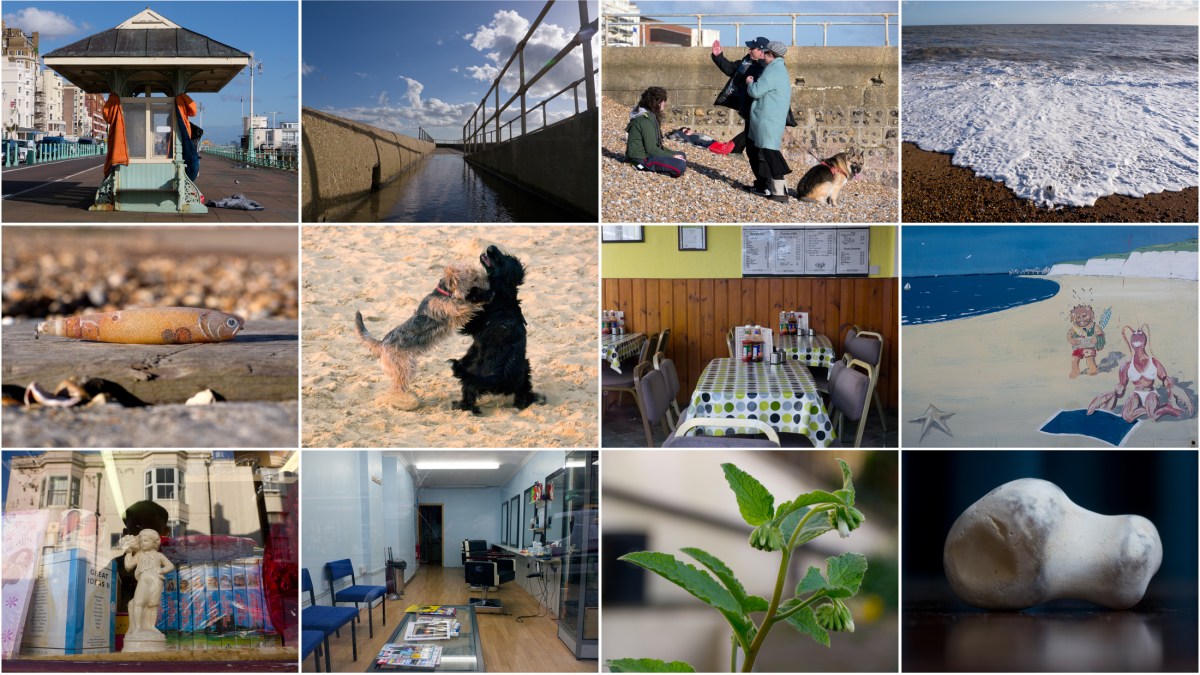
So there’s these two dogs playing in the sand of the volleyball court on the sea front. I can’t help it, they look too cute, Its almost like they are dancing and so I have to photograph them. Then I have a brief chat with the owners about the glorious optimism of dogs. Apparently every night the two owners take the dogs to the beach and every night the little scallywags go through the same routine, as if they’ve known each other all their lives, but also as if every night, they’ve fallen in love for the first time.

This itself is enchanting, but here’s the extraordinary thing: Moments before, while I was taking the pictures, the scraggy brown one spotted me, or rather, it spotted my camera lens, raced over to me, jumped onto the low wall surrounding the court, gave me a big woofy grin and, honest to god, it posed. This was all over in a second and I was so startled I didn’t take a picture in time before it was off again, but it really happened.

As far as I am aware, dogs do not know how cameras work or what they are used for. As for posing, I have always been under the impression that when this happens at Crufts or on youtube videos it is more to do with obedience, training or the promise of a biscuit, not that spontaneous and brilliant reaction you get with accomplished film stars from the golden age of Hollywood. So I am now wondering, is it possible that Fred Astaire and Ginger Rogers (or maybe some other screen couple: Douglas Fairbanks and Mary Pickford, Clark Gable and Carole Lombard, Spencer Tracy and Katherine Hepburn..?) have been reincarnated as dogs living in Brighton and by some amazing chance, found each other again, off screen, in a different life?

Why not? Anything’s possible. If I see them again I’m going to shout ‘Ginger!’ and see what happens.

Salvation Army – Tues 24th March

I was a bit miffed we only came 3rd in the pub quiz last night, losing points on a question I should have known the answer to about a particular patron saint. So today I spent some time engaged in hagiographical research on the web. In the process I came across several lists of saints, plus what they are patrons of. All the sites seem to be respectable, including one Catholic resource, where I have taken the following from (1), though discovering that TV, advertising and radiologists all have their own heavenly representatives did make me doubt its authenticity. Nevertheless, I suppose even the biggest religions have to move with the times, although I am now wondering who the patron saints of computer programmers and quiz show hosts might be.

The attribution of an area of human suffering, or a profession, on the whole seems to follow a simple logic. For example, St Joseph is the patron saint of carpenters, cabinet makers etc. Well he would be, wouldn’t he? Jesus’s dad was a carpenter. It turns out he was also patron of Belgium, married couples and pioneers – these other areas seem to me to be a bit more obscure, and what isn’t mentioned on any of the sites is that he is also patron saint of cuckolds (think about it for a moment and you’ll see that makes sense too).

But I had no idea that so many of these martyrs and miracle workers were such multi-taskers, and have been quite amazed by the sheer variety of what they represent. Why is Saint Peter the Martyr the patron, not only of Inquisitors. but also Midwives? Is there a link between these two professions? And then there is Saint Dymphna the patron of Family harmony, Insanity, Mental illness, Nerves and Runaways. Does this point to her having a troubled childhood?

Anyway, here’s an edited version of the list. It was quite long so I‘ve left out the obvious ones you’ll probably already know, and cut it down to my favourites. I think it’s nice that whatever your problem, there’s someone upstairs who might intercede on your behalf:

Agnes: Chastity and Girl Scouts
Anne: Grandmothers, Mothers, Women in labor and Horse riders
Anthony: Lost articles, the Poor, Amputees and Cemetery workers
Barbara: Ammunition workers, Architects, Builders, Miners, Storms and Sudden death
Bartholomew: Plasterers
Benedict: Monks and Poisoning
Bernadine: Advertising
Bernadino: Impulsive and uncontrolled gambling
Bonaventura: Bowel disorders
Bridget: Ireland and Fallen women
Catherine of Sienna: Italy, Jurors and Fire prevention
Clare of Assisi: Television
Dennis: France and Headaches
Dymphna: Family harmony, Insanity, Mental illness, Nerves and Runaways
Elizabeth: Separated spouses and Difficult marriages
Florian: Austria, Firefighters and chimney sweeps
Francis De Sales: Confessors, the Deaf, Journalists and Teachers
Genesius: Actors, Comedians, Dancers, Epilepsy and Lawyers
Gerard: Pregnant women and those Falsely accused
Joseph: Belgium, Carpenters, Married couples and Pioneers
Jude: Desperation and Hopeless causes
Maurice: Infantrymen, Cramp and Swordsmiths
Maximilian Kolbe: Drug Addiction
Michael: Battles, Germany, Grocers, Police officers, Radiologists, Seafarers
Saint Peter the Martyr: Inquisitors and Midwives
Saint Scholastica: Convulsions in Children and Rain

(1) http://www.catholic-saints.info/patron-saints/list-of-patron-saints-patronage.htm

Salomé – Mon 23rd March

‘This conception of Salomé, so haunting to artists and poets, had obsessed Des Esseintes for years. How often had he read in the old Bible of Pierre Variquet, translated by the theological doctors of the University of Louvain, the Gospel of Saint Matthew who, in brief and ingenuous phrases, recounts the beheading of the Baptist! How often had he fallen into revery, as he read these lines:

But when Herod’s birthday was kept, the daughter of Herodias danced before them, and pleased Herod. Whereupon he promised with an oath to give her whatsoever she would ask. And she, being before instructed of her mother, said: Give me here John Baptist’s head in a charger. And the king was sorry: nevertheless, for the oath’s sake, and them which sat with him at meat, he commanded it to be given her. And he sent, and beheaded John in the prison. And his head was brought in a charger, and given to the damsel: and she brought it to her mother.

But neither Saint Matthew, nor Saint Mark, nor Saint Luke, nor the other Evangelists had emphasized the maddening charms and depravities of the dancer. She remained vague and hidden, mysterious and swooning in the far­ off mist of the centuries, not to be grasped by vulgar and materialistic minds, accessible only to disordered and volcanic intellects made visionaries by their neuroticism; rebellious to painters of the flesh, to Rubens who disguised her as a butcher’s wife of Flanders; a mystery to all the writers who had never succeeded in portraying the disquieting exaltation of this dancer, the refined grandeur of this murderess.’

JK Huysmans, ‘Agains Nature’ (À Rebours)

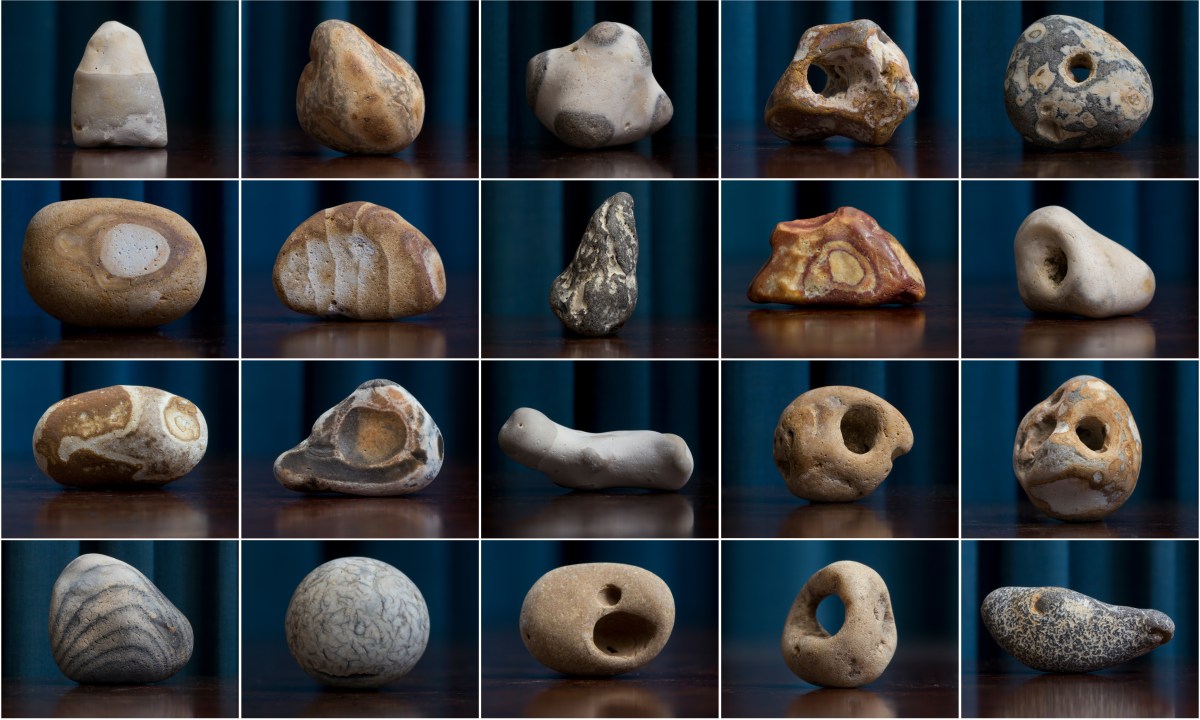
Collected Stones: Feb 2015

‘…the Thriae showed Hermes how to foretell the future from the dance of pebbles in a basin of water; and he himself invented both the game of knuckle-bones and the art of divining by them. Hades also engaged him as his herald, to summon the dying gently and eloquently, by laying the golden staff upon their eyes.’(1)

‘Among the Beng of the Ivory Coast, a regular form of divination involves the diviner’s use of black pebbles placed in a brass pan with a small amount of water. The process of consultation consists of the client informing the diviner about his/her problem and the reason for consultation. Turning the bowl in her hands, she observes how the pebbles settle in the bowl. From her observation she diagnoses the problem and prescribes an appropriate sacrifice.’(2)

(1) Robert Graves – The Greek Myths, 1955, revised 1960
(2) Jacob K Olupona, ‘Sacred Cosmos: An ethnography of African indigenous religious traditions’ in, ‘African Americans and the Bible: sacred texts and social structures’, ed Vincent L. Wimbush, Continuum International Publishing Group, New York, 2003