“Pride is all very well, but a sausage is a sausage.”
(Terry Pratchett, ‘Men at Arms’)
Packing for any eventuality – Tues 21st April
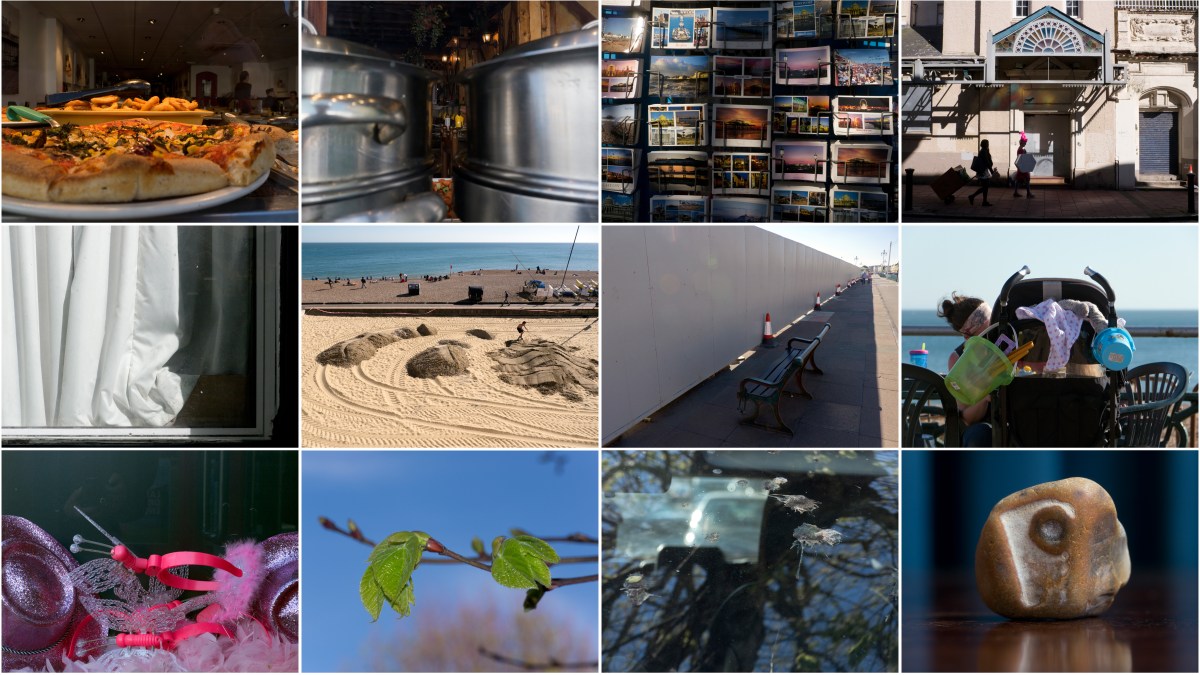
“Pride is all very well, but a sausage is a sausage.”
(Terry Pratchett, ‘Men at Arms’)

“We gather that Tarrou was agreeably impressed by a little scene that took place daily on the balcony of a house facing his window. His room at the hotel looked on to a small side street and there were always several cats sleeping in the shadow of the walls. Every day, soon after lunch, at a time when most people stayed indoors enjoying a siesta, a dapper little old man stepped out on the balcony on the other side of the street. He had a soldierly bearing, very erect, and affected a military style of dressing; his snow-white hair was always brushed to perfect smoothness. Leaning over the balcony he would call: “Pussy!Pussy!” in a voice at once haughty and endearing. The cats blinked up at him with sleep-pale eyes, but made no move as yet. He then proceeded to tear some paper into scraps and let them fall into the street; interested by the fluttering shower of white butterflies, the cats came forward, lifting tentative paws toward the last scraps of paper. Then, taking careful aim, the old man would spit vigorously at the cats and, whenever a liquid missile hit the quarry, would beam with delight.”
Albert Camus ‘The Plague’ (translated by Stuart Gilbert)
An important part of university life is the research of its teaching staff. This is what makes the place of study great and ensures that students studying there receive the best of educations. Research is judged on several criteria, including: ‘originality’ (no copying) ‘academic rigour’ (reading lots and not faking any experiments) ‘peer review’ (what other university lecturers think about what you’re doing) and ‘impact’. This last criterion is still somewhat debated across disciplines but, essentially, it’s how much what you do changes the world; the size of impact your work produces. Of course you have to be careful. Burning down the local hospital would have a great deal of impact and get you a lot of attention in the media, but not necessarily of the right kind. Besides, it would only be deemed local impact and universities want world leaders.
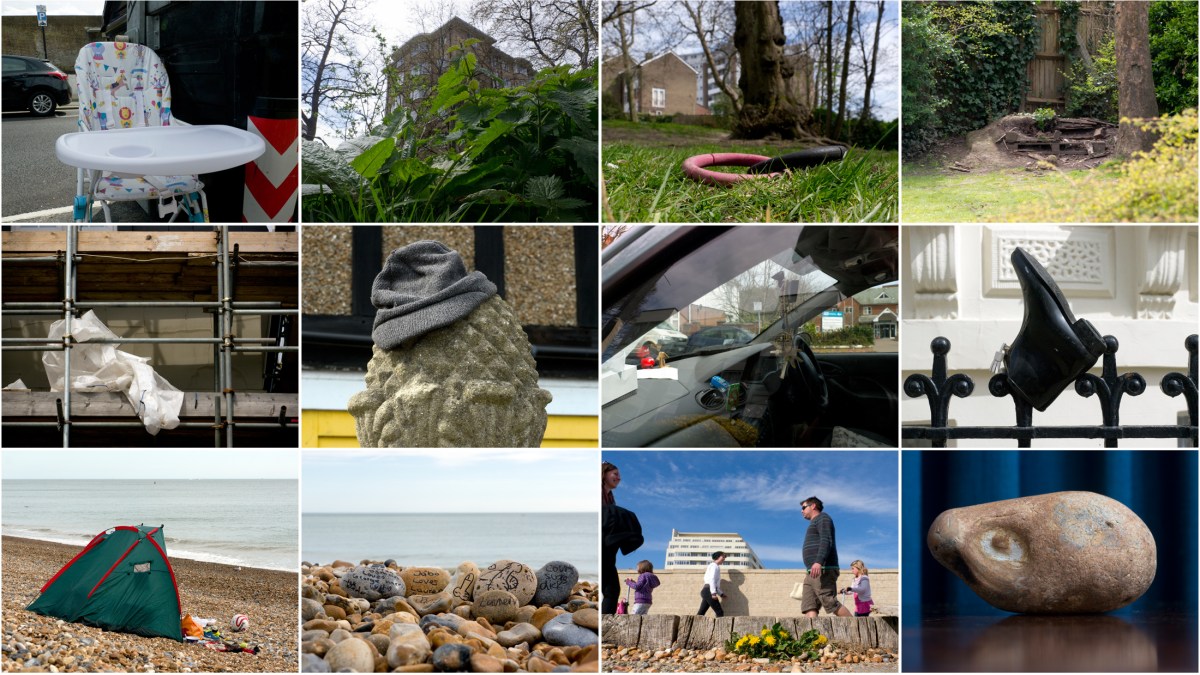
I was thinking of this subject today while on my daily walk when I came across a number of stones with some very unusual patination. On closer inspection I could see that these had not been formed entirely by natural processes; someone, or several someones judging by the different styles, had been writing and drawing on them (see picture in bottom row).
This reminded me of a successful public art initiative that had happened in the area a number of years ago. The project involved local children from all the surrounding schools going to the beach, selecting a stone, drawing a picture on it and then casting it back into the sea. I can’t actually remember what this symbolised (if anything at all) but it was deemed to be a good, indeed a poetic thing, and got a write up in the local paper.
As I mentioned, this was quite a few years ago and the children who had been involved in the event would now be teenagers. Finding today’s inscribed stones has made me wonder: were these drawings made by some of the same people who, as infants, took part in this event? Admittedly the subject matter is very different but it’d be nice to think they were connected, and that their memories of this project had prompted them to revisit the idea. If so, this would be a clear example of impact, albeit still on a local scale.
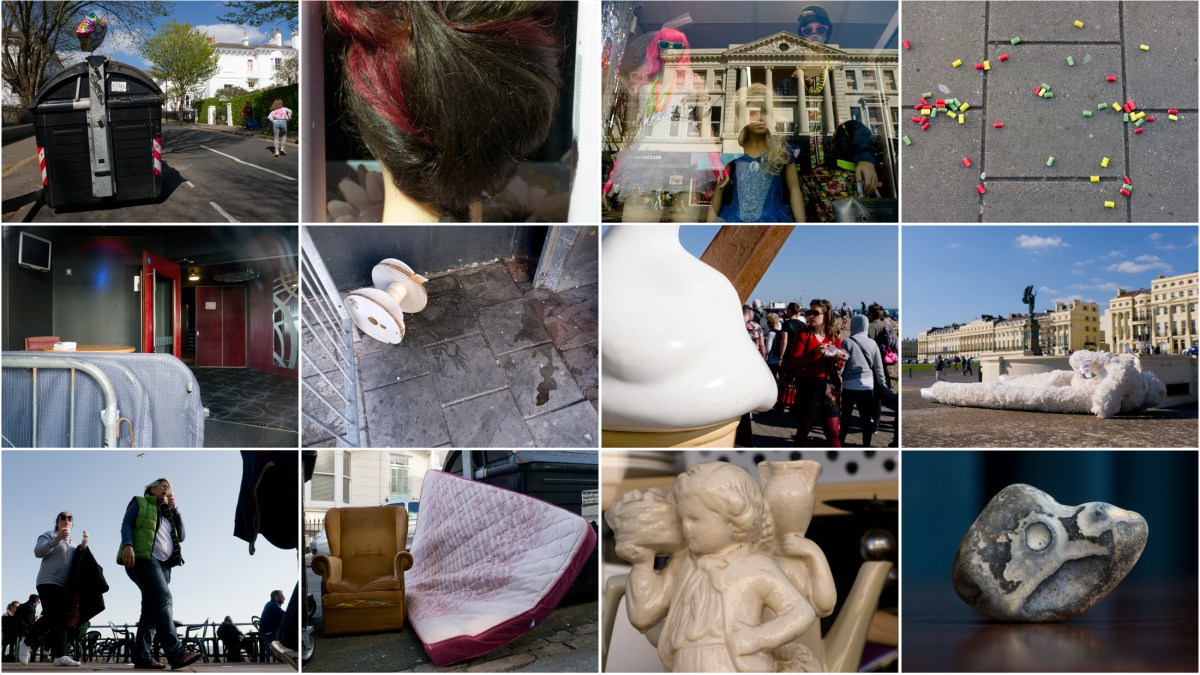
The rubbish bin in the top left picture of today’s contact sheet used to be a nine year-old girl called Clarissa. Unfortunately she was a very naughty child, much given to spiteful remarks about the other children she went to school with, many of whom would run away in tears following one of her ‘observations’. The parents of the other children tried all sorts of things to console their tender offspring, even repeating to them the rather lame rhyme beginning ‘sticks and stones…’ but it was no use, everyone knows how hurtful names are.
So, one day the parents of the other children decided to go and see the local voodoo doctor. The doctor thought about this problem for a long time and eventually decided that, just for a short while, maybe a week or two, Clarissa should be transformed into something useful but lowly to teach her a lesson. After a lot of further consideration and a few more incantations just to make sure, he decided the appropriate shape for her would be that of a municipal rubbish bin.
A lock of Clarissa’s hair was procured, the wax doll made and all was going according to plan until, having successfully completed the spell, the voodoo doctor decided to relax from his endeavours with a nice cup of tea. Halfway through his break the phone rang and, jumping up in a start, he knocked his tea all over his book of reverse spells, making the ink run on the pages so much that he could no longer read the words. With the words of the undoing spells now completely illegible, the voodoo doctor no longer knew how to turn Clarissa back into a little girl so she was now stuck in her new shape forever!
This was a pity. The voodoo priest was very sorry and had to go and see Clarissa’s parents to explain that, without the right incantation, this particular magic could not be undone. They were not happy about this but had to admit she was jolly useful now. So, to this day, Clarissa waits outside her home, hoping that another more competent voodoo doctor will pass by with the right kind of spell remover.
Every year on her birthday, her parents go into town and buy a balloon, which her little sister (pictured right) then ties to Clarissa’s lid. In this way they show her that, even though she is now a rubbish bin, they still love her very much, all things considered.
Tomorrow I will tell you the truly awful story of how Nigel Watley became a supermarket shelf.

‘Plymouth Sound’ is the name of the wide inlet around which the city of Plymouth is built, and essentially the reason for the existence of the city. But why ‘sound’? why not ‘bay’ or ‘straits’ or ‘harbour’? ‘Sound’ is one of those words, like ‘fret’ (see entry for April 9th), that has multiple meanings, each of which adds to the richness of the word. Sound: not only a noise, both uttered, made, or occurring and usually heard (though Bishop Barclay had some doubts…); sound as a sense of wholeness and solidity (your reasoning is sound, the timber is sound); sound as in deep (I slept soundly); then there is sound, as in to ascertain, to sound out, to test, to probe – and, specifically it seems, in relation to sounding the depth of water using a line, pole or, more recently, sonar.
The reason for these differing uses comes from the fact that the word has several etymological origins: the Middle English soun, from Anglo-Norman French soun (noun), suner (verb), from Latin sonus (The form with -d was established in the 16th century); Middle English: from Old English gesund (healthy), of West Germanic origin; related to Dutch gezond and German gesund; Late Middle English: from Old French sonder, based on Latin sub- ‘below’ + unda ‘wave’
I had thought this last origin was the reason for the choice of word, being based on the need to navigate a safe passage through the waters forming this area of coast, but then I found a further possible meaning: ‘A narrow stretch of water forming an inlet or connecting two wider areas of water such as two seas or a sea and a lake. Another name for Øresund from the Middle English, in turn from Old Norse sund ‘swimming, strait’; related to swim’.
At first I was disappointed by this discovery. While this is most likely the reason, it seemed prosaic to name the place purely because of its geographical particulars. But then I thought, was it just because of this one definition? Perhaps whoever christened this stretch of water was well aware of the other meanings and it was a stroke of brilliance to use a name that could encompass so much.
I was having a final cigarette on my last night in Plymouth, listening to the sound of the lapping waters magnified by the sea mist, when the stillness was punctuated by the great boom of an invisible ship off the coast. In that moment the name for this stretch of water seemed to capture, not only all that the word ‘sound’ could have stood for at the time of its naming, but what it would become centuries later.
Reference: http://www.oxforddictionaries.com/definition/english/sound

The force that through the green fuse drives the flower
Drives my green age; that blasts the roots of trees
Is my destroyer.
And I am dumb to tell the crooked rose
My youth is bent by the same wintry fever.
The force that drives the water through the rocks
Drives my red blood; that dries the mouthing streams
Turns mine to wax.
And I am dumb to mouth unto my veins
How at the mountain spring the same mouth sucks.
The hand that whirls the water in the pool
Stirs the quicksand; that ropes the blowing wind
Hauls my shroud sail.
And I am dumb to tell the hanging man
How of my clay is made the hangman’s lime.
The lips of time leech to the fountain head;
Love drips and gathers, but the fallen blood
Shall calm her sores.
And I am dumb to tell a weather’s wind
How time has ticked a heaven round the stars.
And I am dumb to tell the lover’s tomb
How at my sheet goes the same crooked worm.
‘The force that through the green fuse drives the flower’ (1934)
Dylan Thomas

“True, there are revolts against bourgeois ideology. This is what one generally calls the avant-garde. But these revolts are socially limited, they remain open to salvage. First, because they come from a small section of the bourgeoisie itself, from a minority group of artists and intellectuals, without public other than the class which they contest, and who remain dependent on its money in order to express themselves. Then, these revolts always get their inspiration from a very strongly made distinction between the ethically and the politically bourgeois: what the avant-garde contests is the bourgeois in art or morals–the shopkeeper, the Philistine, as in the heyday of Romanticism; but as for political contestation, there is none. What the avant-garde does not tolerate about the bourgeoisie is its language, not its status.”
(Roland Barthes: ‘Mythologies’, translated by Annette Lavers, Hill and Wang, New York, 1984)

The trouble with writing blogs, especially when you’re publishing things that have happened that day, is that you just don’t know what’s going to happen tomorrow. Having expounded several theories yesterday regarding why the birds have vanished…
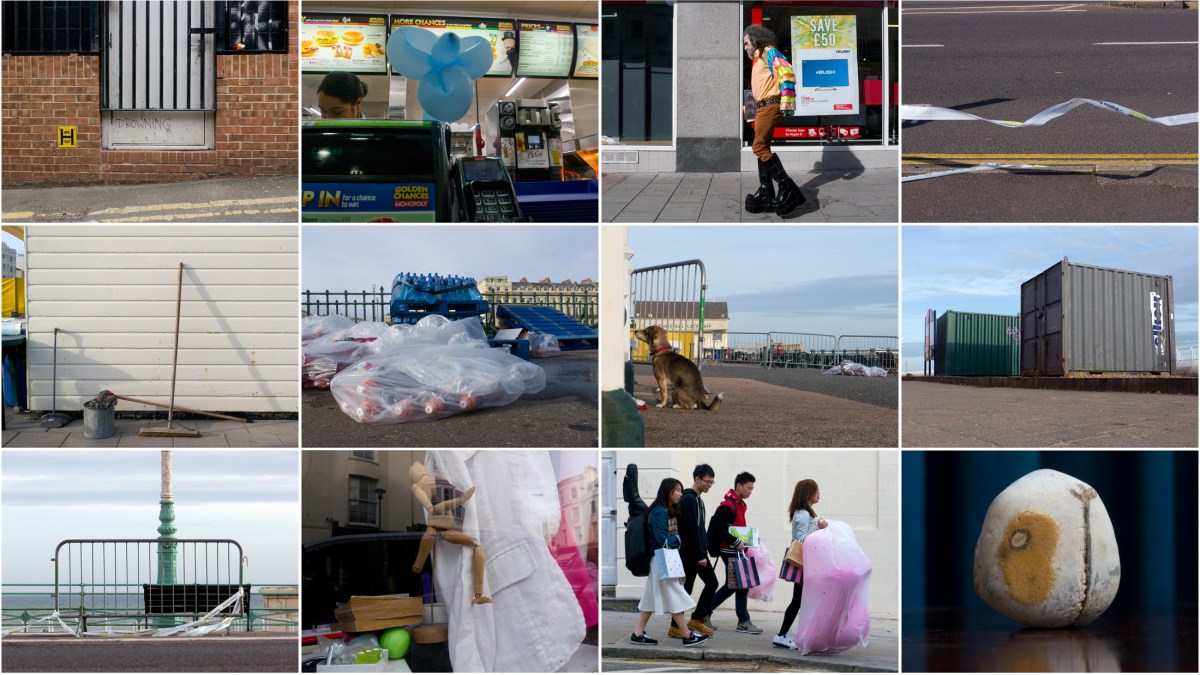
Today I’m sitting drinking tea on the sea front in thick fog, the café is about to close, no tourists, indeed very few people at all saving those of us who seem to like standing on the beach in weird weather (what is it about fog? It’s like staring at nothing, but at the same time, the nothing is so clearly, palpably, something) and then there’s a pigeon by my feet, and then another, and then the family of crows arrives with a great chorus of croaks. So much for my observations then… only maybe they do keep a safe distance when there are too many people at the café, especially if one of them is waving a broom around. And it’s good to know that the birds are just biding their time in the certain knowledge that people are really only a transient phenomenon.
I’ve been wondering where the birds at the café have all gone. The starling will have flown north but what about the wagtail, the crows, even the pigeons? Only a few seagulls remain (nothing is going to put them off, they own the beach). Is it because all the others had flown inland for the breeding period, maybe to find trees to build nests in? Is it because there are too many tourists around? After all, it’s the Easter school holidays still, the weather has been uncharacteristically good, and I too am finding it a bit of a shock seeing so many people around suddenly. Or…
There’s a new guy at the café. His seems to be a bit of a lowly job: collect plates, wipe the tables, do a bit of sweeping up, but all of these tasks he undertakes with creditable gusto. However, it seems he’s also decided the area needs to be a bird-free zone and he now patrols the café with a long-handled brush, swinging it wildly like a polo mallet while charging any hopeful avian that chooses to land anywhere near a plate (or anywhere else for that matter). Given there are a lot of tables and, because of the Easter break most of them are full, there is, therefore, a lot of rushing around going on.
I can understand this is done for the benefit of the customers. It’s not easy eating a plate of chips when your table is covered in pigeons, and they are pretty persistent (though its much more fun watching someone else grappling with the same problem, especially when they make the mistake of throwing a few scraps in the mistaken hope that it might appease these winged vacuum cleaners) but somehow the place isn’t the same without the birds. My only consolation is that, as far as having something to watch while drinking my tea, the spectacle of a maniac lunging at anything with feathers does seem to pass the time.

There was once an old sailor my grandfather knew
Who had so many things which he wanted to do
That, whenever he thought it was time to begin,
He couldn’t because of the state he was in.
He was shipwrecked, and lived on a island for weeks,
And he wanted a hat, and he wanted some breeks;
And he wanted some nets, or a line and some hooks
For the turtles and things which you read of in books.
And, thinking of this, he remembered a thing
Which he wanted (for water) and that was a spring;
And he thought that to talk to he’d look for, and keep
(If he found it) a goat, or some chickens and sheep.
Then, because of the weather, he wanted a hut
With a door (to come in by) which opened and shut
(With a jerk, which was useful if snakes were about),
And a very strong lock to keep savages out.
He began on the fish-hooks, and when he’d begun
He decided he couldn’t because of the sun.
So he knew what he ought to begin with, and that
Was to find, or to make, a large sun-stopping hat.
He was making the hat with some leaves from a tree,
When he thought, “I’m as hot as a body can be,
And I’ve nothing to take for my terrible thirst;
So I’ll look for a spring, and I’ll look for it first.”
Then he thought as he started, “Oh, dear and oh, dear!
I’ll be lonely tomorrow with nobody here!”
So he made in his note-book a couple of notes:
“I must first find some chickens” and “No, I mean goats.”
He had just seen a goat (which he knew by the shape)
When he thought, “But I must have a boat for escape.
But a boat means a sail, which means needles and thread;
So I’d better sit down and make needles instead.”
He began on a needle, but thought as he worked,
That, if this was an island where savages lurked,
Sitting safe in his hut he’d have nothing to fear,
Whereas now they might suddenly breathe in his ear!
So he thought of his hut … and he thought of his boat,
And his hat and his breeks, and his chickens and goat,
And the hooks (for his food) and the spring (for his thirst) …
But he never could think which he ought to do first.
And so in the end he did nothing at all,
But basked on the shingle wrapped up in a shawl.
And I think it was dreadful the way he behaved –
He did nothing but bask until he was saved!
(AA Milne, The Old Sailor)
 Umbrellage