Moving walkways – 6th April 2016

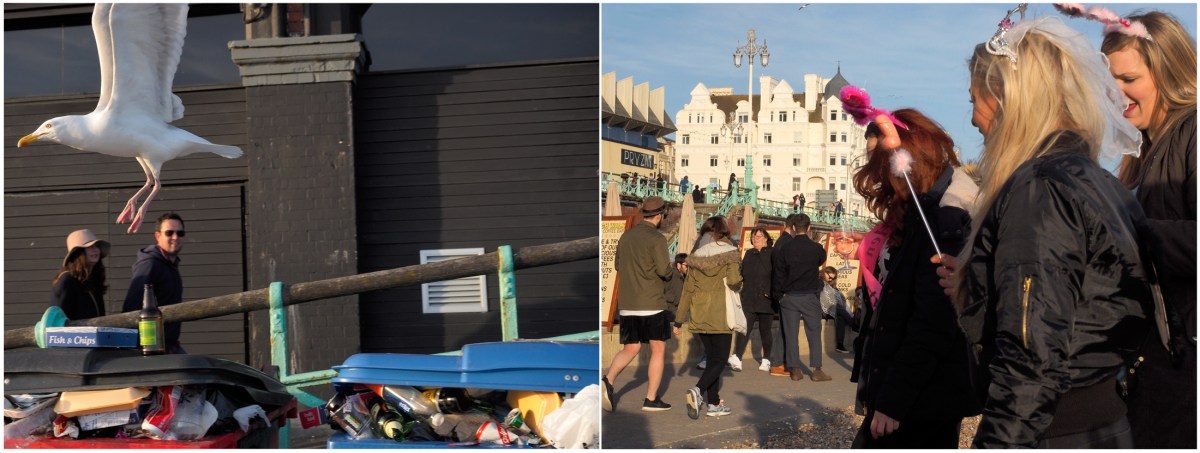
Following on from my post of a few days ago (Jennycliff – 31st March) here’s another space that, while not actually beyond the fence, is pretty close to it. If you’re a smoker, you’ll find yourself passing through a lot of these non-environments. Yet, despite the powers that be doing everything they can to show you how disgusting you are by hiding smoking areas in the ugliest and most difficult to get to of venues, these are the places that we have always been the most familiar with: in the bike sheds and behind the science huts at school, round the back of your mate’s dad’s car repair workshop, the garages at the end of the estate, among the bushes at the bottom of the sports field, these sites offer a welcoming escape from normality and the opportunity for chance meetings, not all of which will be nice, but then what is the world without risk?

On this occasion, at the smoking area at the end of this trav-o-lator™, among others I found: a brittle and angry airline worker sucking the life out of her dog ends as if, in draining them, it would also consume whoever had caused her upset; a young woman texting frantically between puffs, then waiting with equal fervour for a reply; a man holding his cigarette with studied nonchalance trying to look important; three more men joking in an unfamiliar language while waiting for their pick up… and here I felt at home.

Farmyard noises – 5th April 2016

The rest of my stay in Plymouth was delightful, but entirely without incident. In one respect perfect for what I wanted: have a bit of space, wander around, drink tea, look at things and take pictures of them, rest; but less good in terms of coming up with a story. Except…

My sister’s fridge has one of the most interesting personalities of any item of white goods I’ve ever come across. Don’t get me wrong, it does a great job of keeping things at the temperature they are supposed to be, the doors and the lights inside work well enough. What else can you say about a fridge? Well quite a lot as it turns out. Some mornings I’d get up and be making tea while listening to the sounds of the countryside, before realising that Oreston is not exactly ‘country’, more a quiet suburb, and the sounds of cattle lowing, or that of a particularly suggestive chicken scratching in the dirt, were actually being made by the fridge.

I suspect I’m anthropomorphising but given that so many modern appliances now have computer chips that regulate their functions, is there not at least a tiny possibility that one of them has begun to develop a rudimentary degree of consciousness, and alongside this it’s own language to comment on the job in hand? No matter that the task is boring and extremely repetitive, if your sole reason for existence is to keep your insides at a certain temperature, then your world view is going to be centred on this one aspect of material existence and you’re going to think it’s pretty damned important. Indeed important enough to want to comment on it endlessly. Furthermore, I think the fridge has at least a rudimentary degree of awareness of ‘other’. After all, if you’re of even a limited philosophical disposition, it’s only going to be a matter of time before you start asking why your doors are sometimes opened, your insides periodically filled and then slowly emptied again. These events will interfere with your primary function and therefore wellbeing. Depending on your outlook you will see these events as either a challenge, or a discomfort and, eventually, you are going to wonder whether there is something else out there doing these things to you.

Once you’ve got to this stage, self-consciousness has arisen, which may be why it has taken me a year to get an even half decent recording of it in full voice.

Up until now, every time I have become aware of it’s chattering and clucking, and managed to get my recording gear out, things have gone deathly quiet, and carried on this way for long enough for me to abandon the session. It cannot be a coincidence that this keeps happening; the bloody thing has self-awareness and does not like the proximity of other devices, or entities (i.e. me). In the end, like some hunter in the forest, I had to sit patiently for about an hour, pretending to do something else, before I could get even this rather bad recording, but it gives you an idea. Please listen to the whole recording, there are gaps of pregnant silence, but these only serve to make the utterances more powerful when they do happen, and do play the recording at full volume so you don’t miss any of the nuances.

Jennycliff – 31st March 2016

Last year when I first visited Jennycliff, I’d been disappointed to find that the path to the beach had been closed off because of cliff subsidence. Not only was there a big notice, but an even bigger and forbidding fence, complete with sharp bits, had been placed across the path that made sure you kept out. The views from the cliff and the café itself were still good, good enough reason to visit the spot, but there was always that feeling you were missing out on something.

This year I find the big notice and the even bigger forbidding fence are both still there, but in the intervening 12 months enough people had been irritated by this denial of access, and the fact that the cliffs still hadn’t been shored up, that now there was something of a path hacked through the gorse and clay just left of the fence, and just wide enough to allow circumnavigation. Paths like this tell you a lot about what to expect. On the one hand it wasn’t exactly official (if that had been the case the fence would have been taken away) but on the other hand it had seen enough traffic to indicate that more than one intrepid explorer had passed this way, on more than one occasion, had found the scrabbling worthwhile, and had lived to tell the tale. In short, you could get down to the beach, just don’t go crying to mummy if you fall over.

So L and I set off. It wasn’t far before you could see why the fence had been put up. A lot of the cliff had fallen away taking most of the path with it, so there was only a foot wide ledge in places to tread on, most of it mud made even more slippery by the recent rains. However, where it was at its narrowest some public spirited adventurer had tied a rope between the trunks of several shrubs so you had something to hold on to, and it didn’t take us long to get to the bottom.

Fences are strange things. Clearly they are designed to keep you out (or sometimes in) whether it’s ‘for your own good’, or just to keep you off someone else’s property, or make sure you’re where you’re supposed to be. But while their function is to prevent, they also act as a clear advert that here is something someone wants you kept away from, ergo, what’s beyond has to be interesting.

And fences do another thing: they delineate the borders of zones beyond the world of the ordinary, so that, once you’ve crossed this border, you are now in a special place where the usual rules no longer apply.

When we reached the beach there were a few teenagers there, some smoking, others clambering over rocks, throwing stones and rubbish from the shoreline, being generally loud, and one or two wandering on their own as far as the sea would let them. If I’d approached any of them with my ideas on life beyond the borders they would have just laughed or looked at me like I was mad. After all, there are other, more impenetrable boundaries that you only get to cross once.

Oreston – 29th March 2016 

When I mentioned to Michael at the café that I was off to Plymouth again, I could see him begin to gaze into the past (How can you do that? We can’t time travel, but it’s the only way I can describe the look that came over him. Like looking at a boat on the horizon, only backwards). Anyway, Michael grew up in Plymouth, a long, long time ago, worked in the dockyards, then the Navy, before finally leaving for a life as a pub owner, and eventually washing up in Brighton.
“What you doing down there then?”
“My sister’s place is in Oreston, I’m looking after it for a few days”
“Oreston, where’s that?
“One of the suburbs, mouth of the Plym.”
“Ah, you mean OrESTon (I’d pronounced it OReston) ooh that takes me back. You need a translator if you’re going down there!”
“Why not?”
“No, no… I don’t know who’d be left. Went out to Oreston often enough as a boy though. There used to be boat yards and docks everywhere, Devonport, Plymstock, as well as Plymouth itself, all along the coast, all been merged into Plymouth now I suppose, those that are left. We were bombed a lot during the war, but those German buggers couldn’t aim very well so most the time it was the city that got hit. We’d go up on to the hills at night when the bombers came and watch Plymouth burn. If a school got hit we’d all cheer! Bombs don’t come down vertically you know, no one realises that. They come down at an angle, like this… Jennycliff still there?”
“Yes, I’ll be spending some time up there. Got a good café.”
“Ah”

Hippodrome – 28th March 2016

Its only when I started to wonder what to write about today’s images that it suddenly occurred to me what an odd word ‘hippodrome’ is. I mean, think about it, do we go to a hippodrome to see hippos?

A bit of rooting around online and I come up with:

“hippodrome (n.) “horse race-course,” 1580s, from French hippodrome, from Latin hippodromos “race course,” from Greek hippodromos “chariot road, race course for chariots,” from hippos “horse” (see equine) + dromos “course” (see dromedary). In modern use, “circus performance place” (mid-19c.), and thus extended to “large theater for stage shows.””(1)

But why not Equidrome? Did the Romans only use a Greek word for race courses?

And then why are hippopotami called hippopotami? They don’t look anything like horses. Back to the online etymological dictionary, where I find:

“hippopotamus (n.) omnivorous ungulate pachydermatous mammal of Africa, 1560s, from Late Latin hippopotamus, from Greek hippopotamus “riverhorse,” an irregular formation from earlier ho hippos potamios “the horse of the river”), from hippos “horse” (see equine) + adjective from potamos “river, rushing water” (see potamo-). Replaced Middle English ypotame (c. 1300), which is from the same source but deformed in Old French. Glossed in Old English as sæhengest.” (2)

So: ‘horse of the river’ eh? I’m not convinced. Personally I think hippopotami look more like very big pigs (or hornless rhinoceroses?). Actually they look more like my music teacher at school.

(1) From: http://www.etymonline.com/
(2) ibid

The Detectorist – 27th March 2016

“22p, 22p! But on a good day I can make up to £200. That’s after a bank holiday, if I get down here early, or when there’s been a high sea. The waves shift the pebbles, bring stuff up to the surface, rings and coins… I’m the only one that does it proper. Systematic, that’s the only way to do it. There’s others with better equipment but I’m thorough. There used to be another bloke down here, latest stuff and everything, he cut me up a few times, heard he was bad mouthing me behind my back and I says to him “any time, any time, you just say it to my face…” He’s a bus driver and you know what they’re like. He don’t bother me so much now.”

Quixotic windmills – 20th March 2016

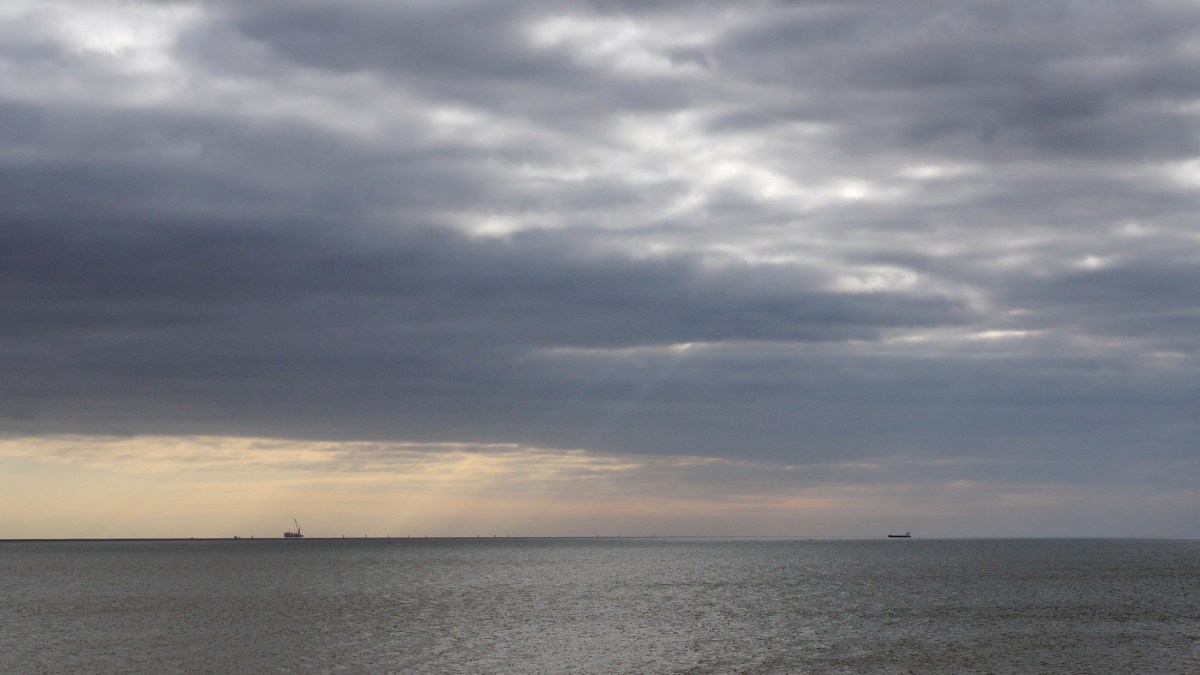
I’ve always quipped that one of the great reasons for living by the sea is that, at least in one direction, you can guarantee that no-one is going to start building and spoil the view. Fool. I suppose it was going to happen one day and I shouldn’t be annoyed. After all, we need energy and a wind farm is a green and renewable solution – one we should encourage, one I applaud, and yet… it’s as if the smooth face of a beloved daughter has started to develop stubble.

On the other hand, I’ve now started thinking, what would it be like to sail between these vast quixotic windmills? Who do I know with a boat?

Intrepid – 18th April 2016

When I was very small I used to take great delight in playing under tables. Empty ones were private studies, tree-houses or caves, where you could escape from adults too big to fit. While when populated, to crawl through the depths of a forest of legs, both wooden and human, all shrouded by the low clouds of the tablecloth’s hems, was the finest of adventures.

I’m glad that I took advantage of my smallness then, because today I had the sudden sharp realisation that this pursuit was one probably no longer open to me.