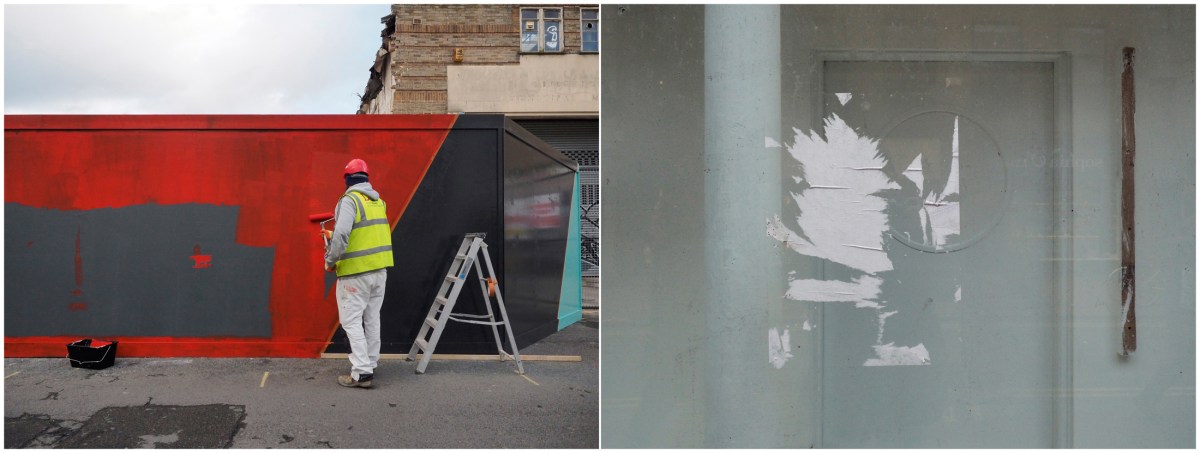
Endangered species – 1st Dec 2015

A couple of months ago a new law was brought in to reduce environmental damage caused by plastic waste (specifically plastic carrier bags). The law is quite simple: from now on, as a deterrent, all shops have to charge for plastic bags at the checkout. At the time (and to my surprise given that we are all supposed to want to care for our environment) the internet was peppered with cries of protest from shoppers. There were even a couple of legal challenges mooted, based on the ‘fact’ that the law couldn’t apply to carrier bags printed with shop or company logos as this was therefore not a service to customers but free company advertising. I’m not sure what’s happened to this particular complaint but I’m happy to say that things seem to have quietened down now.

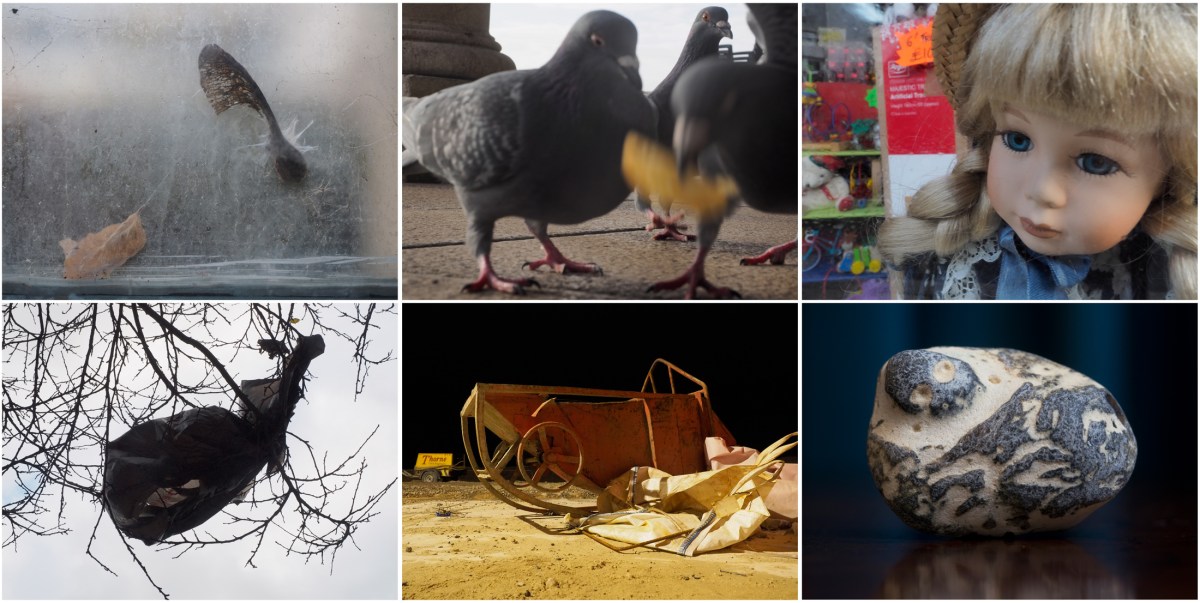
It’s a good law and it certainly seems to be working, yet I do have one regret: those of you who have been reading this blog since I started it a year ago might have noted my delight in ‘witches knickers’ (see Sub Braccae Veneficas – Weds 25th Feb) and this season the crop of these delightful flowers has been substantially reduced. Today’s image (bottom left) is in fact the first bloom I have found of this exotic variety this winter.

I console myself with the knowledge that the world is a marginally better place for this piece of legislation and, after all, there’s still plenty of crap remaining out there to photograph.

Mermaids purses 30-11-15

Mermaids purses, as the name might suggest, resemble money pouches of an antique variety, having what appear to be small draw-strings at each end. Leathery and translucent, at around two inches in length they are just big enough for a small jewel or a few grains of gold, but their real purpose is to encase the young of the lesser-spotted Dogfish (scyliorhinus canicula) protecting them from predators and the current, during the breeding period from November to July. The drawstrings are actually long elastic threads used to attach the egg cases to seaweed or rocks, preventing them, most of the time, from being swept away by the currents. However, at this time of the year the winter storms throw mounds of seaweed up onto the shore, and if you poke through the debris you can often find capsules, not only of dogfish, but also of skate and several different species of ray. Usually they are empty, but occasionally you might come across one which still contains its occupant.

At first I assumed it must be dead, indeed I only noticed the egg case was still full because I’d picked it up to look at it, but in doing so perhaps it felt the heat of my hand through the leathery membrane, and this caused it to stir, switching its tail as it circled round its still-attached yolk sac, coming to rest with its two eyes towards me. Could it see me? Was what I was looking at even conscious? I don’t know, but it was definitely alive and, having picked it up, I now felt I needed to give it a chance of survival.

Twice I hurled it as far as could manage back into the sea, twice the sea threw it back onto the beach, but the third time it took, and swept the little pod away. I suppose I know that the chances of it surviving are almost negligible, but there has to be hope.

And then – 28th Nov 2015

Leader of the House of Commons, Robin Cook’s resignation speech following the majority decision by the British parliament to invade Iraq in 2003:

“I have resigned from the cabinet because I believe that a fundamental principle of Labour’s foreign policy has been violated. If we believe in an international community based on binding rules and institutions, we cannot simply set them aside when they produce results that are inconvenient to us.

I cannot defend a war with neither international agreement nor domestic support. I applaud the determined efforts of the prime minister and foreign secretary to secure a second resolution. Now that those attempts have ended in failure, we cannot pretend that getting a second resolution was of no importance.

In recent days France has been at the receiving end of the most vitriolic criticism. However, it is not France alone that wants more time for inspections. Germany is opposed to us. Russia is opposed to us. Indeed at no time have we signed up even the minimum majority to carry a second resolution. We delude ourselves about the degree of international hostility to military action if we imagine that it is all the fault of President Chirac.

The harsh reality is that Britain is being asked to embark on a war without agreement in any of the international bodies of which we are a leading member. Not Nato. Not the EU. And now not the security council. To end up in such diplomatic isolation is a serious reverse. Only a year ago we and the US were part of a coalition against terrorism which was wider and more diverse than I would previously have thought possible. History will be astonished at the diplomatic miscalculations that led so quickly to the disintegration of that powerful coalition.

Britain is not a superpower. Our interests are best protected, not by unilateral action, but by multilateral agreement and a world order governed by rules. Yet tonight the international partnerships most important to us are weakened. The European Union is divided. The security council is in stalemate. Those are heavy casualties of war without a single shot yet being fired.

The threshold for war should always be high. None of us can predict the death toll of civilians in the forthcoming bombardment of Iraq. But the US warning of a bombing campaign that will “shock and awe” makes it likely that casualties will be numbered at the very least in the thousands. Iraq’s military strength is now less than half its size at the time of the last Gulf war. Ironically, it is only because Iraq’s military forces are so weak that we can even contemplate invasion. And some claim his forces are so weak, so demoralised and so badly equipped that the war will be over in days.

We cannot base our military strategy on the basis that Saddam is weak and at the same time justify pre-emptive action on the claim that he is a serious threat. Iraq probably has no weapons of mass destruction in the commonly understood sense of that term – namely, a credible device capable of being delivered against strategic city targets. It probably does still have biological toxins and battlefield chemical munitions. But it has had them since the 1980s when the US sold Saddam the anthrax agents and the then British government built his chemical and munitions factories.

Why is it now so urgent that we should take military action to disarm a military capacity that has been there for 20 years and which we helped to create? And why is it necessary to resort to war this week while Saddam’s ambition to complete his weapons programme is frustrated by the presence of UN inspectors?

I have heard it said that Iraq has had not months but 12 years in which to disarm, and our patience is exhausted. Yet it is over 30 years since resolution 242 called on Israel to withdraw from the occupied territories.

We do not express the same impatience with the persistent refusal of Israel to comply. What has come to trouble me most over past weeks is the suspicion that if the hanging chads in Florida had gone the other way and Al Gore had been elected, we would not now be about to commit British troops to action in Iraq.

I believe the prevailing mood of the British public is sound. They do not doubt that Saddam Hussein is a brutal dictator. But they are not persuaded he is a clear and present danger to Britain. They want the inspections to be given a chance. And they are suspicious that they are being pushed hurriedly into conflict by a US administration with an agenda of its own. Above all, they are uneasy at Britain taking part in a military adventure without a broader international coalition and against the hostility of many of our traditional allies. It has been a favourite theme of commentators that the House of Commons has lost its central role in British politics. Nothing could better demonstrate that they are wrong than for parliament to stop the commitment of British troops to a war that has neither international authority nor domestic support.”
Graeae – 26th Nov 2015

“Which of the daughters
Of Phorkyas are you?
Since I liken you
To that family.

Are you perhaps one of the Graeae,
A single eye and a single tooth,
Owned alternately between you,
One born of greyness?”

Goethe, ‘Faust part II’
Translated by A. S. Kline

Good as red – 25th Nov 2015

“Mr. James Hennessy offered a resolution that the entire body proceed forthwith to Newark and get drunk… Then the Democrats charged upon the street cars, and being wafted into Newark proceeded, to use their own metaphor, to ‘paint the town red’.”
New York Times 1883

“…because they would be paid up in Chicago for their half-year’s work, and would then do their best towards painting that town in purest vermilion.”
Rudyard Kipling, ‘A Little More Beef’ 1889

“And there he was at the end of his tether after having often painted the town tolerably pink without a beggarly stiver.”
James Joyce, ‘Ulysses’ 1920

“Woe unto you, scribes and Pharisees, hypocrites! for ye are like unto whited sepulchres…”
Matthew 23:27 (King James version) 1611

Sleeping giants – 24th Nov 2015

“Deep in the shady sadness of a vale,
Far sunken from the healthy breath of morn,
Far from the fiery noon, and eve’s one star,
Sat gray-hair’d Saturn, quiet as a stone,
Still as the silence round about his lair.”

Opening lines to John Keats,’Hyperion’ Book 1 (1820)

Enigma

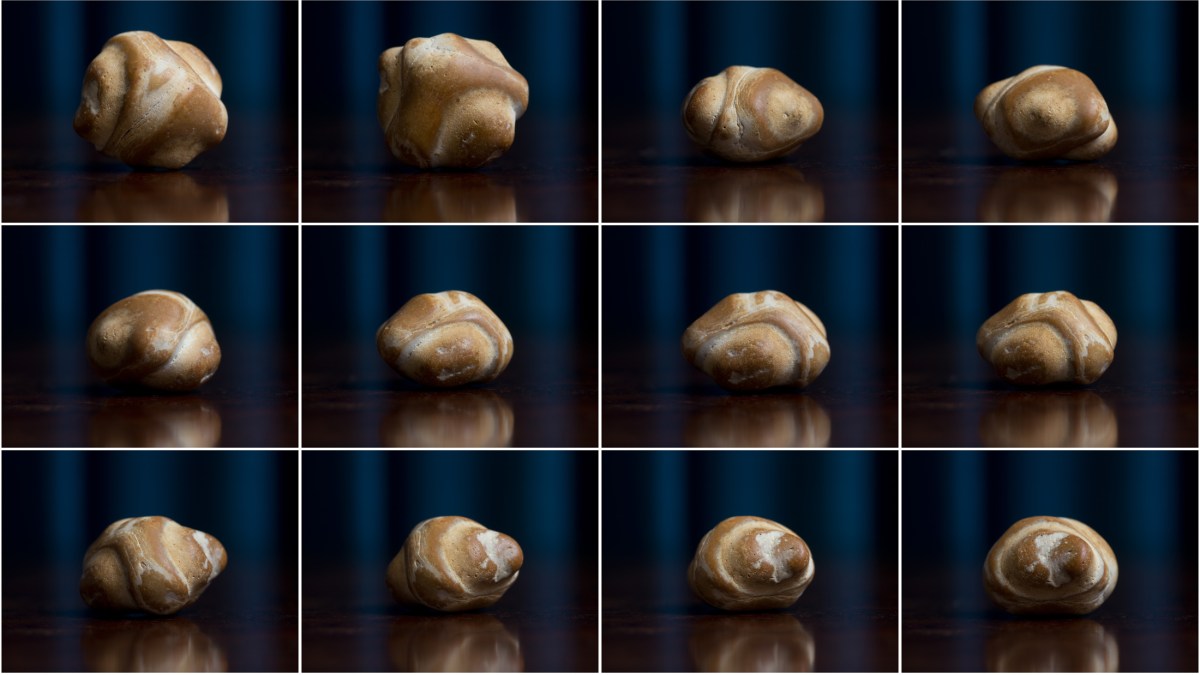
I’ve already mentioned in older posts how some stones I find lend themselves to being photographed, having one good angle that seems to exemplify its personality, while others need to be turned in your hand to fully appreciate the peculiarity of the object. The stone pictured above is another example of this latter category. One image doesn’t do it justice so I’ve decided to present here a page showing twelve different angles of the same stone, in the hope that it might convey more of its character. Even then, I’m not sure how well I’ve succeeded.

It’s quite small, a little larger than a nob of chewing gum. Probably a fossil washed along the coast from Eastbourne or Beachy Head and therefore, given the local geology, likely to date from the Cretaceous Period. It seems to have a kind of three-point symmetry, yet at the same time, the object as a whole is more organic than geometric, so this symmetry is somewhat obscure. Holding the stone and looking at it now, it seems to me that the best way to describe it is thus:

Imagine a pair of underpants stretched tightly around a loaf of uncooked dough, so that the elastic of the material bulges the dough out of the three openings designed for two legs and a waist, each of these extrusions of the dough ball remaining rounded as they protrude from their restricting bond. At the same time, the stone as a whole is reminiscent of an unbaked croissant or other kind of pastry where the dough has been folded over on itself to result in soft ridges, merging back somewhat into the main mass of the dough yet remaining distinct.

I think the above is an accurate description, but its banality undermines the strangeness of the object. It is, after all, a shape made of stone and ultimately, stones aren’t supposed to do things like this unless they are created as a cast of the remains of something long dead. Yet I’ve searched through all three volumes of my book of British fossils and can’t find anything like it. The closest in similarity are the echinoids (sea urchins) but all of these are based on variations of five-point symmetry not three. Part of me is annoyed at not being able to name it, but another part, I think the greater, takes huge delight in finding an object that seems to so elude classification.

Of Comets – 22nd Nov 2015

“Now it must be asked if we can comprehend why comets signify the death of magnates and coming wars, for writers of philosophy say so. The reason is not apparent, since vapour no more rises in a land where a pauper lives than where a rich man resides, whether he be king or someone else. Furthermore, it is evident that a comet has a natural cause not dependent on anything else; so it seems that it has no relation to someone’s death or to war. For if it be said that it does relate to war or someone’s death, either it does so as a cause or effect or sign.”

‘De Cometis’ Albertus Magnus (1200-1280ad)

Worthing tour – 21st Nov 2015

A long, long time ago I played in a band with a guitarist called Frank. His timing was sometimes a bit off and frequently what was supposed to be a twelve-bar came out anywhere between eleven and a half and fourteen (actually this is quite common among blues players), but despite these quirks he had a very convincing way of playing. He’d lived in the Projects in Chicago at the end of the sixties, married the daughter of one of the big players and even spent some time in an American sanatorium. This gave him blues credibility and, despite a tendency towards jumpiness if he forgot his pills, he was considered by many to be the ‘real deal’. He taught me a lot.

One of our more salubrious gigs was in a place called ‘Hustlers’ in Worthing. A bar above one of the pubs on the sea front, there wasn’t a stage as such, just an end of a largish room. The carpet had seen better days. Once it must have been a deep, swirling red, but years of cigarette ash, spilled drinks and the trampling of wet shoes in from the coast-road outside had given it a grey, slightly leathery sheen, through which the pattern nevertheless still fought for attention. It might have looked better if it had shown signs of a recent vacuuming, but with clubs, once the lights are turned down it’d be too dark to notice, and the barman looked like he was used to relying on this fact.

Punters started drifting in while we were still setting up the gear and by the time we began playing we had a smallish audience of about forty people, consisting largely of what looked like TV repair men accompanied, not so much by rock-chicks, as fully fledged chickens.

Frank’s signature move consisted of a kind of whallop-like power-chord, not dissimilar to Pete Townsend’s windmill guitar, but more of a one off strum, this often accompanying a vocal declamation such as “Ah got the Bluuuuues” his cheeks and bottom lip blowing out explosively as he pronounced the ‘B’ while his right arm descended on the guitar with a satisfying clang. When this happened you’d know that Frank would now be in the zone and some marvellous improvisation would likely ensue. Only on this occasion, the explosive was accompanied by something shooting across the room past his microphone and Frank immediately turned to me yelling: “Chris, solo!” This didn’t usually happen and I must have been visibly taken aback, because he then leaned over to me and bellowed in my ear, just loud enough for me to hear under the rest of the band: “I’ve, lost, my, teeth” at which point he unslung his guitar and disappeared into the audience.

I have probably played better solos than the one I performed that night, but it was certainly my longest, sorely testing my abilities to create a meaningful dynamic when, each time I approached a possible climax, I had to check the progress of our lost guitarist, diving hither and thither between the legs of people dancing or just standing holding their drinks. Eventually though he reappeared clutching his prized dentures, giving them a quick wipe on his T-shirt before popping them back into his mouth.

I don’t remember much of the rest of the gig. All I could think about was the carpet, and how much of it was now in Frank’s mouth.