Perch – Fri 16th Jan

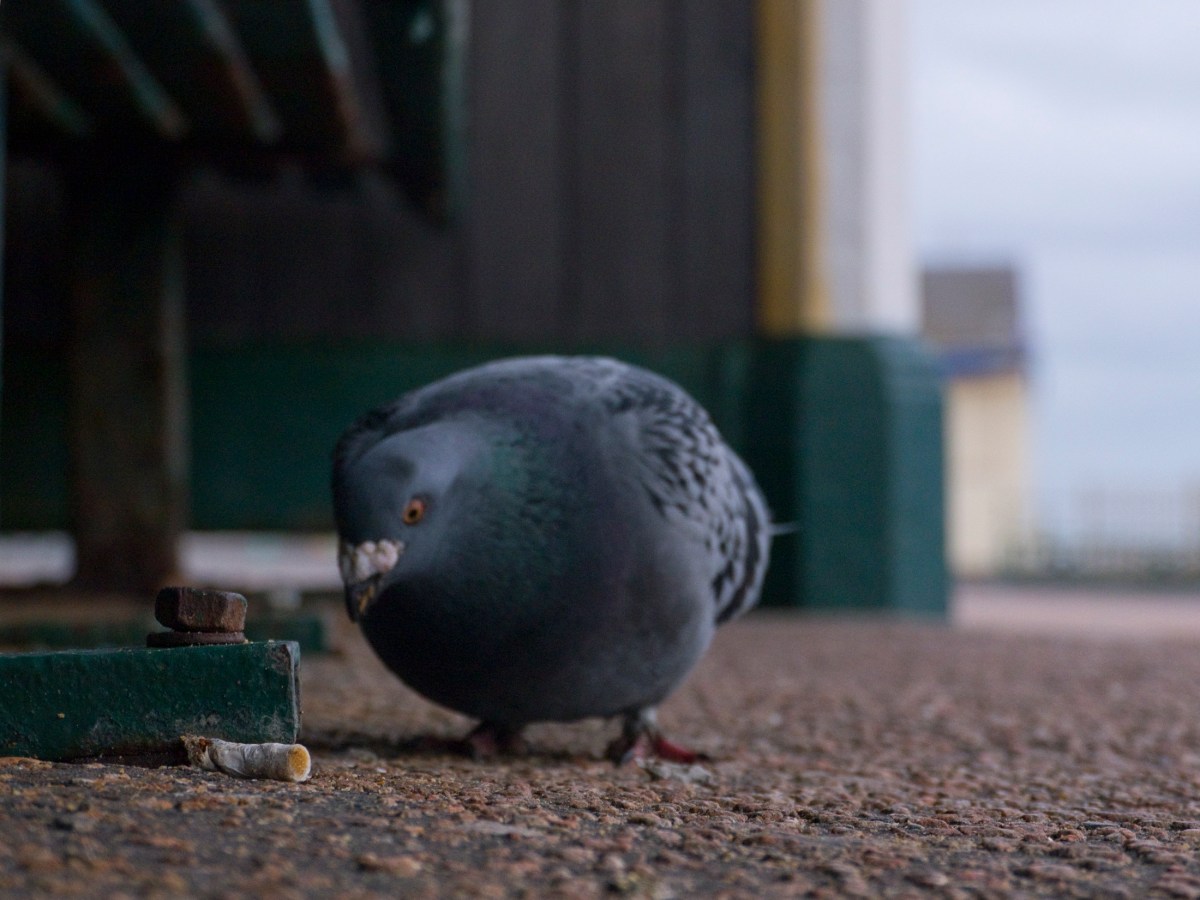
At the café on the sea front where I seem to end up on most days, there are the following: one wagtail, one starling, a family of four crows, around ten pigeons and a population of herring gulls (mainly juveniles) whose number is hard to estimate because they are so mobile. I’m therefore not sure they count as you’d have to see them as passing through rather than truly resident, although there seems to be at least two who have claimed the location as actual territory. These take it in turns to sit on the roof of the café, regularly making more noise than all the other birds put together.

Sometimes the seagulls mob the crows, sometimes the crows mob the gulls. Indeed the gulls often mob each other, seemingly just for the hell of it – and these altercations can, at times, be quite vicious. The pigeons just edge and barge persistently regardless of any other species (including human) or sit on the ground, waiting, like docile cattle, for more food to show up. The starling appears out of nowhere and then vanishes just as mysteriously, while the wagtail spends the majority of its time on the ground, darting hither and thither like a demented clockwork micro-hoover, cleaning crumbs from the cracks between the paving stones.

What gets me though is that despite the fact that they are all after food, when they aren’t actively engaged in foraging they just hang out together, any past misdemeanours seemingly forgotten. And what gets me even more is the disparity in scale between species. This’d be like standing at the bar or waiting at the bus stop with someone three or more times your size and a completely different shape.
Bird Man – Weds 7th Jan

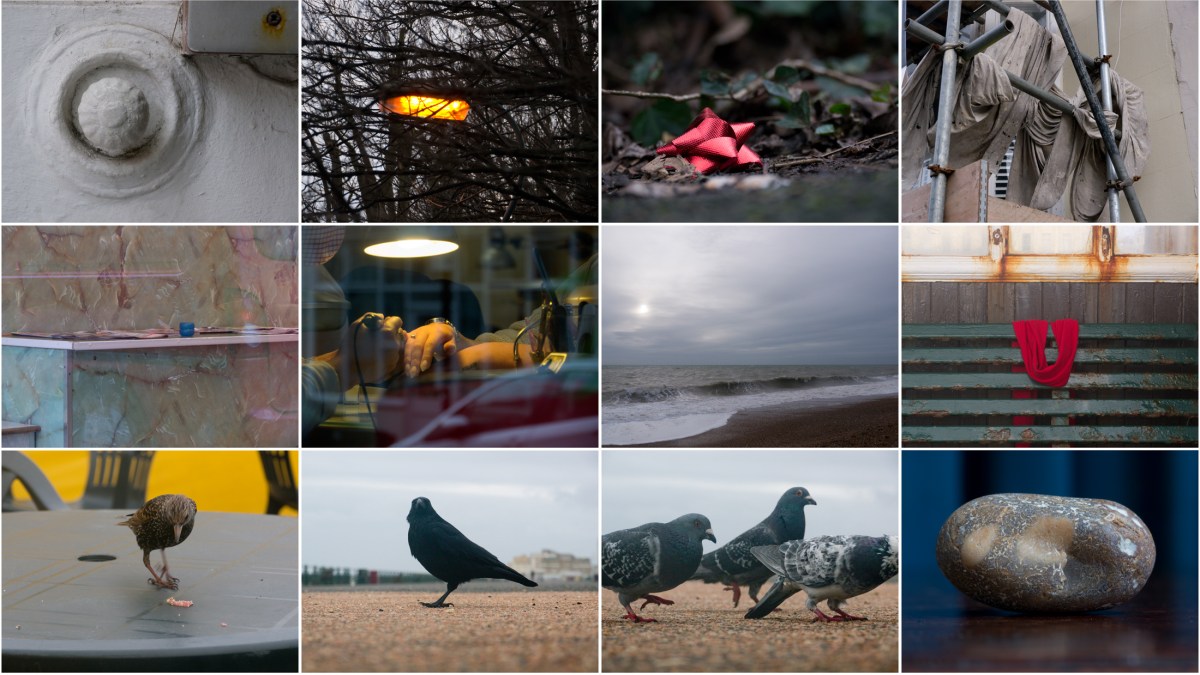
I first noticed it a couple of months ago. There would be the usual gulls, pigeons and crows hanging around the café, and then there was this one starling. Given its diminutive size in relation to the other birds I had to admire its tenacity in staking out the place as it’s territory. Indeed I was also curious: Do starlings actually have territories? Aren’t they flock birds? This one clearly hangs out alone and I am still wondering why: Fiercely independent innovator? Lazy opportunist? Anti social? Or just a runt who, fed up with being at the bottom of the pecking order, decided to clear out? At the end of the summer while the café was still busy and the weather mild enough for the scraps bin to be left outside, it’d dart in and out of it like a humming bird while the less agile pigeons looked on in jealous bemusement. Now in the middle of winter, and punters (and therefore scraps) are thin on the ground, it just perches on top of the wind break waiting patiently for plates too clean for the other birds to bother with, but still yielding enough for its tiny needs. Sometimes it’ll wait so patiently by a diner yet to finish their plate of chips that they can’t resist pushing a few crumbs across the table.

A few weeks ago it flew down and perched on the back of the chair next to mine while I was drinking some tea. It could see there wasn’t any food, but since no one else was around it just stayed there. After a while it began to sing. Starlings have the most extraordinary song, something like a cross between a budgie and radio static, full of pops, whistles and slow descending whoops. I was entranced. In a break in its song, I tried, badly, to imitate it, but it seemed close enough for the bird to recognise the effort. It whistled 2 peeps, one high, one low, and looked at me. I managed to mimic this as a response and after a pause it did it again. So, so did I… This went on for a while, until another customer turned up with a plate of food and it was off.

Yesterday I had some chips at the café. I whistled the two peeps and the starling turned up on queue (to be honest, I think I ordered the chips in the hope it would). So I broke one chip up into tiny pieces and placed these on the opposite side of the table to me. It darted across the table, its claws skittering on the plastic surface, retrieved the crumbs one at a time, skidding and flying back to its perch while finishing each beak-full. Once the chip pieces had gone it sang again. Once again I was entranced.

Today I made it a packed lunch out of a thin slice of salami chopped into bits the size of small garden worms, plus some crumbs from a seeded loaf of bread, and dropped the bits into an old plastic film pot. The wind hit me as soon as I neared the sea front and I could hear the waves booming in the distance. I wondered if it was going to be just too wild, but nevertheless I peeped twice and there it was again. The breadcrumbs were ignored but the salami went down singing hymns (and it bloody well should, my favourite saussison sec avec herbes de provence).

Why does this make me so happy? I don’t know, I don’t really care.

Feathered Friends – Weds 3rd Dec

Birds have some remarkable strategies for getting food. We’ve all seen wildlife programmes about Blue Tits negotiating everything from milk bottle tops to complicated bird-table mechanisms, I’ve mentioned previously the changing dietary habits of seagulls and starlings (see entries for 19th, 16th, 15th Nov) but one of the more fascinating behaviours I’ve seen in several different species of bird, is for them to move across lawns tapping the ground. Apparently, this mimics the sound of rain, which brings earthworms up to the surface in search of a bit of moisture. Having been fooled by the pattering of tiny feet and beaks, the hapless invertebrate then gets skewered by whatever bird has been doing a good job of impersonating a light shower.

You can try something similar for yourself. Indeed we performed the following experiment at school in a memorable biology lesson: First we were told to go out on to the school playing field and dig up various patches of turf to ascertain an average number of worms per square foot (most of which then ended up down the shirts of children who were considered lower in the cohort’s pecking order). Then, sample established, we all had to get down on all fours and tap other areas of ground rhythmically with whatever was to hand, fingers, pencils, or Michael Foreman’s head, and, after a few minutes, dig up these new patches and once again count the number of Lumbricidae present. Sure enough there was a much higher percentage of worms in these manipulated areas (along with a greater degree of anxiety in some of the more clairvoyant of our classmates).

Ok, now this is pretty smart, but I have also recently begun to notice the same behaviour in young urban seagulls, who will stand amongst a flock of grazing starlings, joining in with their smaller feathered brethren by pounding the ground with their webbed feet. I don’t know if this is because urban gulls think worms bear a passing resemblance to rather skinny hot dogs, and I doubt if they’d be able to get the worm out of the ground, but their attempt to learn new foraging techniques from other species of bird is, nevertheless, impressive.

Say it with fish – Weds 19th Nov

Apparently, Herring Gulls have now reached an evolutionary crossroads from which two distinct species will, in time, emerge. It seems to be all to do with diet. Traditionally, seagulls live on the coast and do the things we would expect them to do: catch and eat fish, plus crabs and so on stranded on the beach, nest in cliffs etc. However, many seagulls have found rich pickings on café tables, and in rubbish bins and dumps. These gulls nest on the tops of houses and, even if their young fallout of the nest, they are big enough to be a scary challenge for all but the most hungry of predators. Thus, urban gulls have adapted highly successfully to built up environments and their numbers grow.

The trouble is, seagull courtship rituals are centred around tasty morsels of food regurgitated during their mating displays (yes, they do a lot of regurgitating, see entry for 15th Nov) and when an advance is made between a town gull and a country gull, things go wrong. Country gulls have no idea what to do with the proffered hot dogs, buns, chips and half-eaten sandwiches that form the staple diet of urban gulls, while, frankly, town gulls are crap at fishing. The result is that there are now hardly ever any successful liaisons between the two avian branches and, while at present they remain genetically identical, in terms of behaviour, two distinct tribes have emerged with little or no chance of amorous relations in the future. Evolutionary divergence is only a matter of time.

Bummer.

Take out – Sun 16th Nov

On another occasion, I had just started climbing the metal stairs to get to my studio, when there was a great rush as hundreds of starlings took off all at once from the terrace above me. Startling though this was, it was only a prelude to what I saw when I got to the top of the steps. The entire roof terrace was covered in little pieces of what I took for flamingo coloured foam, shot through with red and brown flecks. Perplexed, I kicked a couple of pieces tentatively with the toe of my shoe. They moved soggily. Then I began to register the excited clicks and whistles of more starlings coming from next door. Creeping towards the parapet to avoid frightening them I peered over the ledge into the yard belonging to the Indian restaurant. My eyes were greeted by the spectacle of a multitude of flapping wings engaged in a wild frenzy to get the best pickings out of the uncovered bins below. On spotting me, and all at once, every single bird flew into the air, simultaneously crapping and dropping tasty orange morsels in wild unison, further covering the roof and myself in tandoori chicken.

Later on that day I had words with the restaurant owners.

Gullet – Sat 15th Nov

Some years ago I had a studio above one of the shops on St James’s st. To get to the door you had to go down a side street, along an alleyway, up a flight of metal steps and across a flat terrace. It made getting paintings in and out of the building a nightmare, but the terrace was a real bonus and, being south facing, wonderful for growing plants on.

Several seagulls also thought it wonderful and every year nested on the roof above the terrace. They did not take kindly to having to share it. As a result, every day there would be a lot of squawking whenever I crossed the terrace. One day I decided to squawk back. This certainly got a reaction so I carried on doing so. After several weeks, I got quite good at mimicking indignant seagulls.

Things escalated. One gull in particular became very bold, bombing me on some days, and on others landing right in front of me where we would try to face each other down, squawking furiously.

What I didn’t know about seagulls at the time, is that when finding themselves in a fight or flight situation, they evacuate their stomach contents. This is, apparently, to allow them to take off quicker, unburdened by any surplus weight. One day I found out about this trait first-hand, when, during a particularly long and spirited volley of avian abuse the gull paused, began to heave and, after a long moment, threw up an entire hot dog, still encased in its ketchup-tinted bun. We both looked at this prize as it lay glistening on the roof. Somehow, it said it all. From then on we kept a wary but respectful distance from each other.

Cuttlefish – Mon 10th Nov

When I was a kid, whenever we were taken to the seaside and my mum would see a cuttlebone she’d pick it up and pocket it, proclaiming knowingly “it’s good for the budgie”. Come to think of it, most of these occasions happened after the budgie had died… but I suppose she gave it to my nan or someone else with a pet bird. Anyway, cuttlebones, as you probably know, are the porous internal shells of cuttlefish, used as a buoyancy aid. They often get washed up on the beach, especially after storms. But what I want to know is, how come if they are so common you never see whole cuttlefish washed up too? What happens to the rest of the body? I mean I suppose they all get eaten but this makes me wonder, do all the fish in the sea get together before a gathering storm and say ‘hey lads, storm’s a gatherin’, its cuttlefish for supper tonight’? Or for that matter, if cuttlebones are so good for budgies then how come these bits don’t get eaten by the fish too? Maybe what’s good for budgies isn’t so good for fish?