Casual study in off-whites
Swagger portrait – 17th March 2016
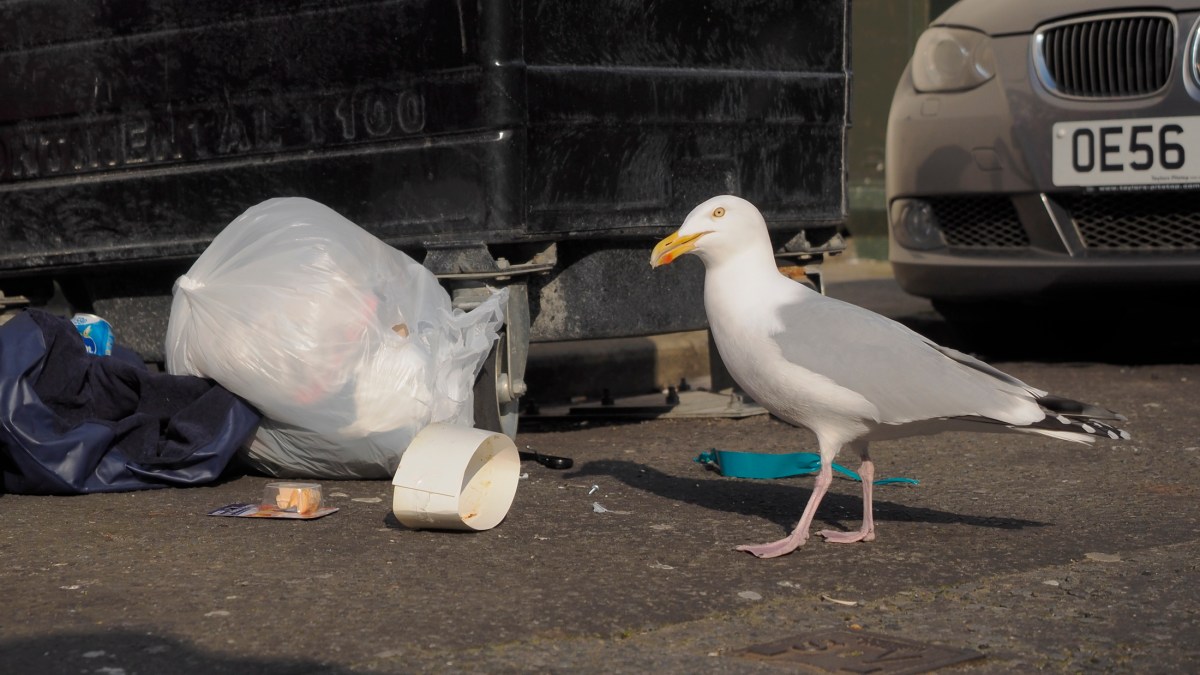
Casual study in off-whites

Young males preparing their courtship displays in readiness for the 2016 tourist season
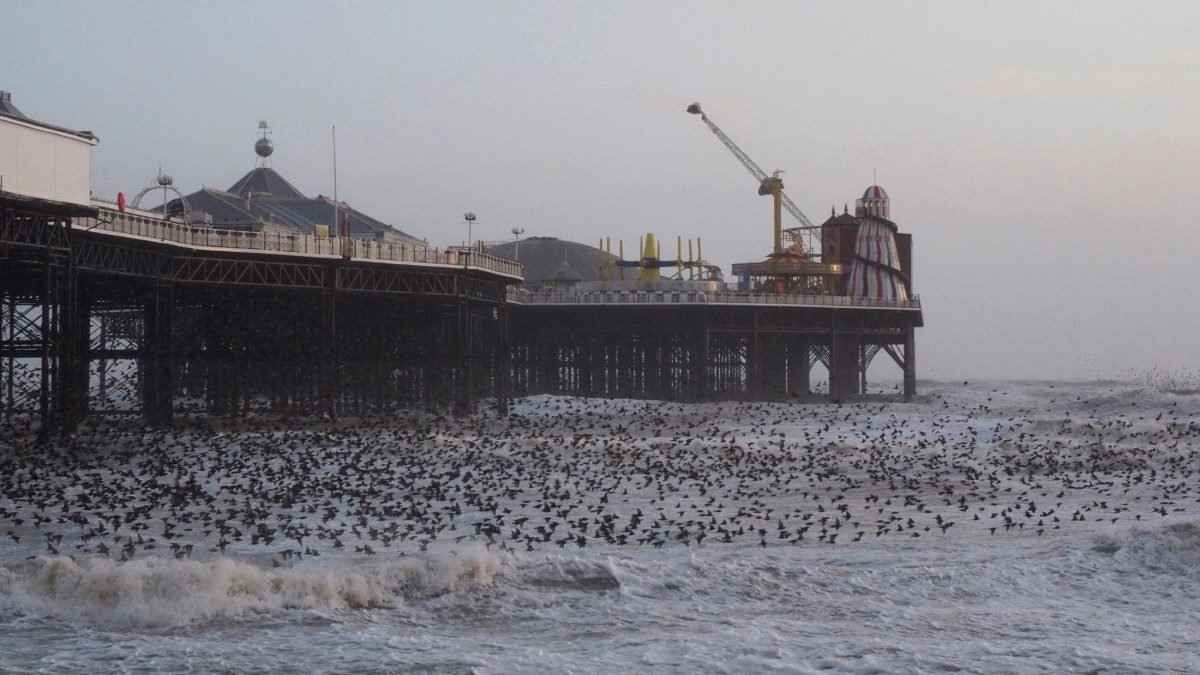
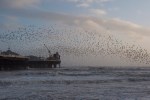
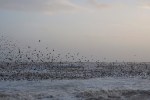
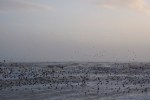
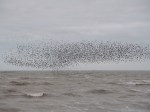
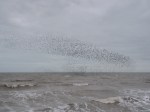
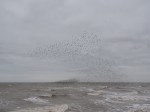
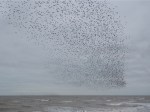
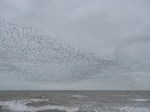
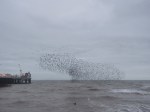
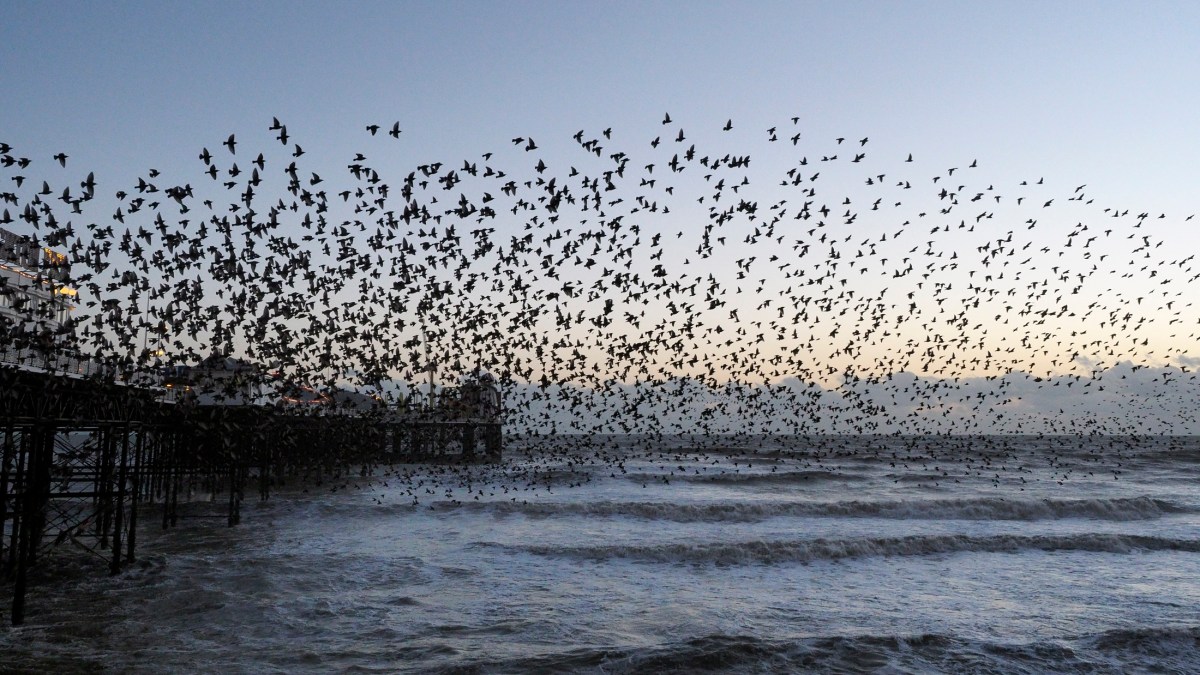
Today ‘Storm Imogen’ hit us on the South coast, so today is also the day when I find out if my theory is right about the altitude of starling murmurations. The light is already failing when I get to the beach and I wonder for a moment if it’s just too windy at 60+mph winds for them to do anything but fly straight to roost, but then I realise the sea is covered in a black carpet. It’s as if I’m watching a fast and granular oil slick spreading back and forth across the water. The waves aren’t that high. I think because of the direction of the wind they’ve been almost flattened out, but the starlings are flying so near the sea that the lowest ones still get lost behind the wave crests. How do they do it without falling into the sea, and with so many brothers and sisters flying so close above them? Yet I’ve never once seen one washed up on to the beach. It isn’t the most extravagant of starling displays, but to fly at all in such high winds, let alone so precipitously, when only a few inches lower would spell certain death to non-swimming birds so tiny, still takes my breath away.











As I was walking all alane,
I heard twa corbies makin a mane;
The tane unto the ither say,
“Whar sall we gang and dine the-day?”
“In ahint yon auld fail dyke,
I wot there lies a new slain knight;
And nane do ken that he lies there,
But his hawk, his hound an his lady fair.”
“His hound is tae the huntin gane,
His hawk tae fetch the wild-fowl hame,
His lady’s tain anither mate,
So we may mak oor dinner swate.”
“Ye’ll sit on his white hause-bane,
And I’ll pike oot his bonny blue een;
Wi ae lock o his gowden hair
We’ll theek oor nest whan it grows bare.”
“Mony a one for him makes mane,
But nane sall ken whar he is gane;
Oer his white banes, whan they are bare,
The wind sall blaw for evermair.”
Anon , Scotland, 17th C

I think I’m getting the hang of this now. It’s generally accepted that starlings hate flying in rain, so that’s one factor that affects their aerial ballet. But I’m now also beginning to realise that the higher the wind, the lower they fly too. When I say lower, I mean that, taking the entire murmuration, while the lowest part of it will always be close to the sea at times, the maximum height varies according to wind speed. So, on days like the foggy one we had on (…), or on other days when there is hardly even a breeze and the light is clear, the murmuration will spread and contract vertically. But the more the wind gets up, the flatter the formation.
I hear there’s another storm on the way, a big one by our standards. If I’m right, when it hits us, if the starlings fly at all, they’ll be almost surfing.









“If I had the knack
I’d sing like
Cherry flakes falling”
Matsuo Bashō










“Chris!”
“Hello Alex!”
“How are you?”
“Good, fine, you?”
“Ok, been really busy, work”
“Me too, up to my eyeballs”
“How’s things there?”
“Oh, the usual, you couldn’t make it up… That’s a fine looking dog you’ve got there. Yours?”
“Yes, had him for a couple of months. He’s really friendly.”
“Why the muzzle then?”
“Retired greyhound, raced for 6 years. Keeps mistaking small dogs for rabbits, got to be a bit careful”
“Ah”
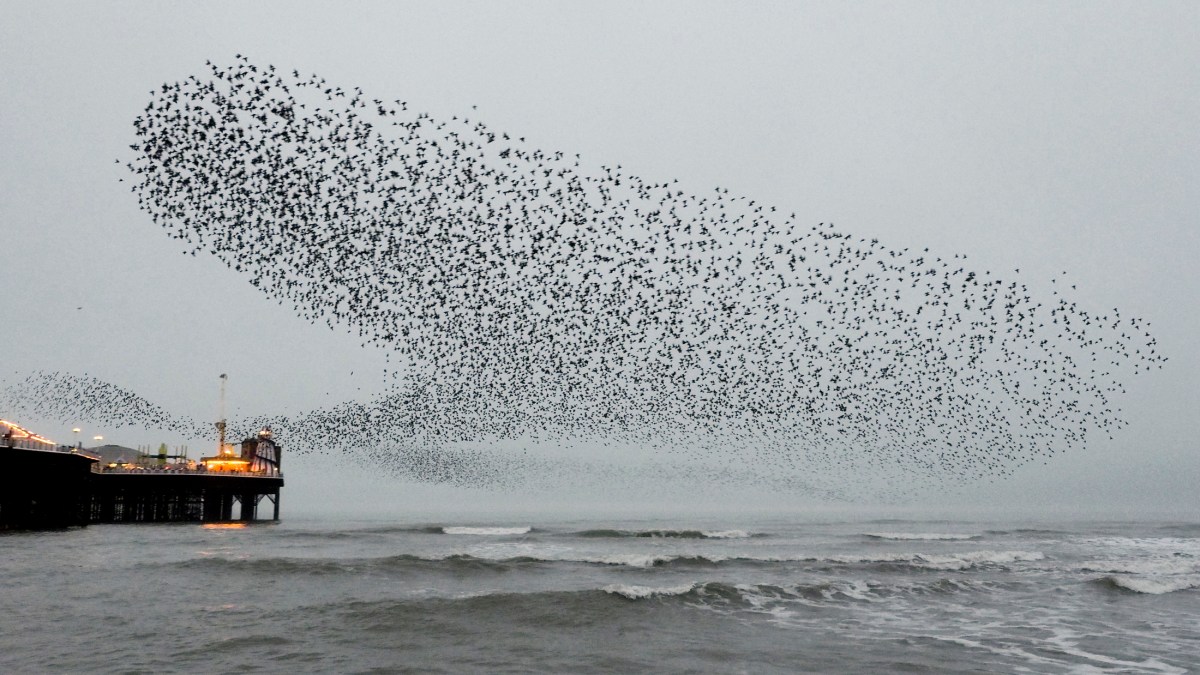
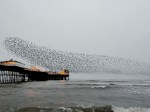
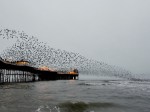
Another truly dismal day largely spent trying to catch up on work. Even though it was only mid afternoon, the light was already fading as I reached the sea front and I half toyed with the idea of just stopping by the café and abandoning any further plans for the day. Then I noticed the fog beginning to creep in from the horizon.
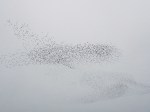
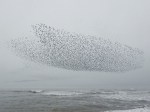
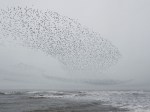
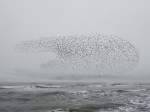
The thing about photographing starling murmurations is that (rather obviously) they are always set against a backdrop of the sky, and if the sky is filled with clouds, then at sunset these can be a rather too beautiful distraction from the spectacle. I’ve never seen starlings gather in fog before, and have always wondered if these weather conditions might actually be the most perfect, where every other element would be pared down to the barest minimum, just the birds, not even a horizon. I didn’t even know if starlings flocked in these conditions. Would I be able to see them? Would they be able to see each other? I set off for the pier to find out.
When I arrived I realised that at least the setting was perfect. Not enough mist to obscure the pier structure, but the sky had become a complete blank and the horizon was almost lost. The birds themselves arrived soon enough, in small groups at first, then in bigger flocks than I’ve seen for many years. Silent as always, the only sounds the wash of insignificant waves against the shore, just enough to cover the traffic sounds already muffled by the mist; even the piped music from the pier seemed more distant than usual.
The spectacle was not only magnificent but eerie. Great swarms appeared and receded in the fog forming shapes that would have been familiar if they hadn’t been so huge: for a moment a spoon hanging implausibly in the air, then a writhing caterpillar; on more than one occasion swooping past like some monstrous composite bird with giant slowly beating wings, while in the distance, other, barely visible shapes appeared and dissolved against the whited sky like sentient smoke.
I was surprised to see them flying so high; the murmurations we see in Brighton tend towards the horizontal, often hugging the waves, but these seemed to disappear vertically as well as towards the horizon. I’ve read somewhere among the theories that attempt to explain this spectacle (no one really knows why) is one suggesting that doing so makes them a beacon for other starlings to aim for, a broadcast to all, that here is somewhere safe to spend the night. If this is true then perhaps the size of the display was a direct response to the fog itself, creating a need in each bird to become even more flamboyant to counter the obscurity of the weather.









You might have noticed I have become fixated on starling murmurations of late. I make no apologies, they are far too extraordinary to ignore and soon enough it will be spring and their displays will stop. However, I was beginning to think I was running out of stories to accompany my photographs, until I came across this today:
“Mozart recorded the purchase of his starling in a diary of expenses, along with a transcription of a melody whistled by the bird and a compliment (Fig. 3). … The theme whistled by the starling must have fascinated Mozart for several reasons. The tune was certainly familiar, as it closely resembles a theme that occurs in the final movement of the piano concerto in G major, K. 453. Mozart recorded the completion of this work in his catalogue on 12 April in the same year. As far as we know, just a few people had heard the concerto by 27 May, perhaps only the pupil for whom it was written, who performed it in public for the first time at a concert on 13 June. Mozart had expressed deep concern that the score of this and three other concertos might be stolen by unscrupulous copyists in Vienna. Thus, he sent the music to his father in Salzburg, emphasizing that the only way it could “fall into other hands is by that kind of cheating”. The letter to his father is dated 26 May 1784, one day before the entry in his diary about the starling.
Mozart’s relationship with the starling thus begins on a tantalizing note. How did the bird acquire Mozart’s music? Our research suggests that the melody was certainly within the bird’s capabilities, but how had it been transmitted? Given that our observation that whistled tunes are altered and incorporated into mixed themes, we assume that the melody was new to the bird because it was so close a copy of the original. Thus, we entertain the possibility that Mozart, like other animal lovers, had already visited the shop and interacted with the starling before 27 May. Mozart was known to hum and whistle a good deal. Why should he refrain in the presence of a bird that seems to elicit such behaviour so easily?
A starling in May would be either quite young, given typical spring hatching times, or at most a year old, still young enough to acquire new material but already an accomplished whistler. Because it seems unlikely to us that a very young bird could imitate a melody so precisely, we envision the older bird. The theme in question from K. 453 has often been likened to a German folk tune and may have been similar to other popular tunes already known to the starling, analogous to the highly familiar tunes our caregivers used. But to be whistled to by Mozart! Surely the bird would have adopted its listening posture, thereby rewarding the potential buyer with “silent applause.”
Given that whistles were learned quite rapidly by the starlings we studied, it is not implausible that the Vienna starling could have performed the melody shortly after hearing it for the first time. Of course, we cannot rule out a role for a shopkeeper, who could have repeated Mozart’s tune from its creator or from the starling. In any case, we imagine that Mozart returned to the shop and purchased the bird, recording the expense out of appreciation for the bird’s mimicry. Some biographers suggest an opposite course of transmission – from the starling to Mozart to the concerto – but the completion date of K. 453 on 12 April makes this an unlikely, although not impossible, sequence of events.”

Text and music score from: West, M.J. and King, A.P: ‘Mozart’s Starling’, in American Scientist Vol 78 (March-April 1990) Pp 111-112
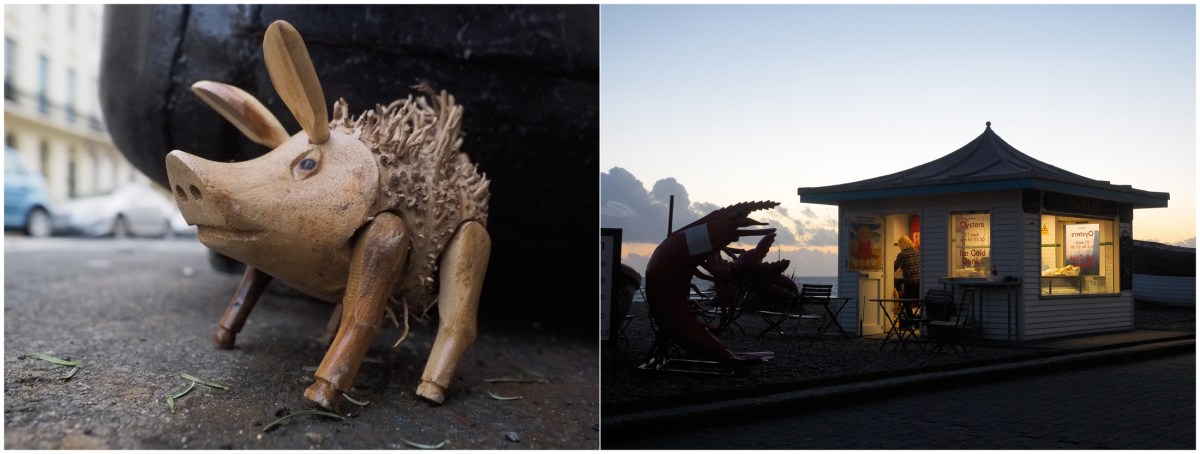
In early January you will sometimes see what look like toys, novelties and unusual objet d’art close to the municipal bins or on doorsteps across our towns. In fact these are not unwanted Christmas presents but the newly hatched offspring of Santa’s elves. A highly unusual and secretive species with an equally unique migration pattern, over the course of several years they will work their way slowly north towards the ice-caves of their parents. During their journey they steal into peoples homes, attempting to perform small tasks and chores for the household. The outcome of these will be more or less successful depending on the developmental stage of the elfling. Through these episodes of contact with humans, they learn all about our daily lives, hopes and desires, this information providing vital updates for the toy factories at the North Pole when they finally complete their long journey.
If looked at, elflings will immediately assume a static pose on the end of a mantelpiece or book shelf, eliciting responses from the homeowners along the lines of “do you remember who gave us that?” following which they will usually find themselves put out into the wild once more to then continue their travels. To make up for lost time, those who have been held up in their journey will hide among items on their way to boot fairs and antiques markets or, in extreme circumstances, strap themselves to the radiator grilles of lorries.
The staple diet of the Christmas elf is cake, trifle and other sweets, so if you see one while out and about, do leave something of this kind close to them; even a square of chocolate will do. They cannot show visible signs of acceptance as, having been spotted, they will have frozen to once more resemble a lifeless object (and indeed you might even find yourself thinking “I wonder who got that for Christmas?”) but they will be grateful for the sustenance. Indeed, word getting around that you are a kind person, next Christmas you may even find yourself foster parent to one of the next generation of Santa’s elflings. If so, once you’ve finished wondering who gave it to you (and who ate the last bit of Christmas cake) please make sure to put the little chap next to the bin rather than inside it, so that it too can begin it’s long journey northward.
 Umbrellage