Dead – 30th May 2016

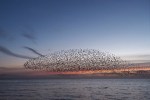
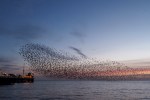
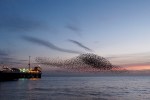
Today I got final confirmation that one of my external hard drives has died. It was the one with all my photographs on it for the last 15 months. All of them. I know I should have backed up, I thought I had, but it was a relatively new drive, so I felt safe, and it’s been another ridiculous year at work, a new demand every week, always coming from a faceless person in an unnumbered office deciding wheels would be better square, or asking you to write another report on why you need four of them.

On one side the should-haves, on the other the excuses; I know it’s better to avoid going down either road, and I’m trying not to. I thought I’d backed it up more recently, but the last time turns out to be February 2015.

It was a long process finding out. Ironically, the thing gave up the ghost the evening, about ten days ago, when I’d decided to start backing it up. It had been a good day and I was finally ahead of things. But when I turned the external hard drive on, it didn’t appear on the desktop. All I could hear was a repeated ‘nik, nik, nik’ sound. I rebooted. Once again, the ‘nik, nik, nik’ sound. I rebooted again, and again the ‘nik, nik, nik’ sound, then a pause, followed by one of those helpful messages you periodically get on computers, this one reading: ‘The disc you have inserted is unreadable, do you want to: Format / Eject / Ignore?’

It’s a bit like coming home to find your most beloved dog lying, almost dead, on the carpet. There is the sheer horror, heavily laced with feelings of guilt, stupidity and self-reproval. The immediate need for action: can I save it? The scrabble through a dozen data retrieval websites and software providers confirming I can’t. So who can? The facebook plea for help, the gratefully received responses providing at least straws to clutch at, set against the mounting wave of fear: have I really lost fifteen months of work? Of course I have the images on this blog, but these represent a tiny fraction of the total and are all low-resolution versions for the web.

I spent most of that evening staring at the computer screen, as if sheer concentration might bring my photographs back.

First thing the next day I set off to one of the repair shops I’d been recommended by kind friends responding to my facebook SOS. Jamie, the man behind the counter was reassuring. It’d probably be ok, he said, and then talked about other more expensive options if it wasn’t… But the day after, he called me to say it wasn’t, and that the hard drive would have to be sent off to a specialist in Newcastle. He reassured me they do amazing things, about 90% chance of getting my work back, but it wouldn’t be cheap –£700 upwards. The cost was eye watering, but of course I said I’d pay. What price do you put on saving the life of your beloved animal? But only 90%? That left a 10% uncertainty.

I’ve been living with that uncertainty for just over a week. During that time I’ve been manically backing up everything else on all the other hard drives. The process is still continuing and I know it’s worth it, for the rest of the work (although I’m getting tired of trying to sleep at night listening to the whirr of computer fans) but it was ok, I was doing something useful. Indeed while waiting for the new hard drives to fill up I’d even begun to write a piece about making the best of things – seeing the incident as an opportunity to interrogate why I’ve been undertaking this project, what you could get out of even bad situations. I couldn’t understand why I was having so much difficulty getting my thoughts in order as I was feeling surprisingly positive about the whole thing. I really saw it as a challenge. But of course at that point the death wasn’t actually real, there was still hope, even though the wait was excruciating. Indeed, up until today, I was almost wishing it was irreparable just to get the suspense over, but then Jamie phoned to give me the final prognosis.

The reality of how I felt when I heard was quite different to what I’d imagined, even though I was pretty sure I’d lost it. It physically hurt. I did my best to reply normally but I could hardly get the words out. I confess I was a little comforted to hear the silence at the other end of the phone. Jamie did me the service of not trying to cheer me up. Then as soon as I put the phone down, I got another email from work with the latest command so I’ve spent the rest of the day trying to get through that. Maybe that was a good thing, something to do, but now it’s past midnight and I’ve finally got time to think.

Maybe I will still write that piece about creating value out of difficulty, but I know now that to do so at this moment in time would be dishonest. The best I can come up with, is the thought that by living with this for a bit, what comes out of this situation might be more authentic.

Until then, bear with me, as my posts might be thin on the ground for a while.

Hippodrome – 28th March 2016

Its only when I started to wonder what to write about today’s images that it suddenly occurred to me what an odd word ‘hippodrome’ is. I mean, think about it, do we go to a hippodrome to see hippos?

A bit of rooting around online and I come up with:

“hippodrome (n.) “horse race-course,” 1580s, from French hippodrome, from Latin hippodromos “race course,” from Greek hippodromos “chariot road, race course for chariots,” from hippos “horse” (see equine) + dromos “course” (see dromedary). In modern use, “circus performance place” (mid-19c.), and thus extended to “large theater for stage shows.””(1)

But why not Equidrome? Did the Romans only use a Greek word for race courses?

And then why are hippopotami called hippopotami? They don’t look anything like horses. Back to the online etymological dictionary, where I find:

“hippopotamus (n.) omnivorous ungulate pachydermatous mammal of Africa, 1560s, from Late Latin hippopotamus, from Greek hippopotamus “riverhorse,” an irregular formation from earlier ho hippos potamios “the horse of the river”), from hippos “horse” (see equine) + adjective from potamos “river, rushing water” (see potamo-). Replaced Middle English ypotame (c. 1300), which is from the same source but deformed in Old French. Glossed in Old English as sæhengest.” (2)

So: ‘horse of the river’ eh? I’m not convinced. Personally I think hippopotami look more like very big pigs (or hornless rhinoceroses?). Actually they look more like my music teacher at school.

(1) From: http://www.etymonline.com/
(2) ibid

Apples – 18th Feb 2016

Apple trees are called apple trees because they are the trees that produce apples, obviously. But isn’t this the wrong way round? Shouldn’t ‘apples’ refer to the trees and their fruit called apple-fruit? After all without the tree there would be no fruit. This is also the case with roses. When we say ‘rose’, we think of the flower first, the bush after; we talk about rose bushes, we don’t say “please have this bouquet of rose-flowers”. True, cauliflowers reverse this naming system, but even here I realise I’ve never heard someone mention the cauli as the definitive name for the plant, apart from, occasionally, as a diminutive.

Is this a clue to the way we think as English people? Historically, have we always placed more importance in the produce than the producer – we name the bit we have a use for – and is this how the naming of things evolved?

What about ‘oak’? To me, this name immediately brings to mind a mighty and ancient tree, one whose fruit has a completely different name: acorns (although ‘acorn’ sounds like it is related as a word, i.e. oak-corn?). The early Indo-European and Celtic (Goidelic, Brythonic?) etymology of ‘oak’ seems to be, simply, ‘tree’, suggesting that the specific species we now refer to as ‘oak’ was originally named as the most tree-like of trees; highly appropriate given the stature of the tree in European culture. But as soon as I’ve written this, I realise that for as many of us, ‘oak’ is just as likely to bring to mind big solid bits of furniture. And I have read another ancient meaning of the word ‘oak’ as simply being: ‘good’, because the tree was good for making things out of, and it also burned well – so we’re back to use again.

Matsuo Bashō, the 17th century Japanese poet, wrote under several pen-names until, in 1680, he was presented with a gift of Bashō trees, a particular species of banana. These plants he loved so much that he eventually renamed himself ‘Bashō’ after them. Several years later he wrote this:

“The leaves of the Bashō tree are large enough to cover a harp. When they are wind-broken, they remind me of the injured tale of a Phoenix, and when they are torn they remind me of a green fan ripped by the wind. The tree does bear flowers, but unlike other flowers, there is nothing gay about them. The big trunk of the tree is untouched by the axe, for it is utterly useless as building wood. I love the tree, however, for its very uselessness… I sit underneath it, and enjoy the wind and rain that blow against it.” *

* Matsuo Bashō quoted in and translated by Nobuyuki Yuasa’s introduction to the Penguin Classics edition of ‘Matsuo Bashō, The Narrow Road to the Deep North and Other Travel Sketches’ Translated by Nobuyuki Yuasa, Penguin Books, 1966

Fog (part 2) – 24th Jan 2016

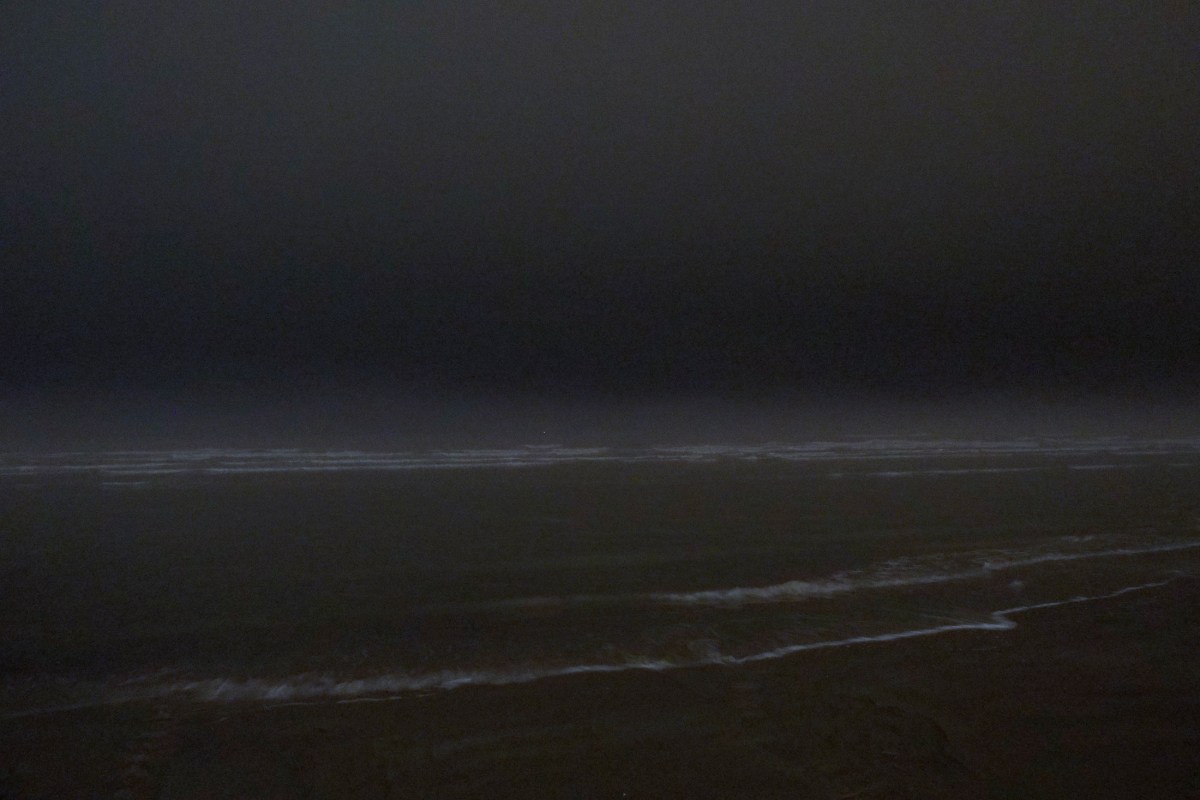
By the time the starlings had finished it was almost dark and it felt like the whole of Brighton had gone home too. Indeed as I wandered homewards along the shore the world itself to my left seemed to have disappeared. I scrabbled across the pebbles toward the sea to have a look.

When nowadays we say things like “It’s the end of the world” we think of apocalypse and Armageddon, nuclear war, ecological disaster… it’s always an ending in time, but before the discovery (by Europeans at least) of the Americas, the ends of the world were an actual place where sea monsters dwelled and from which sailors rarely returned. Tonight, looking out into the soft, dense darkness, I wondered if such a place still existed.

In their own words – 20th Jan 2016

Another thing about starlings is the noises they make. Not exactly a song, in many ways more expressive, filled not only with notes and whistles, but also pops, crackles and other warblings I don’t even know how to describe. Taken together as a whole, a little like listening to music on an old shortwave radio, the static as mysterious as the tunes themselves.

Sometimes you’ll hear one starling on it’s own, perched just a few feet away from you, talking and singing to itself. As the afternoon rolls on you’ll be reminded that the light is failing as they gather on the rooftops outside to whistle together, perhaps exchanging news in preparation for this evenings show.

I remember a long time ago when I first moved to Brighton, walking home through the park late at night in the dead of winter, and as I walked past the trees, whenever the breeze lifted into a gust, the sound of these tiny birds waking briefly with the wind, would ripple as if the branches were festooned with a thousand icicles and shards of glass tinkling together in the darkness.

When they fly together in murmurations, starlings are completely silent, all that you’ll hear is the sussuration of their wings beating together as they pass overhead, their concentration in flight almost palpable. But as soon as they settle the twittering begins so that, if you’re standing on the pier, you’ll suddenly find the air filled with a great mass of shrill calls and squeakings that I’d be tempted to describe as a roar if it wasn’t so high pitched; louder than the waves, and the cocktail jazz and 80’s soul that seems to be the preferred piped music of the pier managers.


Today, as soon as their display ended I headed for the pier to record this extraordinary sound, which I present here, along with today’s photographs:


Beyond the frame – 16th Jan 2016

One of the most interesting things about photographs (for me anyway) is what’s happening outside the frame – the bits you don’t see: the idyllic shot of the English countryside that crops out the ice cream van; fashion shoots that, in focusing on the model, leave out the army of assistants and hangers on holding bags of lenses, reflectors, jumpers and coats; the relatives that have fallen out of favour at weddings… Everyone does it when taking pictures, and I’m particularly guilty when it comes to taking photographs of starlings. Whereas I welcome unexpected intrusions in a lot of my other images, indeed the random incongruities are often the things that make the picture, when it comes to starlings I am a complete fascist and just want the shapes the birds make. Even including the pier is a bit annoying, though I’ll admit I’ve got used to it being there and adding a sense of scale.

And today I’m off to the seafront again on another starling hunt, heading towards my favourite viewpoint at the end of Albion Groyne. Of course, it being the weekend, there are a lot more people about, and when I get there I see a couple of guys fishing from ‘my’ spot. There isn’t a lot of room left but I ask them if they mind me squeezing in, and they’re ok about it, so here we are all huddled together in the freezing air; they with all their equipment and I with mine. I’m a bit miffed because the fishing rods are going to make a clear shot difficult, but they were there first, and they’ve come all the way down from London to fish for the day so I can’t even allow myself to feel annoyed, after all, I’m probably just as much in their way.

Inevitably we get talking. Two brothers, originally from Poland, they’ve been working in London for five years. They like fishing. I reciprocate, telling them why I’m there. They seem a bit nonplussed at the idea of me taking pictures of birds, but I get that indulgent look that says ‘you do what you like, it’s not our problem, we’re here to fish’ and they obviously have the touch because the fish are practically jumping out of the water at them. “Tonight we make big barbecue!” I reckon they will too. They must have caught twenty while I was there.

The birds are now gathering in greater numbers and I’m snapping away as if there is no tomorrow, while lines, hooks and bait whine past my head on the outward path, and fish on the return journey. I’m glad they seem to know what they are doing as I want them to catch fish, not me. Actually it’d be great if I get a flying fish in shot too, but sadly that doesn’t happen. I can hear a couple of other conversations going on behind me about the size of the catch, and the occasional thump as another one gets the coup de grace before joining it’s dead brethren in the bag at my feet. And then I can tell they’ve really started to notice the birds because they start asking me about them, and I’m trying to reply while attempting to keep the camera level.

“What these birds?
“Starlings”
“What is this bird? Is little bird? There are so many? English bird?

I tell them a little more, and about them being migratory. I think they like that these starlings are probably from the Baltic coast. Maybe not so far from where their families are.

Eventually the murmuration is over and it’s only then when I turn round that I realise what’s been behind me, out of shot. The whole beach is dotted with people, some with cameras, some with tripods, most just lounging on the beach but all, like me, wrapped up like laundry bags, their faces fixed in similar expressions of delight. It’s been a good show. I’m glad they were there too.

Duck – 12th Dec 2015

“Are we then to say that the All is composed of indivisible substances? Some thinkers did, in point of fact, give way to both arguments. To the argument that all things are one if being means one thing, they conceded that not-being is; to that from bisection, they yielded by positing atomic magnitudes. But obviously it is not true that if being means one thing, and cannot at the same time mean the contradictory of this, there will be nothing which is not, for even if what is not cannot be without qualification, there is no reason why it should not be a particular not-being. To say that all things will be one, if there is nothing besides Being itself, is absurd. For who understands ‘being itself’ to be anything but a particular substance? But if this is so, there is nothing to prevent there being many beings, as has been said.

It is, then, clearly impossible for Being to be one in this sense.”

Aristotle. ‘Physics’ (Book I Part 3)
Translated by R. P. Hardie and R. K. Gaye