‘Go To jail. Go directly to Jail. Do not pass GO, do not collect £200.’
Monopoly (UK edition) Community chest card
‘Go To jail. Go directly to Jail. Do not pass GO, do not collect £200.’
Monopoly (UK edition) Community chest card
I’m forever blowing bubbles,
Pretty bubbles in the air,
They fly so high,
Nearly touch the sky,
Then like my dreams,
They fade and die.
Fortune’s always hiding,
I’ve looked everywhere,
I’m forever blowing bubbles,
Pretty bubbles in the aiyaaahh…

Alexandra and Barbora, the girls at the café, have been getting creative with their cappuccinos. The heart stencil is a test piece for an ambitious series of works using powdered chocolate on a frothed milk surface. Their plans for the future include a series on iconic European birds (we all miss the starling, but hope he’s now arrived safely at his summer destination on the Baltic coast; the crow family might be included too) and their most daring project: a suite of tableau in homage to Rubens’s Medici cycle, currently hanging in the Louvre, Paris. This latter series will require the purchase of several cappuccinos for the full effect, but they do a loyalty card so you get the last instalment free!
Update (15-3-15): Here is number one in the Iconic European Birds series. ‘The starling’ (winter coat puffed up against the cold):

A long time ago I had a job as a gardener looking after the grounds of a block of flats. To be honest I didn’t know anything about horticulture when I first started. If one of the residents asked me what a particular plant was called, I made up a suitable name from the limited Latin I’d picked up from my mate Vince at school, replying that it was a porcus vulgaris or senex sordidum or something like that.
Nevertheless I realised I’d have to show I knew what I was doing and by trial and error my skills developed quickly. Pretty much the first thing I learned was to tell the difference between weeds and flowers. Here’s some simple advice:
If you want to find out if the plant you are looking at is one or the other, give it a pull. If it comes up easily, it’s a flower.
The second thing I taught myself was how to put them back.

Someone has compiled not one but two full lists of different types of heavy equipment for Wikipedia (1). A few of the items listed will be familiar to most of us; things like tractors, bulldozers and cranes. A few more will be imaginable by having quite descriptive names: steam shovel, snow blower, tunnel boring machine… But others read like implements of doom from a mediaeval manual of warfare or items used in a peasant’s revolt, while a few even seem to suggest zen-like paradoxes (can a wall also be slurry?). In my opinion this is poetry of the highest order, opaque yet richly evocative. To get the full effect I suggest reading the list out loud, preferably in the bath for the best acoustics, and intoning in the manner of Winston Churchill or Edith Sitwell:
Air-track
Bulldozer
Snowcat
Track skidder
Track-type tractors
Tractor
Military engineering vehicles
Grader
Skid steer loader
Compact excavator
Dragline excavator
Dredging
Excavator (wheel)
Excavator (bagger, digger)
Slurry wall excavator
Front shovel
Reclaimer
Steam shovel
Suction excavator
Trencher (machine)
Yarder
Backhoe loader
Backhoe
Feller buncher
Harvester
Skidder
Track harvester
Wheel forwarder
Wheel skidder
Pipelayer
Fresno scraper
Scraper
Wheel tractor-scraper
Construction & mining tractor
Construction & mining trucks
Articulated hauler
Articulated truck
Water wagon
Wheel dozers – soil compactors
Soil stabilizer
Loader
Skip loader (skippy)
Wheel loader (front loader, integrated tool carrier)
Track loader
Aerial work platform / Lift table
Boomtruck
Cherry picker
Crane
Forklift
Knuckleboom loader (trailer mount)
Reach stacker
Telescopic handlers
Asphalt paver
Asphalt plant
Cold planer
Concrete batch plant
Cure rig
Paver
Pneumatic tire compactor
Roller (road roller or roller compactor)
Slipform paver
Vibratory compactor, Compactor
Stomper: concrete drop hammer
Roadheader
Tunnel boring machine
Underground mining equipment
Ballast tamper
Attachments
Drilling machine
Pile driver
Rotary tiller (rototiller, rotovator)
Venturi-mixer
Dump truck
Highway 10 yard rear dump
Highway bottom dump (stiff), pup (belly train), triple
Highway end dump and side dump
Highway transfer, Transfer train
Highway transit-mixer
Lowboy (trailer)
Street sweeper
Auger
Bale spear
Broom
Bulldozer blade
Clamshell bucket
Cold plane
Demolition shears
Equipment bucket
Excavator bucket
Forks
Grapple
Hydraulic hammer, hoe ram
Hydraulic tilting bucket (4-in-1)
Landscape tiller
Material handling arm
Mechanical pulverizer, crusher
Multi processor
Pavement removal bucket
Power take-off (PTO)
Quick coupler
Rake
Ripper
Rotating grab
Sheep’s foot compactor
Skeleton bucket
Snow blower
Stump grinder
Stump shear
Thumb
Tilt rotator
Trencher
Vibratory plate compactor
Wheel saw
(List edited to minimise repetition and enhance narrative flow)
Today I have a work meeting in a place called Hollingbury on the outskirts of town. It’s on the edges of a trading estate and to be honest the area is a bit bleak, but for those of you acquainted with my previous output on this blog, you’ll know that’s fine by me. I take my camera.
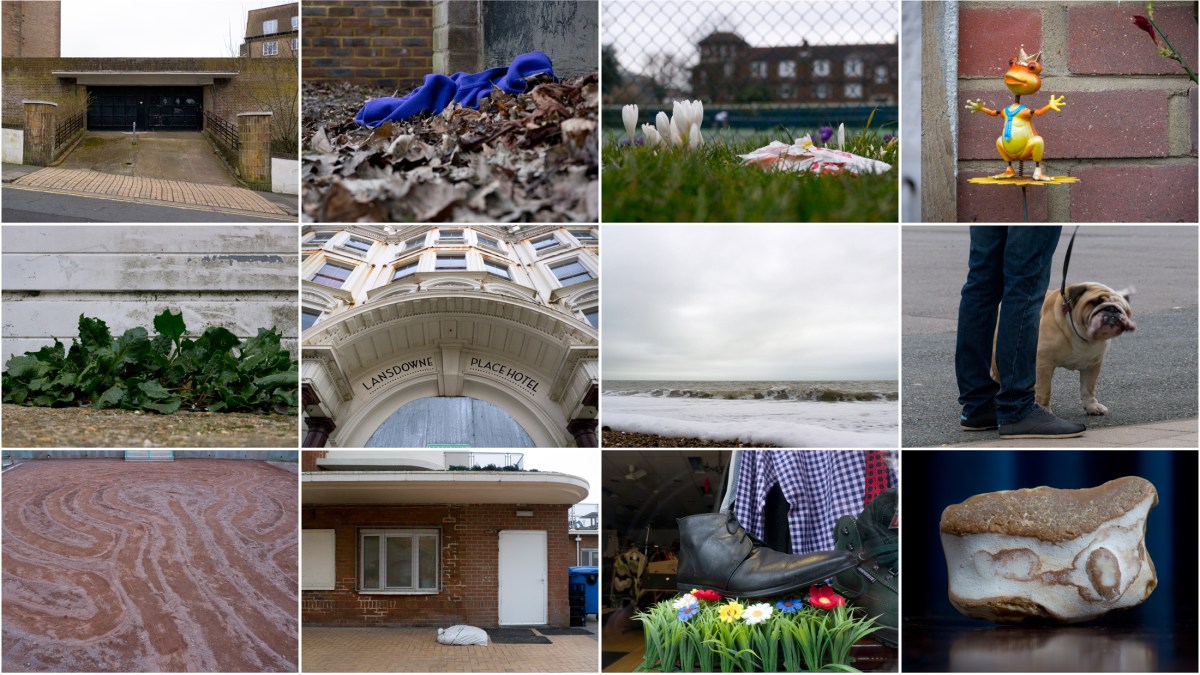
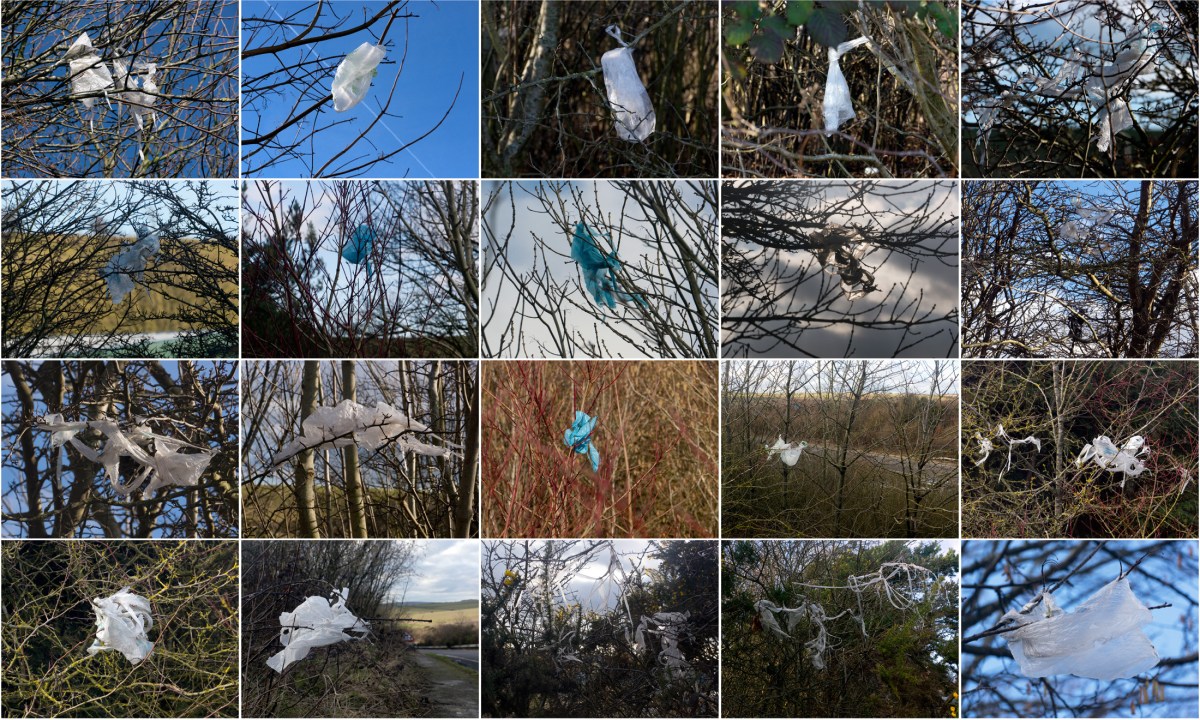
En route I see many interesting things but I was not prepared for what I encounter when I arrive. Spring has started early this year! All the trees are in bloom with the most exotic of flowers: mainly white but some a piercing blue, some full-blown, others drifting and tendril-like, all as voluptuous as galleons in full sail. Clearly this early flowering has been going on for a while now because there are many more blossoms under the trees and strewn across the grass verges. I am entranced and hurriedly take a couple of photos on my way in to the meeting. I comment on these to Lesley, my work colleague. Because she works at this site she is familiar with the area.
“Oh, you mean witches knickers?”
I’ve seen several across town before and indeed included them in previous posts, but never so many together in such wild profusion. I am delighted; I now know what they are called too.
Once the meeting is over I spend quite a bit of time documenting all the best examples I can find. Hollingbury is at the top of a steep hill and would have once been rolling downland. Exposed chalk must be their favoured habitat. I notice that they can be found growing among the hawthorn, blackthorn and dogwoods in the area so they are probably parasitic, perhaps related to mistletoe or even some kind of native bromeliad.
Happy with today’s discovery, I head back down the hill towards the bus stop, taking a few more pictures of other things as I go, to give the contact sheet a sense of context. While photographing one particular building, nice industrial 1930s sub-deco, two men in black approach me.
“Excuse me sir, have you been taking photographs of the police station?”
“Oh, is it a Police station?” (Look, I’m an artist, I don’t always look at obvious things like, er, signs)
“Yes, we’ve had a bit of bother at the other branch with someone else doing the same thing and we’d like to know what you’re doing and why? These are troubled times”
I explain about the blog and my daily walks around the city to document the beautiful and the overlooked within the everyday. They take my details. At this point a large blue van draws up and two further officers climb down from the vehicle. Both are dressed in black combat gear. They join the other two, once again ask the same questions, and take my details again: name, date of birth, address, postcode, contact numbers… I am rather charmed to see they still use proper note-books and the officer taking my particulars has nice handwriting. For the benefit of the two newcomers I reply with the same answers, repeating my rationale for the blog. I also offer to show them the other photographs I have been taking and so the five of us go through them together. I comment on their beauty and describe them with enthusiasm. I also offer to delete the photographs of the police station (they aren’t that good anyway) but ask them if perhaps instead I could take a group shot of our boys in blue (ok, black) for the blog? Sadly this suggestion elicits a bit of an ‘old fashioned look’ from one of the officers (I’m not sure the others were listening) appended with a slight raising of the eyes heavenwards in a manner which unmistakeably communicates the words “I didn’t hear that” without any need for the intervention of my ears in this act of communication. I decide not to pursue the request.
Our discussion then ranges across many issues and debates about the age we live in. They are nice chaps, though I was a little disappointed that, when I say to a couple of them that my therapists believe my blog to be a worthwhile venture, the officers seem to draw back somewhat. Nevertheless it’s a pleasant meeting, we have a chat about the virtues of mirrorless cameras versus traditional DSLRs and they thank me for my time and understanding.
I have, for a while now, been pondering one of my favourite quotes of Bertolt Brecht. Here it is:
“You can’t write poems about trees, when the woods are full of policemen”
After today I can honestly say I disagree, though certain buildings seem to be another matter.
Gore-Tex: marvellous material! I’ve had a pair of trainers made out of the stuff for a few months now. These are the shoes I’ve done most of my expeditions in, in all weathers, and always come home with dry feet, if nothing else.
So today I’m looking at the sea and I see this very interesting repeat wave configuration where, as the sea drains back if forms a semi circular crest which folds in on itself and makes this interesting foamy slap, producing some very odd shapes. ‘Aha!’ thinks I. This has the potential for an interesting image and so, confident in being clad in the ideal footwear, I stride down the beach right to the edge of the water. Then, crouching down low for the right angle, I wait…
Of course the thing you forget about waterproof footwear is that shoes will always have two bloody great holes in them. They are at the top, one per shoe; the ones you use to put your feet into. Today I have been reminded that Gore-Tex is also marvellous at keeping the water in, too.

Quote of the day:
“Dad I’m sick of Panini, can’t I have a pizza?”
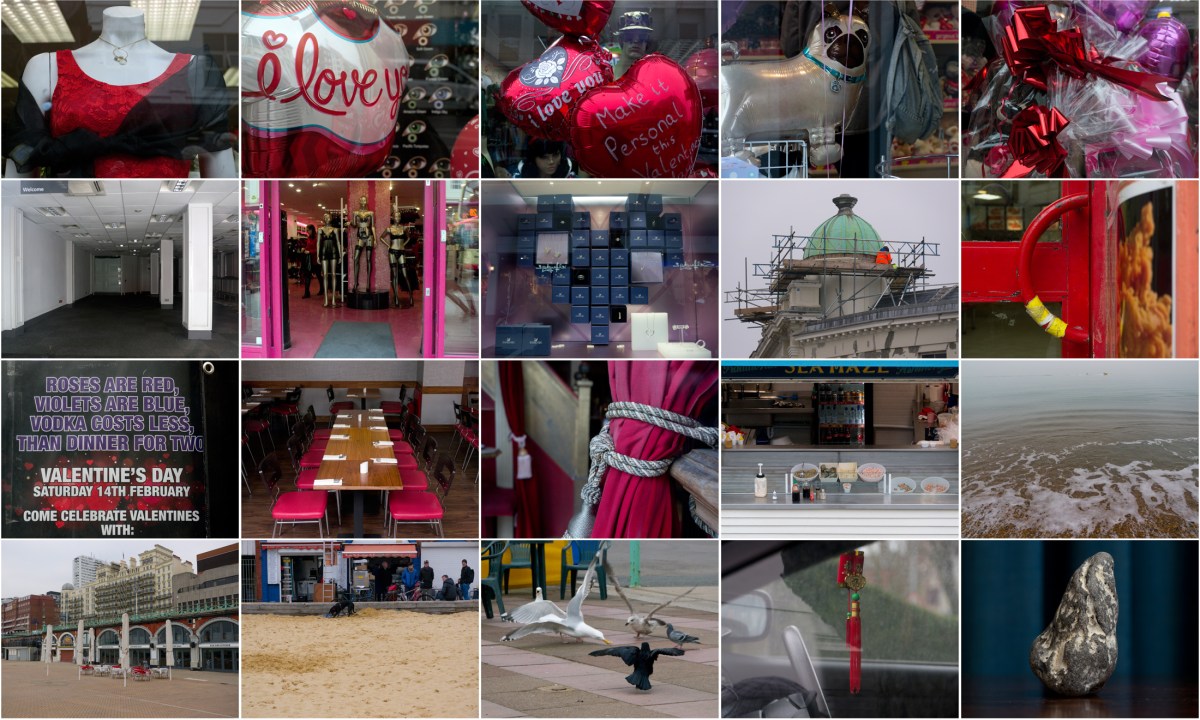
The big day is almost upon us, the day when couples exchange flamboyant cards and cute furry toys to signal their everlasting passion for each other, and then go for a special meal in a restaurant, each table with its own bespoke romantic balloon populated solely by other couples all sitting in reverent silence while, if lucky enough, listening to the collected works of Celine Dion.
Following the huge success of ‘12 tips for Christmas’ (Weds 17th Dec) I have complied ten useful things you might wish to say to your beloved, or intended beloved, to entice him or her to join you for a meal on this most romantic of evenings:
I do hope the above will help you ‘clinch that deal’ and as always am very happy to accept your messages of gratitude for this advice so do please leave your comments. Happy Valentines day!

The buzz-phrase generator
‘I have pointed elsewhere to the baleful influence of American gobbledygook on certain sorts of writing, both academic and official. Defence is a subject which has suffered badly (owing, some say, to the Harvard influence imported by Mr McNamara into the United States Department of Defence.) But the phenomenon has not gone uncriticised even on the other side of the Atlantic. The Canadian Defence Department is credited with the invention of the following ‘buzz-phrase generator’:

The procedure is simple. You think of a 3-digit number at random and take the corresponding word from each column. Thus, 601 gives you the buzz-phrase ‘optimal management flexibility’, 095 gives ‘integrated policy concept’, 352 gives ‘parallel logistical capability’, and so on. The authors claim that the buzz-phrase generator gives its users ‘instant expertise on matters pertaining to defence’, enabling them to invest anything they write, not with any particular meaning, but with ‘that proper ring of decisive, progressive, knowledgeable authority’.
I have seen a British development of this invention which has three columns of no fewer than sixty lines each and includes not only most of the vogue words mentioned elsewhere in this book but many others too. This may be over elaborate for practical use, but its compilation speaks well for British civil servants. It is wonderful how slight the difference is between some of the serious writing produced nowadays on defence matters and some of the parodies produced with the aid of the Canadian or British buzz-phrase generator.’
From: ‘The Complete Plain Words’, by Sir Ernest Gowers, Pelican Books 1982, pp 308-309 (First published as ‘The Complete Plain Words’ HM Stationary Office, 1954)
 Umbrellage