Rights of passage – 4th Nov 2015

On each door is a green plastic plate inscribed, in white lettering, with the word ‘push’. Telling us the doors open out rather than in is useful, though the absence of handles on the side facing us might alone have been a sufficient indicator of direction.

Of course, with most doors that require pushing rather than pulling, where one decides to push, or even what to push with, is largely optional. While most of us understand it is better not to apply pressure to the glass panels (we all know glass can break) there is enough laminated metal door frame to allow for a wide degree of choice in accomplishing your passage over the threshold.

In older styles of architecture, doors demanding regular use have vertical brass plates attached to their ‘push’ side. This not only indicates the tacit instruction: to push, but also protects the wooden frames from being corroded by acids present in human sweat. The green plastic plates on these doors not only acknowledge their architectural antecedents, but also, by adding the word ‘push’ to them, reinforces the message. So much so in fact that the majority of users only push where it says ‘push’. This you can easily tell because the letters forming the words have, over time, been pushed beyond the point of legibility by the action of numerous hands. An additional factor in their migration is that the glue used to attach the lettering to the green plastic is of a kind partially soluble in organic grease, acids, and the various cleaning fluids used to keep the doors looking fresh.

On several occasions I have considered mentioning this to the powers that be. However, I must confess I take great enjoyment that, in this instance, Walter Gropius’s dictum: ‘form follows function’, comes truly alive, the form of the words certainly following the functional results of all this pushing. I also find it appropriate that this pronouncement from the founder of the Bauhaus is embodied so clearly on the main entrance to a modern institute of art and design.
The caretaker – 13th Oct 2015

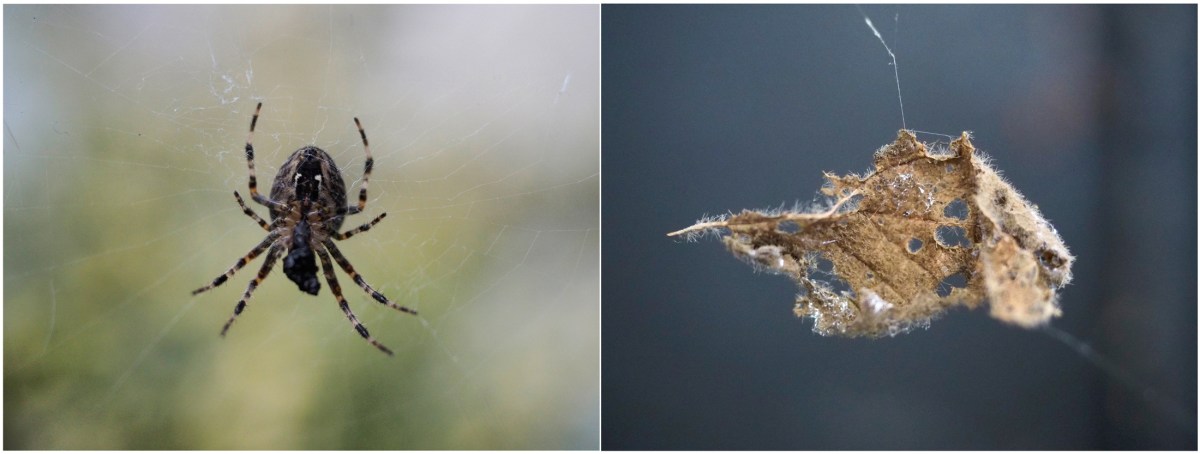
From late summer on the spiders webs start to appear. Not indoor cobwebs, those things that you only ever notice just after you’ve finished cleaning the house, but the big fat proper ones, the ones a bit like a see-through dart-board that remind you of Halloween. And of course each of these big fat webs has a big fat spider sitting in the middle of it. I suppose autumn must be dinnertime for arachnids. Apparently they only need to eat twice a year, though I never see so many webs like this in the spring. Anyway, a few years ago, by accident, I found a new game to play:

I was having a cigarette outside someone’s house one night and, by accident, I dropped a nob of ash onto a spider’s web. Of course it made the web quiver and, like a shot, out of nowhere a spider appeared. This one was so obviously hungry you could practically hear the cutlery rattle, and it rushed straight up to the ash and bit it, and then stopped. I know biologists say that animals don’t register emotion like humans do and we’re just anthropomorphising or projecting of something, but I could swear the irritation was palpable.

The spider looked at the ash; the ash wobbled a bit in the breeze. Then, with the most extraordinary delicacy, the spider wrapped a few strands of silk around the ash, so it was lightly tied together like a parcel. Not a flake moved, the trussing was so precise. The spider then snipped most of the strands of web away from the ash so that it was held like a spit-roast between two threads, which the spider then started to rotate with its legs, all the while playing out new silk onto the crumbly surface. Faster and faster went the little packet of ash, and as it spun round and round, it grew smaller as the thread compressed the bundle, making it all the while more solid. Then, one of the remaining two strands was cut away so that the package dangled, a little more gossamer was added for luck, and, with a final snip, the offending parcel dropped into the bush below.

The whole process took about ten minutes, maybe a little less.

Maybe that night I also projected other feelings onto the spider, including a sense of satisfaction at a job well done, along with the kind of grumpiness you find in caretakers when they have to mop up a floor someone has spilled drink on, or maybe it was just feeings of guilt on my part.

Unfortunately though, my sense of guilt has not been strong enough to stop me carrying out this act of petty vandalism on several occasions since, and each time, the same thing happens. It really is the most perfect performance, and so fastidious. I tell myself that unwanted stuff like bits of leaf and fluff and the like must get blown into spiders webs regularly and having a bit of a clean up is all in a days work for the average spider, but I know the spiders know I’m lying to myself.

Forgetting – Weds 16th Sept

If you ask any child, up to the age of about six, to paint you a picture of rain, they’ll have no problem doing so. The patterns of slashes and spots they will give in response are almost as much a part of infant iconography as lollipop trees and houses with chimney smoke like springs. But I was thinking today, while trying to avoid getting soaked, that I couldn’t remember much in the way of examples of grown ups painting downpours.

Ok, I’m going to have to qualify this a bit. Japanese art has a rich tradition of representing rain, but what about the west? Looking back through our own art history, most only show rain as either atmospheric (Turner, Monet, impressionism) or in terms of its effects and paraphernalia: rainbows, dark threatening clouds, umbrellas, puddles, shiny streets, etc. storm damage and thrashing trees (Ruisdael, Dutch painters). but not much in terms of depictions of recognisably distinct drops. The only exceptions I can find are a few mediaeval paintings showing rains of fire and blood as part of the apocalypse or in the wake of Hailey’s comet (and I don’t think blood and fire counts). Even representations of Noah’s flood seem to be absent of actual falling droplets.

I can only think of three artists: Sickert, Hockney and Alex Katz, who’ve done so. All of these painters worked relatively recently, a long time after Japanese woodblocks had become widely known in the west, and also, after the development of photography to a point of technical advancement able to capture at least streaks of water in its fall downwards.

So how come children have no problem with painting and drawing rain, but adults, at least in the west, do? Is there a point in our development when we forget how to do such simple things?

Babes in the wood – Sat 5th Sept

Things to think about while wandering in the Gloucestershire woods:

What’s that called?
Can I eat it?
Will I find a fossil?
Is that a path?
Where am I?
What was that sound?
Are there still wolves in England?
Has anyone ever seen a unicorn?
Is that a cottage?
Did anyone hear that tree fall?
I’m hungry.

Mr Potato and the Magnificent Seven – Weds 30th Aug

Fun (verb, noun, more recently adjective). Used as an abstract noun, as in:

(a) anticipation of, or while engaged in an activity, to convince yourself or others, e.g. “hey, it’ll be fun!” “hey, we’re having fun!” by parents making the best of a wet day out, teachers seeking the love of their class during field trips, managers describing team-building exercises, new students during fresher’s week, members of office parties, stag and hen events.

(b) also used in the past tense, particularly in situations involving alcohol and substance abuse, or pronounced while leaving the: hospital, police station, realising you have no dry clothes, bedding etc. e.g. “that was fun!”

Facebook and other forms of social media have proved invaluable in ascertaining that fun was had via photographs and videos of group events. Other indicators of fun taking place include the use of multiple exclamation marks, e.g. “that really was fun!!!”

Special occasions – Tues 29th Aug

One of my favourite places to stop and look at on my daily walks is the Partido fancy dress shop on Western road (Partido: party-do, marvellous!). I must have taken a score of photographs of this one outlet over the past few months and if you scroll down through older entries you’ll find the shop crops up several times.

Whoever is responsible for the window displays clearly takes pride in their job, and the results are both detailed and imaginative, representing something of a pilgrim’s progress for the shop mannequins. There are two young adult models: one male, one female, and a third in the likeness of a girl around ten years of age. Over the past year they have journeyed together in changing festive attire through all of the major holidays that punctuate the British calendar: Halloween, Guy Fawkes Night, Christmas, New Year, Valentines Day and Easter. They have also been decked out in regalia appropriate to other, more all-year round rituals, including birthday party dress, stag and hen night costumes; and on occasions, for no actual ritual, but where their outfits are nevertheless coordinated, on these occasions often themed on a romantic nature.

While, usually, all three models are present in the windows, and sometimes clustered together as a family, at other times the male will be separated off to the other side of the door (as around Mother’s day earlier this year) and, when the theme is of a more adult subject, the girl will be absent as she is clearly under age.

Sometimes one particular display suggests others. A few weeks ago both adult mannequins were dressed as tropical beach goers but, while the male (in the next window, not shown) remains in this pose, and with attendant paraphernalia, the female has now become a mermaid, as a variation on this fantasy.

Will they get engaged and marry? I can see endless further possibilities for displays based on situations like meeting the in laws, their first row, the unexpected arrival, the affair… I must introduce myself to the proprietors sometime and offer these suggestions, I’m sure they’d appreciate my interest. The shop girls quite often stare at me while I’m taking my pictures and are clearly curious about what I’m doing outside their shop.

Air sea rescue – Tues 11th Aug

I was listening to one of those Radio 4 amazing facts programmes a few years ago. You know the sort, where a panel of experts give answers to questions sent in by listeners on topics pertaining to the natural world, the sciences, mathematical problems and so on. On this day one particular question stuck in my mind. A listener had written in asking how, when it’s raining, insects, being close in size to raindrops, don’t seem to get hit? After some exploration of different theories, the panel came to the conclusion that rain, as it falls, creates enough turbulence around each droplet to blow any insects out of their path. Upon hearing this, the world seemed to come alive for me and I had this vision of the air around us filled with minute curlicues of turbulence caused by a multitude of falling droplets; a beautiful web of three-dimensional and invisible arabesques. I was delighted.

A few years later, while filming in some woods nearby I chanced on a lepidopterist out searching for butterflies. We fell into conversation and he told me that, for him, the day had not been so good. He’d hoped to photograph some of the rarer species but most of the ones he’d found had wings quite badly damaged by the rain. I remembered my programme and felt a little disappointed, but then, I reasoned, maybe butterflies, because of the size of their wings, created enough drag to prevent them being blown out of the way, and so they might be an exception to the rule.

So, today I’m hiding from the rain under one of the umbrellas at the café when all of a sudden, this shape appears with a splat on the stretched canvas cover. It’s clearly visible through the wet fabric as having six legs. Peeking out from the rim of my shelter I can see it’s a bee that’s been brought down with a bump by a raindrop. Unsurprisingly, it looks stunned. Since the rain is now easing I try a bit of rescue work, breathing and blowing on the bee to dry it out and try to warm it up a bit. To my surprise, this actually works. Acting a bit like a human hair dryer to warm it, and having blown off the surplus water, after a while the bee starts to buzz a bit, dislodging some more water. Then it does what any sensible insect would do under the circumstances, crawling across the surface to the edge, over the rim and then under the canopy where it clings on, probably trying to recover its senses.

Ok, its only one bee. Maybe there are instances where insects are blown out of the way by turbulence caused by falling rain, but from what I can see from the behaviour of this one individual, it seems likely that what actually happens to insects during rain showers is pretty much the same as anyone else caught in a shower, namely, dive for cover and wait it out. And that’s why you don’t see many insects in the rain: they aren’t stupid (well, for a given value of stupid since they can’t have very big brains) and are all hiding underneath leaves on trees and so on.

Only now I have a new problem: the afternoon is drawing on and the people at the café are beginning to put away the tables, chairs and umbrellas away for the night, one of which has a stunned bee under it. I feel a bit of a twit going over to talk to Michel to ask him to watch out for the bee so it doesn’t get trapped as he closes the parasol, but you see, I’ve helped it, so now it’s my responsibility, and I have no idea where it’s hive is.