Of course it may also be that every single stone on Brighton beach is a fossil of a wide family of individual species that, when alive, just happened to look exactly like pebbles…
More on fossils – 20th November

Of course it may also be that every single stone on Brighton beach is a fossil of a wide family of individual species that, when alive, just happened to look exactly like pebbles…

I’m having to modify my views on the existence of fossils on Brighton beach. True, the place is not littered with them the way you might find in other parts of the country, and what you come across is often smashed almost beyond recognition, but I’m seeing more and more of them. Apart from the Fairy Loaf I discovered a few days ago (11th Nov) other stones of the day (e.g. 26th & 29th Oct, 15th & 16th Nov) have shown telltale signs of something that couldn’t just have happened as a result of a purely geological process. After all, the Weald, not so very far away, has a reputation for turning up some remarkable pieces and the chalk cliffs all the way through the Seven Sisters are made up from the remains of countless billions of ancient shellfish.
Today’s stone of the day is a bivalve of some kind (actually you’ll have to take my word for it as it doesn’t photograph well but, seen in 3 dimensions you can much more readily discern that one end is spatulate while the other shows evidence of the suture joining the two valves; in short, it’s mussel-shaped). While its overall form suggests that it was fossilised whole, in its current condition, because of the relentless grinding caused by the tides over innumerable years, only about 50% of the shell survives, and yet these few fragments, because they are so battered, evoke as much their journey over time, as the creatures original appearance, and what is no longer there is suggested by what remains.
Giorgio de Chirico once noted that a vase only has meaning once it has been broken. There is a tradition in Vietnam of repairing ceramics with elaborate inlays of gold wire, to emphasise rather than conceal the fracture lines. We should all gild our wrinkles, but it’s easier said than done.
The practice across England of collecting fairy loaves and placing them in burial mounds and graves, dates back as far as the Palaeolithic era and persisted up until Anglo Saxon times. Indeed within local lore they have been seen as protection from witchcraft, this belief even continuing today in certain circles.
But what are fairy loaves? Small stones with five-point symmetry shaped remarkably like a small loaf of bread, they are in fact the fossilized remains of sea urchins, pre-dating our own species by millions of years. The chances of finding one on a seashore covered entirely with pebbles, so that the beach here acts like an enormous grinder, are about as likely as finding hens teeth. Are they magic? I do hope so since I’ve now got one, found on my search for today’s stone of the day.
I was going to tell you a story about a flock of starlings and some tandoori chicken but that’ll have to wait till another time.
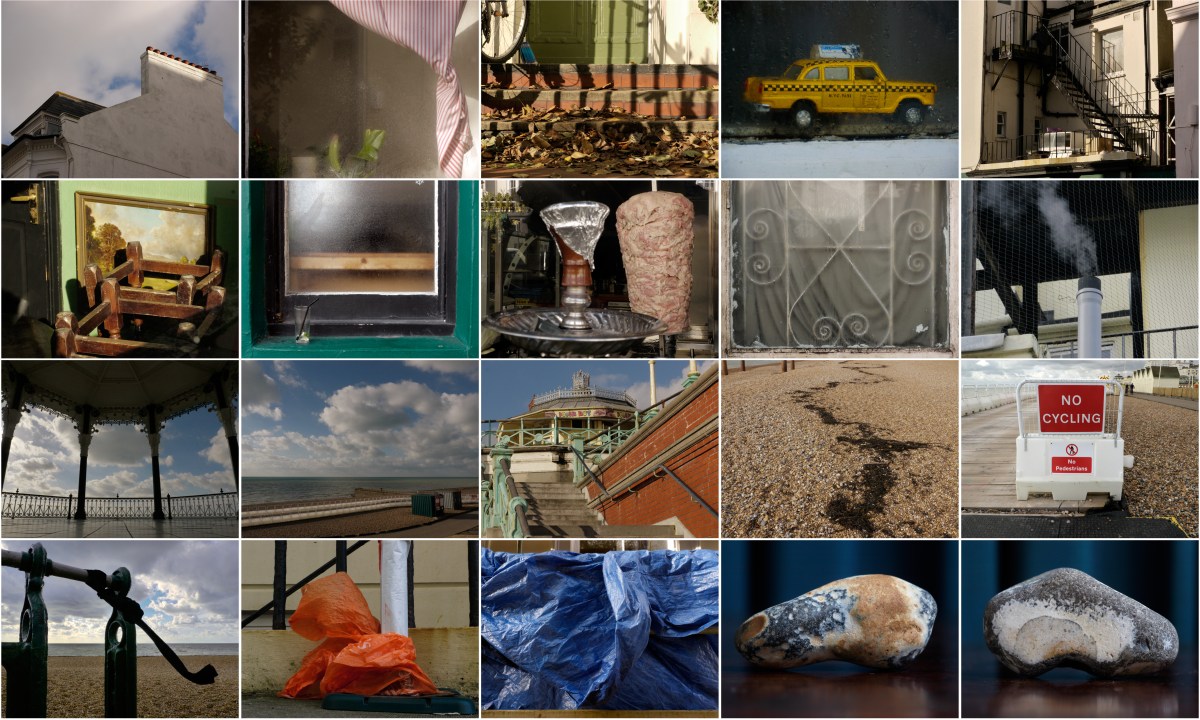
Well there was me thinking about all those day-after-bonfire-nights and the childish delights of coming across burned out (and if you were lucky, unexploded) ordnance, hoping I’d do the same today, and what did I find? One lousy sparkler packet (empty) which was certainly not worth photographing. What happened to all the pyromaniacs and litter-louts? Pah! Instead I found out what the contents of a Kambi’s lamb shawarma looked like uncooked. Eeuw… I also noted that the new seafront boardwalk, still under construction, is purely ornamental. Or maybe it’s just for roller skaters?
Enjoy the blue bits, tomorrow could see a lot of photographs of puddles, and even now as I write I can hear the wind howling outside….
Two stones of the day today. Both have insteps…
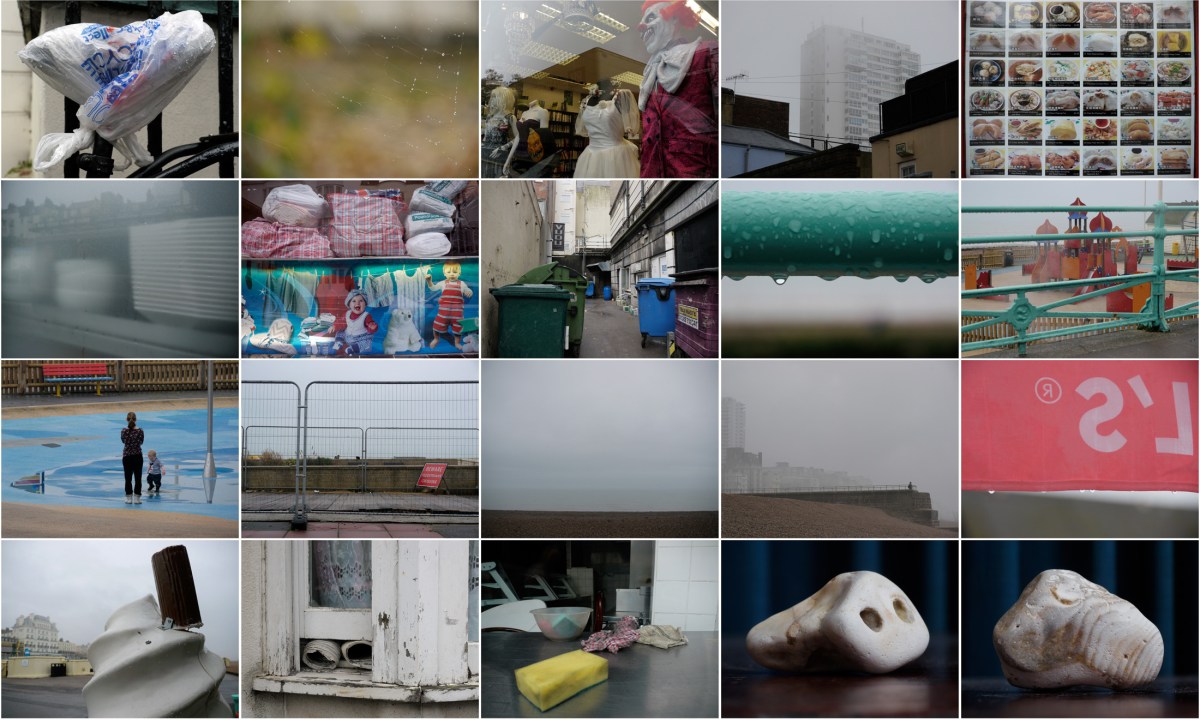
Rained on, dripping from, steamed up, soaked, waterlogged or cloaked in fog; there’s no escaping the fact that today it is wet. But it’s still amazingly warm for a late October day and once you’re out in it you realise it’s better than being in. Inevitably, todays contact sheet is on the theme of being washed out. What am i saying? I don’t do themes. I hate themes. But this page seems to almost have one so what the hell.
I’m still on a bit of a roll with the stones of the day and once again there are two. What can I say about them? Well you wouldn’t want to find the first in a bag of pork scratchings… Or maybe it’s a small Casper-the-ghost, or maybe it’s small wriggling worm with very big eyes so it can see where it’s tunnelling. You choose, or find your own connections? The second? Sometimes you come across stones on the beach that have the most wonderful striped patinations. What causes this? The remains of some fossil shell, or fragment of tree-grain, rings or ridges worn flat by the tides? Or fracture lines developing inside the rock itself? I have no idea, but this makes it all the better.
 Umbrellage