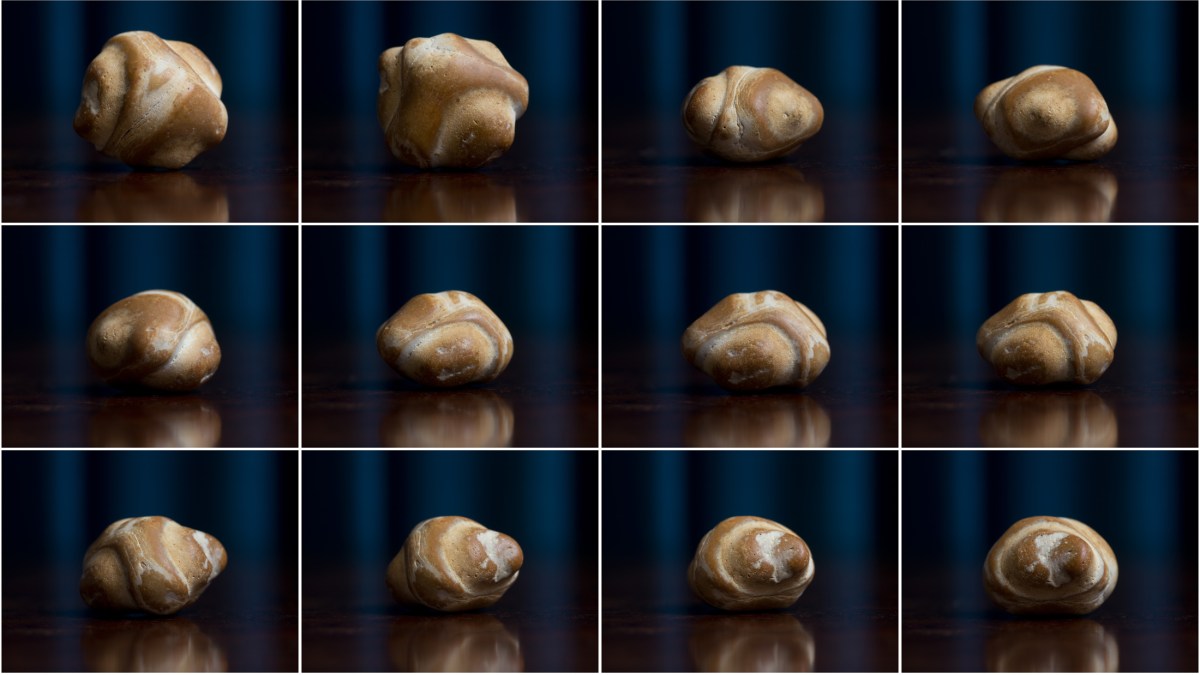
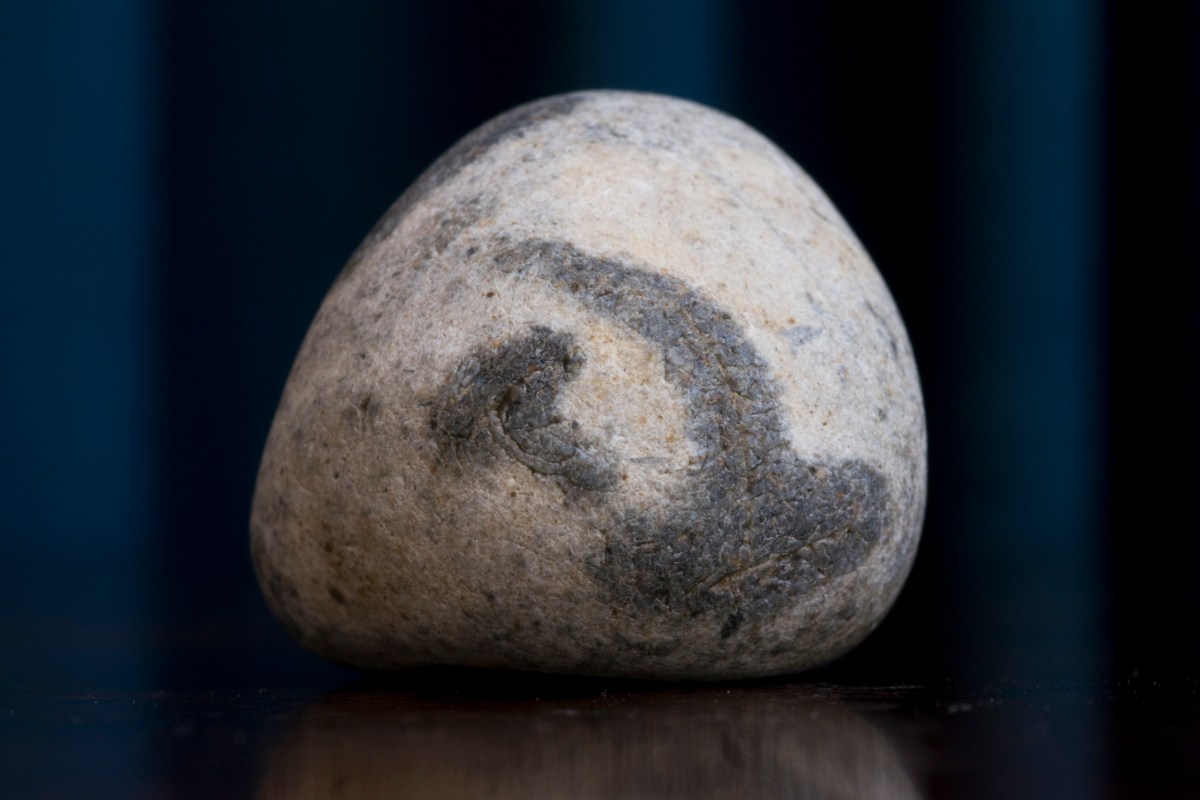
I’ve already mentioned in older posts how some stones I find lend themselves to being photographed, having one good angle that seems to exemplify its personality, while others need to be turned in your hand to fully appreciate the peculiarity of the object. The stone pictured above is another example of this latter category. One image doesn’t do it justice so I’ve decided to present here a page showing twelve different angles of the same stone, in the hope that it might convey more of its character. Even then, I’m not sure how well I’ve succeeded.
It’s quite small, a little larger than a nob of chewing gum. Probably a fossil washed along the coast from Eastbourne or Beachy Head and therefore, given the local geology, likely to date from the Cretaceous Period. It seems to have a kind of three-point symmetry, yet at the same time, the object as a whole is more organic than geometric, so this symmetry is somewhat obscure. Holding the stone and looking at it now, it seems to me that the best way to describe it is thus:
Imagine a pair of underpants stretched tightly around a loaf of uncooked dough, so that the elastic of the material bulges the dough out of the three openings designed for two legs and a waist, each of these extrusions of the dough ball remaining rounded as they protrude from their restricting bond. At the same time, the stone as a whole is reminiscent of an unbaked croissant or other kind of pastry where the dough has been folded over on itself to result in soft ridges, merging back somewhat into the main mass of the dough yet remaining distinct.
I think the above is an accurate description, but its banality undermines the strangeness of the object. It is, after all, a shape made of stone and ultimately, stones aren’t supposed to do things like this unless they are created as a cast of the remains of something long dead. Yet I’ve searched through all three volumes of my book of British fossils and can’t find anything like it. The closest in similarity are the echinoids (sea urchins) but all of these are based on variations of five-point symmetry not three. Part of me is annoyed at not being able to name it, but another part, I think the greater, takes huge delight in finding an object that seems to so elude classification.





 Umbrellage