Plymouth Bites (part one)

The history of the Cornish Pasty is intimately linked to tin mining in Cornwall and Devon, one of the oldest industries of our shores, dating back beyond 2500 BC. The pasty itself evolved as a packed lunch for the miners; a nourishing and hearty meal of beef and root vegetables wrapped up in a pastry case to make them easier to carry down the pit. Also, given that the miners would have had to eat their food in dusty confined spaces and in complete darkness, having your dinner encased in an edible wrapping would have been vital. To get an idea of the importance of this for yourself, try eating your dinner blindfold while hunched up in a cupboard under the stairs (no tables or forks allowed either). For full effect, empty the contents of your vacuum cleaner bag into the space just before starting to eat. Dishes like Salade niçoise or Tagliatelle carbonara aren’t practical in these conditions.

Plymouth’s origins too are closely tied up with the tin mining industry. Plympton, now a district within the city, was one of the key ports for exporting the metal until the river Plym became so silted up with mining debris that it was no longer navigable and boats had to moor south of this original destination. This ecological disaster probably contributed to the development of Plymouth as a major port.

At the time of Christ, the tin mining industry was already venerable and there was significant trade between the south west of England and the Mediterranean countries as far as the Middle East. Indeed legend has it that Joseph of Arimathea, Jesus’ uncle, regularly visited these parts on business as a tin trader and that Jesus, while a boy, once accompanied him. William Blake’s poem (later the anthem): ‘Jerusalem’ celebrates this expedition and I like to think that, while not mentioned in any of the lines, our saviour and his uncle would have stopped off in Plympton for a pasty or two during their time here.

While the tin mining industry in the West Country has now collapsed, the pasty continues as a filling tribute to one of the earliest of British industries. Cornish Pasties are one of a select list of foods produced in the British Isles that have been awarded the status of protected designation of origin (like champagne but so much more satisfying) and justifiably so, you just can’t get a good one outside the region. Locally there are heated debates as to who makes the best ones and the competition between bakers is so fierce (there are even annual championships) that this ensures high standards. However, I was surprised to find that even the packaged ones are good. On a tipoff from the woman in the corner shop (who’d just sold out of hot ones) I tried out one from her fridge and indeed it turned out to be just as good as the freshly cooked versions. It therefore seems appropriate that I should begin my three-part journey through Plymouth with the label from this product.

Further thoughts on concealment – Sat 28th March

One of the many apocryphal stories about the US military relates to their attempts to develop a camouflage effective against thermal imaging devices. As you’ll probably be aware from wildlife programmes, infra-red detection can be used to identify a living being by the heat given off from its body. If the hot spots are rabbit shaped, it’s pretty likely you’re looking at a rabbit; by the same token, if they are man shaped it’ll probably be a man you’re looking at.

Anyone who’s seen ‘Predator’ will also have some idea of what infra-red vision looks like, from the shots where you see through the eyes of the alien. Unfortunately though, I have to report that smearing yourself from head to toe in river mud (in the manner employed so manfully by Mr Schwarzenegger to fool the alien) doesn’t actually work.

Millions of dollars of US government money were spent on finding a solution to the problem of infra-red visibility, leading to the development of clothing that concealed these ‘heat signatures’. Of course soldiers had to be completely covered in this special insulating fabric for it to be effective, but it looked like the defence contractors were on to something really big. Well, until, during field tests when it was discovered that, while anyone wearing these suits would be prevented from giving off any heat whatsoever, thereby making them invisible to thermal imaging devices, they would, as a result, pass out from overheating after only a few minutes and could even die if not rescued quickly.

Actually, I think they missed a trick here. If, instead of totally covering soldiers in heat insulating material, they had instead opted simply to disrupt the human outline by creating heat-transparent windows in the shape of other animals, this could have allowed the cooling necessary for the combatant to continue functioning. In addition, by presenting, in infra-red, what looks like a tower of acrobatic bunnies precariously balancing on each others backs, any sniper seeing such a spectacle would simply assume they’d been overdoing it and go away scratching their head.

You could also vary the animal-shaped windows to include koalas, marmosets, lemurs, squirrel monkeys, kittens, sloths, wombats and other small to moderately sized mammals to keep the enemy off balance.

I’ve decided to publicise this idea openly to the world rather than seeking my fortune from any particular country of military significance because I couldn’t bear the thought of having blood on my hands, whether it be human or any other small mammal that’s good at balancing acts.

28-0785a

Early example of camouflage 11/14/1917
http://research.archives.gov/description/530710

Salomé – Mon 23rd March

‘This conception of Salomé, so haunting to artists and poets, had obsessed Des Esseintes for years. How often had he read in the old Bible of Pierre Variquet, translated by the theological doctors of the University of Louvain, the Gospel of Saint Matthew who, in brief and ingenuous phrases, recounts the beheading of the Baptist! How often had he fallen into revery, as he read these lines:

But when Herod’s birthday was kept, the daughter of Herodias danced before them, and pleased Herod. Whereupon he promised with an oath to give her whatsoever she would ask. And she, being before instructed of her mother, said: Give me here John Baptist’s head in a charger. And the king was sorry: nevertheless, for the oath’s sake, and them which sat with him at meat, he commanded it to be given her. And he sent, and beheaded John in the prison. And his head was brought in a charger, and given to the damsel: and she brought it to her mother.

But neither Saint Matthew, nor Saint Mark, nor Saint Luke, nor the other Evangelists had emphasized the maddening charms and depravities of the dancer. She remained vague and hidden, mysterious and swooning in the far­ off mist of the centuries, not to be grasped by vulgar and materialistic minds, accessible only to disordered and volcanic intellects made visionaries by their neuroticism; rebellious to painters of the flesh, to Rubens who disguised her as a butcher’s wife of Flanders; a mystery to all the writers who had never succeeded in portraying the disquieting exaltation of this dancer, the refined grandeur of this murderess.’

JK Huysmans, ‘Agains Nature’ (À Rebours)

The Land of Cockaigne – Sat 14th March

According to mediaeval myth, Cockaigne is a land of plenty, situated somewhere west of Spain. There the rivers are of milk and beer, pigs wander around ready roasted, it rains sweet pastries and cooked tarts, abbey walls are made of pies and pasties, and the nuns would best be described as naughty (yes, abbeys and nuns, but you should consider that the myth was at its height under this name during the middle ages when European society revolved around religious life, and the only people who were able to write, and therefore record this mythical land, were monks).

The myth survived beyond writing in several customs including the greasy pole game. It may also be that the song: Big Rock Candy Mountains, written in 1895 by the former street busker and hobo Harry McClintock, represents in lyrical form the remnants of this tradition. Here are two verses from the song, as recorded in 1928:

In the Big Rock Candy Mountains
All the cops have wooden legs
And the bulldogs all have rubber teeth
And the hens lay soft-boiled eggs
The farmers’ trees are full of fruit
And the barns are full of hay
Oh I’m bound to go
Where there ain’t no snow
Where the rain don’t fall
The winds don’t blow
In the Big Rock Candy Mountains.

In the Big Rock Candy Mountains
You never change your socks
And the little streams of alcohol
Come trickling down the rocks
The brakemen have to tip their hats
And the railway bulls are blind
There’s a lake of stew
And of whiskey too
You can paddle all around it
In a big canoe
In the Big Rock Candy Mountains

Apparently the recorded version was considerably cleaned up.

Surfacing – Tues 10th March

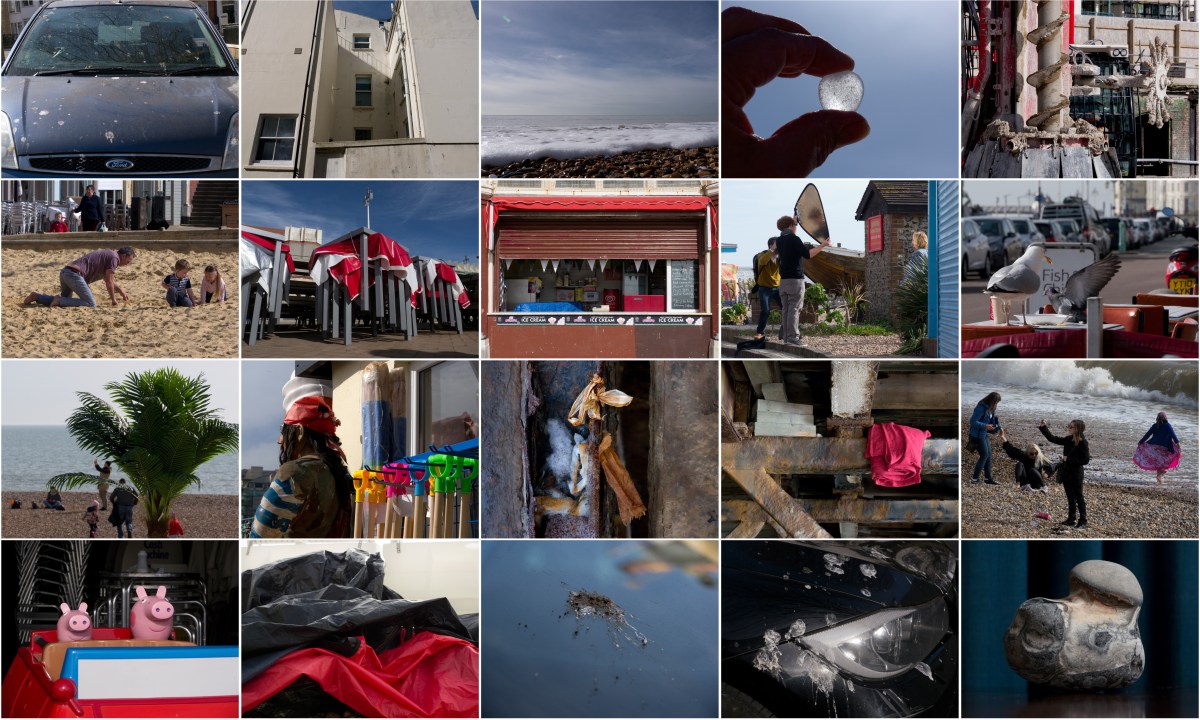
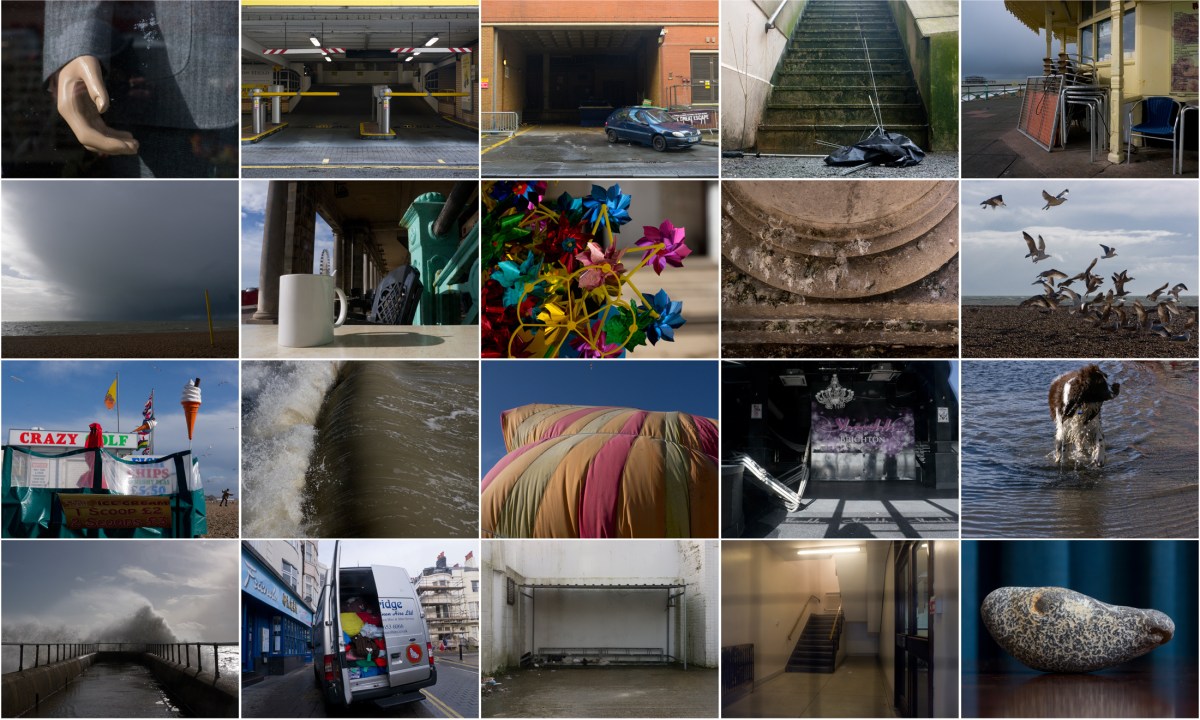
I’ve been searching the beach for interesting stones for a few months now, and I’m surprised that the glass pebble pictured in today’s contact sheet is the first I’ve come across. You used to be able to find these quite often, not only clear glass, but amber and green too, sometimes even blue. I suppose that since we now use so much plastic for bottles, the dwindling of this man-made shoreline phenomenon is inevitable though, given the number of bars and clubs along the sea front, this still surprises me.

I remember the last big open air Fatboy Slim gig on the shore, the one when the beach was so packed with people they themselves seemed like pebbles. And indeed, because no one had considered what would happen if you held an event on the beach that started at low tide, a quarter of a million party people moved like pebbles too, driven up the beach by the rising waters as the evening drew on.

I also remember that the next morning the beach was so strewn with broken bottles it glittered, bejewelled, as if some profligate sultan had abandoned all his riches to the sea. It took a long time before the beach was safe to walk on barefoot and many of the splinters, rather than being collected during the clean up operation, would have settled below the stones where they probably still are, some by now ground down to sand but maybe not all. Now I think about it, I’m even more surprised this is the first piece of glass I’ve found. Perhaps it’s a fragment of vodka bottle whose contents were downed on that infamous night?

But leaving aside these memories, only now surfacing as I write, finding this one has made me ponder further. It’s glass, and it’s definitely a pebble, because it’s been worn smooth and rounded through the continual grinding of the waves on the shore. That’s what pebbles are aren’t they – things rounded smooth by the sea? But it isn’t a stone is it? Stones are formed purely as a result of geological processes. And this is why I’m not photographing it in the usual manner like the others I’ve found, because it isn’t a stone, is it? But now I’m wondering, if the definition of pebble is something worn smooth by the action of the sea, can you have wooden pebbles? Plastic ones? Larger pieces of seashell seem to qualify if rounded enough, as do the occasional fragments of brick or concrete.

This is now really bothering me.

Fatboy Slim big beach boutique 2002

Ecce Homo – Tues 3rd March

“What a piece of work is a man! How noble in reason, how infinite in faculty! In form and moving how express and admirable! In action how like an angel, in apprehension how like a god!”

Closing lines of ‘Britannia Hospital’ (directed by Lindsay Anderson) spoken by the ‘Genesis Project’ a disembodied brain wired to machinery.

Original source: Hamlet, William Shakespeare

Beyond the trees – Mon 23rd Feb

When I was very young I was given a snow globe for Christmas. Inside the plastic dome was a woodland scene in front of which skipped a small likeness of little red riding hood, complete with basket and, pacing in front of her, the wolf. It would be hard to say the monster was menacing, though the modeller had clearly tried to convey this meaning through showing its teeth, lolling tongue and hunched gait. But despite this, the overall appearance gave a wonderful impression of the loneliness of a pine forest in winter, and this strange initial encounter between girl and beast. The tableau entranced me, but I wanted to wander further among the conifers. What was behind the trees? Turning the globe round I was immediately annoyed to find that the back was made out of blue opaque plastic (which, I knew, worked from the front as a clear blue sky) but I found that if you held your eye close to the dome and squinted you could just see behind the trees. Of course what I saw was that all the characters and trees were flat, but this didn’t matter, I knew I was now looking beyond the illusion to its mechanics. Oddly enough this did not spoil the fantasy, but instead made me feel like I’d been let in on a secret, one of the same order as finding out where the tooth fairy lived. A few stray snow-flakes completed this scene beyond, giving it a feeling of abandonment, like a deserted shop, but also a kind of pregnancy, as if something was about to happen, or maybe that whoever had been there had only just left.

For events to be magical, there has to be magical characters making them so, and even the brushes and pots of glue they leave behind them retain some of that enchantment.

Flutter – Sun 22nd Feb

‘As I watched, I was filled with an ominous foreboding. What if, after all, we living beings were nothing more than such scraps of paper? Could there not be a similar unseeable, unfathomable ‘wind’ blowing us from place to place and determining our actions, whilst we, in our simplicity, believe we are driven by our own free will? What if the life within us were nothing other than some mysterious whirlwind? The wind of which it says in the Bible, ‘Thou hearest the sound thereof, but canst not tell whence it cometh, and whither it goeth’? Do we not sometimes dream we have plunged our hands into deep water and caught silvery fish, when all that has happened is that our hands have been in a cold draught?’
The Golem

Gustav Meyrink