“Fairy tales do not tell children the dragons exist. Children already know that dragons exist. Fairy tales tell children that dragons can be killed.”
G.K. Chesterton

“Fairy tales do not tell children the dragons exist. Children already know that dragons exist. Fairy tales tell children that dragons can be killed.”
G.K. Chesterton

Tender flowers thrive on horseshit
“I was extremely tired, and with that, and the heat of the weather, and about half a pint of brandy that I drank as I left the ship, I found myself much inclined to sleep. I lay down on the grass, which was very short and soft, where I slept sounder than ever I remembered to have done in my life, and, as I reckoned, about nine hours; for when I awaked, it was just day-light. I attempted to rise, but was not able to stir: for, as I happened to lie on my back, I found my arms and legs were strongly fastened on each side to the ground; and my hair, which was long and thick, tied down in the same manner. I likewise felt several slender ligatures across my body, from my arm-pits to my thighs. I could only look upwards; the sun began to grow hot, and the light offended my eyes. I heard a confused noise about me; but in the posture I lay, could see nothing except the sky. In a little time I felt something alive moving on my left leg, which advancing gently forward over my breast, came almost up to my chin; when, bending my eyes downwards as much as I could, I perceived it to be a human creature not six inches high, with a bow and arrow in his hands, and a quiver at his back. In the mean time, I felt at least forty more of the same kind (as I conjectured) following the first. I was in the utmost astonishment, and roared so loud, that they all ran back in a fright; and some of them, as I was afterwards told, were hurt with the falls they got by leaping from my sides upon the ground”
From: Jonathan Swift ‘Gulliver’s Travels Into Several Remote Nations of the World’ Published 1726
Brighton in the late 70s and early 80s was the destination of choice for the various youth tribes of the time: Mods, Rockers, Skinheads and Punks. As well as dress code, something well-covered elsewhere, as were the outbreaks of violence between clans, each faction had their own mode of transport: Mods arrived on scooters; Rockers all had very large motorbikes; Punks turned up in vans, someone’s mate’s brother’s car or something; the Skinheads all used trains.
Travelling via public transport meant they could drink more freely than the other subcultures (no one had to be sober enough for the journey down, let alone the return home) but this also created problems for, awaiting their arrival at Brighton station would be the local constabulary, who would immediately corral the Skinheads in cages and then give them a thorough searching. This was principally for concealed weaponry but, more interestingly, someone on the police force also had the bright idea that, given the wearing of ten and even fourteen hole high-top Doc Marten’s boots was de-rigeur among their clan, if you wanted to prevent a Skinhead from being any kind of credible threat, all you had to do was remove their boot laces. This rendered them incapable of moving at any speed greater than a shuffle and consequently very easy either to outrun, or catch up with and apprehend should they be seen engaging in any felonious act.
Given that Skinheads were largely ultra right wing and racist, it became a local sport among anti-fascist groups to congregate outside the station and, just, watch…
As a result of these indignities, the first task of any Skinhead leaving the station was to find new laces. But here another problem emerged: the only stockist of these within waddling distance of the station was the newly opened convenience store a block away, whose owner was of Pakistani origin. He had no problem selling them the laces, but they did have to say please and behave nicely while in his shop. And of course Mr Patel’s stock of laces was never large enough to cater for everyone, so many still found themselves undone, so to speak.
At the time all this was going on, I was working on Brighton seafront in one of my first jobs. Martin, one of the people I worked with had a friend who was something of an entrepreneur. I can’t remember his name, so we shall call him Paul.
Paul was always on the look out for ways he could make money out of situations and this lace-shortage seemed to him to be his big chance to make a killing. The idea was simple: all he needed to do was stand on the promenade with a pair of scissors and a ball of string, offering specially cut lengths at an exorbitant price to any hapless Skinhead who had been unable to purchase laces from Mr Patel. This worked for a while, there is not a lot you can do with unsecured boots and when faced with a crisis most of us are prepared to pay over the odds. The queues formed.
However, what Paul had not figured into the equation was the fact that Skinheads, despite being mistaken in their political views, are not entirely stupid. It only took one of them to realise that now being equipped with functional footwear, plus the moral superiority that comes from having just been fleeced, meant they were now in the position of being able to kick the shit out of this opportunist. A brief fracas ensued which Paul was lucky enough to escape from, but the last Martin heard of him as the police arrived, was his cries of “If I throw you the ball of string will you leave me alone?” emanating from the top of the lamp post he’d managed to shin up in his efforts to escape the angry hoarde.
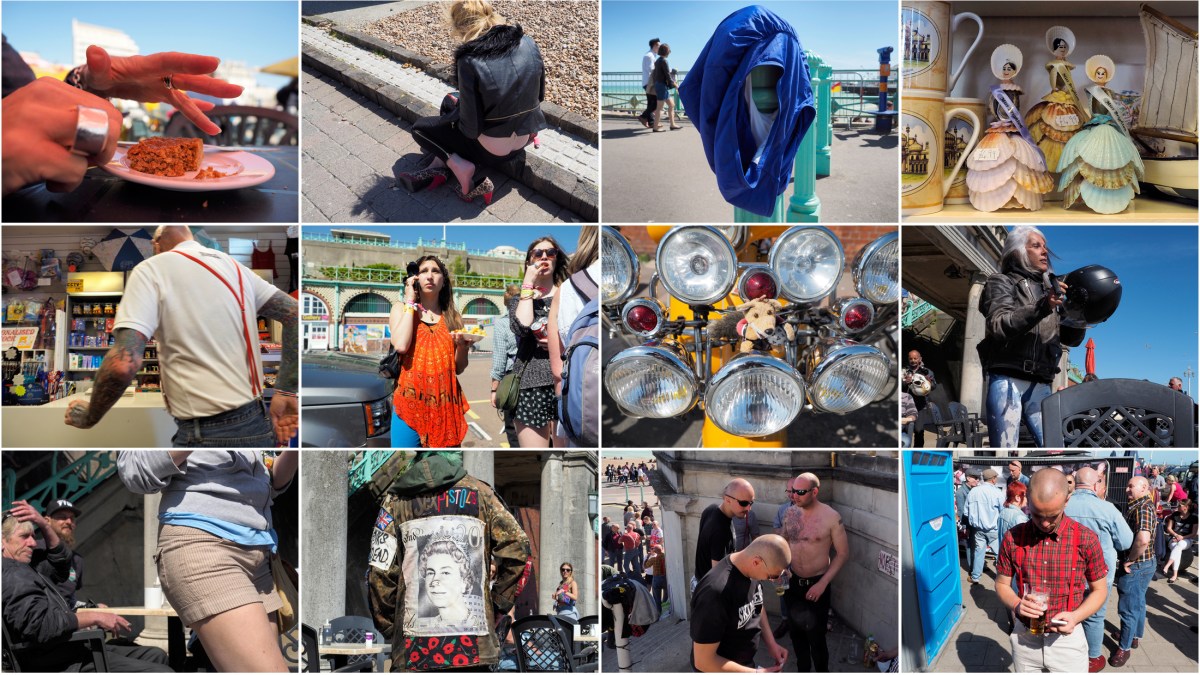
All this came back to me when I saw that today there was an all-day, 70s Skinhead reunion event at the Volk’s Tavern. Given that the Madeira Café – frequented by many of the local hardcore biker population – is only a few feet from the Volk’s, this seemed an opportunity too good to miss, so, accompanied by E.A. my partner in crime for the day, there I headed.
It turned out to be rather a sedate affair. True, gleaming ox blood polished boots, red braces and turned up jeans or sta-press trousers abounded, but many of those whose heads had once been cropped close out of choice, now sported similar haircuts born of necessity. Some of the very few, younger members (who couldn’t have even been alive in the 70’s) exhibited the air of menace that brought back some of my nastier memories, but for most it seemed just an excuse to hold a pint while discussing this and that with old friends. Some wandered off in search of souvenirs in the local knickknack shops.
Only a few feet away, the bikers spent the day drinking tea and waving, as various friends arrived or departed on machines that, surely, were fashioned in the factories of Satan.
–
(With thanks to Simon from down the pub for additional details to complete this story)

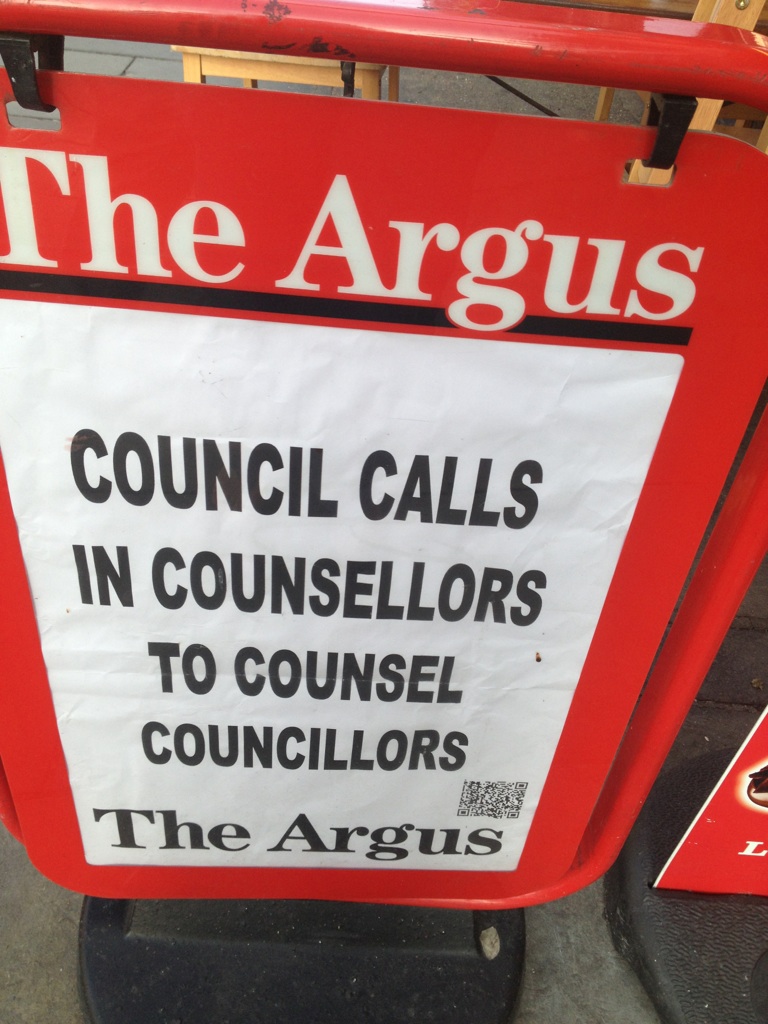
Like most local newspapers, Brighton’s Evening Argus is pretty unremarkable. A scan of its pages is likely to reveal the usual mix. found in any local rag, of sports, stories about town dignitaries, cats up trees, polemics against cyclists, taxi drivers and roadworks (interestingly mostly prevalent when these are taking place anywhere near their headquarters). However, where it excels is in the headlines it provides for the billboards displayed outside its newsagents. Over the years these have become more and more bizarre and spawned a number of imitators. Articles have been written about them and there are several online sites devoted to collections of these slogans. Today’s was a good one but if you want to find some truly spectacular examples of this artform, have a look at these:
http://www.buzzfeed.com/copyranter/the-30-best-headlines-of-the-argus#.hcg4rq2P6

I would like to offer a personal and heartfelt salute to the man responsible for starting this trend. Martin Cooper, may you live long and prosper.
“Is he here?”
“Noooo!”
“Is he over here?”
“Noooo!”
“What about under here?”
“Noooo!”
“Is he in the wardrobe?”
“Noooo!”
“I don’t think he’s here at all”
“HE’S BEHIND YOU!”

‘Once there was a Prince who wanted to marry a Princess. Only a real one would do. So he traveled through all the world to find her, and everywhere things went wrong. There were Princesses aplenty, but how was he to know whether they were real Princesses? There was something not quite right about them all. So he came home again and was unhappy, because he did so want to have a real Princess.
One evening a terrible storm blew up. It lightninged and thundered and rained. It was really frightful! In the midst of it all came a knocking at the town gate. The old King went to open it.
Who should be standing outside but a Princess, and what a sight she was in all that rain and wind. Water streamed from her hair down her clothes into her shoes, and ran out at the heels. Yet she claimed to be a real Princess.
“We’ll soon find that out,” the old Queen thought to herself. Without saying a word about it she went to the bedchamber, stripped back the bedclothes, and put just one pea in the bottom of the bed. Then she took twenty mattresses and piled them on the pea. Then she took twenty eiderdown feather beds and piled them on the mattresses. Up on top of all these the Princess was to spend the night.
In the morning they asked her, “Did you sleep well?”
” Oh!” said the Princess. “No. I scarcely slept at all. Heaven knows what’s in that bed. I lay on something so hard that I’m black and blue all over. It was simply terrible.”
They could see she was a real Princess and no question about it, now that she had felt one pea all the way through twenty mattresses and twenty more feather beds. Nobody but a Princess could be so delicate. So the Prince made haste to marry her, because he knew he had found a real Princess.
As for the pea, they put it in the museum. There it’s still to be seen, unless somebody has taken it.
There, that’s a true story.’
Hans Christian Andersen, ‘The Princess and the Pea’ translated by Jean Hersholt

Incomplete list of bathroom-suite colours. Some might evoke tender memories; the recollection of others could wake you screaming in the night:
Almond Rose, Alpine Blue, Aqua, Armitage Blue, Aubergine, Autumn Tan, Avocado, Bahama Beige, Bali Brown, Bamboo, Bermuda Blue, Blue Grass, Burgundy, Chablis, Crème, Cameo Pink, Caspian Blue, Champagne, Chiffon, Cornflower Blue, Coral Pink, Cream, Damask, Emerald Green, Flamingo Pink, Freshwater, Gazelle Brown, Grey, Harvest Gold, Heather Pink, Honeymoon, Honeysuckle, Indian Ivory, Imperial Purple, Jade Green, Jubilee Blue, Kashmir Beige, Lavender Water, Light Green, Linden Green, Lilac, Melba Peach, Midnight Blue, Mimosa, Mink, Misty Pink, Moss Green, Ocean Spray, Old English White, Orchid Pink, Oyster, Pampas, Peach, Peony, Pergamon, Platinum, Pewter, Pompadour, Primrose, Romany, Rose, Rosewater, Sable, Sandalwood, Sapphire Blue, Savannah Green, Sepia, Shell Pink, Silver Fox, Sky Blue, Soft Mint, Sorbet, Sorrento Blue, Sun King, Tahiti Pink, Turquoise, Twilight Pebble, Whisky, Whisper Apricot, Wild Rose, Wild Sage, Willow Green, Wych Elm.

‘Plymouth Sound’ is the name of the wide inlet around which the city of Plymouth is built, and essentially the reason for the existence of the city. But why ‘sound’? why not ‘bay’ or ‘straits’ or ‘harbour’? ‘Sound’ is one of those words, like ‘fret’ (see entry for April 9th), that has multiple meanings, each of which adds to the richness of the word. Sound: not only a noise, both uttered, made, or occurring and usually heard (though Bishop Barclay had some doubts…); sound as a sense of wholeness and solidity (your reasoning is sound, the timber is sound); sound as in deep (I slept soundly); then there is sound, as in to ascertain, to sound out, to test, to probe – and, specifically it seems, in relation to sounding the depth of water using a line, pole or, more recently, sonar.
The reason for these differing uses comes from the fact that the word has several etymological origins: the Middle English soun, from Anglo-Norman French soun (noun), suner (verb), from Latin sonus (The form with -d was established in the 16th century); Middle English: from Old English gesund (healthy), of West Germanic origin; related to Dutch gezond and German gesund; Late Middle English: from Old French sonder, based on Latin sub- ‘below’ + unda ‘wave’
I had thought this last origin was the reason for the choice of word, being based on the need to navigate a safe passage through the waters forming this area of coast, but then I found a further possible meaning: ‘A narrow stretch of water forming an inlet or connecting two wider areas of water such as two seas or a sea and a lake. Another name for Øresund from the Middle English, in turn from Old Norse sund ‘swimming, strait’; related to swim’.
At first I was disappointed by this discovery. While this is most likely the reason, it seemed prosaic to name the place purely because of its geographical particulars. But then I thought, was it just because of this one definition? Perhaps whoever christened this stretch of water was well aware of the other meanings and it was a stroke of brilliance to use a name that could encompass so much.
I was having a final cigarette on my last night in Plymouth, listening to the sound of the lapping waters magnified by the sea mist, when the stillness was punctuated by the great boom of an invisible ship off the coast. In that moment the name for this stretch of water seemed to capture, not only all that the word ‘sound’ could have stood for at the time of its naming, but what it would become centuries later.
Reference: http://www.oxforddictionaries.com/definition/english/sound

“True, there are revolts against bourgeois ideology. This is what one generally calls the avant-garde. But these revolts are socially limited, they remain open to salvage. First, because they come from a small section of the bourgeoisie itself, from a minority group of artists and intellectuals, without public other than the class which they contest, and who remain dependent on its money in order to express themselves. Then, these revolts always get their inspiration from a very strongly made distinction between the ethically and the politically bourgeois: what the avant-garde contests is the bourgeois in art or morals–the shopkeeper, the Philistine, as in the heyday of Romanticism; but as for political contestation, there is none. What the avant-garde does not tolerate about the bourgeoisie is its language, not its status.”
(Roland Barthes: ‘Mythologies’, translated by Annette Lavers, Hill and Wang, New York, 1984)
 Umbrellage