Worthing tour – 21st Nov 2015

A long, long time ago I played in a band with a guitarist called Frank. His timing was sometimes a bit off and frequently what was supposed to be a twelve-bar came out anywhere between eleven and a half and fourteen (actually this is quite common among blues players), but despite these quirks he had a very convincing way of playing. He’d lived in the Projects in Chicago at the end of the sixties, married the daughter of one of the big players and even spent some time in an American sanatorium. This gave him blues credibility and, despite a tendency towards jumpiness if he forgot his pills, he was considered by many to be the ‘real deal’. He taught me a lot.

One of our more salubrious gigs was in a place called ‘Hustlers’ in Worthing. A bar above one of the pubs on the sea front, there wasn’t a stage as such, just an end of a largish room. The carpet had seen better days. Once it must have been a deep, swirling red, but years of cigarette ash, spilled drinks and the trampling of wet shoes in from the coast-road outside had given it a grey, slightly leathery sheen, through which the pattern nevertheless still fought for attention. It might have looked better if it had shown signs of a recent vacuuming, but with clubs, once the lights are turned down it’d be too dark to notice, and the barman looked like he was used to relying on this fact.

Punters started drifting in while we were still setting up the gear and by the time we began playing we had a smallish audience of about forty people, consisting largely of what looked like TV repair men accompanied, not so much by rock-chicks, as fully fledged chickens.

Frank’s signature move consisted of a kind of whallop-like power-chord, not dissimilar to Pete Townsend’s windmill guitar, but more of a one off strum, this often accompanying a vocal declamation such as “Ah got the Bluuuuues” his cheeks and bottom lip blowing out explosively as he pronounced the ‘B’ while his right arm descended on the guitar with a satisfying clang. When this happened you’d know that Frank would now be in the zone and some marvellous improvisation would likely ensue. Only on this occasion, the explosive was accompanied by something shooting across the room past his microphone and Frank immediately turned to me yelling: “Chris, solo!” This didn’t usually happen and I must have been visibly taken aback, because he then leaned over to me and bellowed in my ear, just loud enough for me to hear under the rest of the band: “I’ve, lost, my, teeth” at which point he unslung his guitar and disappeared into the audience.

I have probably played better solos than the one I performed that night, but it was certainly my longest, sorely testing my abilities to create a meaningful dynamic when, each time I approached a possible climax, I had to check the progress of our lost guitarist, diving hither and thither between the legs of people dancing or just standing holding their drinks. Eventually though he reappeared clutching his prized dentures, giving them a quick wipe on his T-shirt before popping them back into his mouth.

I don’t remember much of the rest of the gig. All I could think about was the carpet, and how much of it was now in Frank’s mouth.
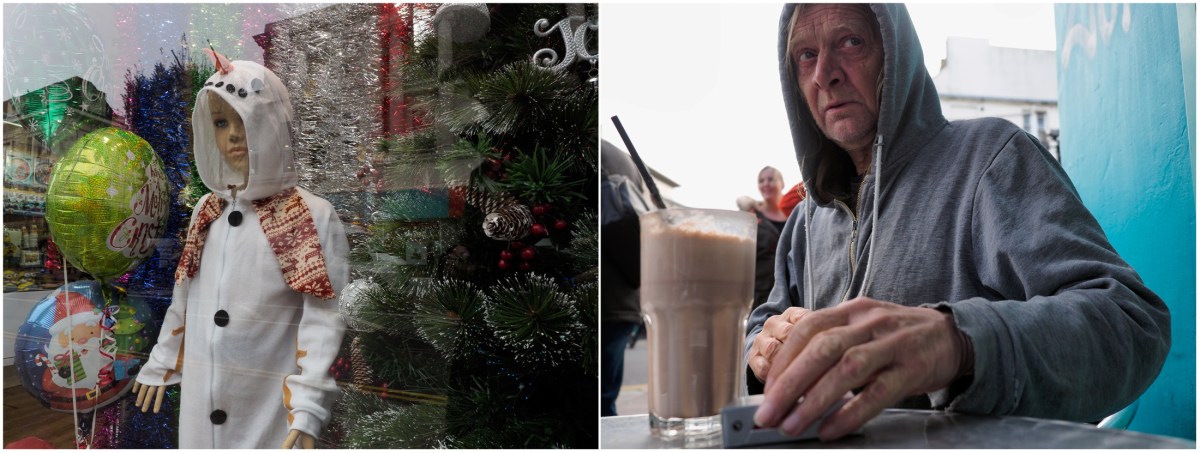
Nation of hoodies –20th Nov 2015

“Across the country, violence, vandalism, theft and disorder are an everyday menace, created by faceless gangs of youths with little fear of ever being caught.
Streets, trains, buses and shopping centres have become no-go zones for terrified citizens who have been intimidated by hoodies for too long.”

Daily Express
Mar 30th, 2008

Sea dogs 18th Nov 2015

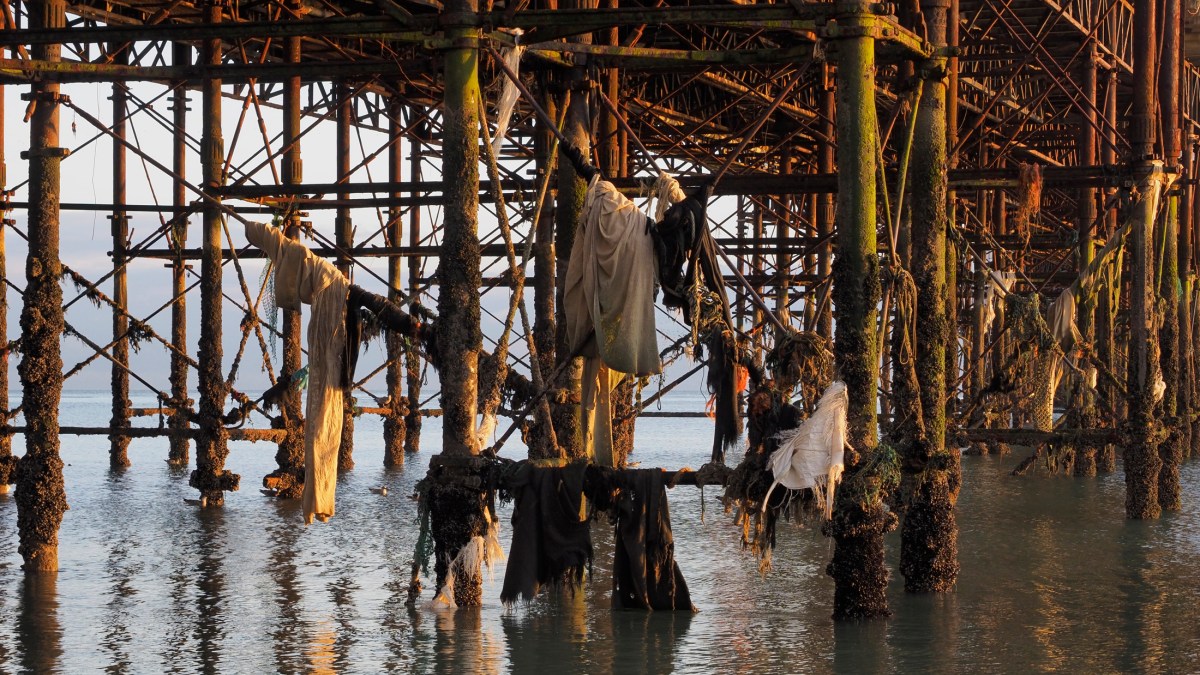
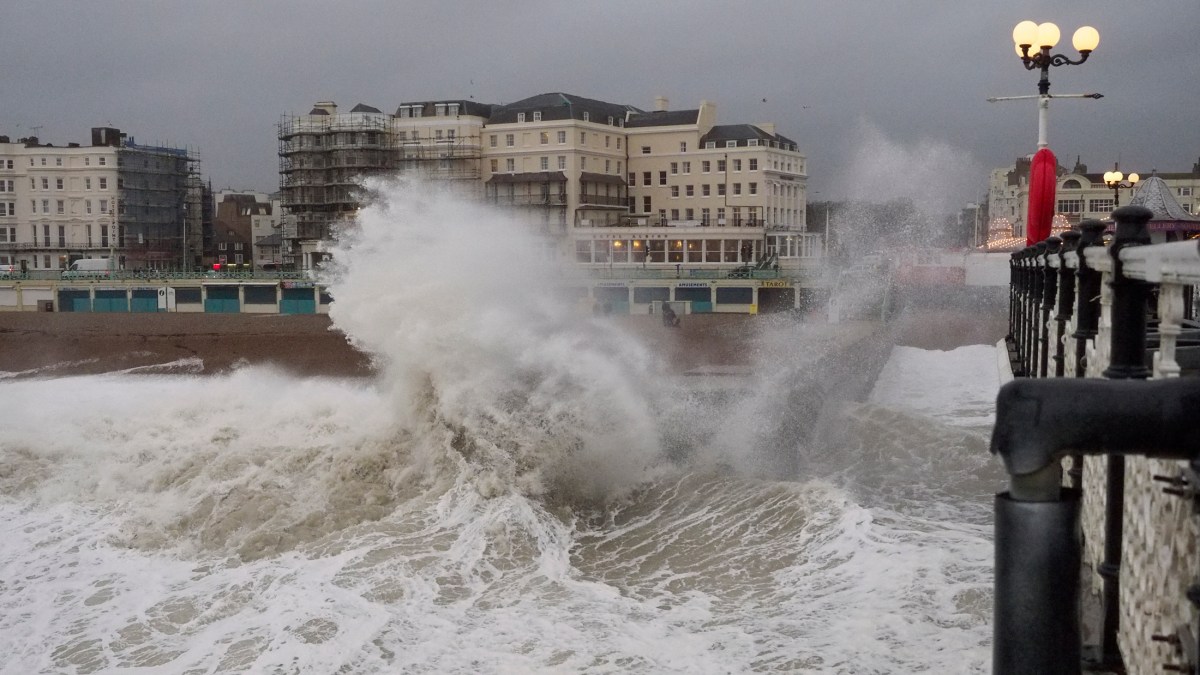
Today I spent some time on the pier watching the sea. We’re in the end of a hurricane and the waves were coming in higher than usual under the weathered boards, sometimes only a few yards away from where the starlings sleep. Occasionally small groups of them took flight towards the marina, perhaps in search of somewhere less perilous to roost, the wind buffeting them as they sped across the grey-green water.

Waves crashed in, some mountainous, some merely huge. I began to notice it was not the tallest ones that made the biggest explosions as they hit Albion Groyne, but those that seemed lower, faster, more angry. Yet despite their speed they never seemed to catch up with the waves in front. It was as if they deliberately distorted time, creating the excuse to race and rage in the hunt for their predecessors; low-hunched wolves with foaming mouths hurling themselves at the shore.

Ancestral vices – 9th Nov 2015

“They fuck you up, your mum and dad.
They may not mean to, but they do.
They fill you with the faults they had
And add some extra, just for you.

But they were fucked up in their turn
By fools in old-style hats and coats,
Who half the time were soppy-stern
And half at one another’s throats.

Man hands on misery to man.
It deepens like a coastal shelf.
Get out as early as you can,
And don’t have any kids yourself.”

Philip Larkin ‘This Be The Verse’ 1971

Aeolian – 29th Oct 2015

“The phrase pathetic fallacy is a literary term for the attributing of human emotion and conduct to all aspects within nature. It is a kind of personification that is found in poetic writing when, for example, clouds seem sullen, when leaves dance, or when rocks seem indifferent.” [1] It was introduced by John Ruskin to critique what he believed to be the over-sentimentality of the British poets (including Burns, Blake, Shelly, Keats, and Wordsworth) in ascribing emotion to the world around us. “Wordsworth supported this use of personification based on emotion by claiming that “objects … derive their influence not from properties inherent in them … but from such as are bestowed upon them by the minds of those who are conversant with or affected by these objects.” [2]

‘Pathetic’, is an awkward phrase. Having shifted in meaning over the years, it is now more likely to imply someone being ridiculous or inadequate (e.g. ‘you’re pathetic!’) but at the time of Ruskin’s writing, the word was associated more with ideas of pity or poignancy (hence: ‘[sym]pathetic’). Nevertheless, it is clear from Ruskin coupling ‘pathetic’ with the word ‘fallacy’, that he was against the idea he coined the phrase for.

Was Ruskin right? I’m not so sure. Wordsworth’s ideas are powerful and show his recognition of the way we all reflect ourselves onto the world around us. Psychoanalysis seems to support Wordsworth’s ideas, inasmuch as our perceptions of the world are what they are because of what and how we are, while Buddhism goes beyond Freud to suggest that every moment we create our surroundings as a reflection of ourselves, and that to change the world we must change ourselves.

Of course the opposite, that we are affected by our surroundings, is a truism. We even have medical conditions like ‘seasonal affective disorder’ to confirm this, but I wonder if really what we have is a symbiotic relationship with our surroundings, where we are at once affected by and affect the world around us; that we are all part of the same system.

This certainly seemed true today. As soon as I stepped out the door, the autumn gales at once hit me, and at the same time (metaphorically) lifted me into a kind of excitement I’ve always felt in high winds. The leaves really were dancing and within a few feet of the end of my street two young bucks screeched their car into a parking space, not so much in anger and aggression, as in testosterone fuelled exuberance.

On the beach, packs of teenagers ran, almost feral, away from the home hearth-sides of half term to congregate in groups, maybe up to no good, but certainly partaking fully of a world that seemed altogether as fast as the wind.

That all this activity was set against a backdrop of a sea-front now more or less closed for the winter (or at least until the sun might come out again one last, last time this season) seemed only to highlight the sense that there was something in the air, and whatever it was, it seemed to call everyone to be a part of it. While café signs were stowed and beach umbrellas trussed like turkeys to prevent them being stolen by the wind, gulls raced with the skies and the beach was dotted with solitaries who, for whatever motive, all seemed to want to lift their arms in the hope of flying too.

We have always sought to personalize the forces around us, sometimes elevating them to the status of Gods. Is it that we need to give them life, or is it that they indeed live and we simply give homage in naming them? And does it matter if this is true or not? The point is more our extraordinary delight as a species to create stories with whatever we find around ourselves, and in so doing to belong to the world rather than be isolated from it, something neither pathetic nor false.

[1] wikipedia, https://en.wikipedia.org/wiki/Pathetic_fallacy -requoting from:
Encyclopedia Britannica; Ruskin, John (1856). “Of the Pathetic Fallacy”. Modern Painters,. volume iii. pt. 4; The Penguin Dictionary of Philosophy Second Edition (2005). Thomas Mautner, Editor. p. 455; Abrams, M.H.; Harpham, G.G. (2011) [1971]. A Glossary of Literary Terms. Wadsworth, Cengage Learning. p. 269; Princeton Encyclopedia of Poetry and Poetics, Alex Preminger, Ed.

[2] ibid, -requoting from: ‘Wordsworth, William. Knight, William Angus, editor. The Poetical Works of William Wordsworth, Volume 4. W Paterson (1883) page 199’

Beauty and the Beast – 25th Oct 2015

“Children believe what we tell them. They have complete faith in us. They believe that a rose plucked from a garden can plunge a family into conflict. They believe that the hands of a human beast will smoke when he slays a victim, and that this will cause him shame when a young maiden takes up residence in his home. They believe a thousand other simple things.

I ask of you a little of this childlike sympathy and, to bring us luck, let me speak four truly magic words, childhood’s “Open Sesame”:
Once upon a time…”

Jean Cocteau, Beauty and the Beast

Becalmed – 14th Oct 2015

“By the Lord! Jack, you may say what you wool; but I’ll be damned if it was not Davy Jones himself. I know him by his saucer eyes, his three rows of teeth, his horns and tail, and the blue smoke that came out of his nostrils. What does the blackguard hell’s baby want with me? I’m sure I never committed murder, except in the way of my profession, nor wronged any man whatsomever since I first went to sea.”

The Adventures of Peregrine Pickle, Tobias Smollett, 1751