Simulacra and Simulations – Mon 5th Jan

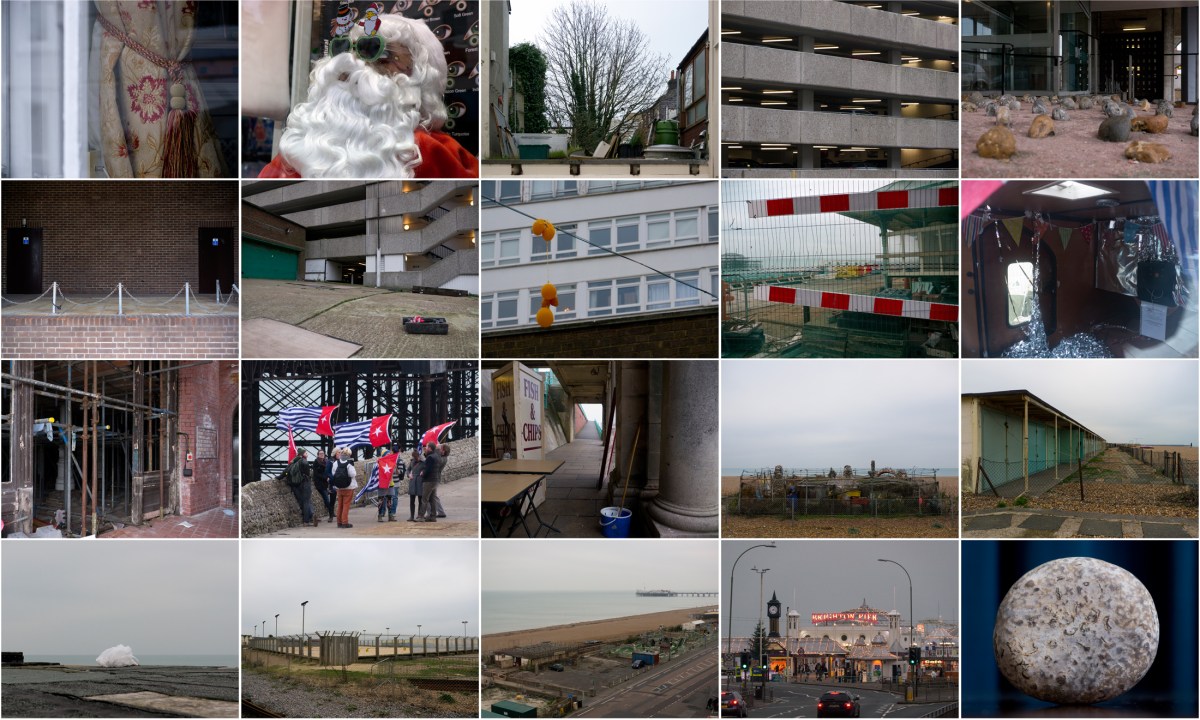
Disneyland is a perfect model of all the entangled orders of simulation. To begin with it is a play of illusions and phantasms: pirates, the frontier, future world, etc. This imaginary world is supposed to be what makes the operation successful. But, what draws the crowds is undoubtedly much more the social microcosm, the miniaturized and religious revelling in real America, in its delights and drawbacks. You park outside, queue up inside, and are totally abandoned at the exit. In this imaginary world the only phantasmagoria is in the inherent warmth and affection of the crowd, and in that sufficiently excessive number of gadgets used there to specifically maintain the multitudinous affect. The contrast with the absolute solitude of the parking lot – a veritable concentration camp – is total. Or rather: inside, a whole range of gadgets magnetize the crowd into direct flows; outside, solitude is directed onto a single gadget: the automobile. By an extraordinary coincidence (one that undoubtedly belongs to the peculiar enchantment of this universe), this deep-frozen infantile world happens to have been conceived and realized by a man who is himself now cryogenized; Walt Disney, who awaits his resurrection at minus 180 degrees centigrade.

Jean Baudrillard, Selected Writings, ed. Mark Poster (Stanford; Stanford University Press, 1988), p166

Glossary – Tues 16th Dec

When I think of the word ‘pebble’ the words that come to mind are: shiny, smooth, polished, round, wet… But the word ‘stone’ conjures much more. In addition to the preceding, I might also think of: rough, lumpen, angular, pitted, sharp… and then there are also stones so important we have added names to them: hearth stone, lode-stone, philosophers stone, millstone, whet stone, altar stone, headstone… Some even have their own gods.

All pebbles are stones, not all stones are pebbles.

Finding treasure – Sun 14th Dec

Over the last few weeks I’ve been on the beach most days looking for interesting stones. I’ve found quite a few now, enough to realise that, to my surprise, I’ve come across all the best ones close to the path next to the beach, or around cafés. According to probability they should be spread pretty evenly across the shore, so this observation has given me pause for thought. There could be several reasons for this happening:

  1. I’m too lazy to go more than a few feet from the nearest cafe or pathway. Actually, that hypothesis is easily dismissed; I have looked all over the beach. Otherwise I wouldn’t have noticed the tendency. I merely note it to show i’ve considered the possibility.
  2. Small children, known for their creativity, openness and inquisitive nature find it impossible to resist collecting interesting examples on their visits to the seashore. However, later when it’s time to go home, their parents, dismayed at the piles of accumulated treasure being lugged up the beach would tell their offspring to leave them behind as they are ‘only stones’ or ‘oh darling we haven’t got room for any more of them’ or ‘what do you want those things for?’ This particular moment of parting would, most likely, happen near the path or, possibly, as a result of the tears caused by this particular separation trauma, near a café, directly as a result of having to console their tender charges with distractions of ice cream.
  3. Brighton is full of poets. Like children they are well known to have extraordinary powers of sensitivity and imagination, and would have no problem spotting these jewels. However everyone also knows that poets are easily distracted, tend to lose things and their pockets are always full of holes (which is why they never have any money). This would cause a higher concentration nearer any pathway. Furthermore, poets spend a lot of time in cafés.
  4. The above could also be true of Jazz musicians.
  5. The stones themselves really are magic. Over millions of years, the most powerful have evolved to be more attractive to humans and, during these same aeons, have slowly worked themselves up the beach to areas where people are more likely to pass by. In short, they want to be found.
  6. Every night, mermaids come out of the sea to look for interesting stones. However, because they have tails instead of legs they can only make it a few yards inland before having to return to the water. This means that the stones nearest the path escape their notice. It is also widely known that mermaids hate coffee – it isn’t salty enough for their liking.

I think this last reason is the most likely as it also explains the cuttlefish mystery (see entry for Mon 10th Nov) and why it is harder to find interesting stones after it’s been raining, or when there has been a high tide.

Logic (Part 2) – Thurs 11th Dec

A good friend of mine was kind enough to respond to my post of 8th December informing me that the ‘Mrs Brown’ piece was originally written by Aristotle to demonstrate the failure of deductive knowledge.

This is remarkable. I mean the last time I saw her I thought she looked a bit tired but I had no idea Mrs Brown was over 3000 years old. Way to go girl! You’re looking great!

It can’t be the same fur coat can it?

Heraclitus villas – Sun 30th Nov

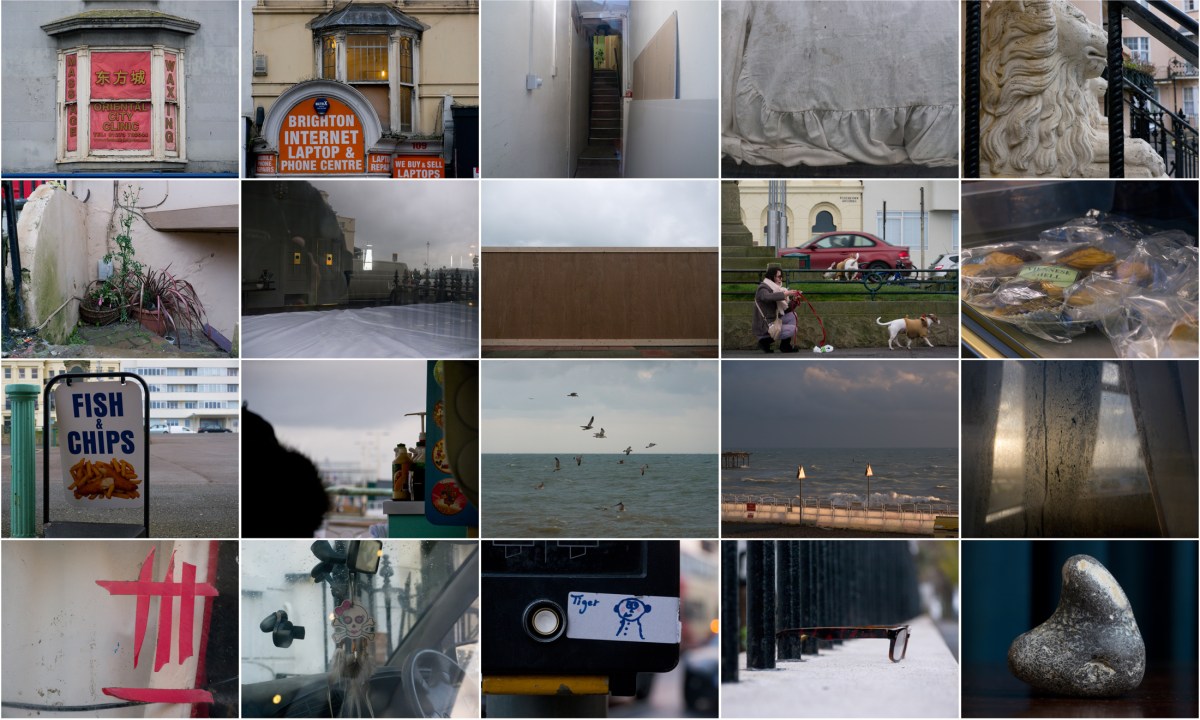
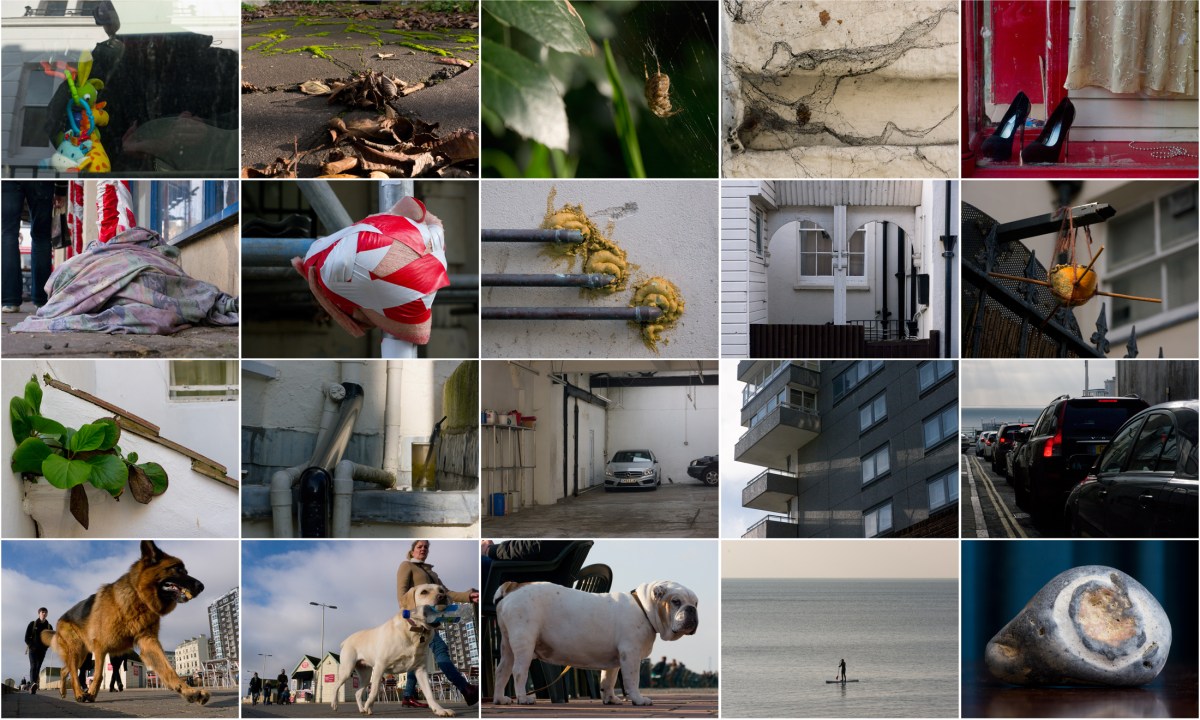
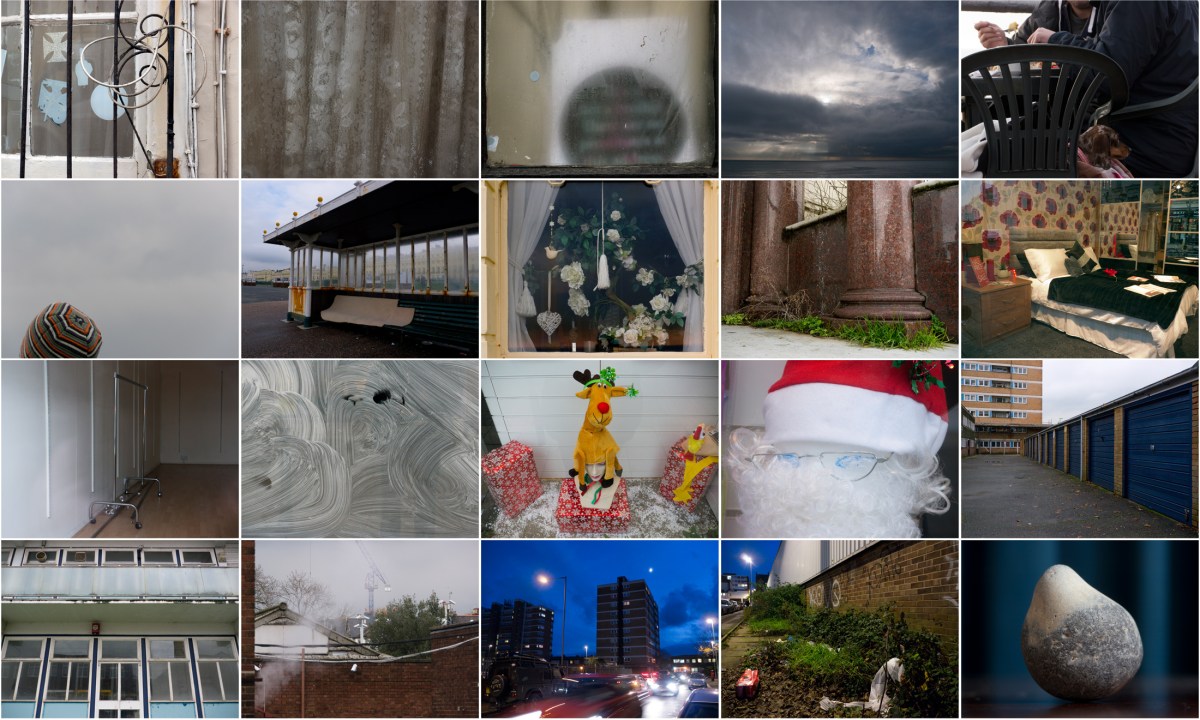
When I started this project I was worried I’d run out of things to photograph. I knew, because of the way I’d set it up as a daily journey across Brighton, and inevitably there would be time constraints, that my journeys were usually going to cover a fairly limited amount of ground. What I didn’t realise at the time was how complex these excursions would become in terms of nuance:

Walk down any street and you’ll see a certain number of things. Some of these will be unusual; others will not change much from day to day. However, walk up the same street and because you’re going in the opposite direction, you’ll see other things, plus many of the same, but quite differently; what doesn’t work from one angle, does for another. This makes you realise that if you go down the street on the other side you’ll see another new set of possibilities, and of course you’d then need to consider going in the opposite direction on that side too. Every street has now become four times as long, but in the time it takes to cover all of it, what are you missing in the next one?

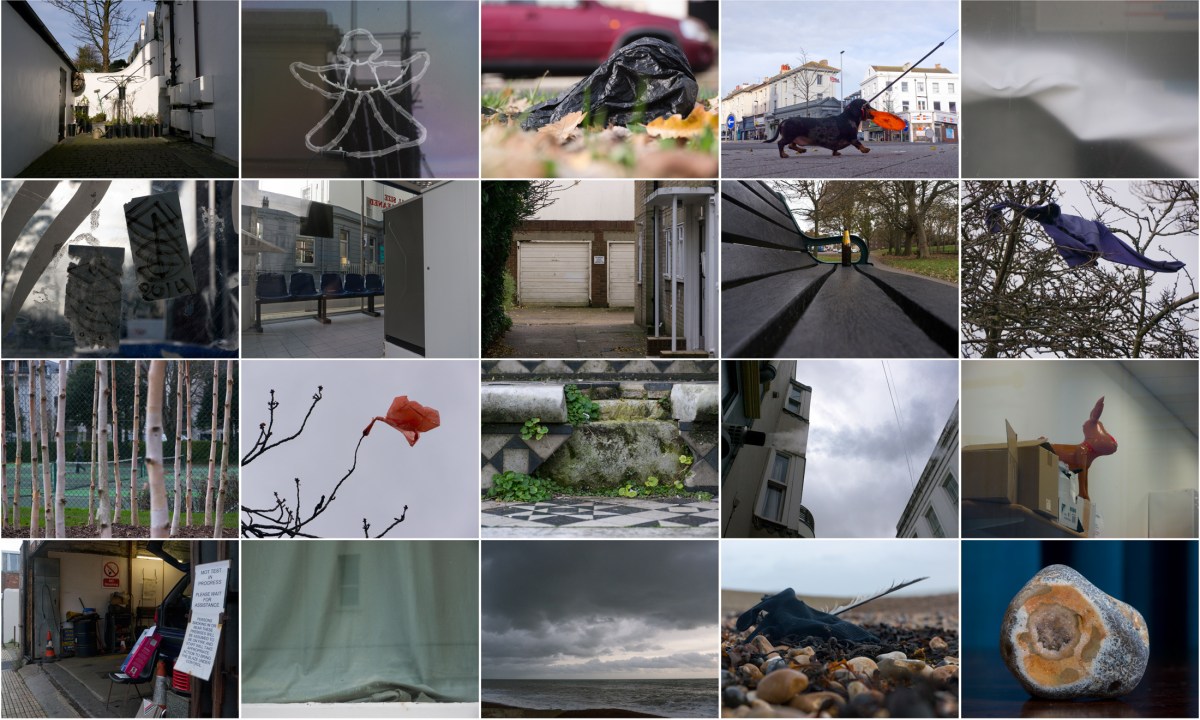
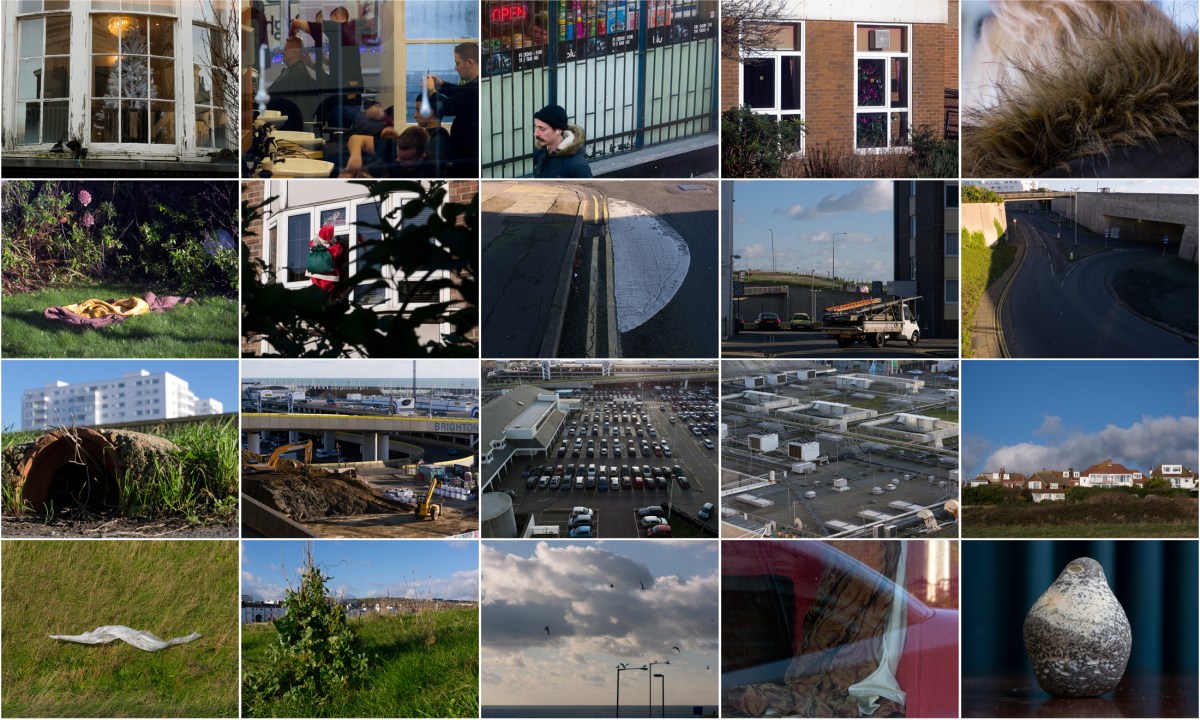
Then there’s the weather. If its sunny you get shadows and reflections, picking out some things and not others, and these can make an image, but equally if it’s gloomy or raining the interiors of buildings come alive and the rain animates everything differently which can, again, make an image. Throw in some strong winds and the whole world comes alive, but of course some things are impossible to photograph when it’s windy. Different days of the week have different flavours (Sunday’s are particularly good for dogs, if it isn’t raining). While all this has been going on time has been slipping by and you’ve realised that you’ve passed through Halloween, Guy Fawkes night and now the shops are full of fake snow, shiny baubles and lights. The trees have lost most of their leaves and the sun now slants at a very low angle, lighting everything differently.

Then there are the delights of chance, not only in terms of the possibility of extraordinary events, and because we leave a trail of stuff behind ourselves all the time, but also because the first thing I see on any given journey will completely colour the rest of the walk, suggesting I look maybe up rather than down, and so I’ll notice roofs one day, and gutters the next; or really small things, or big ones. Then I’ll remember that I don’t have to hold the camera at head height but maybe try putting it on the ground, and boy does that change things…

And of course underlying all of this is you yourself. How are you feeling today? And how much of this reflects back on you from the world you are looking at? What are you looking for – even if you don’t realise you’re looking for it?

I now know I’m never going to complete this project. Suits me.

Etch-a-sketch – Thurs 27th November

Palimpsest is the name for a particular kind of manuscript in which a text has been erased to allow the page to be re-used for a subsequent work. The term dates from well before the introduction of paper, when scribes wrote on parchment or vellum. Because both of these kinds of surface are made from animal skins (goat or sheep) they are highly durable, allowing them to be scraped back and re-written. As a result, during times when writing surfaces were difficult to come by, or demand outstripped supply, whole books or scrolls were erased to make room for newer or (what at the time was considered) more important works. Sometimes, heretical or ‘pagan’ works were overwritten with biblical text in order to sanctify or neutralise the older writings.

Often the previous works were not completely erased, or left enough of an impression on the surface, so that scholars have since been able to decipher what was written before. In recent times archaeologists have made additional finds through the use of digital technologies, together with a range of multi-spectral photographic techniques. The study of palimpsests has led to discoveries of lost works by Euclid, Archimedes, St John Chrysostom, Cicero, Seneca… one particular Qur’anic work has been dated to within fifteen years of the death of the Prophet Muhammad.

Palimpsest seems to be one of those peculiarly archaic words destined to the dusty corners of a few highly specialised subjects, yet, in truth, we should be using this word regularly. Pretty much every piece of information we have on our computers (i.e. everything these days) is a digital, multi-layered, hyper-palimpsest: the result of information written and over-written on previously erased surfaces carried out so often that, had they needed to be physically re-prepared so many times, they would have worn transparent and disintegrated.

Every time you transfer an image from your camera, to your computer, to your iPad, to someone else’s, to… you take up space on your hard drive or memory card which you’re likely to soon delete again. The web page you’re reading now will soon be replaced by something else, even though we assume it remains ‘somewhere’. Indeed digital technology has re-written the meaning of the word original. Ask yourself, where are all the original photos you took? You probably erased them a long time ago, but you still have the originals on your computer, don’t you?

Fossil Fuel – Tues 18th Nov

I’m having to modify my views on the existence of fossils on Brighton beach. True, the place is not littered with them the way you might find in other parts of the country, and what you come across is often smashed almost beyond recognition, but I’m seeing more and more of them. Apart from the Fairy Loaf I discovered a few days ago (11th Nov) other stones of the day (e.g. 26th & 29th Oct, 15th & 16th Nov) have shown telltale signs of something that couldn’t just have happened as a result of a purely geological process. After all, the Weald, not so very far away, has a reputation for turning up some remarkable pieces and the chalk cliffs all the way through the Seven Sisters are made up from the remains of countless billions of ancient shellfish.

Today’s stone of the day is a bivalve of some kind (actually you’ll have to take my word for it as it doesn’t photograph well but, seen in 3 dimensions you can much more readily discern that one end is spatulate while the other shows evidence of the suture joining the two valves; in short, it’s mussel-shaped). While its overall form suggests that it was fossilised whole, in its current condition, because of the relentless grinding caused by the tides over innumerable years, only about 50% of the shell survives, and yet these few fragments, because they are so battered, evoke as much their journey over time, as the creatures original appearance, and what is no longer there is suggested by what remains.

Giorgio de Chirico once noted that a vase only has meaning once it has been broken. There is a tradition in Vietnam of repairing ceramics with elaborate inlays of gold wire, to emphasise rather than conceal the fracture lines. We should all gild our wrinkles, but it’s easier said than done.

Cuttlefish – Mon 10th Nov

When I was a kid, whenever we were taken to the seaside and my mum would see a cuttlebone she’d pick it up and pocket it, proclaiming knowingly “it’s good for the budgie”. Come to think of it, most of these occasions happened after the budgie had died… but I suppose she gave it to my nan or someone else with a pet bird. Anyway, cuttlebones, as you probably know, are the porous internal shells of cuttlefish, used as a buoyancy aid. They often get washed up on the beach, especially after storms. But what I want to know is, how come if they are so common you never see whole cuttlefish washed up too? What happens to the rest of the body? I mean I suppose they all get eaten but this makes me wonder, do all the fish in the sea get together before a gathering storm and say ‘hey lads, storm’s a gatherin’, its cuttlefish for supper tonight’? Or for that matter, if cuttlebones are so good for budgies then how come these bits don’t get eaten by the fish too? Maybe what’s good for budgies isn’t so good for fish?