Canis Philosophica – Mon 9th Feb

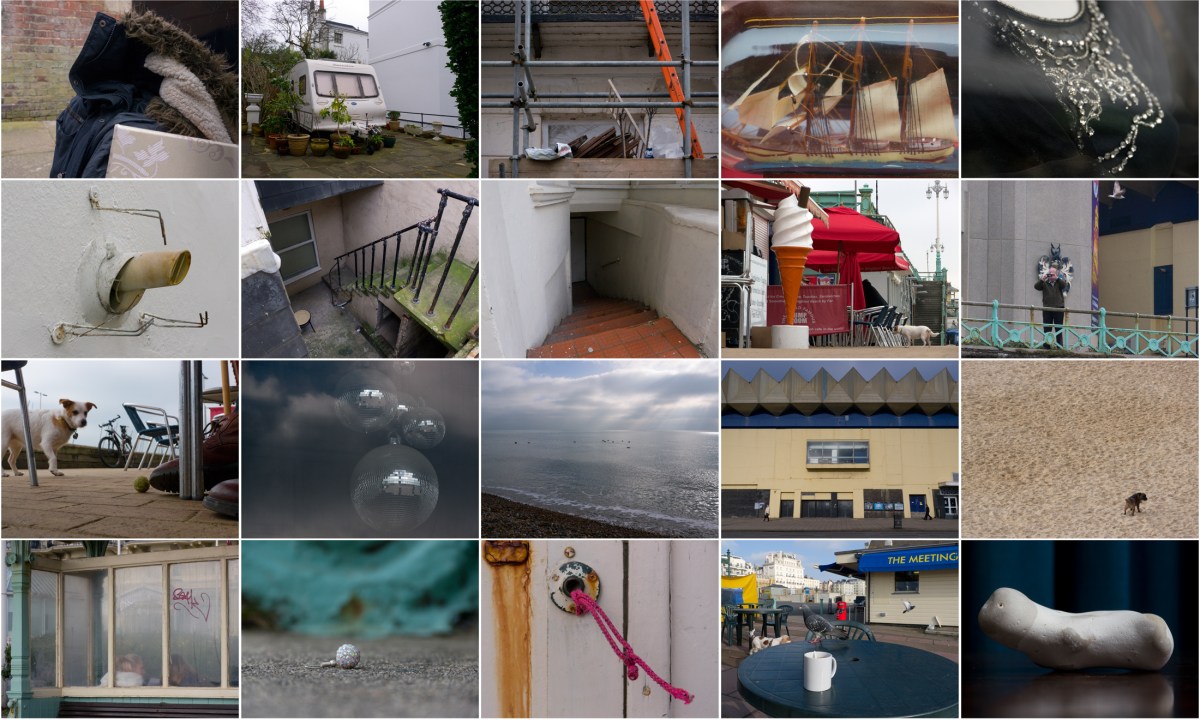
Dogs are great optimists. They are also, by nature, empiricists. Experience has taught them that if they wait long enough, and with sufficient faith (manifest in a particular look which, while not resembling any human equivalent, nevertheless communicates itself to us across the species divide with absolute certainty) that which is believed in will come to pass: the ball will be thrown; the sausage will fall from the table. Dogs are also rarely disappointed. On the few occasions when the above does not work, something more interesting will inevitably turn up that then becomes of crucial importance. In this way, existential crisis is averted. The pigeon may not be caught, but look, there is another!

Of course, it may be that dogs have no intention of catching pigeons or, for that matter, car wheels. It is enough that the pigeon flies away, the car retreats. These too are results.

I spent several years of my childhood living in a bungalow. Down its center ran a hallway, at one end of which was the front door. This was panelled with two moderately sized sheets of patterned glass, one above, one below the letterbox. These panes, while offering privacy, nevertheless allowed us to see visitors approaching the door. Every morning one such visitor was the postman. You could set your watch by the regularity of his appearance, something our small and perky terrier knew only too well, and, as the time approached, Patch would skulk at the kitchen end of the corridor, with eager anticipation badly disguised as nonchalance. At the sound of the postman’s approaching steps the dog would fly down the hallway barking furiously and, a few feet before the door, leap forwards, hitting the glass with a satisfying clang. Equally satisfying would be the sound of the entire family shouting ‘Patch! Stop it!’ accompanied on the other side of the door by muttered curses occasionally augmented with a backwards stumble. It mattered not to Patch that the door prevented any chance of apprehending the intruder. Clearly the defensive manoeuvre had worked and the postman had, once again, been seen off. Happy with his work, our faithful guardian would then trot off and lie on the sofa.

However, over time the glass must have weakened so that, one day, the morning ritual did not culminate in the usual clang but with a great shattering explosion as the glass gave way and Patch, for the first time, found himself in actual physical contact with the postman. Perhaps contact is too strong a word? Bouncing off the postman’s legs Patch ended up seated on the lawn, surrounded by glass, while the postman ran up the garden path shouting ‘you want to watch that bloody dog’. It didn’t occur to Patch to chase the intruder because hitting the glass door had always worked, and now, with this obstacle removed, he found himself in unfamiliar territory. Instead, slightly bemused, he got up and found some very interesting things to sniff around the garden.


Monstroceros – Sun 8th Feb

In 1821 a fossil tooth was discovered by a labourer while quarrying at Cuckfield in Sussex. The tooth came to the attention of Gideon Mantell, the Victorian palaeontologist. Mantell excited by what he believed to be the uniqueness of the find consulted a French comparative anatomist, a certain Baron Cuvier, but Cuvier pronounced it to be merely that of an ancient rhinoceros. Mantell cannot have been entirely convinced by this dismissal because, upon acquiring several more similar remains, he began to search for a living descendant whose teeth might resemble his own growing collection more closely. In his quest he came upon a specimen of iguana from the Galapagos islands. The Galapagos iguana is a herbivorous lizard whose staple diet is seaweed. While its teeth would have been substantially smaller than the petrified equivalents in Mantell’s possession; in every other respect the physical similarities, even down to the patterns of wear, were too similar to be ignored. In 1824 Mantell published these findings in a paper, pronouncing the discovery of a ‘new’ species and naming it Iguanadon, meaning Iguana tooth.

The study of palaeontology in Sussex during the 19th century was fraught with problems. Discoveries were rare and almost invariably incomplete; moreover, not enough was known within this emerging science to provide a framework within which to fit new examples as they came to light. What kind of animal could the teeth have belonged to? From the similar patterns of wear displayed in Mantell’s growing collection, Iguanadon could be established as being a herbivore, but biped or quadruped? Furthermore, of all the other bones that were from time to time dug up, which ones belonged to which? The physical attributes of the tooth collection’s original owners persisted as an enigma for years. Then in 1834 a quarryman in Maidstone found a more complete example of Iguanadon which, while still only partial and scattered, included a similar tooth. Mantell recognised the importance of this find and purchased it. He then set to reconstructing the pieces.

From his knowledge of other ancient and modern skeletons there were few difficulties in the putting together of this strange monster: hip bones, ribs and vertebrae were easily recognisable despite the novelty of the species and a team of technicians and assistants assembled these disparate elements into a semblance of what the creature may have looked like. There was one problem, no one could fathom the placement of a long sharp bone found with the others. Perhaps the earlier meeting with Baron Cuvier had an influence because it was finally decided that this fossil fragment should go on the end of the creatures nose thus giving it a somewhat rhinoceros like appearance.

Illustrations were prepared and the resulting pictures of this exotic beast, when published, stirred the imaginations of the contemporary scientific community. In the great inaugural exhibition of Crystal Palace in London it is recorded that a full sized model of iguanadon was shown, proudly displaying it’s horn.

Several years later in 1878, nineteen more or less complete examples of the dinosaur were exhumed by coal miners in a pit at Benissart in Belgium. In the ensuing excavation organised by Louis Dollo it was discovered that each came with not one but two of the aforementioned pointed bones. In all of the remains their position, when found, corresponded to the places where we might find thumbs on other animals. The illustrations and skeletal reconstructions were subsequently changed.

Bored room – Sat 31st Jan

I seem to have been put on someone’s mail list as a manager, and regularly get emails inviting me to different corporate training weekends, focus groups, sandpit sessions, conferences, consultations, and other events larded with the latest jargon. All of these go straight into the trash file. Well, all except this one, which I append for your delight:

As every dog owner knows, it takes a lot of time and patience to train a dog–whether she’s a puppy or an adult dog learning new behaviors. 1000 Best Dog Training Secrets is packed full of useful training tips for new and seasoned dog owners from two experts in the field.

The easy-to-follow advice covers everything from basic skills to socialization, obedience training, manners, tricks and more. ‘X’ and ‘Y’, owners and operators of ‘Z’ Training and Education school in N.E. offer insight into handling dogs at all stages of development from brand new puppy to geriatric, so it’s never too late to get started.

You will learn about:

  • Establishing leadership
  • Socialization–learning from human leaders
  • Obedience training
  • Developing life skills
  • Teaching manners
  • Dog etiquette
  • Behavior problem prevention and solutions
  • Toys, games and leisure activities

Given that the above content is so similar to all the other emails I receive, I suspect that ‘dog’ is the latest euphemism for employee.

(names removed out of courtesy to the owners)

Babel – Tues 27th Jan

As with every language, French has a variety of words for verbal communication. Three that have become important to linguistic theory and psychoanalysis over the last century, particularly as they have been defined and to some extent redefined by Saussure and Lacan, are ‘Langue’, ‘Langage’ and ‘Parole’. Saussure writes:

‘But what is language [langue]? It is not to be confused with human speech [langage], of which it is only a definite part, though certainly an essential one. It is both a social product of the faculty of speech and a collection of necessary conventions that have been adopted by a social body to permit individuals to exercise that faculty. Taken as a whole, speech is many-sided and heterogeneous; straddling several areas simultaneously-physical, physiological, and psychological – it belongs both to the individual and to society; we cannot put it into any category of human facts, for we cannot discover its unity.’ (1)

And a few pages later:

‘Among all the individuals that are linked together by speech, some sort of average will be set up: all will reproduce – not exactly of course, but approximately – the same signs united with the same concepts. How does the social crystallization of language come about? Which parts of the circuit are involved? For all parts probably do not participate equally in it.
The non-psychological part can be rejected from the outset. When we hear people speaking a language that we do not know, we perceive the sounds but remain outside the social fact because we do not understand them. Neither is the psychological part of the circuit wholly responsible: the executive side is missing, for execution is never carried out by the collectivity. Execution is always individual, and the individual is always its master: I shall call the executive side speaking [parole].’ (2)

Elsewhere, regarding Lacan’s ideas:

‘Lacan takes up Saussure’s theory that language is a structure composed of differential elements, but whereas Saussure had stated this of langue, Lacan states it of langage.
Langage becomes, for Lacan, the single paradigm of all structures.
Lacan then proceeds to criticize the Saussurean concept of language, arguing that the basic unit of language is not the sign but the signifier.
Lacan then argues that the unconscious is, like language, a structure of signifiers, which also allows Lacan to formulate the category of the symbolic with greater precision.’ (3)

And:

‘The French term parole presents considerable difficulty to the English translator because it does not correspond to any one English word. In some contexts it corresponds to the English term “speech,” and in others is best translated as “word.” … Lacan’s use of the term parole owes little to Saussure – whose opposition between parole and langue is replaced in Lacan’s work with the opposition between parole and langage – and is far more determined by references to anthropology, theology, and metaphysics.’ (4)

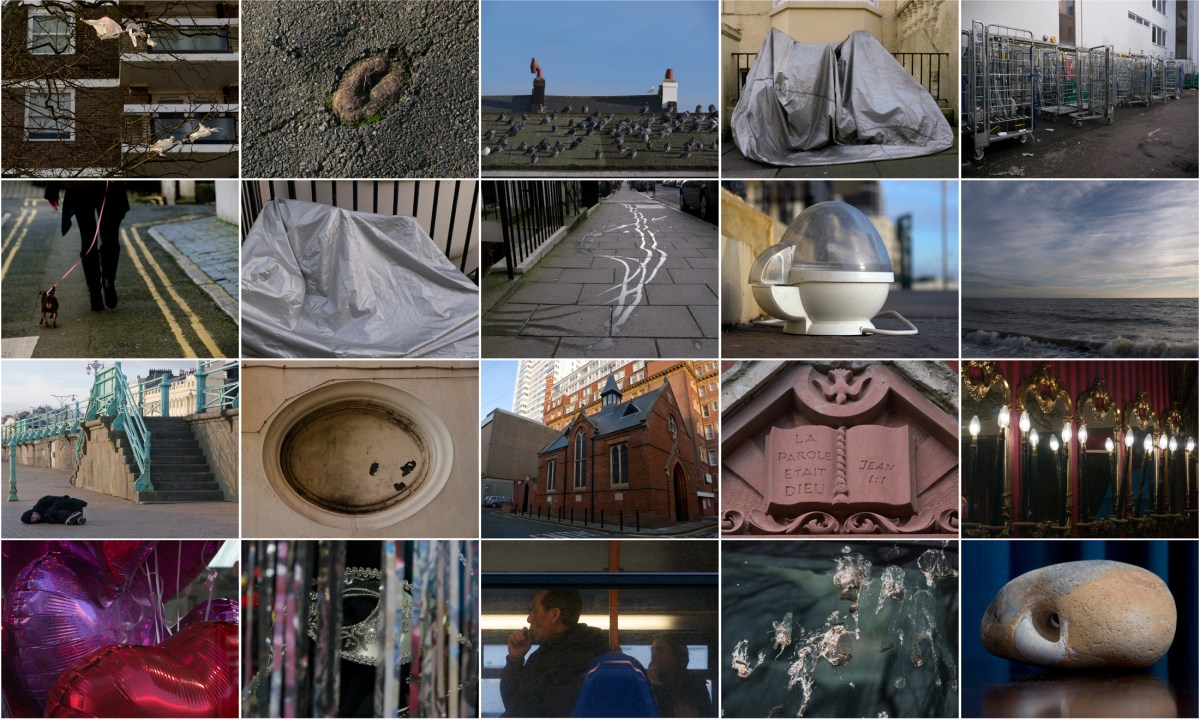
I was reminded of these ideas recently when I came upon a small French Protestant church tucked away behind the Metropole Hotel (despite having lived in Brighton for decades, I’m not sure I’ve ever seen this building before. How easily we take for granted the places we live, sticking to the most efficient routes while ignoring many others because they don’t seem to offer enough to warrant our time or attention). The church is tiny and as you can see from some of today’s pictures, made of brick, with terracotta ornamentation, including a sculpted book over the door, upon which the following legend is inscribed:

LA PAROLE ETAIT DIEU
JEAN 1:1

My French is rudimentary but I can remember enough (augmented by memories of religious studies at school and occasional attendance at church services) to be able to translate this to ‘The word was God’ and to spot that the ‘word’ used in this instance was (in French of course): Parole.

I see it as an advantage that, because English has no direct equivalent translation, this actually gives more scope for exploration in finding an equivalent. In English, we speak, we say; but also: we utter, pronounce, invoke, give voice, whisper, enunciate, deliver…

My understanding of the above arguments, is that for both Saussure and Lacan, ‘Parole’ is an intimate and intensely personal act, a way we reveal our innermost selves in our communications. And yet also (perhaps more for Lacan) because it is so personal, so loaded with private associations and history, it is, to some extent, always unknowable.

This simple phrase in the first verse of the gospel according to John, re-translated via French, now becomes so much more complex, more pregnant.

And, of course, the French version would have been translated from a Latin or Greek text, and the original manuscript by John, was probably written in Greek but could have been Aramaic or Hebrew, and would certainly have owed much to far earlier Hebrew, or Assyrian or Babylonian creation legends (these languages possibly even owing something to early Sanskrit, a language considered by some ancient chroniclers to be so perfect that to utter a name using that tongue, would be to bring the thing it signifies into existence). And how would the notion of ‘the word’ of speech as an intimate act have been understood, and used then, so long ago?

In the beginning was the Word, and the Word was with God, and the Word was God. (5)

Notes
1. ‘Course in General Linguistics’ Ferdinand de Saussure. Edited by Charles Bally and Albert Sechehaye In collaboration with Albert Riedlinger. Translated by Wade Baskin. McGraw-Hill Book Company, New York, Toronto, London. p9
2. Ibid. p13
3. ‘Encyclopedia of Lacanian Psychoanalysis’ http://nosubject.com/index.php?title=Language
4. Ibid. http://nosubject.com/index.php?title=Speech
5. ‘John 1:1’ (King James version)

Fold – Weds 14th Jan

Civilized human beings wear clothes, therefore there can be no portraiture, no mythological or historical storytelling without representations of folded textiles. But though it may account for the origins, mere tailoring can never explain the luxuriant development of drapery as a major theme of all the plastic arts. Artists, it is obvious, have always loved drapery for its own sake – or, rather, for their own. When you paint or carve drapery, you are painting or carving forms which, for all practical purposes, are non-representational – the kind of unconditioned forms on which artists even in the most naturalistic tradition like to let themselves go. In the average Madonna or Apostle the strictly human, fully representational element accounts for about ten per cent of the whole. All the rest consists of many colored variations on the inexhaustible theme of crumpled wool or linen. And these non-representational nine-tenths of a Madonna or an Apostle may be just as important qualitatively as they are in quantity. Very often they set the tone of the whole work of art, they state the key in which the theme is being rendered, they express the mood, the temperament, the attitude to life of the artist. Stoical serenity reveals itself in the smooth surfaces, the broad untortured folds of Piero’s draperies. Torn between fact and wish, between cynicism and idealism, Bernini tempers the all but caricatural verisimilitude of his faces with enormous sartorial abstractions, which are the embodiment, in stone or bronze, of the everlasting commonplaces of rhetoric – the heroism, the holiness, the sublimity to which mankind perpetually aspires, for the most part in vain. And here are El Greco’s disquietingly visceral skirts and mantles; here are the sharp, twisting, flame-like folds in which Cosimo Tura clothes his figures: in the first, traditional spirituality breaks down into a nameless physiological yearning; in the second, there writhes an agonized sense of the world’s essential strangeness and hostility. Or consider Watteau; his men and women play lutes, get ready for balls and harlequinades, embark, on velvet lawns and under noble trees, for the Cythera of every lover’s dream; their enormous melancholy and the flayed, excruciating sensibility of their creator find expression, not in the actions recorded, not in the gestures and the faces portrayed, but in the relief and texture of their taffeta skirts, their satin capes and doublets. Not an inch of smooth surface here, not a moment of peace or confidence, only a silken wilderness of countless tiny pleats and wrinkles, with an incessant modulation – inner uncertainty rendered with the perfect assurance of a master hand – of tone into tone, of one indeterminate color into another. In life, man proposes, God disposes. In the plastic arts the proposing is done by the subject matter; that which disposes is ultimately the artist’s temperament, proximately (at least in portraiture, history and genre) the carved or painted drapery. Between them, these two may decree that a fete galante shall move to tears, that a crucifixion shall be serene to the point of cheerfulness, that a stigmatization shall be almost intolerably sexy…

Aldous Huxley. The Doors of Perception (1954)

Veil – Mon 12th Jan

Enigmatic signifiers are messages received in early infancy that the fledgling human subject is simply unable to comprehend. These messages, which can be verbal, visual, tactile, or even olfactory, constitute the prototype for all future experiences of bewilderment. While the infant may understand that they are addressed to her, and that they demand a response of some kind, their content is wholly unintelligible. To make matters worse, these communications are permeated with meanings of which even their senders are unaware; they are unconscious on the part of both parties. They also lack originals; according to Laplanche, every enigmatic signifier is a copy of an endless series of copies that has been passed down through the generations as in a game of telephone. For Laplanche, these signs do not disappear with mature understanding but rather remain at the heart of human interaction. The originary scenario of the enigmatic signifier is retriggered throughout the subject’s life whenever he or she is sent a mixed message, hailed by an ambiguous address, or confronted with a scenario that seems to invite and yet resist decoding.

King, Homay: ‘Lost in Translation: Orientalism, Cinema, and the Enigmatic Signifier’ Duke University Press (23 Sep 2010). pp3-4

Gone with the wind – Sun 11th Jan

In ancient Greece, followers of Pythagoras were expressly prohibited from eating beans. This was actually quite a sensible proscription if you consider that, in the ancient Greek language the word πνευμα (pneuma) means not only ‘wind’ (hence pneumatic: inflated, or pneumonia: πνευμονία) but also ‘soul’, which meaning still survives today as a linguistic metaphor, as in: ‘breath of life’, and the rather quaint custom of saying ‘bless you’ to someone who has just sneezed.

While the real purpose of this blessing is now ambiguous, it stems from the European belief that the soul is expelled from the body when sneezing and that, variously, the devil might either steal away your soul while in this homeless state, or, conversely, that our temporarily vacant bodies could become occupied by the devil in our absence. Incidentally, Judith, one of the canteen ladies where I work, told me off recently when I thanked her for her answering benediction, telling me that to express gratitude in this particular instance would negate the response.

As above, so below, as the saying goes. I’m not sure if Brussels sprouts were known to the Pythagoreans but if they were, I suspect they would have been forbidden too.

Language can be a tricky thing.

Orientalism – Sat 10th Jan

Gaétan Henri Alfred Edouard Léon Marie Gatian de Clérambault was a French psychiatrist who, while perhaps less widely known than other practitioners working in the earlier part of the 20th century, was not without influence. He ‘introduced the term ‘psychological (mental) automatism’ and suggested that the mechanism of ‘mental automatism’ might be responsible for ‘hallucination experiences’’(1). He also defined the condition which became known as De Clérambault’s syndrome (aka erotomania) in which sufferers come to believe they are the object of desire for a person, usually famous or high-status, who they have usually had little or no contact with. ‘During an erotomanic episode, the patient believes that a secret admirer is declaring their affection to the patient, often by special glances, signals, telepathy, or messages through the media. Usually the patient then returns the perceived affection by means of letters, phone calls, gifts, and visits to the unwitting recipient. Even though these advances are unexpected and often unwanted, any denial of affection by the object of this delusional love is dismissed by the patient as a ploy to conceal the forbidden love from the rest of the world'(2). Jacques Lacan regarded de Clérambault as his ‘only master in psychiatry.’

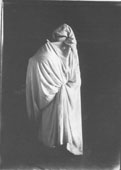
In addition to his work as a psychiatrist, de Clérambault was also an accomplished artist – for a while teaching classes on the art of the draped costume at the École nationale supérieure des Beaux-Arts in Paris – and an obsessive photographer. Between 1914 and 1918 he produced over 30,000 photographs, some of which formed part of a research project on the symptoms of hysteria, but also a sizeable body of work portraying Moroccan women under the veil. In these photographs, all of the female subjects are so elaborately and completely concealed from head to toe by swags of cloth, that it is difficult to tell that there is a human being, let alone a woman, under these garments. Yet at the same time these enigmatic and spectral figures seem to possess a quality that is both predatory and erotic.

All artists project their desires onto their surroundings. Perhaps the same is true of psychiatrists, or indeed anyone seeking to further our own (or maybe just their) abilities to make sense of the world. What interests me most about de Clérambault is the conjunction between his psychiatric practice and his private compulsion to record this singular subject.

(1) Vladimir Lerner, British Journal of Psychiatry http://bjp.rcpsych.org/content/197/5/371.short
(2) Anderson CA, Camp J, Filley CM (1998). “Erotomania after aneurysmal subarachnoid hemorrhage: case report and literature review”. J Neuropsychiatry Clin Neurosci 10 (3): 330–7

Ûm¶Û