Alien encounter (part 2) – Sat 9th May

Several theories have been floated regarding the sensation I described yesterday*. These range from out of body experiences, to comments that I was under the influence of various artificial stimulants. One suggestion: ‘somatic symptom disorder’, does come close – after all, it was certainly ‘all in [or on] my head’ – but only because in reality a seagull had landed on mine in the mistaken belief that it would provide a handy platform from which to eat the (my) aforementioned prawn sandwich.

I suppose it could have been worse. As mentioned in my post of 19th March, Aeschylus the Greek Tragedian was killed outright when an Eagle mistook his head for a rock and dropped a tortoise on him from a great height. At least I (and my sandwich) came out of the encounter unscathed, and it is some comfort to know that now, somewhere on the seafront, a seagull has learned that certain kinds of large pebble will shout “fuck off you little sod!” when landed on.

*mainly because facebook truncated my post again, removing the (admittedly somewhat obscure) punchline.

Jerusalem dissected – Thurs 7th May

“The phrase “dark Satanic Mills”, which entered the English language from this poem, is often interpreted as referring to the early Industrial Revolution and its destruction of nature and human relationships.

This view has been linked to the fate of the Albion Flour Mills, which was the first major factory in London. Designed by John Rennie and Samuel Wyatt, it was built on land purchased by Wyatt in Southwark. This rotary steam-powered flour mill by Matthew Boulton and James Watt used grinding gears by Rennie to produce 6000 bushels of flour per week.

The factory could have driven independent traditional millers out of business, but it was destroyed in 1791 by fire, perhaps deliberately. London’s independent millers celebrated with placards reading, “Success to the mills of ALBION but no Albion Mills.” Opponents referred to the factory as satanic, and accused its owners of adulterating flour and using cheap imports at the expense of British producers. A contemporary illustration of the fire shows a devil squatting on the building. The mills were a short distance from Blake’s home.”

From Wikipedia (I admit it, I love Wikipedia): http://en.wikipedia.org/wiki/And_did_those_feet_in_ancient_time

Stubborn – Thurs 23rd April

“Dandelion. noun… ORIGIN late middle English: from French dent-de-lion, translation of medieval Latin dens leonis ‘lion’s tooth’ (because of the jagged shape of the leaves)”

Actually I thought it was called dent-de-lion, not after the leaves but the flowers, whose petals are not only many, long and pointed (like the teeth in a lion’s mouth) but also because during the late middle ages up until the time of Shakespeare, lions teeth were thought to be yellow due to their monstrously carnivorous diet.

I’ve just been searching all over the place for some evidence of this and in particular through the play: ‘A Midsummer Night’s Dream’ because I could have sworn there was a line in it that backed up this theory, but there isn’t.

I am now really irritated and I have to ask myself: why have I wasted several hours trying to prove the Oxford English Dictionary is wrong?

I still think my version is better.

Further thoughts on concealment – Sat 28th March

One of the many apocryphal stories about the US military relates to their attempts to develop a camouflage effective against thermal imaging devices. As you’ll probably be aware from wildlife programmes, infra-red detection can be used to identify a living being by the heat given off from its body. If the hot spots are rabbit shaped, it’s pretty likely you’re looking at a rabbit; by the same token, if they are man shaped it’ll probably be a man you’re looking at.

Anyone who’s seen ‘Predator’ will also have some idea of what infra-red vision looks like, from the shots where you see through the eyes of the alien. Unfortunately though, I have to report that smearing yourself from head to toe in river mud (in the manner employed so manfully by Mr Schwarzenegger to fool the alien) doesn’t actually work.

Millions of dollars of US government money were spent on finding a solution to the problem of infra-red visibility, leading to the development of clothing that concealed these ‘heat signatures’. Of course soldiers had to be completely covered in this special insulating fabric for it to be effective, but it looked like the defence contractors were on to something really big. Well, until, during field tests when it was discovered that, while anyone wearing these suits would be prevented from giving off any heat whatsoever, thereby making them invisible to thermal imaging devices, they would, as a result, pass out from overheating after only a few minutes and could even die if not rescued quickly.

Actually, I think they missed a trick here. If, instead of totally covering soldiers in heat insulating material, they had instead opted simply to disrupt the human outline by creating heat-transparent windows in the shape of other animals, this could have allowed the cooling necessary for the combatant to continue functioning. In addition, by presenting, in infra-red, what looks like a tower of acrobatic bunnies precariously balancing on each others backs, any sniper seeing such a spectacle would simply assume they’d been overdoing it and go away scratching their head.

You could also vary the animal-shaped windows to include koalas, marmosets, lemurs, squirrel monkeys, kittens, sloths, wombats and other small to moderately sized mammals to keep the enemy off balance.

I’ve decided to publicise this idea openly to the world rather than seeking my fortune from any particular country of military significance because I couldn’t bear the thought of having blood on my hands, whether it be human or any other small mammal that’s good at balancing acts.
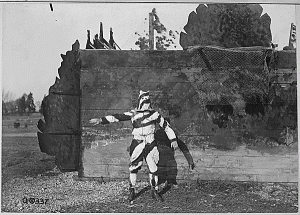
28-0785a

Early example of camouflage 11/14/1917
http://research.archives.gov/description/530710
Bay – Fri 27th March

‘To hold all this together, Rauschenberg’s picture plane had to become a surface to which anything reachable-thinkable would adhere. It had to be whatever a billboard or dashboard is, and everything a projection screen is, with further affinities for anything that is flat and worked over—palimpsest, canceled plate, printer’s proof, trial blank, chart, map, aerial view. Any flat documentary surface that tabulates information is a relevant analogue of his picture plane—radically different from the transparent projection plane with its optical correspondence to man’s visual field. And it seemed at times that Rauschenberg’s work surface stood for the mind itself—dump, reservoir, switching center, abundant with concrete references freely associated as in an internal monologue—the outward symbol of the mind as a running transformer of the external world, constantly ingesting incoming unprocessed data to be mapped in an overcharged field’

Leo Steinberg
The Flatbed Picture Plane
First published in ‘Reflections on the State of Criticism’, in Artforum in March 1972; then in ‘Other Criteria’, 1972, pp.61-98

Kyoto rocks – Weds 4th March

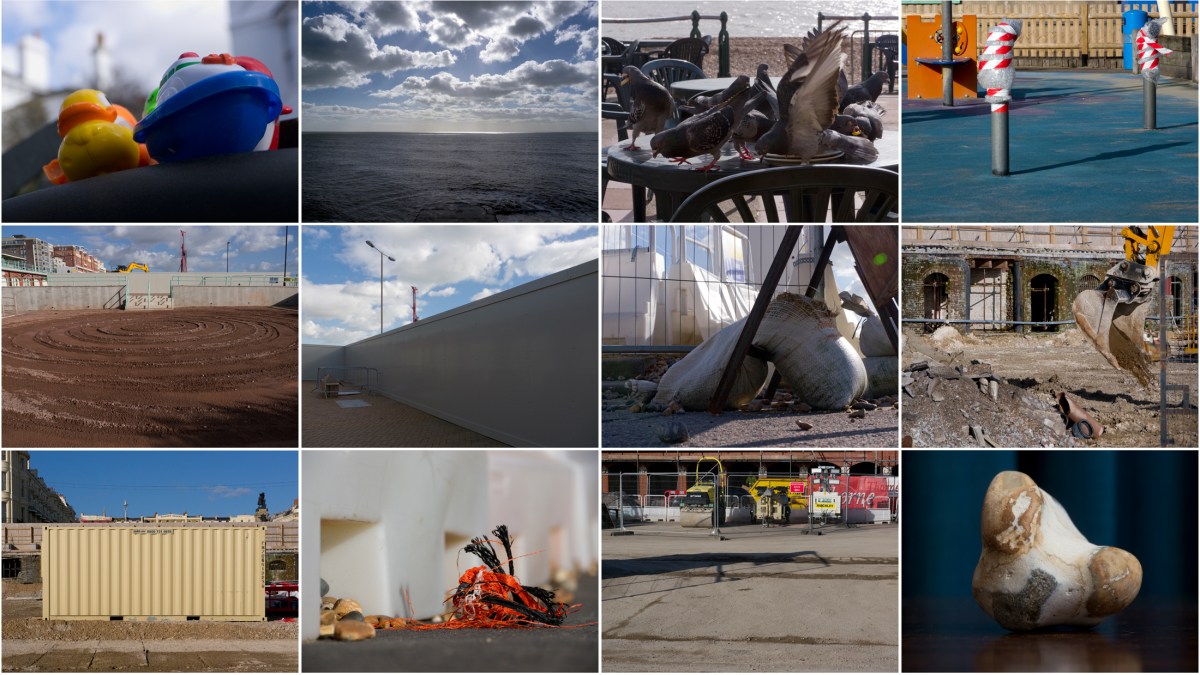
Work continues apace on the new sea front developments. This leaves me with mixed feelings. On the one hand, it makes me weep that the council have demolished most of the 40s and 50s architecture, put in yet more shops and re-branded that part of the beach the new ‘creative quarter’. I get a bit funny about things being branded ‘creative’ when the real ‘creatives’ are being driven out of the city either because they can’t afford the increasing rents or because their studios have been demolished to make way for redevelopment… and for that matter, ‘quarter’ of what? What’s the other three quarters doing that’s so different?

On the other hand, I retain an utterly childish delight in any huge mechanical thing that can shovel vast amounts of earth from one place to another, make really big holes in the ground and then fill them with quick-setting slurry.

As a result of this ambivalence I spent a fair bit of time on the sea front today looking at the works in progress, outwardly sneering in righteous indignation while my inner 6-year old waited in forlorn hope for the site foreman to come over and say to me “here you are sonny, do you want a go on the big yellow monster?”

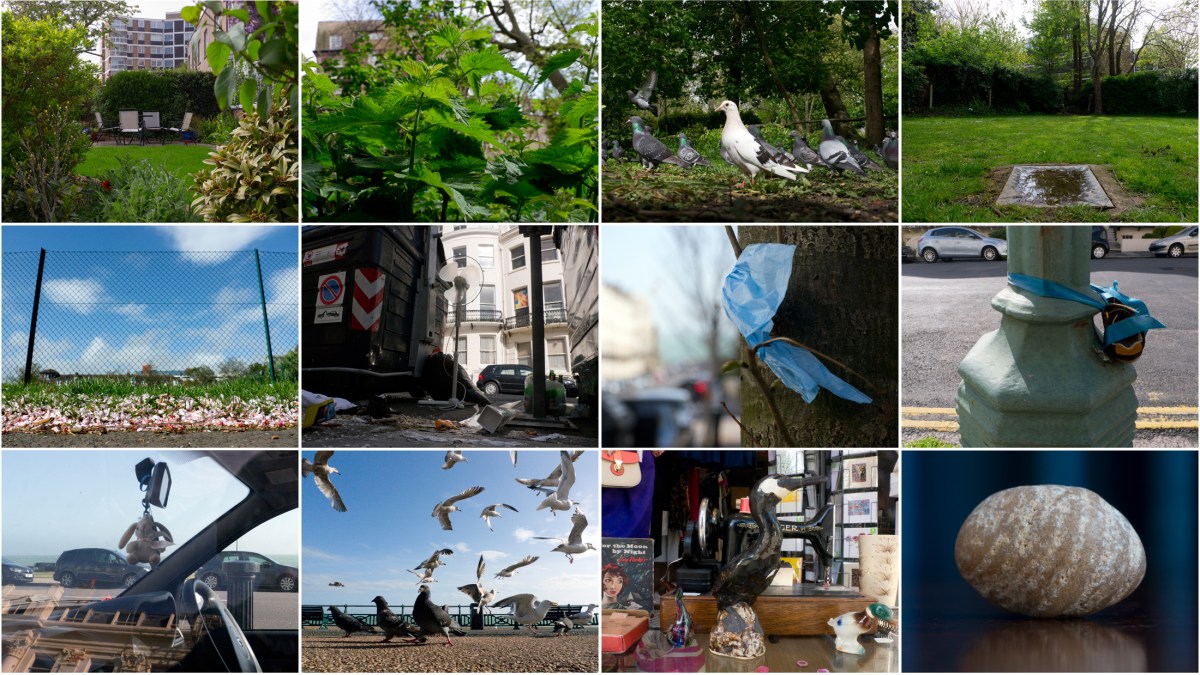
However, the real point of today’s entry is to highlight yet another mystery of the city, that of the zen garden immediately adjoining the building site. This is in reality a patch of mud bordered by low walls, but the mud itself had been combed into a variety of different shapes over the past few months by something big. Yesterday I noticed it was in the shape of a heart, at other times it has been a spiral, wavy lines… today it was combed into a series of concentric circles. I’ve photographed it a few times now, so scroll through some of my previous entries and see for yourself.

Today I also noticed that the diggers and bulldozers can be surprisingly sensitive when used by trained operators. Not a simple case of smashing the ground from here to there but more like old films you see of elephants nudging logs into a pile, or dexterously taking and eating buns proffered by visitors to the zoo.

So, can it be, that one of the construction workers is actually a closet Buddhist who, before starting work in the morning and while the city still sleeps, takes his metal monster and rakes the mud into these designs in an act of contemplation and oneness with the world? I imagine the dawn light filled with the asthmatic Om of mechanical devotion purring sonorously from one of the bulldozers while it completes its lonely task. There always has to be hope.

Beyond the trees – Mon 23rd Feb

When I was very young I was given a snow globe for Christmas. Inside the plastic dome was a woodland scene in front of which skipped a small likeness of little red riding hood, complete with basket and, pacing in front of her, the wolf. It would be hard to say the monster was menacing, though the modeller had clearly tried to convey this meaning through showing its teeth, lolling tongue and hunched gait. But despite this, the overall appearance gave a wonderful impression of the loneliness of a pine forest in winter, and this strange initial encounter between girl and beast. The tableau entranced me, but I wanted to wander further among the conifers. What was behind the trees? Turning the globe round I was immediately annoyed to find that the back was made out of blue opaque plastic (which, I knew, worked from the front as a clear blue sky) but I found that if you held your eye close to the dome and squinted you could just see behind the trees. Of course what I saw was that all the characters and trees were flat, but this didn’t matter, I knew I was now looking beyond the illusion to its mechanics. Oddly enough this did not spoil the fantasy, but instead made me feel like I’d been let in on a secret, one of the same order as finding out where the tooth fairy lived. A few stray snow-flakes completed this scene beyond, giving it a feeling of abandonment, like a deserted shop, but also a kind of pregnancy, as if something was about to happen, or maybe that whoever had been there had only just left.

For events to be magical, there has to be magical characters making them so, and even the brushes and pots of glue they leave behind them retain some of that enchantment.

Call of the wild – Sat 21st Feb

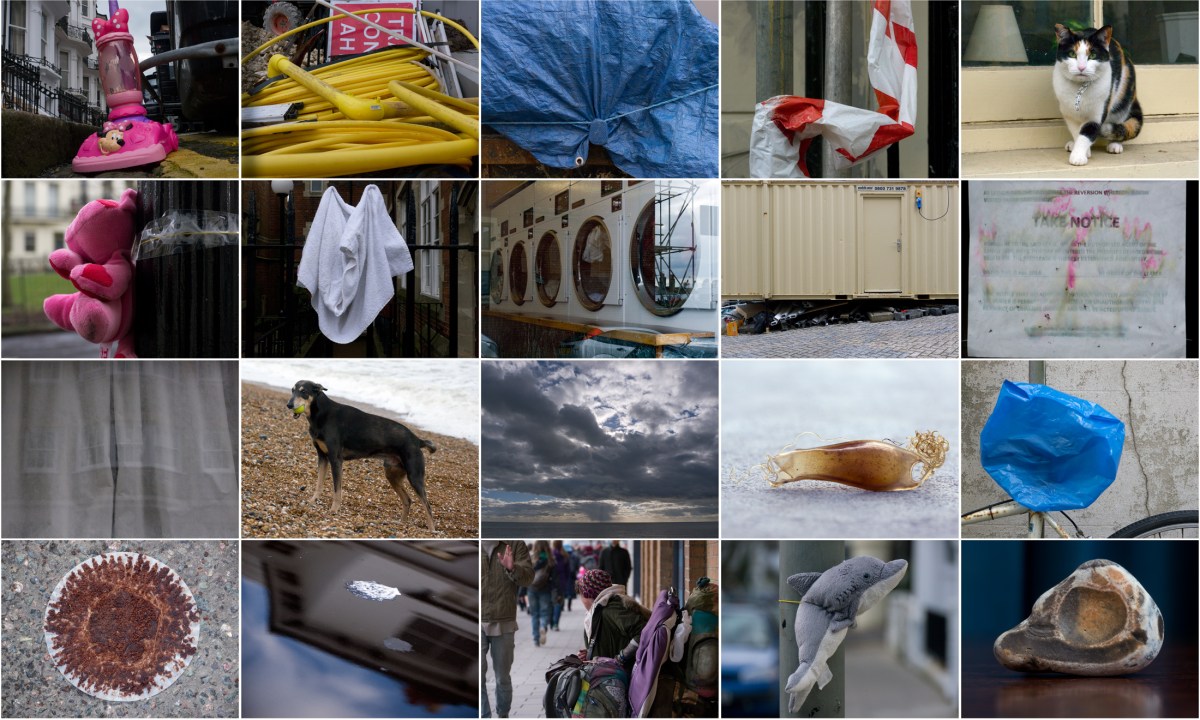
Someone has started strapping soft toys to lampposts. I came across the first one a couple of days ago (see image for 18th Feb) then three more on the way to the pub last night, and then two more today. Why? What’s going on?

Possible explanations:

  1. A dark witch or wizard living in the area has decided to put a hex on someone. Unfortunately because of various EU/Health and safety regulations, it is no longer possible to get hold of live animals to sacrifice; pre-packed nuggets, chops, burgers and cutlets, while real flesh, just don’t look right, and so she/he has had to be inventive; at least soft toys look a bit like whole animals.
  2. Something similar could apply to a local mafia boss, who, faced with the same regulations and the impossibility of getting hold of substantial equine parts to leave in the bed of rivals, is instead leaving coded messages along the lines of ‘You’ll be the next one to get stuffed. Remember Luca Brazzi…’
  3. A couple of robbers have ‘done over’ one of the local toy shops, been startled by the intruder alarm and fled, grabbing the nearest boxes of stock in their escape. These boxes have turned out not to be filled with highly desirable and re-saleable sega-wii-station-play consoles (or whatever they are called) but the aforementioned cuddly animals. In a fit of pique the robbers are now making a ‘statement’ by leaving them around town strapped to lampposts.
  4. They aren’t toys at all but cunningly disguised aliens hoping that people will take them home somewhere warm where they will be able to spawn. This strategy clearly hasn’t worked as they are all still there.
  5. A local lothario has purchased for each one of his unwitting harem a soft toy as a valentine’s gift. Unbeknownst to him these love-crossed women have recently found out about each other and are hatching a plan, the first part of which is to truss his duplicitous gifts to lampposts. I tremble to think of what might follow.
  6. An ogre has moved into the area and is hoping to use the toys as bait to lure children to their doom, a bit like leaving a trail of sweets in the forest. Again, this is proving a failure as a strategy because Brighton, having become gentrified of late, is filled with children who can recognise the difference between acrylic and natural fibres and therefore spurn these cheap goods.
  7. Going back to the Aliens theory, it might be that the toys are actually the fruiting bodies of fungus-based life forms from an asteroid that will soon explode filling the streets with mutant spores.

I’m hoping this last theory isn’t true as the idea has scared me a bit just thinking about it.

Pseudolithophilia – Tues 10th Feb

In ancient China, the appreciation of stones developed into a highly structured art form called ‘Gongshí’, or ‘scholars rocks’. Over subsequent centuries similar disciplines emerged in both Japan and Korea, named, respectively: ‘Suiseki’ and ‘Suseok’. In India, sacred stones, Shiva Linga, are still a vital part of daily worship. Western Europe saw the prehistoric megalith cultures, and the old and new stone ages. Some sections of modern society still place great store in the curative or talismanic properties of certain stones. Palaeontology deserves a whole book to itself. The 18th century French painter François Boucher prized his collection of objects of ‘natural philosophy’ (an emerging forerunner of modern sciences) including curiously shaped stones and minerals. And in recent decades, artists counting, among many others, Barbara Hepworth and Paul Nash, have had a tendency to collect odd shaped flints and other rocks for their aesthetic or mimetic qualities.

But, today, following my discovery of a mobile cliff face in a car park at the eastern edge of town, what I want to know is this: is there a similar practice that relates to the appreciation of artificial rocks and stones? We have plenty of models to use as a foundation for this new discipline: Star Trek abounds with exquisite examples as does the more esoteric 1957 East German children’s film: ‘The Singing Ringing Tree’ (‘Das singende, klingende Bäumchen’). Further pieces can be found in early episodes of Dr Who and numerous 50s B-movies. Then there are crazy golf courses, theme park rocks, ghost train caves and Christmas grottos, costume jewellery, garden, aquarium and vivarium ornaments, fountain accessories, coal-effect fires, decorative external cladding…

Every time I come up with what I think is a new idea, a quick search on the internet proves someone else has already been holding conferences on the subject, so, on that basis, the practice will surely, by now, be pretty well developed. So what’s it called? What are its rules and codes? Why can’t I find any mention of it? Or is this as yet still an underground movement?

singing ringing tree

Still from The Singing Ringing Tree, 1957, directed by Francesco Stefani