Uncertainty –17th Jan 2016

“There is no denying the reality of consciousness. For most of us, it is so self-evident that it requires no explanation. Your conscious self is the owner of your private reality, and your actions stem from conscious choice.

However, the more that is discovered about consciousness, the less obvious its role appears to be. For example, measurements of brain activity reveal that muscles and brain areas prepare for an action, such as a reaching out for an object, before we are even aware of our intention to make that movement. As noted by the psychologist Jeffrey Grey and others, consciousness simply occurs too late to affect the outcomes of the mental processes apparently linked to it.”

New Scientist
12th August 2015
https://www.newscientist.com/article/mg22730340-200-consciousness-evolved-for-the-greater-good-not-just-the-self/

Duck – 12th Dec 2015

“Are we then to say that the All is composed of indivisible substances? Some thinkers did, in point of fact, give way to both arguments. To the argument that all things are one if being means one thing, they conceded that not-being is; to that from bisection, they yielded by positing atomic magnitudes. But obviously it is not true that if being means one thing, and cannot at the same time mean the contradictory of this, there will be nothing which is not, for even if what is not cannot be without qualification, there is no reason why it should not be a particular not-being. To say that all things will be one, if there is nothing besides Being itself, is absurd. For who understands ‘being itself’ to be anything but a particular substance? But if this is so, there is nothing to prevent there being many beings, as has been said.

It is, then, clearly impossible for Being to be one in this sense.”

Aristotle. ‘Physics’ (Book I Part 3)
Translated by R. P. Hardie and R. K. Gaye

Wholesale – 11th Nov 2015

“To found a great empire for the sole purpose of raising up a people of customers may at first sight appear a project fit only for a nation of shopkeepers. It is, however, a project altogether unfit for a nation of shopkeepers; but extremely fit for a nation whose government is influenced by shopkeepers.”

Adam Smith, The Wealth of Nations 1776

Late transformation – 31st Oct 2015

“Once upon a time, I, Chuang Chou, dreamt I was a butterfly, fluttering hither and thither, a veritable butterfly, enjoying itself to the full of its bent, and not knowing it was Chuang Chou. Suddenly I awoke, and came to myself, the veritable Chuang Chou. Now I do not know whether it was then I dreamt I was a butterfly, or whether I am now a butterfly dreaming I am a man.”

Zhūangzi (莊子 also transliterated as Chuang Chou) c. 369 BC – c. 286 BC, China

Translated by James Legge

Magic marker – 22nd Oct 2015

Today I found a pink highlighter pen in the office where I work. On a strip of paper neatly taped to one side is written the word: ‘doom’. This discovery has deeply unsettled me. I have tried to rationalise my discomfort. After all, I tell myself, if you turn the pen round the word looks like ‘wood’, but this attempt at positive thinking is undermined by the fact that, this way up, the ‘d’ isn’t right. Either it’s back to front or, if it’s a lower-case ‘d’ then the upper part of the letter is missing. And the word is written too neatly to be subject to this kind of oversight. In any case, writing the word ‘wood’ (neatly, but with errors) on the side of a plastic pen seems to me to be even more nonsensical than ‘doom’.

No, I fear that ‘doom’ it is. But why would anyone tape the word ‘doom’ to the side of a pink highlighter pen? Have I stumbled upon a new bureaucratic form of voodoo, practiced by the administrators in the floor below? Or is this one of the secret and sacred tools of senior management? Is this a pen so powerful that, not only is it used to highlight, on some diabolic spreadsheet, the departments destined for ‘reorganization’, but also for deciding the eternal fate of the institution’s employees? And, more worrying still, why has it appeared on my desk?

Career opportunities – 21st Oct 2015

It has occurred to me that, after all, there may be a place for vampires in our modern world. One of the biggest problems in product photography is trying to avoid the image of the photographer intruding on pictures of things with reflective surfaces. Given the undead cannot be reflected in mirrors etc. this might give them a real advantage. Indeed, many of them may have already found employment in this specialist area. Its nice to think that there is a place for everyone nowadays.

Coming up soon: career opportunities for werewolves.

Sound effects – 19th Oct 2015

In cartoons, storytellers will sometimes reinforce a particular abstract concept with a sound effect. The sound of falling in love could include flutes and tweeting birds; abandonment might be accompanied by violins and slightly out of tune piano (in a minor key) while befuddlement resulting from a knock-out blow to the head will get tweeting birds but no music. There are also a rich variety of sounds associated with different aspects of financial exchange. Two that immediately spring to mind include noises of cash registers opening, and fruit machines hitting the jackpot, both signalling the imminent likelihood of increased cash flow.

Today, I wake up to the sound of builders on my roof. While dragging myself to the kettle, I overhear the following monologue: “Its fucking fucked mate, the worst I’ve ever seen, total shit. I mean look at that: fucked, and it goes all the fucking way down there too, see? I’m surprised no one’s got fucking killed from bits falling off looking at the fucking state of that. Here, see, fucked, fucked, fucked” etc.

And all at once I realise that this is the sound an overdraft makes as it hurtles straight towards you.

Details 1

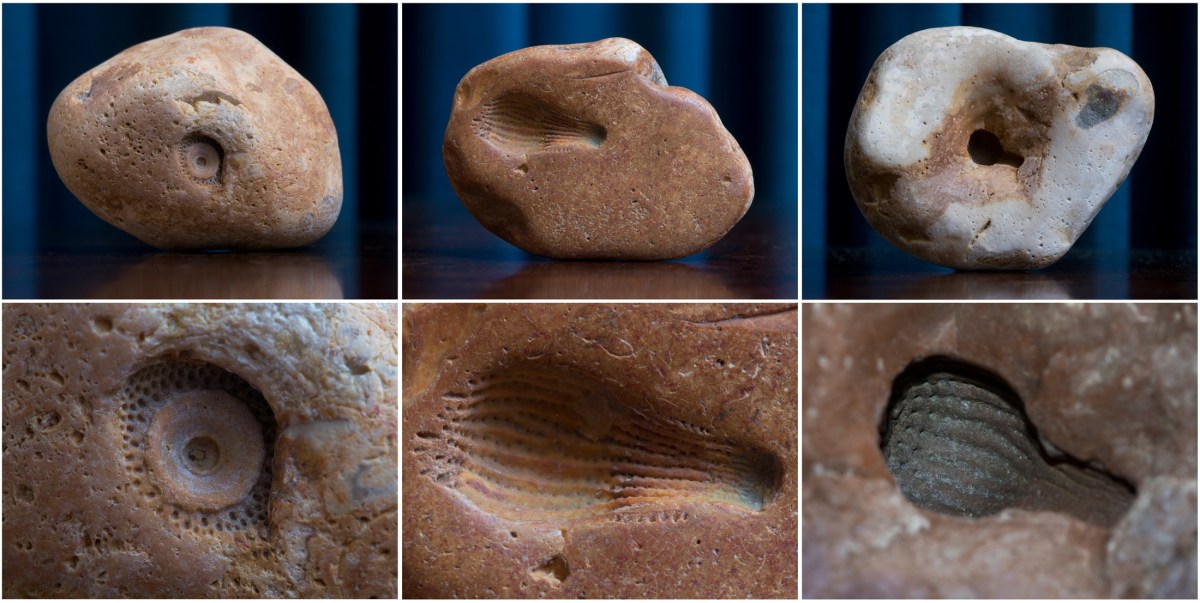
So far, of the stones I’ve collected, some present one particularly good angle and therefore photograph well. Others, often the most interesting, are more difficult as their specialness relies on them being held and turned in your hand. Trying to pin down their personality in a single image is tricky. On one occasion, I’ve posted a whole page of different views of the same object to try to get across the experience of the object in the round (see: Gargoyle – Weds 21st Jan). But there are still other stones, which, while not at first glance seeming particularly interesting, contain one detail that singles them out as remarkable. In most of those I’ve found so far, these details have been fossils: imprints of things that lived millions of years ago.

For a while now I’ve been wondering how to represent this kind of stone. In those I’ve found that are small, the point of interest is comparatively large enough to allow recognition in a small image. However in others, this facet is lost because of its diminutive size in relation to the object as a whole. So I’ve decided to post today a special page of three such examples, the complete stone shown on top and a close-up detail underneath.

Although not created by light falling on a sensitized surface, in other ways fossils are close natural equivalents to photographs: They are causal in nature, i.e. there had to have been a something for them to be an imprint of. Therefore, like photographs, they are indexical: always referring to things outside of themselves. And of course, as with photographs, they are often much more permanent than their subject; that which caused the imprint no longer remains, at least as it was when the imprint was made.

Actually, this is more obvious with fossils than photos, but the rule applies to both:

Take a picture of someone you know and the next time you do so they will have changed, maybe they’ll be wearing different clothes and you’ll find them a different mood (and always a little older). Even if you take several pictures on the same day, the light will change, the weather and so on. And even if in a matter of seconds, one fleeting expression will have gone, replaced with another, the wind will have ruffled their hair, a cloud will have passed in front of the sun.

Even statues change from moment to moment. Not their fabric of course, not obviously anyway, that takes longer. But their context, their relationship with the world around them, and this will reflect back on our apprehension of the objects themselves. The different people, birds, cars around them; or, again, the light, the weather, the time of day, the seasons, festive decorations, graffiti, the slow accretion of grime and lichen, the state of the neighbourhood… And, after all, none of us ever see the same thing the same way twice because we too change from minute to minute. You could spend the whole of your life photographing the same thing and never end up with the same result. But then, now I think about it, if we too change from moment to moment, maybe we could spend our whole lives revisiting the same photograph and never see it in the same way?

Where was I?

In these details I’ve tried to get across the tiny thing I think made these stones noteworthy, but of course to get the most out of the detail I’ve had to change the lighting, so some of them might not look entirely like they come from the object as a whole, as represented above them. But they are the same things, you’ll just have to trust me on this.