One Way Street – 23rd April 2016

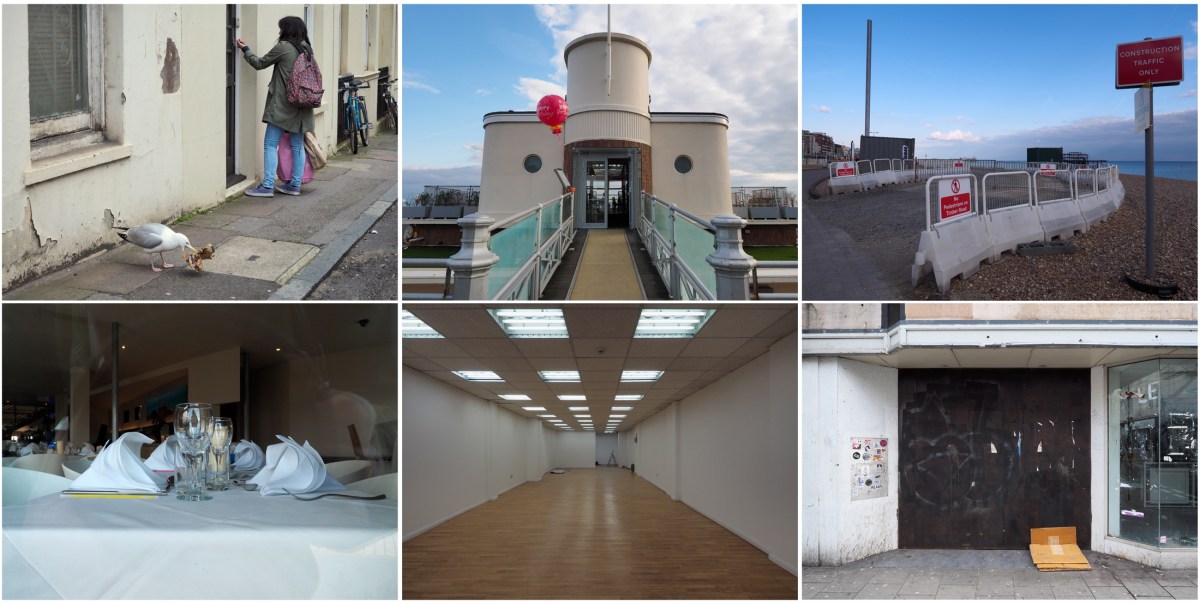
“The furniture style of the second half of the nineteenth century has received its only adequate description, and analysis, in a certain type of detective novel at the dynamic centre of which stands the horror of apartments. The arrangement of the furniture is at the same time this site plan of deadly traps, and the suite of rooms prescribes the fleeing victim’s path. That this kind of detective novel begins with Poe – at a time when such accommodation hardly yet existed – is no counter-argument. For without exception the great writers perform their combinations in a world that comes after them, just as the Paris streets of Baudelaire’s poems, as well as Dostoyevsky’s characters, only existed after 1900. The bourgeois interior of the 1860s to the 1890s, with its gigantic sideboards distended with carvings, the sunless corners where palms stand, the balcony embattled behind its balustrade, and the long corridors with their singing gas flames, fittingly houses only the corpse. “On this sofa the aunt cannot but be murdered.” The soulless luxuriance of the furnishings becomes true comfort only in the presence of a dead body. Far more interesting than the Oriental landscapes in detective novels is that rank Orient inhabiting their interiors: The Persian carpet and the Ottoman, the hanging lamp and the genuine Caucasian dagger. Behind the heavy, gathered Khilim tapestries The master of the house has orgies with his share certificates, feels himself the eastern merchant, the indolent Pasha in the caravanserai of otiose enchantment, until that dagger in its silver sling above the divan puts an end, one fine afternoon, to his siesta and himself. This character of the bourgeois apartment, tremulously awaiting the nameless murderer like a lascivious old lady her gallants, has been penetrated by a number of authors who, as writers of “detective stories” – and perhaps also because in their works part of the bourgeois pandemonium is exhibited – have been denied the reputation they deserve. The quality in question has been captured in isolated writings by Conan Doyle and in a major production by A. K. Green; and with The Phantom of the Opera, one of the great novels about the 19th century, Gaston Leroux has brought the genre to its apotheosis.

‘Manorially Furnished Ten-Room Apartment’ in ‘One Way Street’, Walter Benjamin, written 1925-26

Lithographs – 10th April 2016

The seven embellished pebbles shown in the photograph bottom left are, to my mind, some of the best examples of this peripatetic artform I’ve come across to date. Also, they raise several questions: Do they all have the same author or is this a group work? I suspect the latter as there is a difference, both in content and manner of execution. Three are decorative and quite beautifully drawn plant forms. Another resembles a stylised mediaeval comet; this suggests at least one of the authors has a sophisticated knowledge of early European manuscripts. Lastly, there are my favourites: the three in the top row, the ones I can’t fathom the meaning of. Why do I feel such a fondness for these? Probably because I can’t fathom their meaning.

Farmyard noises – 5th April 2016

The rest of my stay in Plymouth was delightful, but entirely without incident. In one respect perfect for what I wanted: have a bit of space, wander around, drink tea, look at things and take pictures of them, rest; but less good in terms of coming up with a story. Except…

My sister’s fridge has one of the most interesting personalities of any item of white goods I’ve ever come across. Don’t get me wrong, it does a great job of keeping things at the temperature they are supposed to be, the doors and the lights inside work well enough. What else can you say about a fridge? Well quite a lot as it turns out. Some mornings I’d get up and be making tea while listening to the sounds of the countryside, before realising that Oreston is not exactly ‘country’, more a quiet suburb, and the sounds of cattle lowing, or that of a particularly suggestive chicken scratching in the dirt, were actually being made by the fridge.

I suspect I’m anthropomorphising but given that so many modern appliances now have computer chips that regulate their functions, is there not at least a tiny possibility that one of them has begun to develop a rudimentary degree of consciousness, and alongside this it’s own language to comment on the job in hand? No matter that the task is boring and extremely repetitive, if your sole reason for existence is to keep your insides at a certain temperature, then your world view is going to be centred on this one aspect of material existence and you’re going to think it’s pretty damned important. Indeed important enough to want to comment on it endlessly. Furthermore, I think the fridge has at least a rudimentary degree of awareness of ‘other’. After all, if you’re of even a limited philosophical disposition, it’s only going to be a matter of time before you start asking why your doors are sometimes opened, your insides periodically filled and then slowly emptied again. These events will interfere with your primary function and therefore wellbeing. Depending on your outlook you will see these events as either a challenge, or a discomfort and, eventually, you are going to wonder whether there is something else out there doing these things to you.

Once you’ve got to this stage, self-consciousness has arisen, which may be why it has taken me a year to get an even half decent recording of it in full voice.

Up until now, every time I have become aware of it’s chattering and clucking, and managed to get my recording gear out, things have gone deathly quiet, and carried on this way for long enough for me to abandon the session. It cannot be a coincidence that this keeps happening; the bloody thing has self-awareness and does not like the proximity of other devices, or entities (i.e. me). In the end, like some hunter in the forest, I had to sit patiently for about an hour, pretending to do something else, before I could get even this rather bad recording, but it gives you an idea. Please listen to the whole recording, there are gaps of pregnant silence, but these only serve to make the utterances more powerful when they do happen, and do play the recording at full volume so you don’t miss any of the nuances.

Jennycliff – 31st March 2016

Last year when I first visited Jennycliff, I’d been disappointed to find that the path to the beach had been closed off because of cliff subsidence. Not only was there a big notice, but an even bigger and forbidding fence, complete with sharp bits, had been placed across the path that made sure you kept out. The views from the cliff and the café itself were still good, good enough reason to visit the spot, but there was always that feeling you were missing out on something.

This year I find the big notice and the even bigger forbidding fence are both still there, but in the intervening 12 months enough people had been irritated by this denial of access, and the fact that the cliffs still hadn’t been shored up, that now there was something of a path hacked through the gorse and clay just left of the fence, and just wide enough to allow circumnavigation. Paths like this tell you a lot about what to expect. On the one hand it wasn’t exactly official (if that had been the case the fence would have been taken away) but on the other hand it had seen enough traffic to indicate that more than one intrepid explorer had passed this way, on more than one occasion, had found the scrabbling worthwhile, and had lived to tell the tale. In short, you could get down to the beach, just don’t go crying to mummy if you fall over.

So L and I set off. It wasn’t far before you could see why the fence had been put up. A lot of the cliff had fallen away taking most of the path with it, so there was only a foot wide ledge in places to tread on, most of it mud made even more slippery by the recent rains. However, where it was at its narrowest some public spirited adventurer had tied a rope between the trunks of several shrubs so you had something to hold on to, and it didn’t take us long to get to the bottom.

Fences are strange things. Clearly they are designed to keep you out (or sometimes in) whether it’s ‘for your own good’, or just to keep you off someone else’s property, or make sure you’re where you’re supposed to be. But while their function is to prevent, they also act as a clear advert that here is something someone wants you kept away from, ergo, what’s beyond has to be interesting.

And fences do another thing: they delineate the borders of zones beyond the world of the ordinary, so that, once you’ve crossed this border, you are now in a special place where the usual rules no longer apply.

When we reached the beach there were a few teenagers there, some smoking, others clambering over rocks, throwing stones and rubbish from the shoreline, being generally loud, and one or two wandering on their own as far as the sea would let them. If I’d approached any of them with my ideas on life beyond the borders they would have just laughed or looked at me like I was mad. After all, there are other, more impenetrable boundaries that you only get to cross once.

Nesting season – 10th March 2016

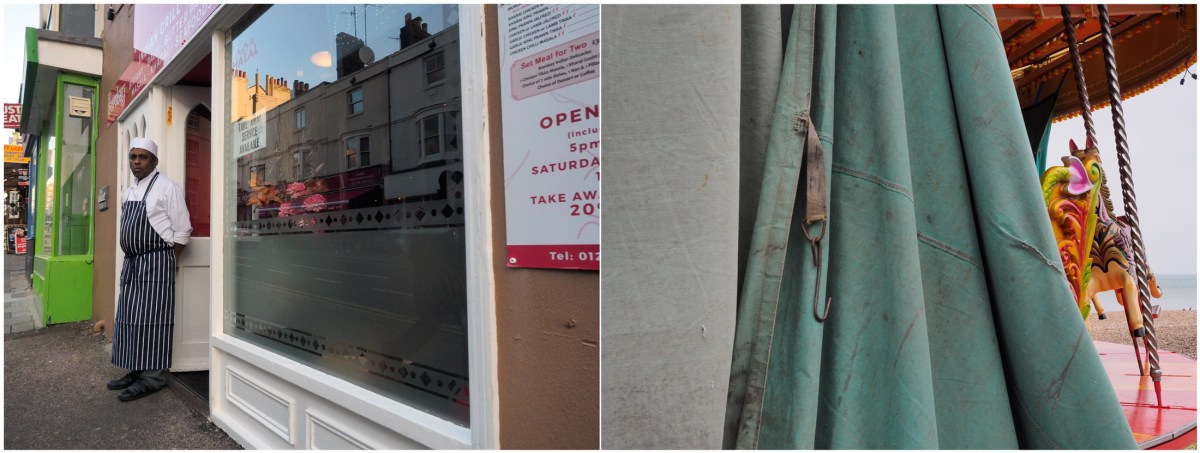
One of the delights about running a blog for an extended period of time, is that you can then look at what happened this time last year and note any seasonal variations. For instance: despite the weather being nowhere near as good as it was in March 2015, the seafront carousel is being assembled several days earlier. This is probably because we are having an early Easter this year, and the carousel boys will need to make sure everything works before the approaching holiday weekend.

To be honest though, observations like these are rather obvious. Much more interesting are the dates of this year’s mattress dumping season. For months it has been quiet on the abandoned bedding front but, as noted before (Weds 28th Jan 2015) as soon as the sun comes out properly, so do all the mattresses! Today’s example has not been the first I’ve seen on the streets; they’ve been appearing for a few weeks now (something I perhaps should have recorded, but I’d rather felt I’d ‘done’ that last year). However, while this means this seasonal event is running about a month late in purely calendar terms, it confirms that the phenomenon is directly linked to the amount of direct sunlight present on a number of given days, i.e. as soon as it gets sunnier, the rate of this activity rises. This is not dissimilar to the breeding habits of pigeons who, while remaining sexually active throughout the year, show a marked increase in ‘interest’ as the days get longer. Therefore I am confident that the human nesting season has begun; a sure sign that the new spring is on its way!

Smile! – 24th Feb 2016

Every so often you see an item on the news, or social media, with a caption something like ‘best selfie of 2015’ showing a picture of someone simultaneously wrestling a shark while extending their arm in that telltale gesture, or being photo bombed by dancing Chihuahuas, or maybe five world leaders showing they can be spontaneous and goofy while taking time off from discussing important plans to appear to do something about global warming or, or…

In all of these cases, it’s the content of the photo that earns the caption. This is all fine and well, but in placing so much emphasis on what’s in the picture we overlook one of the defining characteristics of the selfie, that of pose. To me, this is where the true quality of the new artform lies.

Therefore, I propose that from now on, any awards for best selfie of the year should take into consideration the following criteria:

Facial expression: this does not need to convey happiness, but should reflect the intentions of the photographer/subject, plus the relationship between knowingness and sincerity
Stance: very important, you are not only conveying a self-image, but are also acting as steady support for the camera – all blurring for whatever reason should be penalised
Nuance: this comprising detail in relation to the entire concert of gestures, props and clothing.
Context: highly important, but should always be subordinated to the photographer’s ideas, so kiss goodbye to the photo-bombing Chihuahuas, they weren’t intended.
Inanity: this is a difficult concept to define positively, but in the case of the selfie I think it has something to do with evidence of ‘really meaning it’ despite the banality of the form.

This is only my first attempt at distilling these key elements and will doubtless need amending. However, I believe today’s photograph exemplifies the above qualities to a conspicuous degree.

Wabi-sabi – 23rd Feb 2016

“Wabi-sabi is ambivalent about separating beauty from non-beauty or ugliness. The beauty of wabi-sabi is in one respect, the condition of coming to terms with what you consider ugly. Wabi-sabi suggests that beauty is a dynamic event that occurs between you and something else. Beauty can spontaneously occur at any moment given the proper circumstances, context, or point of view. Beauty is thus an altered state of consciousness, an extraordinary moment of poetry and grace.”

Leonard Koren, ‘Wabi-Sabi: for Artists, Designers, Poets & Philosophers’

Change of use – 17th Feb 2016

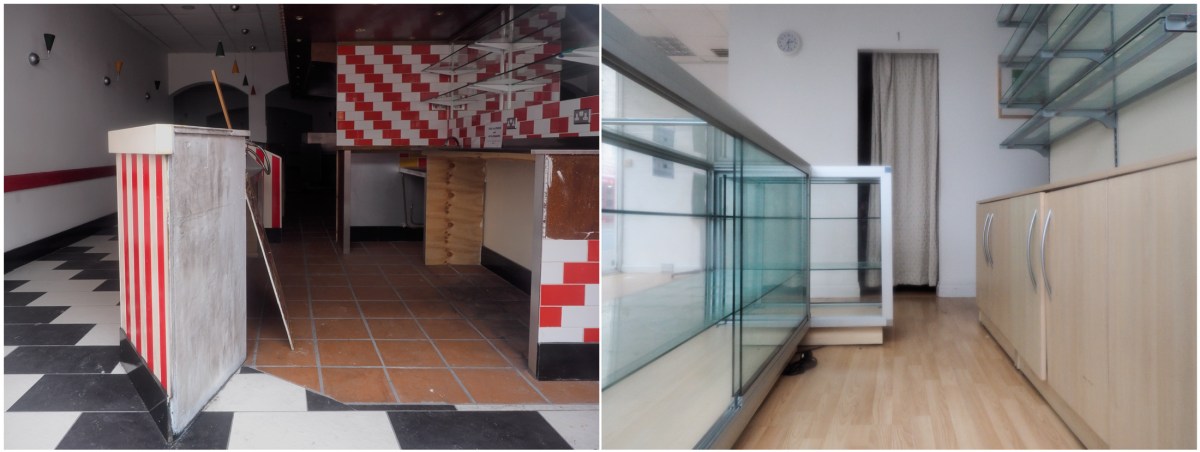
The one on the left is a closed down burger bar. The one on the right used to be a shop selling natural remedies and offering alternative therapies. Before these businesses, they were something else. Afterward, they will, again, be something different.

Perhaps in the same way that, in the days of early Christianity, churches were built on the sites of former temples and places of pagan worship to ‘cleanse’ these places of their former use, yet nevertheless something holy and ancient would still persist, does something of the spirit of past occupants colour these new ventures? Would fast food sold from a burger bar opened on the site of a health clinic be mysteriously better for you? (Eat all you like and never put on a pound!) Would a health shop opened on the former site of a burger bar be doomed to failure? Can we ever know these things?

Thingness – 26th Jan 2016

“We see the things themselves, the world is what we see: formulae of this kind express a faith common to the natural man and the philosopher — the moment he opens his eyes; they refer to a deep-seated set of mute “opinions” implicated in our lives. But what is strange about this faith is that if we seek to articulate it into theses or statements, if we ask ourselves what is this we, what seeing is, and what thing or world is, we enter into a labyrinth of difficulties and contradictions.”

Opening lines of: Maurice Merleau-Ponty ‘The Visible and the Invisible’ Translated by Alphonso Lingis, Northwestern University Press 1968