Simulacra and Simulations (part 2) Tues 20th Jan

Baudrillard heads his essay: ‘Simulacra and Simulations’ (already quoted from on 5th Jan) with these lines from Ecclesiastes:

The simulacrum is never what hides the truth – it is truth that hides the fact that there is none. The simulacrum is true.

This powerful introduction, not so much header as headstone, sets the tone for the whole piece, an excoriation of the 20th century consumer dream made reality, that in Baudrillard’s view:

Disneyland is presented as imaginary in order to make us believe that the rest is real, when in fact all of Los Angeles and the America surrounding it are no longer real, but of the order of the hyperreal and of simulation. It is no longer a question of a false representation of reality (ideology), but of concealing the fact that the real is no longer real.

It is therefore appropriate that this quote from Ecclesiastes is a fake. Even the word simulacrum was only first recorded as being used in the English language in the 16th Century.

Here’s some genuine verses from Ecclesiastes:

To every thing there is a season, and a time to every purpose under the heaven:
a time to be born, and a time to die; a time to plant, and a time to pluck up that which is planted;
a time to kill, and a time to heal; a time to break down, and a time to build up;
a time to weep, and a time to laugh; a time to mourn, and a time to dance;
a time to cast away stones, and a time to gather stones together…
(Ecclesiastes 3: 1-5, King James Version)

Given my current interests, I particularly like the last line of this quote.

Perch (part 2) – Sat 17th Jan

Yesterdays post caused quite a stir, eliciting several responses. Among these were two from regular readers, both of whom pointed out that being in a bar ‘with someone three or more times your size and a completely different shape’ was not supposition but fact, if you live in either Glasgow or Plymouth.

This discovery gives rise to the following questions:

  1. What kind of bars were they hanging around in?
  2. How much had they had to drink?
  3. Am I getting out enough?

Of course, this reported phenomenon might actually be based on an incomplete grasp of the laws of perspective. Since I used to teach this subject, I am aware of a number of teaching resources which might help clear up any possible misconceptions and I append one of the finest lectures I know of, dealing with just this matter. Please don’t be confused by the Father Ted preamble, it is well worth watching till the end:

Gone with the wind – Sun 11th Jan

In ancient Greece, followers of Pythagoras were expressly prohibited from eating beans. This was actually quite a sensible proscription if you consider that, in the ancient Greek language the word πνευμα (pneuma) means not only ‘wind’ (hence pneumatic: inflated, or pneumonia: πνευμονία) but also ‘soul’, which meaning still survives today as a linguistic metaphor, as in: ‘breath of life’, and the rather quaint custom of saying ‘bless you’ to someone who has just sneezed.

While the real purpose of this blessing is now ambiguous, it stems from the European belief that the soul is expelled from the body when sneezing and that, variously, the devil might either steal away your soul while in this homeless state, or, conversely, that our temporarily vacant bodies could become occupied by the devil in our absence. Incidentally, Judith, one of the canteen ladies where I work, told me off recently when I thanked her for her answering benediction, telling me that to express gratitude in this particular instance would negate the response.

As above, so below, as the saying goes. I’m not sure if Brussels sprouts were known to the Pythagoreans but if they were, I suspect they would have been forbidden too.

Language can be a tricky thing.

Green – Sun 4th Jan

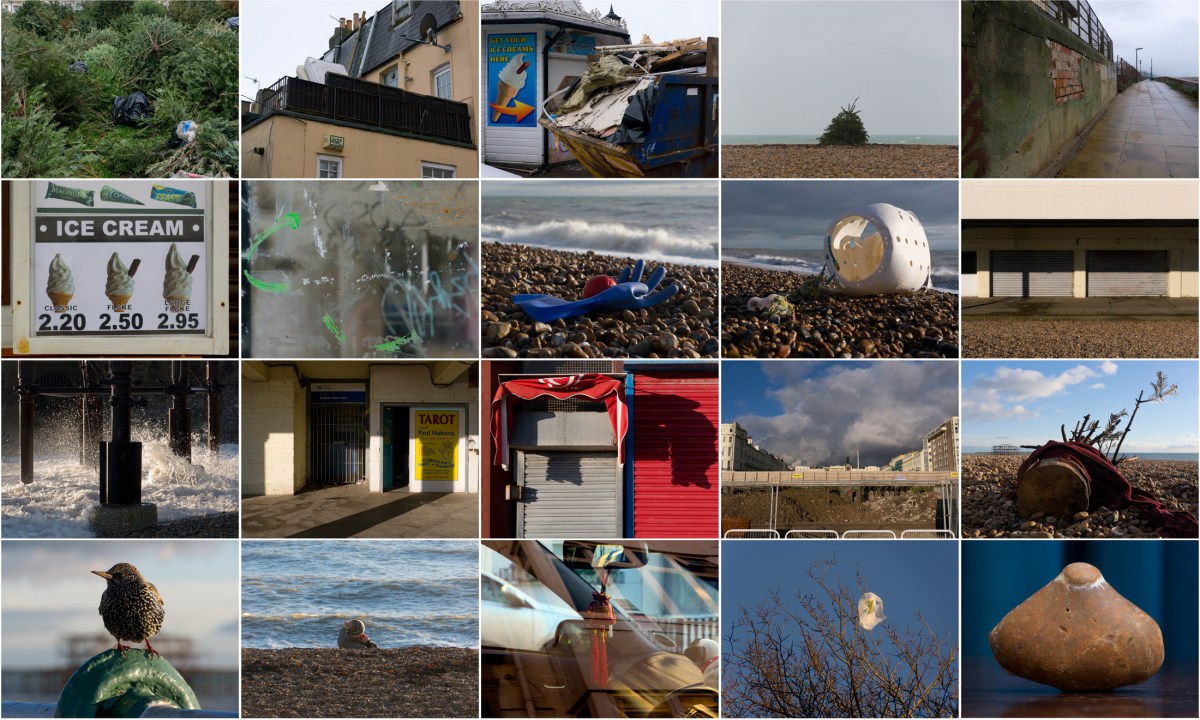
Everyone’s heard of Santa and his little helpers, who work tirelessly throughout the year to make sure everyone has something to open on Christmas day (by the way, on that subject, everyone really does get something from Santa. The myth about naughty children going without is exactly that, a myth. Santa’s ways are far more subtle, if you’ve been bad he just makes sure you get something you can’t even get rid of on ebay). Anyway, so, we all know how Christmas is prepared for, but what about the aftermath? Well today I found out when I met one of the cleanup fairies pulping abandoned Christmas trees in the crescent round the corner from me. They do this job in secret, assuming no one is about because we are all at the January sales. Consequently he was a bit surprised when I walked over to him, but was reassured by my confession that I hadn’t got any film in the camera (well I haven’t, it’s digital). He let me watch him at his work for a bit and then we had a chat. Apparently all the wood-pulp is collected and flown by reindeer back to the north pole where, because Santas workshop now has injection moulding facilities, the pulp is turned into next years presents. Smart eh?

He also told me the equipment logo stands for: JENSEN – January Elf (North) Sanitising Everything back to Normal.

In future posts I will tell you more about the tooth fairy, the hangover fairy (she’s the one that comes in the night and carefully coats your tongue in off-white goo that tastes like the bottom of a parrot cage) and the office party photocopier fairy. However I will not be revealing anything about the Sandman as his case is still sub-judicae.

Logic (Part 2) – Thurs 11th Dec

A good friend of mine was kind enough to respond to my post of 8th December informing me that the ‘Mrs Brown’ piece was originally written by Aristotle to demonstrate the failure of deductive knowledge.

This is remarkable. I mean the last time I saw her I thought she looked a bit tired but I had no idea Mrs Brown was over 3000 years old. Way to go girl! You’re looking great!

It can’t be the same fur coat can it?

Etch-a-sketch – Thurs 27th November

Palimpsest is the name for a particular kind of manuscript in which a text has been erased to allow the page to be re-used for a subsequent work. The term dates from well before the introduction of paper, when scribes wrote on parchment or vellum. Because both of these kinds of surface are made from animal skins (goat or sheep) they are highly durable, allowing them to be scraped back and re-written. As a result, during times when writing surfaces were difficult to come by, or demand outstripped supply, whole books or scrolls were erased to make room for newer or (what at the time was considered) more important works. Sometimes, heretical or ‘pagan’ works were overwritten with biblical text in order to sanctify or neutralise the older writings.

Often the previous works were not completely erased, or left enough of an impression on the surface, so that scholars have since been able to decipher what was written before. In recent times archaeologists have made additional finds through the use of digital technologies, together with a range of multi-spectral photographic techniques. The study of palimpsests has led to discoveries of lost works by Euclid, Archimedes, St John Chrysostom, Cicero, Seneca… one particular Qur’anic work has been dated to within fifteen years of the death of the Prophet Muhammad.

Palimpsest seems to be one of those peculiarly archaic words destined to the dusty corners of a few highly specialised subjects, yet, in truth, we should be using this word regularly. Pretty much every piece of information we have on our computers (i.e. everything these days) is a digital, multi-layered, hyper-palimpsest: the result of information written and over-written on previously erased surfaces carried out so often that, had they needed to be physically re-prepared so many times, they would have worn transparent and disintegrated.

Every time you transfer an image from your camera, to your computer, to your iPad, to someone else’s, to… you take up space on your hard drive or memory card which you’re likely to soon delete again. The web page you’re reading now will soon be replaced by something else, even though we assume it remains ‘somewhere’. Indeed digital technology has re-written the meaning of the word original. Ask yourself, where are all the original photos you took? You probably erased them a long time ago, but you still have the originals on your computer, don’t you?

Fairy loaves – Tues 11th Nov

The practice across England of collecting fairy loaves and placing them in burial mounds and graves, dates back as far as the Palaeolithic era and persisted up until Anglo Saxon times. Indeed within local lore they have been seen as protection from witchcraft, this belief even continuing today in certain circles.

But what are fairy loaves? Small stones with five-point symmetry shaped remarkably like a small loaf of bread, they are in fact the fossilized remains of sea urchins, pre-dating our own species by millions of years. The chances of finding one on a seashore covered entirely with pebbles, so that the beach here acts like an enormous grinder, are about as likely as finding hens teeth. Are they magic? I do hope so since I’ve now got one, found on my search for today’s stone of the day.

I was going to tell you a story about a flock of starlings and some tandoori chicken but that’ll have to wait till another time.