Getting creative – Thurs 30th April

I’ve heard several politicians speaking recently on the TV and radio, in the run up to the elections, about support for the creative industries. This all sounds lovely, we don’t get a lot of assistance for the arts in the UK and its nice to think that there are people out there who care for artistic production, especially since the Olympic games soaked up so much national funding. Except…

I had to do some work on this subject a couple of years ago and, in so doing, it came as a bit of a surprise to find out what the civil service terms ‘creative industry’. Art might be included, but it’s buried in a very long list of other occupations, most of which don’t actually seem to involve making anything.

‘So what’ you might say? And indeed I’d have to agree, there are a lot of other things we should be spending public funds on like housing, healthcare, education etc. But if someone says they are going to do something, its worth knowing what they mean. And if ‘supporting the creative industries’ actually means tax breaks for ‘Marketing and sales directors’ (one of the industries on the list, for instance) then I’m not sure if this qualifies for support for the arts.

The list itself, as defined by the DCMS, goes a long way to suggesting the kinds of issues created by lumping so many different occupations under this title, so here it is for your delectation. Do look through the whole list, the devil is in the details, but don’t expect anyone using the term to actually have the faintest idea about the issues faced by actual, er, artists. So, if you come across a politician in the next couple of weeks, why not ask them to explain what they mean if they use the term. If nothing else it might give you a laugh.

Creative industries as defined by the DCMS (Department for Culture, Media and Sport):

Advertising and marketing: Marketing and sales directors; Advertising and public relations directors; Public relations professionals; Advertising accounts managers and creative directors; Marketing associate professionals
Architecture: Architects; Town planning officers; Chartered architectural technologists; Architectural and town planning technicians
Crafts: Smiths and forge workers; Weavers and knitters; Glass and ceramics makers; decorators and finishers; Furniture makers and other craft woodworkers; Other skilled trades not elsewhere classified
Design: product, graphic and fashion design: Graphic designers; Product, clothing and related designers
Film, TV, video, radio and photography: Arts officers, producers and directors; Photographers, audio-visual and broadcasting equipment operators
IT, software and computer services: Information technology and telecommunications directors; IT business analysts, architects and systems designers; Programmers and software development professionals; Web design and development professionals
Publishing: Journalists, newspaper and periodical editors; Authors, writers and translators
Museums, galleries and libraries: Librarians; Archivists and curators
Music, performing and visual arts: Artists; Actors, entertainers and presenters; Dancers and choreographers; Musicians

(DCMS headings in bold followed by what’s grouped under these titles)
Bedtime Story – Sat 18th April

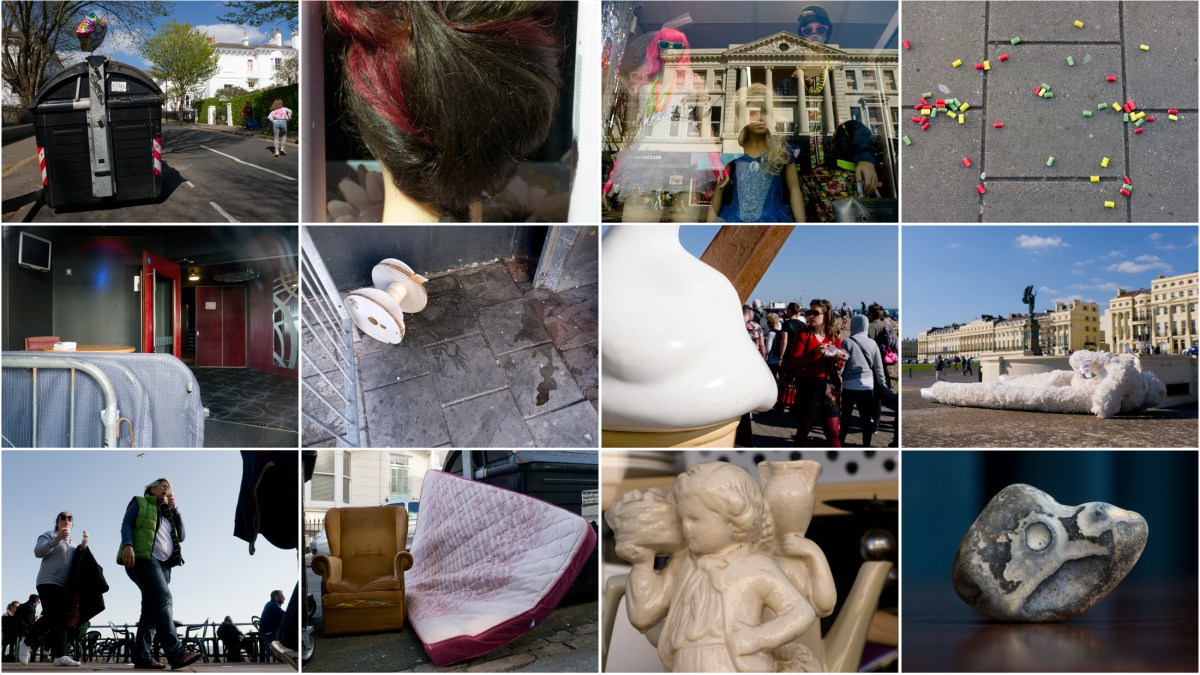
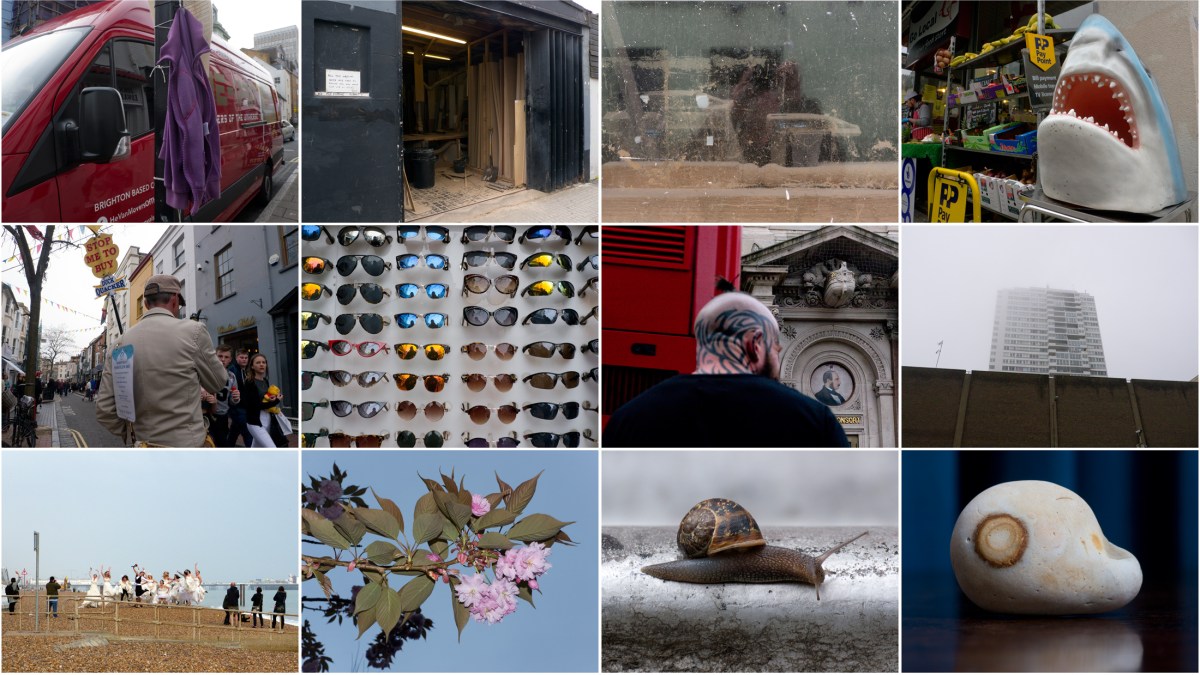
The rubbish bin in the top left picture of today’s contact sheet used to be a nine year-old girl called Clarissa. Unfortunately she was a very naughty child, much given to spiteful remarks about the other children she went to school with, many of whom would run away in tears following one of her ‘observations’. The parents of the other children tried all sorts of things to console their tender offspring, even repeating to them the rather lame rhyme beginning ‘sticks and stones…’ but it was no use, everyone knows how hurtful names are.

So, one day the parents of the other children decided to go and see the local voodoo doctor. The doctor thought about this problem for a long time and eventually decided that, just for a short while, maybe a week or two, Clarissa should be transformed into something useful but lowly to teach her a lesson. After a lot of further consideration and a few more incantations just to make sure, he decided the appropriate shape for her would be that of a municipal rubbish bin.

A lock of Clarissa’s hair was procured, the wax doll made and all was going according to plan until, having successfully completed the spell, the voodoo doctor decided to relax from his endeavours with a nice cup of tea. Halfway through his break the phone rang and, jumping up in a start, he knocked his tea all over his book of reverse spells, making the ink run on the pages so much that he could no longer read the words. With the words of the undoing spells now completely illegible, the voodoo doctor no longer knew how to turn Clarissa back into a little girl so she was now stuck in her new shape forever!

This was a pity. The voodoo priest was very sorry and had to go and see Clarissa’s parents to explain that, without the right incantation, this particular magic could not be undone. They were not happy about this but had to admit she was jolly useful now. So, to this day, Clarissa waits outside her home, hoping that another more competent voodoo doctor will pass by with the right kind of spell remover.

Every year on her birthday, her parents go into town and buy a balloon, which her little sister (pictured right) then ties to Clarissa’s lid. In this way they show her that, even though she is now a rubbish bin, they still love her very much, all things considered.

Tomorrow I will tell you the truly awful story of how Nigel Watley became a supermarket shelf.

Plymouth Bites (part one)

The history of the Cornish Pasty is intimately linked to tin mining in Cornwall and Devon, one of the oldest industries of our shores, dating back beyond 2500 BC. The pasty itself evolved as a packed lunch for the miners; a nourishing and hearty meal of beef and root vegetables wrapped up in a pastry case to make them easier to carry down the pit. Also, given that the miners would have had to eat their food in dusty confined spaces and in complete darkness, having your dinner encased in an edible wrapping would have been vital. To get an idea of the importance of this for yourself, try eating your dinner blindfold while hunched up in a cupboard under the stairs (no tables or forks allowed either). For full effect, empty the contents of your vacuum cleaner bag into the space just before starting to eat. Dishes like Salade niçoise or Tagliatelle carbonara aren’t practical in these conditions.

Plymouth’s origins too are closely tied up with the tin mining industry. Plympton, now a district within the city, was one of the key ports for exporting the metal until the river Plym became so silted up with mining debris that it was no longer navigable and boats had to moor south of this original destination. This ecological disaster probably contributed to the development of Plymouth as a major port.

At the time of Christ, the tin mining industry was already venerable and there was significant trade between the south west of England and the Mediterranean countries as far as the Middle East. Indeed legend has it that Joseph of Arimathea, Jesus’ uncle, regularly visited these parts on business as a tin trader and that Jesus, while a boy, once accompanied him. William Blake’s poem (later the anthem): ‘Jerusalem’ celebrates this expedition and I like to think that, while not mentioned in any of the lines, our saviour and his uncle would have stopped off in Plympton for a pasty or two during their time here.

While the tin mining industry in the West Country has now collapsed, the pasty continues as a filling tribute to one of the earliest of British industries. Cornish Pasties are one of a select list of foods produced in the British Isles that have been awarded the status of protected designation of origin (like champagne but so much more satisfying) and justifiably so, you just can’t get a good one outside the region. Locally there are heated debates as to who makes the best ones and the competition between bakers is so fierce (there are even annual championships) that this ensures high standards. However, I was surprised to find that even the packaged ones are good. On a tipoff from the woman in the corner shop (who’d just sold out of hot ones) I tried out one from her fridge and indeed it turned out to be just as good as the freshly cooked versions. It therefore seems appropriate that I should begin my three-part journey through Plymouth with the label from this product.

Salvation Army – Tues 24th March

I was a bit miffed we only came 3rd in the pub quiz last night, losing points on a question I should have known the answer to about a particular patron saint. So today I spent some time engaged in hagiographical research on the web. In the process I came across several lists of saints, plus what they are patrons of. All the sites seem to be respectable, including one Catholic resource, where I have taken the following from (1), though discovering that TV, advertising and radiologists all have their own heavenly representatives did make me doubt its authenticity. Nevertheless, I suppose even the biggest religions have to move with the times, although I am now wondering who the patron saints of computer programmers and quiz show hosts might be.

The attribution of an area of human suffering, or a profession, on the whole seems to follow a simple logic. For example, St Joseph is the patron saint of carpenters, cabinet makers etc. Well he would be, wouldn’t he? Jesus’s dad was a carpenter. It turns out he was also patron of Belgium, married couples and pioneers – these other areas seem to me to be a bit more obscure, and what isn’t mentioned on any of the sites is that he is also patron saint of cuckolds (think about it for a moment and you’ll see that makes sense too).

But I had no idea that so many of these martyrs and miracle workers were such multi-taskers, and have been quite amazed by the sheer variety of what they represent. Why is Saint Peter the Martyr the patron, not only of Inquisitors. but also Midwives? Is there a link between these two professions? And then there is Saint Dymphna the patron of Family harmony, Insanity, Mental illness, Nerves and Runaways. Does this point to her having a troubled childhood?

Anyway, here’s an edited version of the list. It was quite long so I‘ve left out the obvious ones you’ll probably already know, and cut it down to my favourites. I think it’s nice that whatever your problem, there’s someone upstairs who might intercede on your behalf:

Agnes: Chastity and Girl Scouts
Anne: Grandmothers, Mothers, Women in labor and Horse riders
Anthony: Lost articles, the Poor, Amputees and Cemetery workers
Barbara: Ammunition workers, Architects, Builders, Miners, Storms and Sudden death
Bartholomew: Plasterers
Benedict: Monks and Poisoning
Bernadine: Advertising
Bernadino: Impulsive and uncontrolled gambling
Bonaventura: Bowel disorders
Bridget: Ireland and Fallen women
Catherine of Sienna: Italy, Jurors and Fire prevention
Clare of Assisi: Television
Dennis: France and Headaches
Dymphna: Family harmony, Insanity, Mental illness, Nerves and Runaways
Elizabeth: Separated spouses and Difficult marriages
Florian: Austria, Firefighters and chimney sweeps
Francis De Sales: Confessors, the Deaf, Journalists and Teachers
Genesius: Actors, Comedians, Dancers, Epilepsy and Lawyers
Gerard: Pregnant women and those Falsely accused
Joseph: Belgium, Carpenters, Married couples and Pioneers
Jude: Desperation and Hopeless causes
Maurice: Infantrymen, Cramp and Swordsmiths
Maximilian Kolbe: Drug Addiction
Michael: Battles, Germany, Grocers, Police officers, Radiologists, Seafarers
Saint Peter the Martyr: Inquisitors and Midwives
Saint Scholastica: Convulsions in Children and Rain

(1) http://www.catholic-saints.info/patron-saints/list-of-patron-saints-patronage.htm

Epic – Sat 28th Feb

Someone has compiled not one but two full lists of different types of heavy equipment for Wikipedia (1). A few of the items listed will be familiar to most of us; things like tractors, bulldozers and cranes. A few more will be imaginable by having quite descriptive names: steam shovel, snow blower, tunnel boring machine… But others read like implements of doom from a mediaeval manual of warfare or items used in a peasant’s revolt, while a few even seem to suggest zen-like paradoxes (can a wall also be slurry?). In my opinion this is poetry of the highest order, opaque yet richly evocative. To get the full effect I suggest reading the list out loud, preferably in the bath for the best acoustics, and intoning in the manner of Winston Churchill or Edith Sitwell:

Air-track
Bulldozer
Snowcat
Track skidder
Track-type tractors
Tractor
Military engineering vehicles
Grader
Skid steer loader
Compact excavator
Dragline excavator
Dredging
Excavator (wheel)
Excavator (bagger, digger)
Slurry wall excavator
Front shovel
Reclaimer
Steam shovel
Suction excavator
Trencher (machine)
Yarder
Backhoe loader
Backhoe
Feller buncher
Harvester
Skidder
Track harvester
Wheel forwarder
Wheel skidder
Pipelayer
Fresno scraper
Scraper
Wheel tractor-scraper
Construction & mining tractor
Construction & mining trucks
Articulated hauler
Articulated truck
Water wagon
Wheel dozers – soil compactors
Soil stabilizer
Loader
Skip loader (skippy)
Wheel loader (front loader, integrated tool carrier)
Track loader
Aerial work platform / Lift table
Boomtruck
Cherry picker
Crane
Forklift
Knuckleboom loader (trailer mount)
Reach stacker
Telescopic handlers
Asphalt paver
Asphalt plant
Cold planer
Concrete batch plant
Cure rig
Paver
Pneumatic tire compactor
Roller (road roller or roller compactor)
Slipform paver
Vibratory compactor, Compactor
Stomper: concrete drop hammer
Roadheader
Tunnel boring machine
Underground mining equipment
Ballast tamper
Attachments
Drilling machine
Pile driver
Rotary tiller (rototiller, rotovator)
Venturi-mixer
Dump truck
Highway 10 yard rear dump
Highway bottom dump (stiff), pup (belly train), triple
Highway end dump and side dump
Highway transfer, Transfer train
Highway transit-mixer
Lowboy (trailer)
Street sweeper

Auger
Bale spear
Broom
Bulldozer blade
Clamshell bucket
Cold plane
Demolition shears
Equipment bucket
Excavator bucket
Forks
Grapple
Hydraulic hammer, hoe ram
Hydraulic tilting bucket (4-in-1)
Landscape tiller
Material handling arm
Mechanical pulverizer, crusher
Multi processor
Pavement removal bucket
Power take-off (PTO)
Quick coupler
Rake
Ripper
Rotating grab
Sheep’s foot compactor
Skeleton bucket
Snow blower
Stump grinder
Stump shear
Thumb
Tilt rotator
Trencher
Vibratory plate compactor
Wheel saw

(List edited to minimise repetition and enhance narrative flow)

(1) http://en.wikipedia.org/wiki/Heavy_equipment

Lingua Banqua – Weds 18th Feb

The naming of products is a fast-developing area of linguistic innovation. Long gone are the days when you named a company after the founder and then appended a descriptive name to the item to be sold. While a few reminders of this practice remain, Wright’s Coal Tar soap being one example, in general, products now seemed to be named after some beast (mythical or real) Egyptian god, exotic place, dance, pseudo-scientific tosh, or often just a string of letters and numbers. Many product names are also simply nonsense.

One of the first to lead in this trend was Kodak. Founded by George Eastman in 1888, the company name was a complete invention, its rationale being that the made up name should be short, easy to pronounce and not be associated with anything else. This last prerequisite turns out to be important. Various companies have found themselves in difficulty because their product name, while sounding grand in the originators native tongue, can have very different associations to overseas markets. Vauxhall had to rename their Cavalier car model for European export because ‘Cavalier’ is the name of a leading brand of condom on the continent. It seems the only people who want be seen driving around in cavaliers are us Brits.

There are other darker stories, albeit apocryphal. Apparently the name of one brand of detergent, even though completely fabricated on the Kodak principle, nevertheless translated in one of the more obscure African dialects, into an insult something along the lines of: ‘your mother has a face like a horsefly sucking lemons’ (I’m afraid I can’t remember the product or the actual insult, but maybe this is just as well). Needless to say though, the product did not do well in the part of the planet.

As a result of these problems, many software development companies and researchers now work on computer programs and services that can produce words which have no meaning in any language. I think this should be recognised as one of the great achievements of our global community.

Comb-over – Weds 11th Feb

There’s a lot of big metal diggers on the beach at the moment. This is partly because of the developments next to the remains of the West Pier* but also, for a more seasonal reason, as this is the time of year when many seaside resorts rearrange their beaches. Alongside the knickknack shops and cafés getting their annual face-lifts, the stones themselves are being groomed. Some years ago I saw several bulldozers in a line combing the shore between the Palace Pier and the marina and, viewed from the upper promenade, they looked like mechanical Buddhist monks raking a huge Zen garden.

This practice seems cosmetic but is in fact entirely sensible. After a heavy storm, Hove promenade can be buried under beach rubble and many of the groynes become so banked up with stones on the western side that they spill over on to the walkways themselves. And the tides don’t just go in and out, currents also move vast amounts of matter in different directions over time. It’s a constant struggle to stop Brighton beach ending up in Newhaven, while Newhaven’s ends up in Eastbourne. So, while every year, throughout the year, the tides wash stones along the coast, every year in February, contractors are employed to gather up these migrant beaches in great lorry loads and put them all back where they started.

I have seen a more extreme example of this annual ritual in Minehead, a seaside town on the North coast of Somerset, but that’s another story…

* We are to have a new tower of Babel sprouting on the shore, a rotating vertical replacement for the derelict one that, ahem, accidentally burned down a few years ago.

AOB – Sat 7th Feb

The buzz-phrase generator

‘I have pointed elsewhere to the baleful influence of American gobbledygook on certain sorts of writing, both academic and official. Defence is a subject which has suffered badly (owing, some say, to the Harvard influence imported by Mr McNamara into the United States Department of Defence.) But the phenomenon has not gone uncriticised even on the other side of the Atlantic. The Canadian Defence Department is credited with the invention of the following ‘buzz-phrase generator’:

Document2

The procedure is simple. You think of a 3-digit number at random and take the corresponding word from each column. Thus, 601 gives you the buzz-phrase ‘optimal management flexibility’, 095 gives ‘integrated policy concept’, 352 gives ‘parallel logistical capability’, and so on. The authors claim that the buzz-phrase generator gives its users ‘instant expertise on matters pertaining to defence’, enabling them to invest anything they write, not with any particular meaning, but with ‘that proper ring of decisive, progressive, knowledgeable authority’.

I have seen a British development of this invention which has three columns of no fewer than sixty lines each and includes not only most of the vogue words mentioned elsewhere in this book but many others too. This may be over elaborate for practical use, but its compilation speaks well for British civil servants. It is wonderful how slight the difference is between some of the serious writing produced nowadays on defence matters and some of the parodies produced with the aid of the Canadian or British buzz-phrase generator.’

From: ‘The Complete Plain Words’, by Sir Ernest Gowers, Pelican Books 1982, pp 308-309 (First published as ‘The Complete Plain Words’ HM Stationary Office, 1954)

Viscous – Thurs 22nd Jan

Whenever I remember to, and I do so often enough, I try to see that the sheet of glass I am looking at, or through or am reflected in, is a liquid. And this fact still amazes me.

Later…

Well, it did until I put out the above an hour or so ago, whereupon I was contacted more or less immediately by a friend telling me that glass is in fact a viscous solid. (Actually, having checked this, I find out it’s an amorphous solid but who’s quibbling?) So, tomorrow, as I am sure to remember to, I will see any sheet of glass I am looking at, or through or am reflected in, as an amorphous solid. And I probably won’t be amazed by this.

The following morning… (the tomorrow I mentioned yesterday) I’m sent a link from another friend (see comments) with more information on the nature of glass. Here’s an extract from the page:

There is no clear answer to the question “Is glass solid or liquid?”. In terms of molecular dynamics and thermodynamics it is possible to justify various different views that it is a highly viscous liquid, an amorphous solid, or simply that glass is another state of matter that is neither liquid nor solid. The difference is semantic. In terms of its material properties we can do little better. There is no clear definition of the distinction between solids and highly viscous liquids. All such phases or states of matter are idealisations of real material properties. Nevertheless, from a more common sense point of view, glass should be considered a solid since it is rigid according to everyday experience. The use of the term “supercooled liquid” to describe glass still persists, but is considered by many to be an unfortunate misnomer that should be avoided…

http://math.ucr.edu/home/baez/physics/General/Glass/glass.html

So now, the day after the tomorrow I mentioned a couple of days ago, as I am sure to remember to, I will see (and have seen) any sheet of glass I am looking at, or through or am reflected in, as emblematic of an ongoing discussion on borderline states of matter, and it will remind me to avoid bad and rushed attempts at poetry.

(But it still knocks me out that so many of the things we perceive are seen through something else, and that includes windows, screens, camera lenses and our own eyeballs)