Juggernaut – Sun 13th Sept

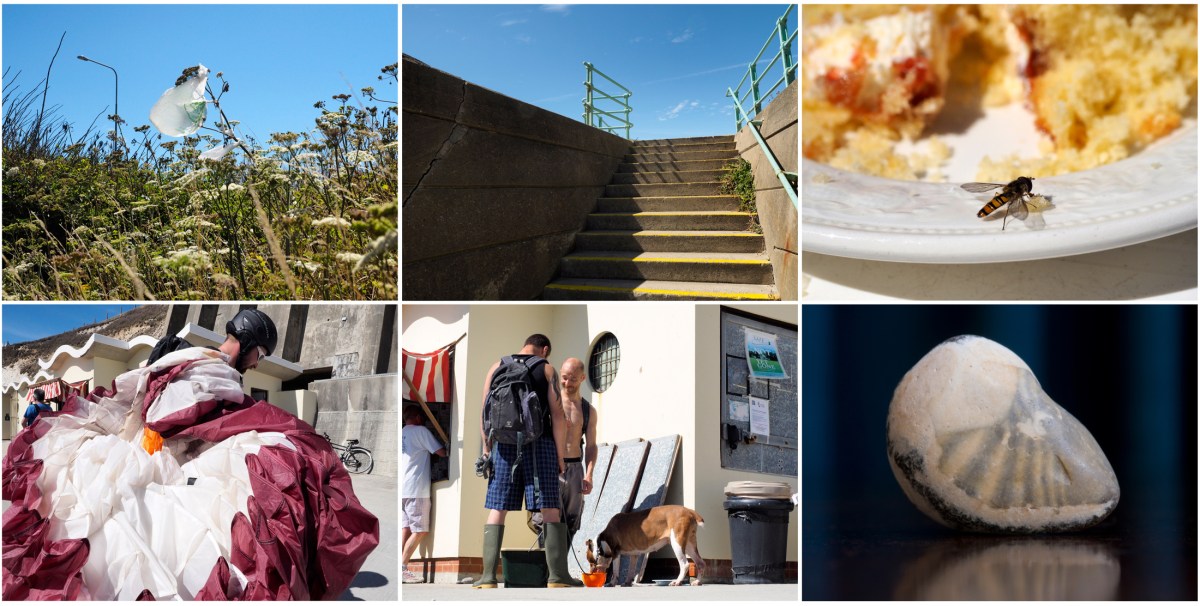
The last time I came across a Jugganath was many years ago in a temple back yard in Chennai, so it was a treat to see one on Hove prom today, pulled by a large gathering of Hare Krishna devotees. Jugganath is the name of a particular form of Vishnu, but we are more familiar with the word through its association with the huge wooden chariot that transports the deity. This name, anglicised to ‘Juggernaut’ has become synonymous with not only monstrous trucks, but anything vast and relentless. Even without the rather fanciful stories brought back from India by early European visitors, of religious fanatics throwing themselves in ecstasy under the wheels of this lumbering beast, it’s not hard to see this giant as being unstoppable.

Juggernaut isn’t the only word from the Indian subcontinent to have been incorporated into English. Quite apart from those you’d expect, like the mystical: Karma and Nirvana, or those words associated with food, like: Basmati and Dhal, there are plenty more. Here are a few favourites of mine:

Bangle, Beryl, Blighty, Bungalow, Chutney, Cushy, Dekko, Jungle, Karma, Loot, Palaver, Pundit, Pukka, Pyjamas, Sorbet, Shampoo, Thug, Toddy, Typhoon, Veranda.

Oddly enough though, ‘Curry’ is not Indian in origin. Well, I say that, the subject is still hotly debated. But while on the one hand, the word has been suggested as being an Anglicisation of the Tamil word ‘Kari’ (கறி) meaning ‘sauce’, or, according to other sources, ‘gravy’ and ‘stew’ – the word in this form first encountered in the mid-17th century by members of the British East India Company – on the other hand, the word ‘Cury’ is known to be Middle English in origin, one proof of this being that it is one of the title words in the first English cookbook: ‘The Forme of Cury’ written in the late 14th Century during the reign of Richard II.

Or maybe in a fabulous instance of synchronicity the word arose, in relation to cooking, in both places at once? Who knows? But I would suggest that if you go into a restaurant in India asking for a curry, you’ll get a very old fashioned look from the catering staff.

Mondrian green – Sat 12th Sept

And while we’re on the subject of the colour preferences of artists: According to Michel Seuphor, the Belgian artist and writer, the only flower he ever saw in Mondrian’s studio was one made of plastic, with leaves which the artist had painted white “to banish the green which reminded him too much of nature”.

Horse feathers – Weds 2nd Sept

The little fat babies with wings we see depicted in old paintings (and more recently reappearing in animated films such as Disney’s ‘Fantasia’) are not cherubs but ‘putti’. Cherubs are Biblical angels purported to have four faces (of different animals) and several sets of wings. Cherubs are supposed to be terrifying, in this respect making them more akin to Harpies, Valkyrie and some of the deities in the Hindu pantheon.

No, Putti (plural, from ’putto’ singular, the name deriving from the Latin, meaning ‘small boy child’) were non-Christian spirits, said to be able to influence human lives as messengers of the gods (though distinct and more lowly than Hermes or Mercury, who probably had more important things to deliver). This tradition dates back to ancient Rome and Greece. Their role as messengers may explain their connection with notions such as the arrival of love, however, putti are just as likely to appear in funerary works as those based on romance (e.g. Raphael’s Sistine Madonna) so they don’t always bring good news.

Nor are putti cupids. Indeed the whole notion of a cupid is a nonsense as Cupid is of course the name of a deity, according to myth either the son of Venus or, alternatively, her companion.

So next time you are in a shop searching for tokens of a romantic nature make sure you ask for a card with putti on it rather than cherubs. This will be of enormous help to the shop assistants.

Origins of species – Sat 22nd Aug

Contrary to popular belief, dogs are not descended from wolves. Rather they share a common ancestry, diverging as species between 27,000 and 40,000 years ago. Nevertheless wolves and dogs have very similar mitochondrial DNA (differing by about 0.2%) and are therefore able to interbreed. This accounts for the resemblance some varieties of dog have to wolves, e.g. Huskies, Alsatians. However, it does not explain how Dachshunds happened. Their name may be a translation from the German, meaning ‘badger hound’ but I don’t reckon they just ended up that way as a result of a staple diet of badgers necessitating the development of shorter legs (to go down holes in the ground) via natural selection.

Spectacular – Fri 21st Aug

While sunglasses as such are a relatively recent invention, dating back to the earlier part of the 20th century, tinted lenses have been around for a lot longer. Pliny the Elder wrote that the Emperor Nero liked to watch gladiator matches through emeralds; in 12th century China, court judges used lenses of smoky quartz to hide their emotions from those they were questioning; In the mid 18th Century, James Ayscough began to experiment with blue and green-tinted lenses, believing that these could correct a number of sight conditions; and in the 19th and early 20th centuries, yellow and brown lenses were used in one of the many, pre-penicillin treatments of syphilis (based on the fact that sensitivity to light is one of the symptoms of the disease).

None of these had anything to do with protection from harmful ultraviolet rays. Indeed their popularity, once tinted glass became more widely available, came from their use by film stars in the 1920s. At that time it was commonly believed that sunglasses were worn by the famous to avoid recognition by fans. However, an alternative theory has been suggested more recently: Because of the low sensitivity of early film stock, dangerously high-powered arc lighting was needed on film sets. Prolonged exposure to these gave film stars very red eyes and sunglasses were worn to cover up a multitude of eye conditions. Whatever the reason, even once ultraviolet filters were developed for film-studio lighting, the popularity of wearing sunglasses continued among film stars, and of course the rest of us followed suit.

But how did the wearing of dark glasses by special agents, detectives, fearless but unorthodox crime-fighters etc. become such a cliché? I’m not saying all cops really do wear them (probably the reverse, though, then again, how do you know the man behind you wearing dark glasses isn’t tailing you?) but the image crops up often enough in the cinema and TV for it to have become a familiar association and one I’ve seen transferred to reality in some places, having had some interesting experiences involving Mexican law officers and the secret police of Tamil Nadu, several of whom had a predilection for these items of eyewear. There was also one other occasion:

I’d taken an overnight plane to Athens, arriving about 4am. My connecting boat didn’t leave till that evening so I had time to kill and decided to go and see the Acropolis at dawn. I missed the sunrise but it was still very early on a beautiful clear morning as I began my climb to the top of the hill. Hardly any people were about at that hour and the first one I passed was a man dressed in a dark suit and pale blue shirt open at the collar, standing next to one of the park benches. He was wearing sunglasses and carrying a folded newspaper. The suit surprised me, it seemed a bit formal for the setting, or that time in the morning. Then, a few yards later, I came across another man in a similar suit, light blue open-necked shirt, dark glasses and folded newspaper. Oddly enough, my initial thought when, a little further up the hill, I came across two more in similar clothes and accessories standing together silently, was that I’d stumbled into a gay cruising area. I decided that the suit, sunglasses and newspaper indicated some sort of code, but on seeing a fifth man lurking near some bushes a bit further on, again dressed similarly and with the same props, I began to revise my theory. What gave it away was the loud squawk that came from his newspaper, which, on second glance, seemed to have a short aerial sticking out of it. By the time I’d reach the Parthenon I had spotted about 15 more men, all similarly attired with folded newspapers, which, now I was looking for them, all had short aerials poking out from the top of them.

I have to say that, while I enjoyed the ancient architecture and statues, I was now more interested in finding out what was going on. However, it seemed a breach of etiquette to ask any of the men with folded newspapers, so I gave up and left.

Some time later as I neared the streets below, I heard the approach of a helicopter and, looking round, saw it begin to descend towards the Parthenon. This heightened my curiosity even more, but it was several days before I found out that my visit had coincided with that of Daniel Ortega then President of Nicaragua, who would have been arriving on the helicopter as I left.

At the time it made me laugh to think that I’d stumbled on possibly the most conspicuous plain-clothes operation in history, but it has since occurred to me that the reason why some film stars and certain members of security forces wear sunglasses is not to evoke anonymity, but the complete opposite: to say, I am here, I want you to see me, but don’t get any closer because I am important. If this is the case, then this particular use of sunglasses is not so different from their use by 12th century Chinese interrogators.

Air sea rescue – Tues 11th Aug

I was listening to one of those Radio 4 amazing facts programmes a few years ago. You know the sort, where a panel of experts give answers to questions sent in by listeners on topics pertaining to the natural world, the sciences, mathematical problems and so on. On this day one particular question stuck in my mind. A listener had written in asking how, when it’s raining, insects, being close in size to raindrops, don’t seem to get hit? After some exploration of different theories, the panel came to the conclusion that rain, as it falls, creates enough turbulence around each droplet to blow any insects out of their path. Upon hearing this, the world seemed to come alive for me and I had this vision of the air around us filled with minute curlicues of turbulence caused by a multitude of falling droplets; a beautiful web of three-dimensional and invisible arabesques. I was delighted.

A few years later, while filming in some woods nearby I chanced on a lepidopterist out searching for butterflies. We fell into conversation and he told me that, for him, the day had not been so good. He’d hoped to photograph some of the rarer species but most of the ones he’d found had wings quite badly damaged by the rain. I remembered my programme and felt a little disappointed, but then, I reasoned, maybe butterflies, because of the size of their wings, created enough drag to prevent them being blown out of the way, and so they might be an exception to the rule.

So, today I’m hiding from the rain under one of the umbrellas at the café when all of a sudden, this shape appears with a splat on the stretched canvas cover. It’s clearly visible through the wet fabric as having six legs. Peeking out from the rim of my shelter I can see it’s a bee that’s been brought down with a bump by a raindrop. Unsurprisingly, it looks stunned. Since the rain is now easing I try a bit of rescue work, breathing and blowing on the bee to dry it out and try to warm it up a bit. To my surprise, this actually works. Acting a bit like a human hair dryer to warm it, and having blown off the surplus water, after a while the bee starts to buzz a bit, dislodging some more water. Then it does what any sensible insect would do under the circumstances, crawling across the surface to the edge, over the rim and then under the canopy where it clings on, probably trying to recover its senses.

Ok, its only one bee. Maybe there are instances where insects are blown out of the way by turbulence caused by falling rain, but from what I can see from the behaviour of this one individual, it seems likely that what actually happens to insects during rain showers is pretty much the same as anyone else caught in a shower, namely, dive for cover and wait it out. And that’s why you don’t see many insects in the rain: they aren’t stupid (well, for a given value of stupid since they can’t have very big brains) and are all hiding underneath leaves on trees and so on.

Only now I have a new problem: the afternoon is drawing on and the people at the café are beginning to put away the tables, chairs and umbrellas away for the night, one of which has a stunned bee under it. I feel a bit of a twit going over to talk to Michel to ask him to watch out for the bee so it doesn’t get trapped as he closes the parasol, but you see, I’ve helped it, so now it’s my responsibility, and I have no idea where it’s hive is.

Jump! – Sun 9th Aug

During flight, a wing produces lift by accelerating airflow over its upper surface and, in some fixed wing flight, accelerated air can, and does, reach supersonic speeds, even though the airplane itself may be flying at a subsonic airspeed.

Helicopters stay up because, even though the body of the aircraft can be stationary, the wings rotate fast enough to provide lift in a manner similar to fixed wing aircraft.

Airborne insects can be likened to revolving propeller bladed aircraft because their wings generate lift by steadily pushing air downward.

Therefore, if, like helicopters, hovering insect flight is possible because of the high speed of their wings despite the static position of their bodies; then do really high speed wing flappers, e.g. hoverflies, also ever accelerate upper wing surface airflow to supersonic speeds?

If this is the case, then how do these insects avoid creating small sonic booms? Or if they don’t, then why don’t we hear them? Or maybe we do? Maybe the irritating whine we hear when listening closely to something like a hoverfly, is actually a series of really tiny sonic booms merging into one long hum?

References:

https://en.wikipedia.org/wiki/High-speed_flight

‘Airplane Flying Handbook’ (2004). U.S. Department of Transportation Federal Aviation Administration Flight Standards Service

Sanjay P. Sane: ‘Induced airflow in flying insects I. A theoretical model of the induced flow’

Fishy – Thurs 6th Aug

If you want to make a Greek laugh, ask them to say the name for mermaid in their language and then try repeating it back to them. I’ve tried many times and never once succeeded in getting it right. The word begins with a sound somewhere between a gurgle and a rumble, as far as I can understand made at the back of the throat, proceeds to a short ‘o’ (omicro?) before transitioning to a roll not dissimilar to the starting growl, (unless you’re Greek, in which case I’m sure it sounds completely different, actually you can sort of tell its a bit different too though it’s hard to say how) this part of the word involving something like tongue rolling, but not quite the way you might pronounce a rolled ‘r’ – especially not a French ‘r’. But in any case, you’ve hardly had time to get your tongue around that before you’re back into trying to pronounce the first gurgle again, then leaving that behind to try your hand at a longer ‘o’ ( though despite it being longer it isn’t omega) finally to reach the familiar phonetic safety of ‘na’ to finish off. The whole procedure should, despite the complexity, take only a fraction of a second to accomplish.

By this point in time your friend will be creased up with laughter and begging you to have another go.

Written down, the word gets even more interesting, because γοργόνα, transliterated into western script, is ‘gorgóna’ and you immediately think to yourself (well I did anyway) that’s Gorgon, not mermaid, and is there a connection between women with snakes for hair and those with tails instead of legs? Apparently, the name derives from the ancient Greek word gorgós, which means ‘dreadful’. Well, the name does, but mermaids are more closely related to sirens (σειρήνα), because of their behaviour, i.e. using their beauty and songs to lure sailors to their deaths – only why ‘gorgóna’ then, why not something similar to siren?

You can try this argument on the Greek you’ve been speaking with, but like as not he’ll just reply: “go on, say it again”…