Alabaster – 20th April 2016

“Titanium dioxide, also known as titanium(IV) oxide or titania, is the naturally occurring oxide of titanium, chemical formula TiO2. When used as a pigment, it is called titanium white, Pigment White 6 (PW6), or CI 77891. Generally it is sourced from ilmenite, rutile and anatase. It has a wide range of applications, from paint to sunscreen to food colouring. When used as a food colouring, it has E number E171…

The most important application areas are paints and varnishes as well as paper and plastics, which account for about 80% of the world’s titanium dioxide consumption. Other pigment applications such as printing inks, fibers, rubber, cosmetic products and foodstuffs account for another 8%. The rest is used in other applications, for instance the production of technical pure titanium, glass and glass ceramics, electrical ceramics, catalysts, electric conductors and chemical intermediates. It also is in most red-coloured candy…

Titanium dioxide is the most widely used white pigment because of its brightness and very high refractive index, in which it is surpassed only by a few other materials. Approximately 4.6 million tons of pigmentary TiO2 are used annually worldwide, and this number is expected to increase as utilization continues to rise. When deposited as a thin film, its refractive index and colour make it an excellent reflective optical coating for dielectric mirrors and some gemstones like “mystic fire topaz”. TiO2 is also an effective opacifier in powder form, where it is employed as a pigment to provide whiteness and opacity to products such as paints, coatings, plastics, papers, inks, foods, medicines (i.e. pills and tablets) as well as most toothpastes. In paint, it is often referred to offhandedly as “the perfect white”, “the whitest white”, or other similar terms. Opacity is improved by optimal sizing of the titanium dioxide particles. Some grades of titanium based pigments as used in sparkly paints, plastics, finishes and pearlescent cosmetics are man-made pigments whose particles have two or more layers of various oxides – often titanium dioxide, iron oxide or alumina – in order to have glittering, iridescent and or pearlescent effects similar to crushed mica or guanine-based products. In addition to these effects a limited colour change is possible in certain formulations depending on how and at which angle the finished product is illuminated and the thickness of the oxide layer in the pigment particle; one or more colours appear by reflection while the other tones appear due to interference of the transparent titanium dioxide layers. In some products, the layer of titanium dioxide is grown in conjunction with iron oxide by calcination of titanium salts (sulfates, chlorates) around 800 °C or other industrial deposition methods such as chemical vapour deposition on substrates such as mica platelets or even silicon dioxide crystal platelets of no more than 50 µm in diameter. The iridescent effect in these titanium oxide particles (which are only partly natural) is unlike the opaque effect obtained with usual ground titanium oxide pigment obtained by mining, in which case only a certain diameter of the particle is considered and the effect is due only to scattering.”

From:
https://en.wikipedia.org/wiki/Titanium_dioxide

Staring games – 17th April 2016

As children, we’ve all played games involving out-staring a friend, these usually ending with a cry of “You blinked!” “No, I didn’t, you blinked first!” “No, you did!” etc… Why this is such a good game when you’re young I’m not sure. It has limited application in adult life, where there are limits on how long you can look at a fellow human being who is also discovered to be looking back. Try it on a train with a complete stranger and anything more than a micro second could get you punched, or slapped. Even the romance attached to: ‘their eyes met across a crowded room’ is only underlined by the briefness of these rare moments.

But these latter are not really staring games, more like glancing games. If, as an adult, you want to play a staring game and you can’t find any friends interested in playing, we all know the game works on animals too. Admittedly with dogs it’ll only last a few seconds before the dog looks away and you suddenly feel ashamed you could even think of putting your beloved companion through this torture. But cats, on the other hand, are much more fun. A cat will keep up the contest for quite a while, sometimes even winning the match, and if it is you who outlasts the cat, the feline indignation as it looks away at least partially makes up for your minor cruelty. Indeed the knowledge that cats will stare at each other for hours serves as confirmation that they place a great deal of importance on staring.

However, the real masters of staring games are sheep. If you don’t believe me, go and stand in the same field as a flock of these ruminants and wait. It won’t be long before you find one of them staring at you, and when you do, try staring back. The sheep will happily carry on looking at you directly in the eyes for what will seem like an age. In this time you will find yourself wondering what on earth it can possibly hope to accomplish by this contact, after all, sheep are not predators, nor are they territorial. You will also find yourself trying to fathom the expression on the sheep’s face. The gaze of the sheep goes well beyond ‘unconcerned’ to your realization that if there are any emotions or thoughts present, that these are of the absolute right the animal considers itself to have in looking at you. You will find yourself reminded of the time you accidentally stumbled into a yoga class full or pregnant women, or perhaps memories of school when, having accomplished some small act of drollery, you find the gaze of your teacher locked onto yours with the full force of a blowtorch. No one can survive these kinds of looks for more than a few seconds.

Yet at this moment, with your confidence reduced to a pulp and with the full knowledge that the sheep has won before you have even begun to tire, the sheep will then turn it’s head and look somewhere else. And this will actually make your defeat worse, because you will know that whatever the sheep is now staring at, the stare will be just as intense and self-righteous as it has been when the quadruped had been looking at you, that you are no more important than a tree, or a gate, or the water-trough, and with this you will recognise that your humiliation is now complete.

Flock – 26th Feb 2016

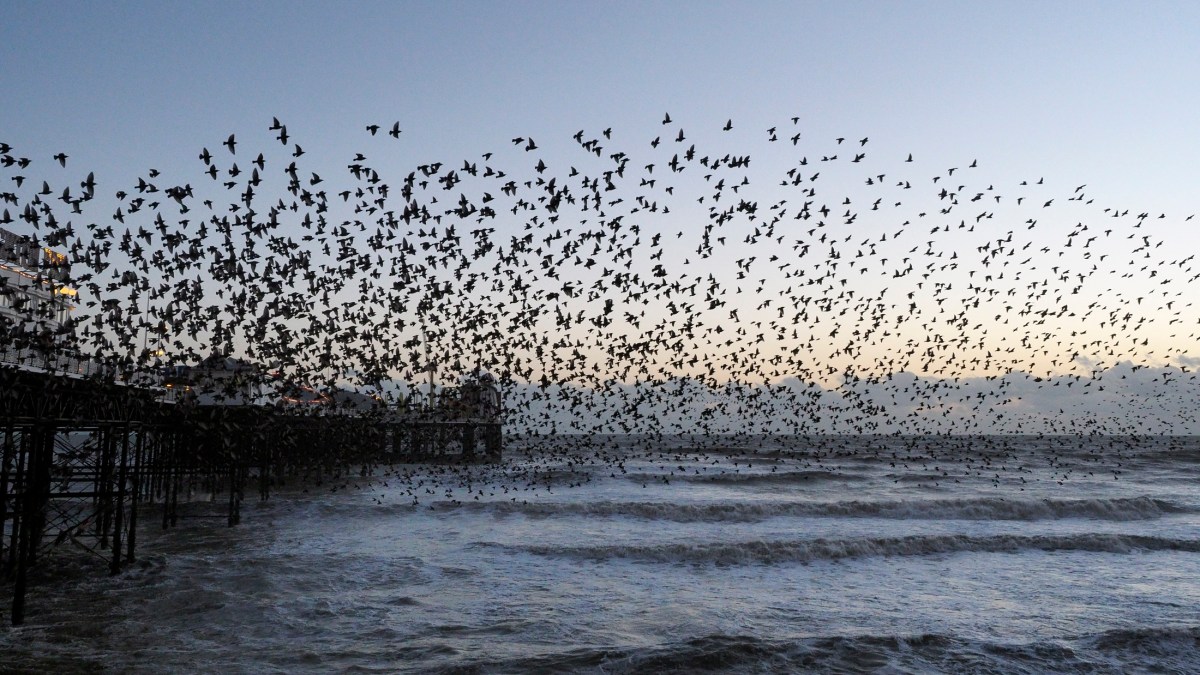
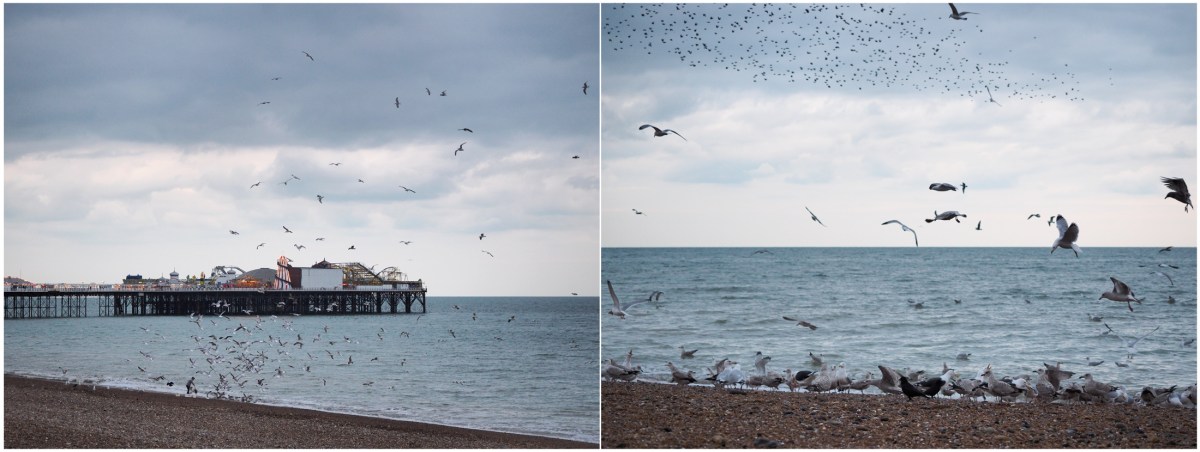
Every day as sunset draws near the starlings gather. Recently I’ve also noticed that the seagulls are doing so too, in larger and larger flocks. I have begun to wonder why? Is this another remarkable example of interspecies learning? Seagulls are intelligent birds and, in addition to their extraordinary adaptability to take on the diet of the average tourist (sandwiches, hot dogs, chips, cake and buns) I’ve seen them stamping the ground to attract worms in imitation of other birds who have found out how to imitate rain, drawing small invertebrates to the surface. And indeed young fledgling seagulls will poke and peck at anything, seemingly to see how it works. So why shouldn’t they have noticed how starlings gather together every day, and decided to do so too? Ok, they haven’t quite got the hang of close formation, but the results still look pretty spectacular. This has been going for a while now, and I’ve been in poetic rapture at the thought of a new sunset teeming with aerial displays in glorious pan-species exultation.

So much for poetry. I found out today that due to the time of year and it being off-season, sunset is about the time when the seafood stall dumps all its remaining fish bits, guts and mollusc scraps into the sea, to clean out the buckets before closing for the night.

Hermits – 20th Feb 2016

In a manner not entirely dissimilar to hermit crabs who, rather than creating their own exoskeletons, rely on empty mollusc shells to provide them with protection, some trees and plants have evolved to take advantage of the small pottery containers that are now so much a part of our gardens. Of course trees and plants do not generally create armoured exteriors, relying instead on the sheer amount of ground around them to bulwark their roots. Nevertheless, evolving to take advantage of pots has given them a distinct advantage over other more stationary species, allowing them greater mobility and therefore enhanced opportunity to seek out sunlight and the more sheltered spots away from the wind.

However, like hermit crabs, this developmental ‘choice’ is not entirely free of danger: as individual plants grow they will need to change their pot from time to time. This is always a tricky moment, and like hermit crabs, not all of them make it through that moment of extreme vulnerability between shells.

Change of use – 17th Feb 2016

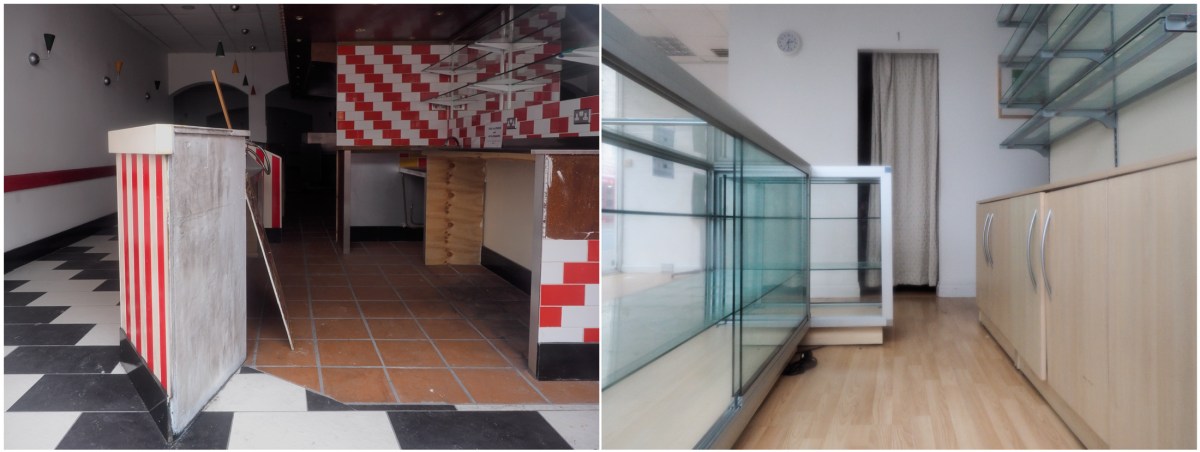
The one on the left is a closed down burger bar. The one on the right used to be a shop selling natural remedies and offering alternative therapies. Before these businesses, they were something else. Afterward, they will, again, be something different.

Perhaps in the same way that, in the days of early Christianity, churches were built on the sites of former temples and places of pagan worship to ‘cleanse’ these places of their former use, yet nevertheless something holy and ancient would still persist, does something of the spirit of past occupants colour these new ventures? Would fast food sold from a burger bar opened on the site of a health clinic be mysteriously better for you? (Eat all you like and never put on a pound!) Would a health shop opened on the former site of a burger bar be doomed to failure? Can we ever know these things?

Thingness – 26th Jan 2016

“We see the things themselves, the world is what we see: formulae of this kind express a faith common to the natural man and the philosopher — the moment he opens his eyes; they refer to a deep-seated set of mute “opinions” implicated in our lives. But what is strange about this faith is that if we seek to articulate it into theses or statements, if we ask ourselves what is this we, what seeing is, and what thing or world is, we enter into a labyrinth of difficulties and contradictions.”

Opening lines of: Maurice Merleau-Ponty ‘The Visible and the Invisible’ Translated by Alphonso Lingis, Northwestern University Press 1968

Unseen wanderers – 23rd Jan 2016

It’s a closely guarded secret among more experienced gardeners, that on certain nights, shrubs will sometimes lift themselves from their flower beds and wander abroad in the night air, keen to experience the freedom accorded members of the animal kingdom. Most of them don’t travel far. Very soon they experience a great homesickness for the soil they have lived in all of their lives, and by daybreak will be back in their beds, so neatly position that few of us notice they’ve moved at all. However, occasionally a more adventurous plant will travel further and become lost. With very little idea of direction beyond the narrow confines of its garden or woodland corner, compelled by some unknown atavistic impulse the shrub will then head for the coast. On arrival it will bed down on the shore and begin a new life, by day surprising tourists by its mere presence so close to the watery margins, and in the evenings whispering tales to its seedlings of its former home.

Mozart’s starling –7th Jan 2016

You might have noticed I have become fixated on starling murmurations of late. I make no apologies, they are far too extraordinary to ignore and soon enough it will be spring and their displays will stop. However, I was beginning to think I was running out of stories to accompany my photographs, until I came across this today:

“Mozart recorded the purchase of his starling in a diary of expenses, along with a transcription of a melody whistled by the bird and a compliment (Fig. 3). … The theme whistled by the starling must have fascinated Mozart for several reasons. The tune was certainly familiar, as it closely resembles a theme that occurs in the final movement of the piano concerto in G major, K. 453. Mozart recorded the completion of this work in his catalogue on 12 April in the same year. As far as we know, just a few people had heard the concerto by 27 May, perhaps only the pupil for whom it was written, who performed it in public for the first time at a concert on 13 June. Mozart had expressed deep concern that the score of this and three other concertos might be stolen by unscrupulous copyists in Vienna. Thus, he sent the music to his father in Salzburg, emphasizing that the only way it could “fall into other hands is by that kind of cheating”. The letter to his father is dated 26 May 1784, one day before the entry in his diary about the starling.

Mozart’s relationship with the starling thus begins on a tantalizing note. How did the bird acquire Mozart’s music? Our research suggests that the melody was certainly within the bird’s capabilities, but how had it been transmitted? Given that our observation that whistled tunes are altered and incorporated into mixed themes, we assume that the melody was new to the bird because it was so close a copy of the original. Thus, we entertain the possibility that Mozart, like other animal lovers, had already visited the shop and interacted with the starling before 27 May. Mozart was known to hum and whistle a good deal. Why should he refrain in the presence of a bird that seems to elicit such behaviour so easily?

A starling in May would be either quite young, given typical spring hatching times, or at most a year old, still young enough to acquire new material but already an accomplished whistler. Because it seems unlikely to us that a very young bird could imitate a melody so precisely, we envision the older bird. The theme in question from K. 453 has often been likened to a German folk tune and may have been similar to other popular tunes already known to the starling, analogous to the highly familiar tunes our caregivers used. But to be whistled to by Mozart! Surely the bird would have adopted its listening posture, thereby rewarding the potential buyer with “silent applause.”

Given that whistles were learned quite rapidly by the starlings we studied, it is not implausible that the Vienna starling could have performed the melody shortly after hearing it for the first time. Of course, we cannot rule out a role for a shopkeeper, who could have repeated Mozart’s tune from its creator or from the starling. In any case, we imagine that Mozart returned to the shop and purchased the bird, recording the expense out of appreciation for the bird’s mimicry. Some biographers suggest an opposite course of transmission – from the starling to Mozart to the concerto – but the completion date of K. 453 on 12 April makes this an unlikely, although not impossible, sequence of events.”

Starling score

Text and music score from: West, M.J. and King, A.P: ‘Mozart’s Starling’, in American Scientist Vol 78 (March-April 1990) Pp 111-112

Elf migration – 6th Jan 2016

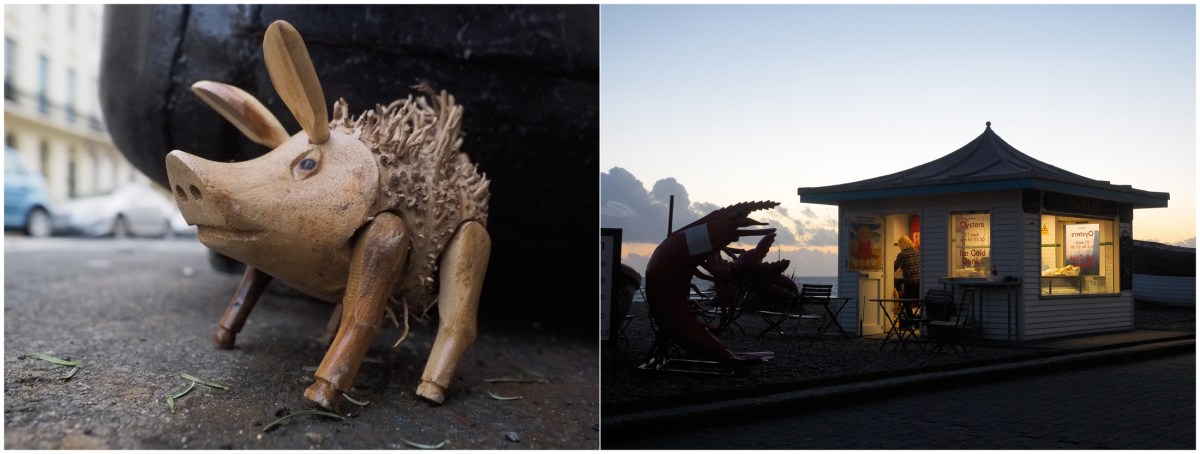
In early January you will sometimes see what look like toys, novelties and unusual objet d’art close to the municipal bins or on doorsteps across our towns. In fact these are not unwanted Christmas presents but the newly hatched offspring of Santa’s elves. A highly unusual and secretive species with an equally unique migration pattern, over the course of several years they will work their way slowly north towards the ice-caves of their parents. During their journey they steal into peoples homes, attempting to perform small tasks and chores for the household. The outcome of these will be more or less successful depending on the developmental stage of the elfling. Through these episodes of contact with humans, they learn all about our daily lives, hopes and desires, this information providing vital updates for the toy factories at the North Pole when they finally complete their long journey.

If looked at, elflings will immediately assume a static pose on the end of a mantelpiece or book shelf, eliciting responses from the homeowners along the lines of “do you remember who gave us that?” following which they will usually find themselves put out into the wild once more to then continue their travels. To make up for lost time, those who have been held up in their journey will hide among items on their way to boot fairs and antiques markets or, in extreme circumstances, strap themselves to the radiator grilles of lorries.

The staple diet of the Christmas elf is cake, trifle and other sweets, so if you see one while out and about, do leave something of this kind close to them; even a square of chocolate will do. They cannot show visible signs of acceptance as, having been spotted, they will have frozen to once more resemble a lifeless object (and indeed you might even find yourself thinking “I wonder who got that for Christmas?”) but they will be grateful for the sustenance. Indeed, word getting around that you are a kind person, next Christmas you may even find yourself foster parent to one of the next generation of Santa’s elflings. If so, once you’ve finished wondering who gave it to you (and who ate the last bit of Christmas cake) please make sure to put the little chap next to the bin rather than inside it, so that it too can begin it’s long journey northward.

Way out west – Christmas 2015

From the St Ives tourist association website:

“St Ives enters recorded history with the arrival of St. Ia or Hya, the Irish princess who introduced Christianity to the area in the 5th Century.

The legend tells how Saint Ia, a Virgin Saint of noble birth went to the seashore to depart for Cornwall from her native Ireland along with other saints. Finding that they had gone without her and fearing that she was too young to undertake such a hazardous journey alone, she was grief stricken and began to pray.

As she prayed she noticed a little leaf floating on the water and touched it with a rod to see if it would sink. Lo, as she looked it grew bigger and bigger. Taking this as a sign from God, she climbed aboard the leaf and was straightaway wafted across the Channel, reaching her destination well before the others.”

http://www.stives-cornwall.co.uk/about-our-town/history/