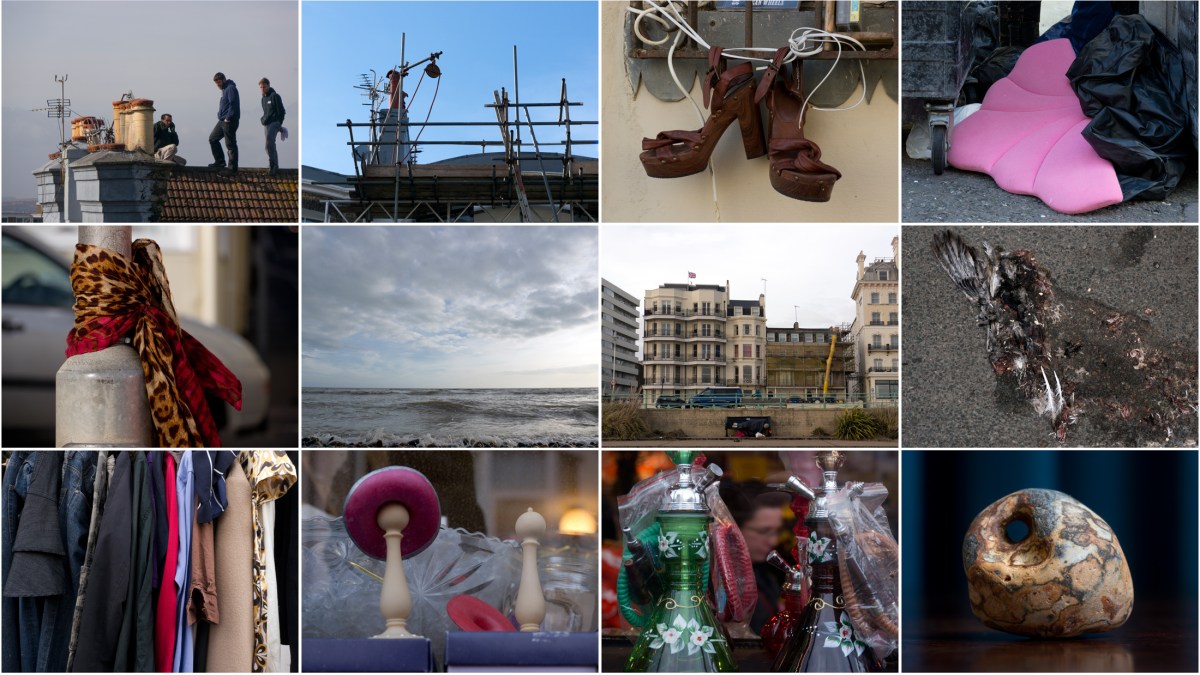
And then – 28th Nov 2015

Leader of the House of Commons, Robin Cook’s resignation speech following the majority decision by the British parliament to invade Iraq in 2003:

“I have resigned from the cabinet because I believe that a fundamental principle of Labour’s foreign policy has been violated. If we believe in an international community based on binding rules and institutions, we cannot simply set them aside when they produce results that are inconvenient to us.

I cannot defend a war with neither international agreement nor domestic support. I applaud the determined efforts of the prime minister and foreign secretary to secure a second resolution. Now that those attempts have ended in failure, we cannot pretend that getting a second resolution was of no importance.

In recent days France has been at the receiving end of the most vitriolic criticism. However, it is not France alone that wants more time for inspections. Germany is opposed to us. Russia is opposed to us. Indeed at no time have we signed up even the minimum majority to carry a second resolution. We delude ourselves about the degree of international hostility to military action if we imagine that it is all the fault of President Chirac.

The harsh reality is that Britain is being asked to embark on a war without agreement in any of the international bodies of which we are a leading member. Not Nato. Not the EU. And now not the security council. To end up in such diplomatic isolation is a serious reverse. Only a year ago we and the US were part of a coalition against terrorism which was wider and more diverse than I would previously have thought possible. History will be astonished at the diplomatic miscalculations that led so quickly to the disintegration of that powerful coalition.

Britain is not a superpower. Our interests are best protected, not by unilateral action, but by multilateral agreement and a world order governed by rules. Yet tonight the international partnerships most important to us are weakened. The European Union is divided. The security council is in stalemate. Those are heavy casualties of war without a single shot yet being fired.

The threshold for war should always be high. None of us can predict the death toll of civilians in the forthcoming bombardment of Iraq. But the US warning of a bombing campaign that will “shock and awe” makes it likely that casualties will be numbered at the very least in the thousands. Iraq’s military strength is now less than half its size at the time of the last Gulf war. Ironically, it is only because Iraq’s military forces are so weak that we can even contemplate invasion. And some claim his forces are so weak, so demoralised and so badly equipped that the war will be over in days.

We cannot base our military strategy on the basis that Saddam is weak and at the same time justify pre-emptive action on the claim that he is a serious threat. Iraq probably has no weapons of mass destruction in the commonly understood sense of that term – namely, a credible device capable of being delivered against strategic city targets. It probably does still have biological toxins and battlefield chemical munitions. But it has had them since the 1980s when the US sold Saddam the anthrax agents and the then British government built his chemical and munitions factories.

Why is it now so urgent that we should take military action to disarm a military capacity that has been there for 20 years and which we helped to create? And why is it necessary to resort to war this week while Saddam’s ambition to complete his weapons programme is frustrated by the presence of UN inspectors?

I have heard it said that Iraq has had not months but 12 years in which to disarm, and our patience is exhausted. Yet it is over 30 years since resolution 242 called on Israel to withdraw from the occupied territories.

We do not express the same impatience with the persistent refusal of Israel to comply. What has come to trouble me most over past weeks is the suspicion that if the hanging chads in Florida had gone the other way and Al Gore had been elected, we would not now be about to commit British troops to action in Iraq.

I believe the prevailing mood of the British public is sound. They do not doubt that Saddam Hussein is a brutal dictator. But they are not persuaded he is a clear and present danger to Britain. They want the inspections to be given a chance. And they are suspicious that they are being pushed hurriedly into conflict by a US administration with an agenda of its own. Above all, they are uneasy at Britain taking part in a military adventure without a broader international coalition and against the hostility of many of our traditional allies. It has been a favourite theme of commentators that the House of Commons has lost its central role in British politics. Nothing could better demonstrate that they are wrong than for parliament to stop the commitment of British troops to a war that has neither international authority nor domestic support.”

Plongeur – 15th Nov 2015

“I began to protest, but he cut me short. ‘A PLONGEUR with a moustache —nonsense! Take care I don’t see you with it tomorrow.’
On the way home I asked Boris what this meant. He shrugged his shoulders. ‘You must do what he says, MON AMI. No one in the hotel wears a moustache, except the cooks. I should have thought you would have noticed it. Reason? There is no reason. It is the custom.’
I saw that it was an etiquette, like not wearing a white tie with a dinner-jacket, and shaved off my moustache. Afterwards I found out the explanation of the custom, which is this: waiters in good hotels do not wear moustaches, and to show their superiority they decree that PLONGEURS shall not wear them either; and the cooks wear their moustaches to show their contempt for the waiters.”

George Orwell, ‘Down and Out in Paris and London’ 1933

Plymouth Bites (part one)

The history of the Cornish Pasty is intimately linked to tin mining in Cornwall and Devon, one of the oldest industries of our shores, dating back beyond 2500 BC. The pasty itself evolved as a packed lunch for the miners; a nourishing and hearty meal of beef and root vegetables wrapped up in a pastry case to make them easier to carry down the pit. Also, given that the miners would have had to eat their food in dusty confined spaces and in complete darkness, having your dinner encased in an edible wrapping would have been vital. To get an idea of the importance of this for yourself, try eating your dinner blindfold while hunched up in a cupboard under the stairs (no tables or forks allowed either). For full effect, empty the contents of your vacuum cleaner bag into the space just before starting to eat. Dishes like Salade niçoise or Tagliatelle carbonara aren’t practical in these conditions.

Plymouth’s origins too are closely tied up with the tin mining industry. Plympton, now a district within the city, was one of the key ports for exporting the metal until the river Plym became so silted up with mining debris that it was no longer navigable and boats had to moor south of this original destination. This ecological disaster probably contributed to the development of Plymouth as a major port.

At the time of Christ, the tin mining industry was already venerable and there was significant trade between the south west of England and the Mediterranean countries as far as the Middle East. Indeed legend has it that Joseph of Arimathea, Jesus’ uncle, regularly visited these parts on business as a tin trader and that Jesus, while a boy, once accompanied him. William Blake’s poem (later the anthem): ‘Jerusalem’ celebrates this expedition and I like to think that, while not mentioned in any of the lines, our saviour and his uncle would have stopped off in Plympton for a pasty or two during their time here.

While the tin mining industry in the West Country has now collapsed, the pasty continues as a filling tribute to one of the earliest of British industries. Cornish Pasties are one of a select list of foods produced in the British Isles that have been awarded the status of protected designation of origin (like champagne but so much more satisfying) and justifiably so, you just can’t get a good one outside the region. Locally there are heated debates as to who makes the best ones and the competition between bakers is so fierce (there are even annual championships) that this ensures high standards. However, I was surprised to find that even the packaged ones are good. On a tipoff from the woman in the corner shop (who’d just sold out of hot ones) I tried out one from her fridge and indeed it turned out to be just as good as the freshly cooked versions. It therefore seems appropriate that I should begin my three-part journey through Plymouth with the label from this product.

Camouflage and other protective clothing – Thurs 5th March

“…there are known knowns; there are things we know we know. We also know there are known unknowns; that is to say we know there are some things we do not know. But there are also unknown unknowns – the ones we don’t know we don’t know…”

DoD News Briefing – Secretary Rumsfeld and Gen. Myers
Presenter: Secretary of Defense Donald H. Rumsfeld February 12, 2002 11:30 AM EDT
http://www.defense.gov/transcripts/transcript.aspx?transcriptid=2636

Left – Tues 24th Feb

‘In February 1948, Communist leader Klement Gottwald stepped out on the balcony of a Baroque palace in Prague to address the hundreds of thousands of his fellow citizens packed into Old Town Square. It was a crucial moment in Czech history – a fateful moment of the kind that occurs once or twice in a millennium.

Gottwald was flanked by his comrades, with Clementis standing next to him. There were snow flurries, it was cold, and Gottwald was bareheaded. The solicitous Clementis took off his own fur cap and set it on Gottwald’s head.

The party propaganda section put out hundreds of thousands of copies of a photograph of that balcony with Gottwald, a fur cap on his head and comrades at his side, speaking to the nation. On that balcony the history of Communist Czechoslovakia was born. Every child knew the photograph from posters, schoolbooks, and museums.

Four years later Clementis was charged with treason and hanged. The propaganda section immediately airbrushed him out of history and, obviously, out of all the photographs as well. Ever since, Gottwald has stood on that balcony alone. Where Clementis once stood, there is only bare palace wall. All that remains of Clementis is the cap on Gottwald’s head.’

Opening paragraphs from: The Book of Laughter and Forgetting, Milan Kundera. Translated by Michael Henry Heim.

Shoreham on Sea – Sun 25th Jan

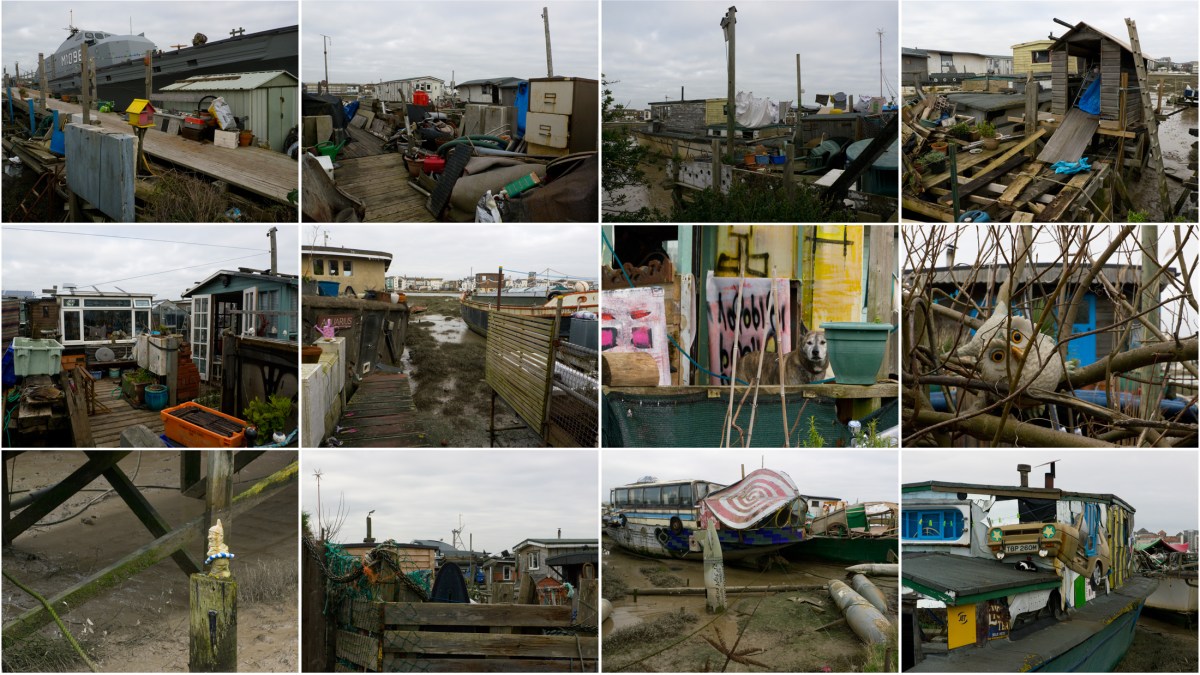
A few miles out of Brighton travelling west is a place called Shoreham on Sea. Cross the bridge south onto the Brighton Road, take a left more or less immediately, and you will find the Shoreham houseboats. Given that one is actually an old minesweeper, another has a top deck made out of two halves of a bus, and that most of the others are cobbled together out of old cars, sheds, garden conservatories and any other conceivable kinds of scrap, the words ‘house’ and ‘boat’ might not immediately spring to mind when looking at them. Nevertheless, people have lived here in these extraordinary ramshackle dwellings for decades, in a small local community that is still resisting the standardisation and gentrification that infects so much of the rest of the world. I hope they survive for many years to come.

Atlantis – Mon 19th Jan

They say that somewhere out in the middle of the Atlantic, lies a vast floating island made out of millions of tons of the plastic bags, bottles, bin liners, nylon ropes, nets and all the disposable containers we have jettisoned over the years. Gaily coloured and rotating slowly with the currents that gathered its component pieces, it is both a death trap to myriads of marine creatures and a monument to our unsupportable lifestyles. And yet if someone said to me, let’s go and see it, I’d jump at the chance. In my imagination I am already there.

Does this make me a monster?

Ozymandias – Sat 3rd Jan

I met a traveller from an antique land
Who said: Two vast and trunkless legs of stone
Stand in the desert. Near them on the sand,
Half sunk, a shatter’d visage lies, whose frown
And wrinkled lip and sneer of cold command
Tell that its sculptor well those passions read
Which yet survive, stamp’d on these lifeless things,
The hand that mock’d them and the heart that fed;
And on the pedestal these words appear:
‘My name is Ozymandias, king of kings:
Look on my works, ye Mighty, and despair!’
Nothing beside remains. Round the decay
Of that colossal wreck, boundless and bare,
The lone and level sands stretch far away.

P. B. Shelley

Different Shores – Christmas 2014

Allright I admit it. I was totally seduced by St Ives (where I’ve just spent Christmas) and have been a complete tourist there. Having said that, the project is about being a tourist, so here’s a Cornish contact sheet taken over the week.

Normal service will be resumed after new years day, but in the meantime, here’s a transcript of one of the conversations I had there, illustrating one of the pitfalls of travelling to somewhere with a very different kind of beach to the one you’re used to:

“Excuse me? The man in the cafe downstairs said it might be possible to use your toilet?”
“Are you Sandy?”
“Um no, my name is Chris. Did he phone up to let you know I was popping up?”
“Actually there’s a public toilet just up the road but as he said you could come up its fine but I wanted to know if you were Sandy?”
“Like I said, my name is Chris, maybe you got me confused with someone else? What’s your name?”
“I’m Margaret. It’s lovely to meet you but I’ve just done the floors see and you can’t come in if you’re sandy because I don’t want to have to do them all again.”
“No, no, I told you, my name is Chris and, oh, I see what you mean. No, really, I’m not sandy at all. Can I come in?”

Il Pleut. Moi non plus – Mon 17th Nov

When I was at school we had this French textbook. ‘La Famille Marsaud’ featured prominently in it. They were, according to my French teacher Mrs Clay (of whom I will write about more in due course) a typical French family who lived in a beautiful suburban chateau with a walled garden. Monsieur Marsaud worked in a bank (or some other important managerial post), Mme Marsaud was an extraordinarily competent and rather elegant housewife with a tiny waist who endlessly cooked delights for the long family dinners, and the two children, one boy, one girl (whose names I have successfully blocked from my memory) were both beautifully turned out, of a sunny disposition and exceptionally well behaved. I seem to remember them crying ‘Maman, maman!’ a lot while squealing around the garden with Bruno (une belle chien). I think ‘un jolie ballon rouge’ was involved in these proceedings.

Typical French family eh? Clearly the whole point of the book was to humiliate us as uncouth, woad-daubed barbarians by presenting this utopian ideal of the family unit in cartoon form for British children to learn that elsewhere in the world things were better. Even the bloody French weather was always: ‘En France il fait du soleil beaucoup, mais en Engleterre il pleut et il fait mauvais’. So what if this particular observation was true? (I admit, it was today, I got soaked again.) There was no need to rub it in.

Whoever wrote that book should have been shot for engendering anti-European feelings. I’m sure key members of the UK Independence Party all had to read it at school too.

I failed my French O-level.