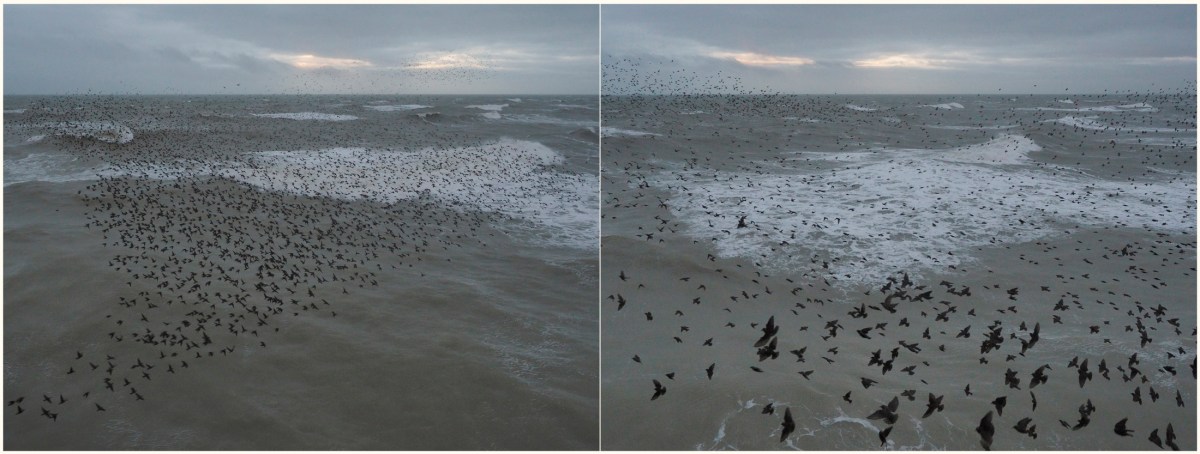
Recently several images have appeared in the press and media showing huge starling murmurations taking place in Rome and Israel. I confess I am jealous. Ours have never been the same since first the hurricane of ‘87 felled most of the trees in central Brighton, and then in 2003 the West Pier, the other most popular starling roost in the area, mysteriously burned down, twice. What is left of our own starling population cannot compete with these more exotic locations and the displays we now see are only a shadow of their former glory. Well, except…
Except in some respects, Brighton remains unique for the observation of starling murmurations. This is because so many of them now use the remaining pier as a congregation point, and because, rather than spending the night on top, as you might suppose, they roost underneath it, just below the boardwalk.
To fully appreciate this variation on the spectacle, go and find a spot on Brighton pier an hour before sunset. Sometimes you might have to wait a while but, unless it’s raining, they will soon come. At first only in small numbers forming modest flocks, these will be joined by other small groups of birds till the murmuration becomes substantial. True, nothing unusual in that, but over the past few years these particular displays seem to have developed along undulating horizontal themes rather than in clouds as you would see elsewhere, and standing on the pier places you above the performance so that you find yourself looking down on a swiftly moving veil hugging the contours of the waves like a giant and ragged silk scarf that tears and reforms continually. When it rises, suddenly you will find yourself almost touching the leading edge of a swarm of thousands, maybe tens of thousands of birds as they speed past, away and back again, and finally, in huge numbers, to dive directly below where you stand to their roosts, only a few feet away on the other side of the decking.
 Umbrellage