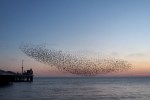
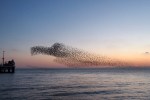
Hur hur – 22nd Jan 2016

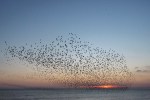
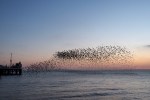
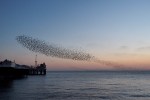
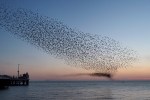
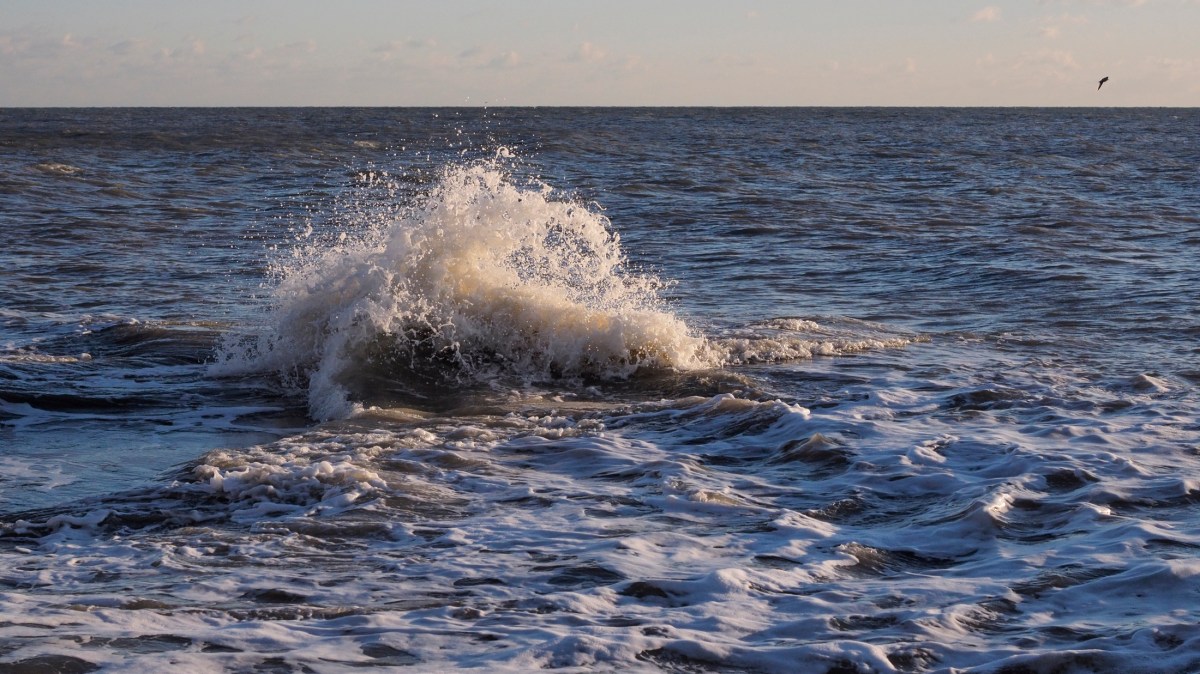
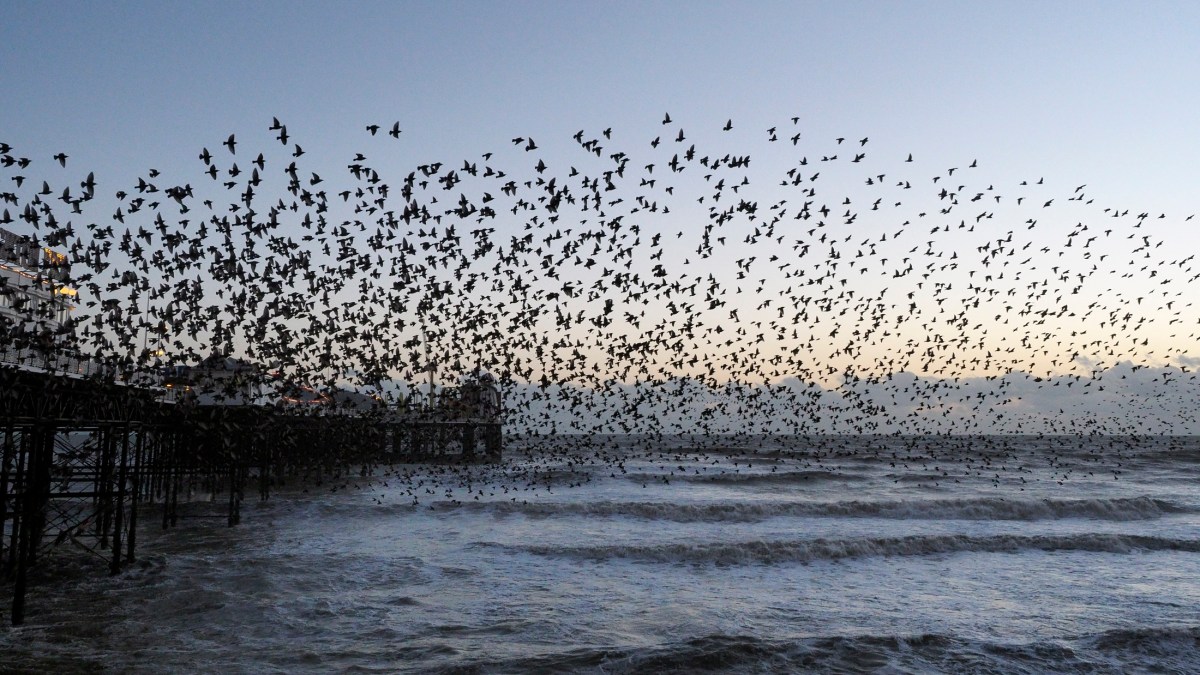
I’m back on the beach next to the Pier photographing starlings again. The wind is stronger than yesterday and on days like this the starlings fly much closer to the water. I want to be as low as possible so I can still see them against the sky, and I’m pretty close to the waves as I don’t want any people in front of me, just the birds. The murmuration has started and I’ve already been photographing for about ten minutes when two men and a woman blunder into shot, right in front of me. They start to take pictures of each other clowning about. It’s difficult not to see this intrusion as provocative, the beach is almost empty today and they could have stood anywhere else to get the same pictures.

Both men are huge, and of the sort that go ‘hur hur’ rather than genuinely laugh. I would bet on one of them being called Jason, or at least wanting to be. The girl is a wispy blonde. All are dressed in their finery; all set for a night out somewhere. I’m saying nothing as I get the impression they want some attention, and anyway, they’ll soon go, but no, they are now looking at all the photos they have taken, and then taking some more while moving a bit closer to me.

I am being really patient about this as the starlings are now flying, full throttle, making some fantastic shapes, many of which I’m not getting good shots of because of this group. But you know what? I’m happy for them to be exactly where they are, so close to me, and the sea. Because I spend a lot of my time on the beach taking photos, I’ve become an expert at judging where to stand to avoid the occasional larger wave that travels that bit further up the beach than most. I’m positioned just beyond this safe limit, but because they are in front of me, they aren’t. I keep taking pictures, and so do they.

After maybe another minute I hear the inevitable squeal and, peeking up for a moment from the viewfinder, witness the tableau of three people caught up to their shins in water, followed by a lot of stumbling on the pebbles. Some jovial and urbane comments follow from the group and it now seems the right time for me to find a new position a little further up the coast to carry on photographing from.

Cruelty comes in many forms.
Curtains – 21st Jan 2016

“Paralytic sycophants, effete betrayers of humanity, carrion-eating servile imitators, arch-cowards and collaborators, gang of women-murderers, degenerate rabble, parasitic traditionalists, playboy soldiers, conceited dandies.”

East German Communist Party’s approved terms of abuse when describing the English, 1953. Quoted from: ‘The Mammoth Book of Tasteless and Outrageous Lists’, Karl Shaw, 2014

In their own words – 20th Jan 2016

Another thing about starlings is the noises they make. Not exactly a song, in many ways more expressive, filled not only with notes and whistles, but also pops, crackles and other warblings I don’t even know how to describe. Taken together as a whole, a little like listening to music on an old shortwave radio, the static as mysterious as the tunes themselves.

Sometimes you’ll hear one starling on it’s own, perched just a few feet away from you, talking and singing to itself. As the afternoon rolls on you’ll be reminded that the light is failing as they gather on the rooftops outside to whistle together, perhaps exchanging news in preparation for this evenings show.

I remember a long time ago when I first moved to Brighton, walking home through the park late at night in the dead of winter, and as I walked past the trees, whenever the breeze lifted into a gust, the sound of these tiny birds waking briefly with the wind, would ripple as if the branches were festooned with a thousand icicles and shards of glass tinkling together in the darkness.

When they fly together in murmurations, starlings are completely silent, all that you’ll hear is the sussuration of their wings beating together as they pass overhead, their concentration in flight almost palpable. But as soon as they settle the twittering begins so that, if you’re standing on the pier, you’ll suddenly find the air filled with a great mass of shrill calls and squeakings that I’d be tempted to describe as a roar if it wasn’t so high pitched; louder than the waves, and the cocktail jazz and 80’s soul that seems to be the preferred piped music of the pier managers.


Today, as soon as their display ended I headed for the pier to record this extraordinary sound, which I present here, along with today’s photographs:


Infant Sorrow – 19th Jan 2016

My mother groaned, my father wept:
Into the dangerous world I leapt,
Helpless, naked, piping loud,
Like a fiend hid in a cloud.

Struggling in my father’s hands,
Striving against my swaddling bands,
Bound and weary, I thought best
To sulk upon my mother’s breast.

William Blake
Songs of Experience 1794

General Stone Tiger – 18th Jan 2016

“The mighty warrior General Li Kuang, whose mother had been devoured by a tiger, shot an arrow at the stone he believed was the tiger. The arrow penetrated the stone all the way up to its feathers. But once he realized it was only a stone, he was unable to pierce it again. Later he came to be known as General Stone Tiger.”

Nichiren Daishonin 1222 – 1282

Uncertainty –17th Jan 2016

“There is no denying the reality of consciousness. For most of us, it is so self-evident that it requires no explanation. Your conscious self is the owner of your private reality, and your actions stem from conscious choice.

However, the more that is discovered about consciousness, the less obvious its role appears to be. For example, measurements of brain activity reveal that muscles and brain areas prepare for an action, such as a reaching out for an object, before we are even aware of our intention to make that movement. As noted by the psychologist Jeffrey Grey and others, consciousness simply occurs too late to affect the outcomes of the mental processes apparently linked to it.”

New Scientist
12th August 2015
https://www.newscientist.com/article/mg22730340-200-consciousness-evolved-for-the-greater-good-not-just-the-self/

Beyond the frame – 16th Jan 2016

One of the most interesting things about photographs (for me anyway) is what’s happening outside the frame – the bits you don’t see: the idyllic shot of the English countryside that crops out the ice cream van; fashion shoots that, in focusing on the model, leave out the army of assistants and hangers on holding bags of lenses, reflectors, jumpers and coats; the relatives that have fallen out of favour at weddings… Everyone does it when taking pictures, and I’m particularly guilty when it comes to taking photographs of starlings. Whereas I welcome unexpected intrusions in a lot of my other images, indeed the random incongruities are often the things that make the picture, when it comes to starlings I am a complete fascist and just want the shapes the birds make. Even including the pier is a bit annoying, though I’ll admit I’ve got used to it being there and adding a sense of scale.

And today I’m off to the seafront again on another starling hunt, heading towards my favourite viewpoint at the end of Albion Groyne. Of course, it being the weekend, there are a lot more people about, and when I get there I see a couple of guys fishing from ‘my’ spot. There isn’t a lot of room left but I ask them if they mind me squeezing in, and they’re ok about it, so here we are all huddled together in the freezing air; they with all their equipment and I with mine. I’m a bit miffed because the fishing rods are going to make a clear shot difficult, but they were there first, and they’ve come all the way down from London to fish for the day so I can’t even allow myself to feel annoyed, after all, I’m probably just as much in their way.

Inevitably we get talking. Two brothers, originally from Poland, they’ve been working in London for five years. They like fishing. I reciprocate, telling them why I’m there. They seem a bit nonplussed at the idea of me taking pictures of birds, but I get that indulgent look that says ‘you do what you like, it’s not our problem, we’re here to fish’ and they obviously have the touch because the fish are practically jumping out of the water at them. “Tonight we make big barbecue!” I reckon they will too. They must have caught twenty while I was there.

The birds are now gathering in greater numbers and I’m snapping away as if there is no tomorrow, while lines, hooks and bait whine past my head on the outward path, and fish on the return journey. I’m glad they seem to know what they are doing as I want them to catch fish, not me. Actually it’d be great if I get a flying fish in shot too, but sadly that doesn’t happen. I can hear a couple of other conversations going on behind me about the size of the catch, and the occasional thump as another one gets the coup de grace before joining it’s dead brethren in the bag at my feet. And then I can tell they’ve really started to notice the birds because they start asking me about them, and I’m trying to reply while attempting to keep the camera level.

“What these birds?
“Starlings”
“What is this bird? Is little bird? There are so many? English bird?

I tell them a little more, and about them being migratory. I think they like that these starlings are probably from the Baltic coast. Maybe not so far from where their families are.

Eventually the murmuration is over and it’s only then when I turn round that I realise what’s been behind me, out of shot. The whole beach is dotted with people, some with cameras, some with tripods, most just lounging on the beach but all, like me, wrapped up like laundry bags, their faces fixed in similar expressions of delight. It’s been a good show. I’m glad they were there too.

Holiday spirit – 15th Jan 2016

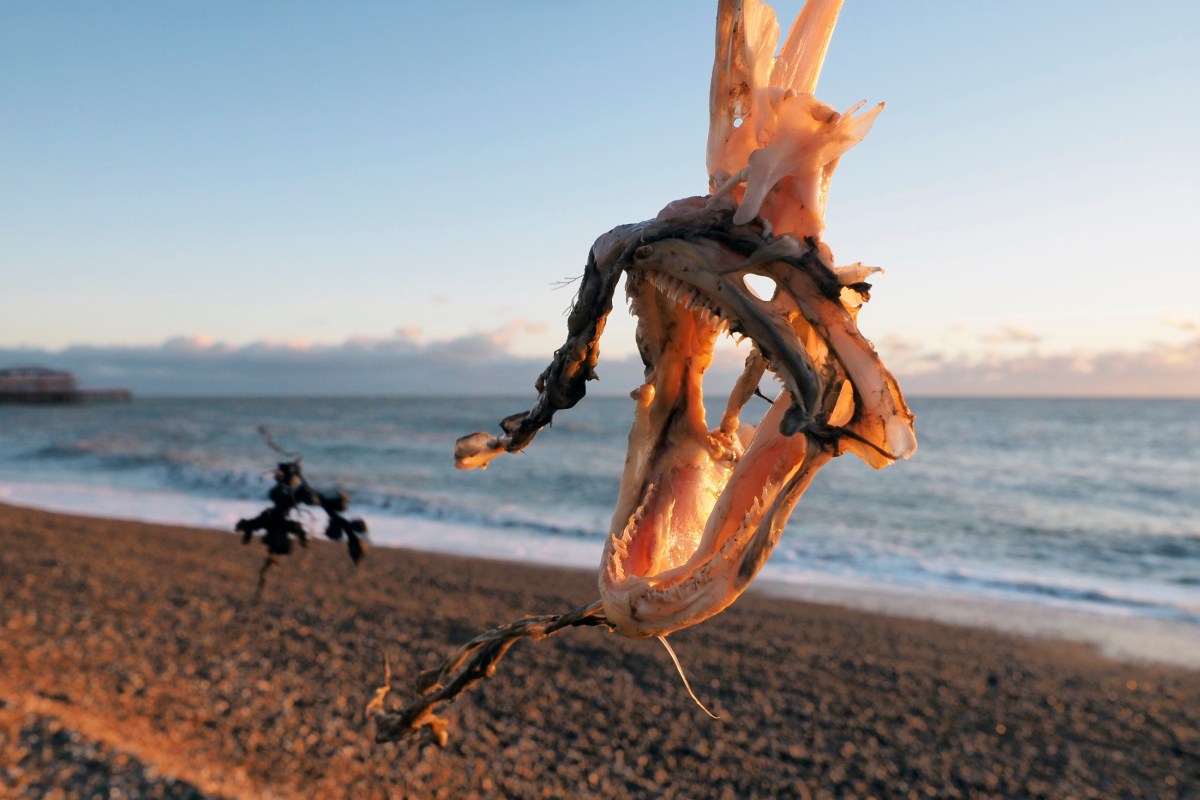
Today, while prodding through the seaweed at the high-water mark in search of interesting things, I came across a small pile of perfectly preserved seashells. I was surprised to see such a hoard, given the slim chances of anything emerging unscathed from the pummelling of the recent storms. And my surprise grew when, on a closer inspection of the shells, I found that all of them seemed to come from the Philippine and East China seas. Clearly, one of the local mermaids has just returned from her holidays.
Crackers – 14th Jan 2016

Today when heading off to the seafront I came across a box of Christmas crackers lying on the pavement. None of them had been opened. What’s more, these were of no ordinary variety; the box said so, proclaiming on its top in large letters that these were ‘Luxury Christmas Crackers’. Well what would you have done? I immediately opened the box and started pulling them. My first disappointment was on finding that none of them made any noise; more of a ‘plip’ – I suppose the damp had got to the small explosive charges that would normally have facilitated some sort of a bang, or crack. Nevertheless, undeterred, I rooted round inside to see what sort of gift could be obtained from crackers that proclaimed themselves ‘luxury’. The first contained a small puzzle made of several bits of bent wire that had already started to rust. Not exactly luxurious, but, I reasoned, you always get a few sub-standard surprises inside crackers. I pulled another. This revealed a small plastic pen that made the puzzle seem rather more attractive in comparison. The contents of the third cracker: two plastic golf tees, confirmed my worst suspicions that the description on the box was a marketing ploy devoid of any integrity.

Yet it is an ill wind that blows no one any good. While engaged in this activity I had spotted several people walking down the road towards me and, had I not first experimented with these three, I might have had the false confidence to approach them with the box in the hope that they would have pulled the remaining crackers with me in a random and spontaneous act of friendship. Thank heavens I didn’t! With my newly acquired knowledge of the contents of these ‘luxury crackers’ I was able to avoid the embarrassment of revealing myself as some kind of cheapskate to complete strangers.

My only regret is that, in thereupon beating a hasty retreat, I forgot to read the jokes.

Mozart’s starling –7th Jan 2016

You might have noticed I have become fixated on starling murmurations of late. I make no apologies, they are far too extraordinary to ignore and soon enough it will be spring and their displays will stop. However, I was beginning to think I was running out of stories to accompany my photographs, until I came across this today:

“Mozart recorded the purchase of his starling in a diary of expenses, along with a transcription of a melody whistled by the bird and a compliment (Fig. 3). … The theme whistled by the starling must have fascinated Mozart for several reasons. The tune was certainly familiar, as it closely resembles a theme that occurs in the final movement of the piano concerto in G major, K. 453. Mozart recorded the completion of this work in his catalogue on 12 April in the same year. As far as we know, just a few people had heard the concerto by 27 May, perhaps only the pupil for whom it was written, who performed it in public for the first time at a concert on 13 June. Mozart had expressed deep concern that the score of this and three other concertos might be stolen by unscrupulous copyists in Vienna. Thus, he sent the music to his father in Salzburg, emphasizing that the only way it could “fall into other hands is by that kind of cheating”. The letter to his father is dated 26 May 1784, one day before the entry in his diary about the starling.

Mozart’s relationship with the starling thus begins on a tantalizing note. How did the bird acquire Mozart’s music? Our research suggests that the melody was certainly within the bird’s capabilities, but how had it been transmitted? Given that our observation that whistled tunes are altered and incorporated into mixed themes, we assume that the melody was new to the bird because it was so close a copy of the original. Thus, we entertain the possibility that Mozart, like other animal lovers, had already visited the shop and interacted with the starling before 27 May. Mozart was known to hum and whistle a good deal. Why should he refrain in the presence of a bird that seems to elicit such behaviour so easily?

A starling in May would be either quite young, given typical spring hatching times, or at most a year old, still young enough to acquire new material but already an accomplished whistler. Because it seems unlikely to us that a very young bird could imitate a melody so precisely, we envision the older bird. The theme in question from K. 453 has often been likened to a German folk tune and may have been similar to other popular tunes already known to the starling, analogous to the highly familiar tunes our caregivers used. But to be whistled to by Mozart! Surely the bird would have adopted its listening posture, thereby rewarding the potential buyer with “silent applause.”

Given that whistles were learned quite rapidly by the starlings we studied, it is not implausible that the Vienna starling could have performed the melody shortly after hearing it for the first time. Of course, we cannot rule out a role for a shopkeeper, who could have repeated Mozart’s tune from its creator or from the starling. In any case, we imagine that Mozart returned to the shop and purchased the bird, recording the expense out of appreciation for the bird’s mimicry. Some biographers suggest an opposite course of transmission – from the starling to Mozart to the concerto – but the completion date of K. 453 on 12 April makes this an unlikely, although not impossible, sequence of events.”

Starling score

Text and music score from: West, M.J. and King, A.P: ‘Mozart’s Starling’, in American Scientist Vol 78 (March-April 1990) Pp 111-112