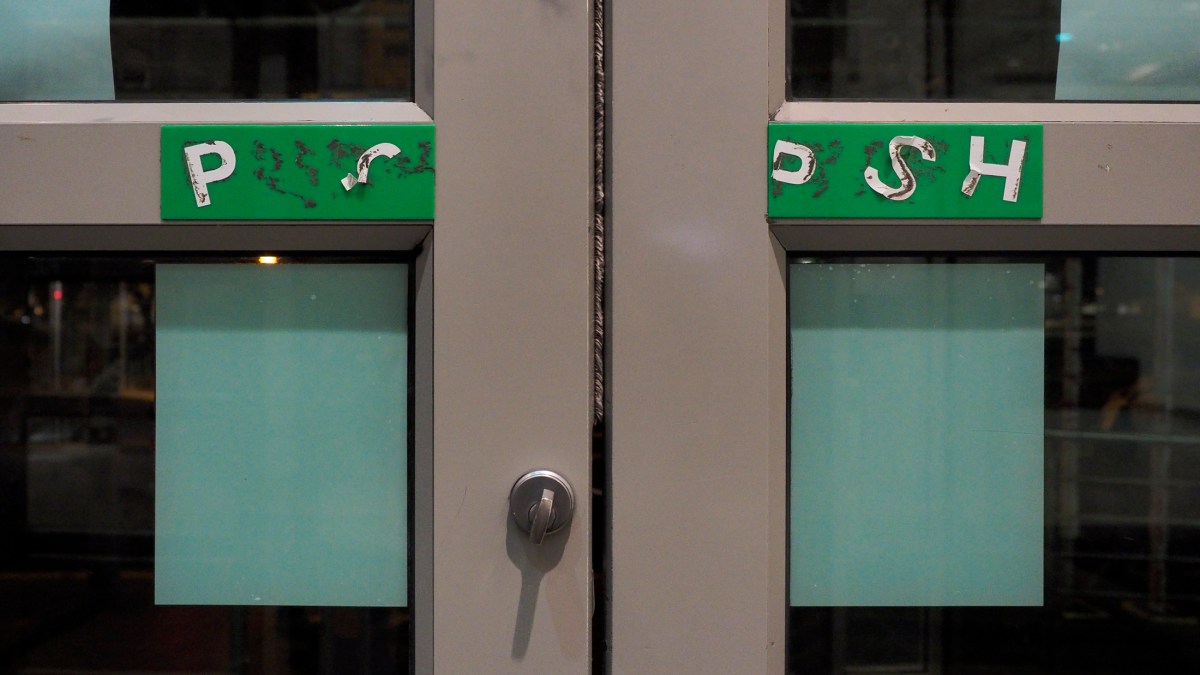
On each door is a green plastic plate inscribed, in white lettering, with the word ‘push’. Telling us the doors open out rather than in is useful, though the absence of handles on the side facing us might alone have been a sufficient indicator of direction.
Of course, with most doors that require pushing rather than pulling, where one decides to push, or even what to push with, is largely optional. While most of us understand it is better not to apply pressure to the glass panels (we all know glass can break) there is enough laminated metal door frame to allow for a wide degree of choice in accomplishing your passage over the threshold.
In older styles of architecture, doors demanding regular use have vertical brass plates attached to their ‘push’ side. This not only indicates the tacit instruction: to push, but also protects the wooden frames from being corroded by acids present in human sweat. The green plastic plates on these doors not only acknowledge their architectural antecedents, but also, by adding the word ‘push’ to them, reinforces the message. So much so in fact that the majority of users only push where it says ‘push’. This you can easily tell because the letters forming the words have, over time, been pushed beyond the point of legibility by the action of numerous hands. An additional factor in their migration is that the glue used to attach the lettering to the green plastic is of a kind partially soluble in organic grease, acids, and the various cleaning fluids used to keep the doors looking fresh.
On several occasions I have considered mentioning this to the powers that be. However, I must confess I take great enjoyment that, in this instance, Walter Gropius’s dictum: ‘form follows function’, comes truly alive, the form of the words certainly following the functional results of all this pushing. I also find it appropriate that this pronouncement from the founder of the Bauhaus is embodied so clearly on the main entrance to a modern institute of art and design.
 Umbrellage