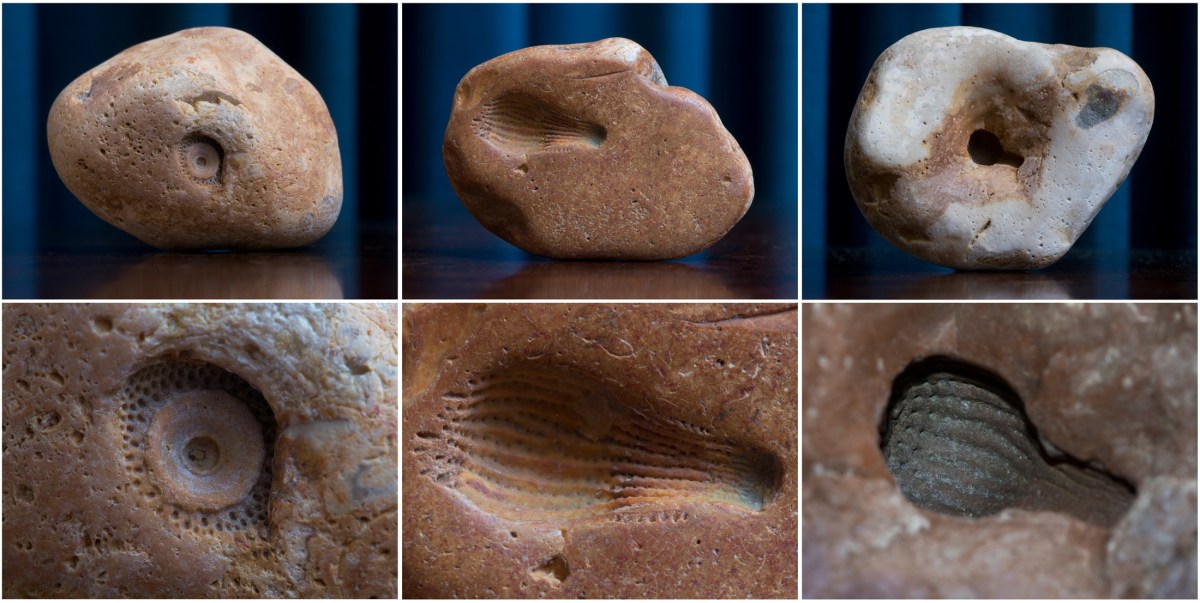
So far, of the stones I’ve collected, some present one particularly good angle and therefore photograph well. Others, often the most interesting, are more difficult as their specialness relies on them being held and turned in your hand. Trying to pin down their personality in a single image is tricky. On one occasion, I’ve posted a whole page of different views of the same object to try to get across the experience of the object in the round (see: Gargoyle – Weds 21st Jan). But there are still other stones, which, while not at first glance seeming particularly interesting, contain one detail that singles them out as remarkable. In most of those I’ve found so far, these details have been fossils: imprints of things that lived millions of years ago.
For a while now I’ve been wondering how to represent this kind of stone. In those I’ve found that are small, the point of interest is comparatively large enough to allow recognition in a small image. However in others, this facet is lost because of its diminutive size in relation to the object as a whole. So I’ve decided to post today a special page of three such examples, the complete stone shown on top and a close-up detail underneath.
Although not created by light falling on a sensitized surface, in other ways fossils are close natural equivalents to photographs: They are causal in nature, i.e. there had to have been a something for them to be an imprint of. Therefore, like photographs, they are indexical: always referring to things outside of themselves. And of course, as with photographs, they are often much more permanent than their subject; that which caused the imprint no longer remains, at least as it was when the imprint was made.
Actually, this is more obvious with fossils than photos, but the rule applies to both:
Take a picture of someone you know and the next time you do so they will have changed, maybe they’ll be wearing different clothes and you’ll find them a different mood (and always a little older). Even if you take several pictures on the same day, the light will change, the weather and so on. And even if in a matter of seconds, one fleeting expression will have gone, replaced with another, the wind will have ruffled their hair, a cloud will have passed in front of the sun.
Even statues change from moment to moment. Not their fabric of course, not obviously anyway, that takes longer. But their context, their relationship with the world around them, and this will reflect back on our apprehension of the objects themselves. The different people, birds, cars around them; or, again, the light, the weather, the time of day, the seasons, festive decorations, graffiti, the slow accretion of grime and lichen, the state of the neighbourhood… And, after all, none of us ever see the same thing the same way twice because we too change from minute to minute. You could spend the whole of your life photographing the same thing and never end up with the same result. But then, now I think about it, if we too change from moment to moment, maybe we could spend our whole lives revisiting the same photograph and never see it in the same way?
Where was I?
In these details I’ve tried to get across the tiny thing I think made these stones noteworthy, but of course to get the most out of the detail I’ve had to change the lighting, so some of them might not look entirely like they come from the object as a whole, as represented above them. But they are the same things, you’ll just have to trust me on this.
 Umbrellage