Paradise – Thurs 9th July

“O’re the smooth enameld green
Where no print of step hath been,
Follow me as I sing,
And touch the warbled string.

Under the shady roof
Of branching Elm Star-proof,
Follow me,
I will bring you where she sits,
Clad in splendor as befits
Her deity.
Such a rural Queen
Arcadia hath not seen.”

MIlton ‘Arcades’ 1633

The Birth of Venus – Mon 6th July

It seems obvious to say that one of the most important things about photography is knowing where to point your camera. But implicit in this is that, in doing so, you are therefore always excluding a lot of other things. I’m just as guilty of this as any other photographer. I don’t see how you could do otherwise, given that the camera viewfinder gives you a rectangle that only allows so much of the world to be present in any particular shot. But doing this inevitably creates a certain view of the world out of which narratives breed. It always make me laugh hearing the old phrase ‘the camera never lies’ as, even without the panoply of digital correction and retouching techniques now available, omission itself is another kind of falsehood. Photographers never tell the whole truth.

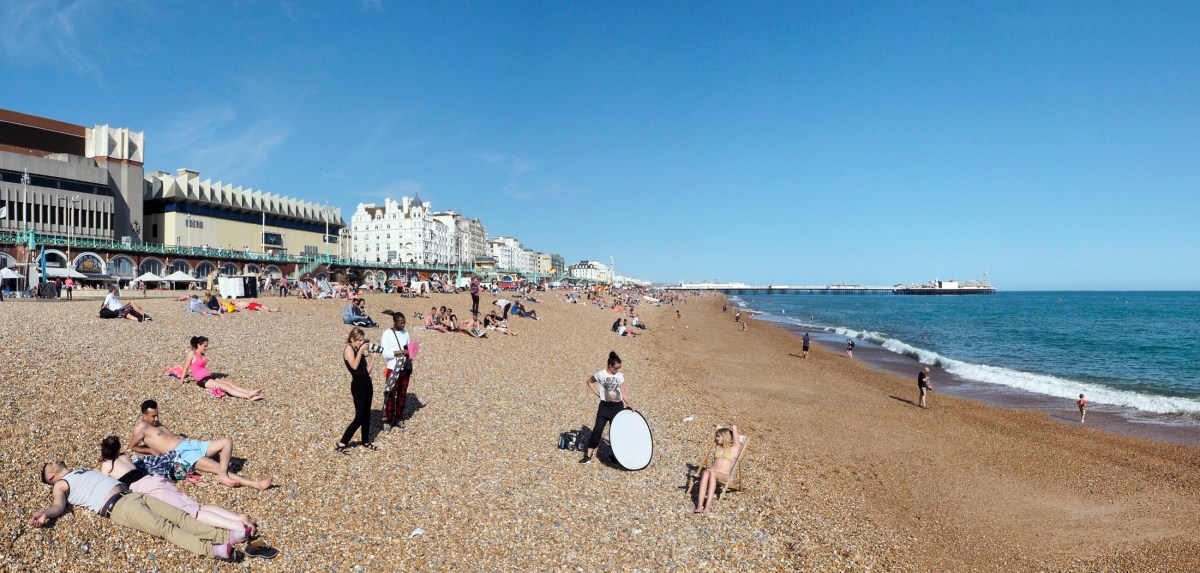
So anyway, today I was delighted to find a photographic crew engaged in just such an act of exclusion down at the spot I’ve started taking my panoramas from. They were there for quite a while; so was I.

Judging by the length of the lens I’d say the shots they were looking for would be close, probably only a head and shoulders with a bit of the sea in the background, no horizon, compressed, narrow depth of field. Also, judging by the cost of the lens (Canon L series lenses have all the self-effacing diffidence of a Maserati) and all the other paraphernalia: circular reflector, several expensive bags full of other mysterious goodies, plus the fact there was three of them to take a picture of one girl, heavily made up to look natural, I’d say this was a professional outfit taking pictures destined for a teen fashion magazine or perhaps a catalogue.

I was also struck by the difference between the girl in front of the lens, and those behind it constructing the shot: their attitude of control, concentration and intent; her passivity. They could have just as well have been taking a picture of a vase of flowers, or a car.

I wanted to ask: Which magazine? What for? Is it a lifestyle shot, makeup suggestions, or for advertising swimwear? I wanted to ask the girl what she thought of all this? But by the time I’d finished taking my photographs the woman with the reflector (I think she was the one managing the shoot) had started to look pretty grumpy so I decided I’d better not push my luck.

If anyone reading this comes across the final picture, do let me know. I’d love to find out how the world looked from their point of view.

Wake – Sun 5th July

Sometimes for sport the men of loafing crews
Snare the great albatrosses of the deep,
The indolent companions of their cruise
As through the bitter vastitudes they sweep.
Scarce have they fished aboard these airy kings
When helpless on such unaccustomed floors,
They piteously droop their huge white wings
And trail them at their sides like drifting oars.
How comical, how ugly, and how meek
Appears this soarer of celestial snows!
One, with his pipe, teases the golden beak,
One, limping, mocks the cripple as he goes.
The Poet, like this monarch of the clouds,
Despising archers, rides the storm elate.
But, stranded on the earth to jeering crowds,
The great wings of the giant baulk his gait.

Charles Baudelaire
‘The Albatross’ (in ‘Les Fleurs du Mal’)
Translated by Roy Campbell, 1952

Fol-dee-rol – Thurs 2nd July

I’ve already written about the strangeness of the spaces at crossroads and under bridges (see Witches cottages– Fri 14th Nov). Today I was back in that part of Brighton where three viaducts almost converge, a very singular place indeed and, well, since the other thing everyone knows about bridges is that trolls live under them, I thought I’d go a-hunting for one.

Sure enough I soon found evidence in the form of a sheep’s skeleton and a haul of treasure, both hidden in plain sight in window displays, some pigeon feathers too, lying in the road, and then the gnawed remains of a headless human torso (ok it was made of plaster, but trolls are really only interested in bones so the plaster would have tasted similar enough to fool one of them, at least for a bit). So, I tried softly humming one of their songs as I know they can’t resist a tune they know the words of. It goes like this (as faithfully translated from the Norwegian by Frank Luther in 1947):

“I’m a troll, fol-dee-rol, I’m a troll, fol-dee-rol
I’m a troll, fol-dee-rol, fol-dee-rol-dee-rullee
I have three heads and I have three hats
I have three chins and I have three cats
I have six eyes and I have six ears
When I cry, I cry six tears”

Anyway, I’d only just finished singing the verse when this really low rumbling started, and as it grew louder I’m afraid my courage failed me and I fled, running all the way up the hill till I got to the other side of the bridge across New England Hill.

I did wonder afterwards if it could have been the sound of a train crossing the bridge, but I know the difference between the sounds a train and a troll makes, and I wasn’t going to hang around for the next line of the song was I?

“I’m a troll, fol-dee-rol, I’m a troll, fol-dee-rol
I’m a troll, fol-dee-rol and I’ll eat you for supper”

No sir-ee, I’m not stupid.

Wall St – Weds 1st July

Last night I shared a post I found on facebook comparing the cost of the Greek bailout with the amount used to prop up the banks following the banking crisis a few years ago. The figures were compelling; it also turns out they were fabricated. This is sad because the author had made a good point, and if he had checked his sources he would have found that, while the amount the banks were bailed out by was different to the figures he quoted, it was still colossal in comparison to what Greece needs. Therefore here is some more reliable information:

An article posted in the Guardian on 12th September 2011 (since updated, 20th May 2014) quotes a number of figures based on different factors, but concludes:

“not only has the [UK] government bailed the banks out to the tune of £123.93bn, and at its peak had liabilities for the banking crisis of £1.2 trillion, but the value of its stakes in the biggest banks has plummeted and the interest it is receiving on the loans is relatively small. The interest collected is smaller than that the government pays on its debts, taken out to refinance the banks”

Source: http://www.theguardian.com/politics/reality-check-with-polly-curtis/2011/sep/12/reality-check-banking-bailout

A report published by the USA’s Congressional Budget Office provides several more figures on the American banking crisis. These include:

“By CBO’s estimate, $428 billion of the initially authorized $700 billion will be disbursed through the TARP, including $419 billion that has already been disbursed and $9 billion in additional projected disbursements. The cost to the federal government of the TARP’s transactions (also referred to as the subsidy cost), including grants for mortgage programs that have not yet been made, will amount to $21 billion, CBO estimates…”

Source: http://www.cbo.gov/sites/default/files/cbofiles/attachments/44256_TARP.pdf

$21bn doesn’t sound very much in comparison to other figures mentioned, but it should be pointed out that this was the actual cost of the bailout, i.e. what the American tax payer won’t ever get back, not the amount of the loans considered necessary, deemed to be $700 billion. It also doesn’t take into account the appalling personal losses through mortgage foreclosures, job losses etc.

The current IMF estimate of the additional loan needed to prop up Greece is 52 billion euros. Of course Greece will need more if it is to finance itself for a full recovery, plus far better repayment terms based on sane levels of economic growth. And consider this: Greece is not a bank, it is a country of just over 11 million people, including children, the old and the sick. Furthermore, the situation Greece is now in is just as much, if not more, to do with the incompetence and near-sightedness (and obsession with propping up banks) of other European Governments, than it is to do with it’s own fiscal inadequacies, yet an entire nation is set to suffer as a result of decisions made by politicians and executives who only seem to have compassion when it comes to their own kind, not others.

Here’s one more quote, from the EU constitution:

“The Union is founded on the values of respect for human dignity, freedom, democracy, equality, the rule of law and respect for human rights, including the rights of persons belonging to minorities. These values are common to the Member States in a society in which pluralism, non-discrimination, tolerance, justice, solidarity and equality between women and men prevail.”

(Article 1-2 The Union’s values. Treaty establishing a Constitution for Europe as signed in Rome on 29 October 2004)

Panorama – Tues 30th June

Over the past few months I’ve been out nearly every day taking pictures of anything that interested me. Mostly, I’ve found myself drawn to marginalia and odd details. I wanted to document the sorts of things one might easily overlook, but which had beauty, or strangeness, or ‘something’ even if I wasn’t sure quite what, to show how interesting the world can be if one only takes the time to look. However, in focusing on small things, there is a danger of missing the obvious.

A few days ago I was having a conversation with Jack and Mark, two of the guys at another café on the seafront. They asked me if I had any shots of the pier; they needed one for a billboard. I had to admit I didn’t, beyond close ups. So I decided to find a spot on the beach where I could get the whole thing in, side on, without any distortion. Of course this meant including a lot of beach packed with people, which creates the problem of framing the shot so there aren’t too many cut off heads sticking up into the bottom of the frame, which meant including quite a lot of the beach, and the sea, and a fair bit of the promenade too, by which point, I realized if I wanted to preserve any detail I’d have to take several photographs and stitch them together as a panorama.

It was only when I started piecing together about 30 photographs that I became engrossed in what I’d got. It seemed like all of life was going on before me – something brought out more by it being a still rather than a first-hand experience. Who are they? Where are they from? What kinds of lives do they lead? How many are falling in, or out of love?

I know none of these are particularly new observations, but that doesn’t diminish their power, so since that first one I’ve taken several more over 3 separate days. This one is of Brighton beach on a really hot day (taken for today’s entry of course). Even though it was shot around 5pm and it’s not yet quite high season, the place is literally jumping.

The version you see here is scaled down a lot so it doesn’t take forever to load onto your screens, but the original is about 2m long (at 240dpi) – a high definition representation of everyone visible at that moment in time. It feels like I’ve captured the whole world – in which case maybe it isn’t so different to the other photographs I’ve been taking, only this time it’s one panorama assembled out of fragments, rather than a contact sheet of different moments representing a journey.

And, of course, look at all those stones! I wonder which of them will end up being photographed in close-up some time in the future…

I think I might do some more over the coming weeks.

Commerce – Sun 28th June

Stones found on one of the tables at the café today, one marked with a price (£3.50) and a name (Alex). Possible theories concerning these objects:

Alex is making his first foray into the world of commerce, selling stones from the beach. While the idea isn’t entirely without merit, it is only likely to appeal to people with stiletto heels who do not want to break them on the pebbles – a limited market. Anyone otherwise so lazy they cannot be bothered to go the extra few feet to gather their own would have been unlikely to have made it as far as the café from their car. If Alex wishes to pursue this venture he should consider a stall by the roadside, although the gift-wrapping is a nice thought.

Alex himself (or possibly herself) has been sold for the measly sum of £3.50. Indeed, judging by the pile of stones and the Kleenex, the vendors might have settled for these instead of cash.

This second theory begs several further questions:

Why has Alex been sold? Is it because Alex had been naughty (Alex must have been very naughty indeed, children usually fetch a much higher price) or because Alex’s parents were hard up and needed to buy some petrol for the car so they could go home? (These things happen, but they’ll be in for a surprise when they try to pay with the rest of the pebbles)

Who to? This particular question holds limitless possibilities, though, given the stones left behind, perhaps as change, it is most likely to be mermaids (mermaids use stones for currency, see entry: ‘Finding treasure – Sun 14th Dec’).

Where is he or she now? Well, that would depend on the correct answer to the above questions.

What do you think?