Seagulls are not the greatest of nest builders. Not for them an intricately weaved bower, or miniature castle made of fastidiously masticated mud. No, half the time you wouldn’t know that the handful of sticks and a bit of wool was a nest at all. I’ve seen better-constructed piles of rubbish and leaves accumulated by the wind in neglected gutters.
Their chicks are not much to write home about either, resembling a hybrid life form hurriedly assembled out of a velociraptor, an oven-ready turkey and a half-sucked sweet dropped down the back of the sofa. Yet they not only survive but flourish as a species. This must be, in part, due to the ferocious aggression of their parents, who yell at anything within 50ft of their ‘nest’ (frequently joined by every other seagull in the area) and also because the chicks grow at such a prodigious rate that they are, within only a few weeks of hatching, bigger than anything that could get that far up a building, apart from a builder perhaps. So, on the rooftops they lumber about and mewl continuously, driving insane any person living in a room below them until they either take off, or, more often than not, fall out of the ‘nest’ where they start a life of strolling, joining to form gangs with other misplaced juveniles and terrorising the local cat population. Sometimes though, those that fall do not land on the ground, but on a roof terrace or balcony below. This can create problems for any mere human who wishes to use this facility for their own benefit.
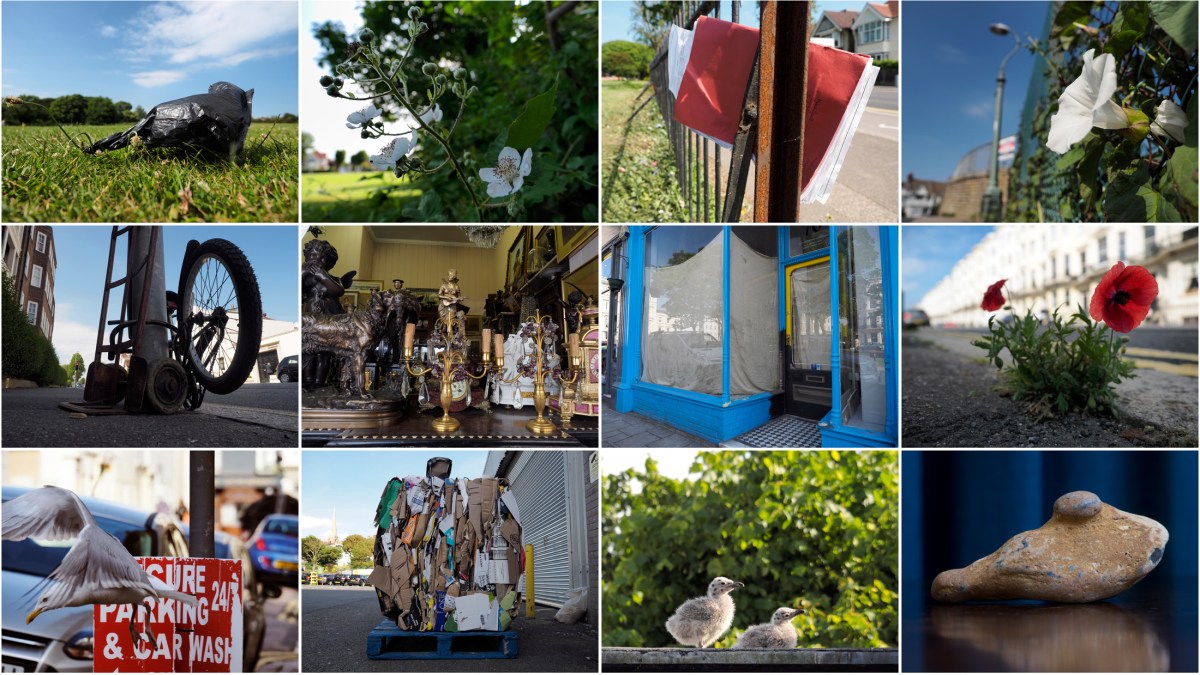
Some years ago this happened at my then studio, which, as I have mentioned in an earlier post (see Sat 15th November) had to be approached across a flat roof. I’d taken me years to make the space attractive, filling it with pots and plants which, because the terrace was such a fabulous suntrap, grew both fast and luxurious. I was justifiably proud of my garden and would, every day, on my way to start painting, stop to do a little watering and weeding, nipping out any dead heads and stray shoots. One morning on reaching the top of the steps from the entrance alley, an infernal squawking began from above and I was immediately buzzed by an extremely aggressive gull (probably the same one mentioned in the November post). I beat a tactical retreat to the studio doorway to consider my options and, looking back over the terrace I could see a beak poking out from behind one of the flower-pots. The beak was attached to a head and in turn to a hunched body, it’s posture reminiscent of a school kid caught smoking behind the bicycle sheds. I looked at the chick, the chick looked back.
What exactly do you do with a displaced juvenile seagull? This was the topic of conversation among several of my studio mates about an hour later. No one wanted to risk putting it back in its nest as this would, most likely, end up with whoever drew the short straw being pecked to death. We decided to phone the RSPB for advice. They told us it was best to leave it be – the gull would eventually be strong enough to fly away and, frankly, they had far too many calls of this nature to be able to send someone out to take every fallen bird to a baby seagull nursery, even if one did exist. Expert advice having been given, we all stared at the gull. Someone thought it looked thirsty so a bowl was found, filled with water and put outside in the shade of one of the pots. Several bits of sandwich followed.
Each time one of us ventured outside we were immediately bombed by the parents but, after a while, seeing that none of us had so far actually been touched, we grew bolder. As long as we didn’t get too close to the chick, things were tolerably quiet and an uneasy peace settled on the roof. The juvenile started to explore, tentatively nibbling bits of plant within its reach or just resting in the shade. By the afternoon, several of us managed tea on the other side of the terrace where we looked at our new neighbour, its parents looked at us, and after a while, another chick’s head appeared over the edge of the roof above, looking down to see what was going on.
The next morning there were two juveniles on the terrace. Clearly the other one felt it was missing out and had decided to follow its bolder (or clumsier) sibling. They had also now made a much better nest in one of my plant pots, in the process squashing several geraniums and a young fuchsia. This did not make me happy and I directed a volley of abuse at them. This was answered from above with outrage but, I’m sorry, I am not having my plants damaged. After a lot more shouting and waving my arms about the two of them lumbered out of the way.
Half an hour later they were on another plant pot, squashing several more flowers in the process. Once again I yelled and waved my arms, once again they lumbered off to another part of the roof where they stared at me from a safe distance. You might call me cruel, maybe you’d be right, but given how uncomfortable seagull nests are, while I had no problem in sharing the space, I wasn’t going to see it turned into a wasteland. There were plenty of other bits of roof just as comfortable as they’d been used to above. I went back into my studio and found every sharp object I could lay my hands on: forks, nails, pointy off-cuts of wood, and planted these in every pot I had to deter the little sods.
Half an hour later I re-emerged on the terrace to see that they had now taken up residence on probably the spikiest arrangement of the lot. Clearly, far from putting them off, I had simply made them a nest much more closely resembling the dysfunctional twig pile they been used to before. There was only one thing for it, if I couldn’t stop them I’d have to find an alternative they simply couldn’t refuse. I went back upstairs to my room, picked up an old chair cushion and took it out to them, placing it in the most sheltered spot I could find. I then put the water-bowl in front of it plus another bit of sandwich.
Nothing much else happened for the rest of that day but the following morning I was pleased to see that not many more plants had been crushed and the cushion had now found favour. True, when I arrived they were not actually sitting on it, but the bowl was empty, the sandwich had gone and there was enough bird shit on and around the cushion to suggest it had been used. Later on that day I did see them enthroned upon it.
I’d like to be able to tell you a Disneyesque story about how, over the ensuing weeks, man and bird became close, and that eventually they took morcels right out of our hands, that we gave them names which they responded to, and that they would come and sit with us as we took our tea together. I’d like to tell you this, but if I did I’d be lying. For most of the rest of the summer we continued to be yelled at and bombed by their parents, more plants got squashed and the only truly remarkable thing was the sheer volume and smell of guano that accreted across the entire terrace.
A few weeks later another chick joined them. Smaller in size than the first two had now become, they both turned on it sporadically, when they felt like it, just because they could, but they’d still end up sleeping together on a cushion now more closely resembling concrete than cheap embroidery.
And then one day one of them had gone, and then a few days later the other, leaving only the runt to hang around for a week or so before it, too, disappeared. That the skies had, around this time, been filled even more than usual with the cries of gulls, and that these cries had seemed more excited than before, gave the clue that, all across town it was time for the young birds to make their first flight. It’s a shame we didn’t see them take off, this would have been quite a privilege, but nevertheless we all felt we’d done our bit for nature. Then we started scrubbing down the terrace.
It took hours.
 Umbrellage