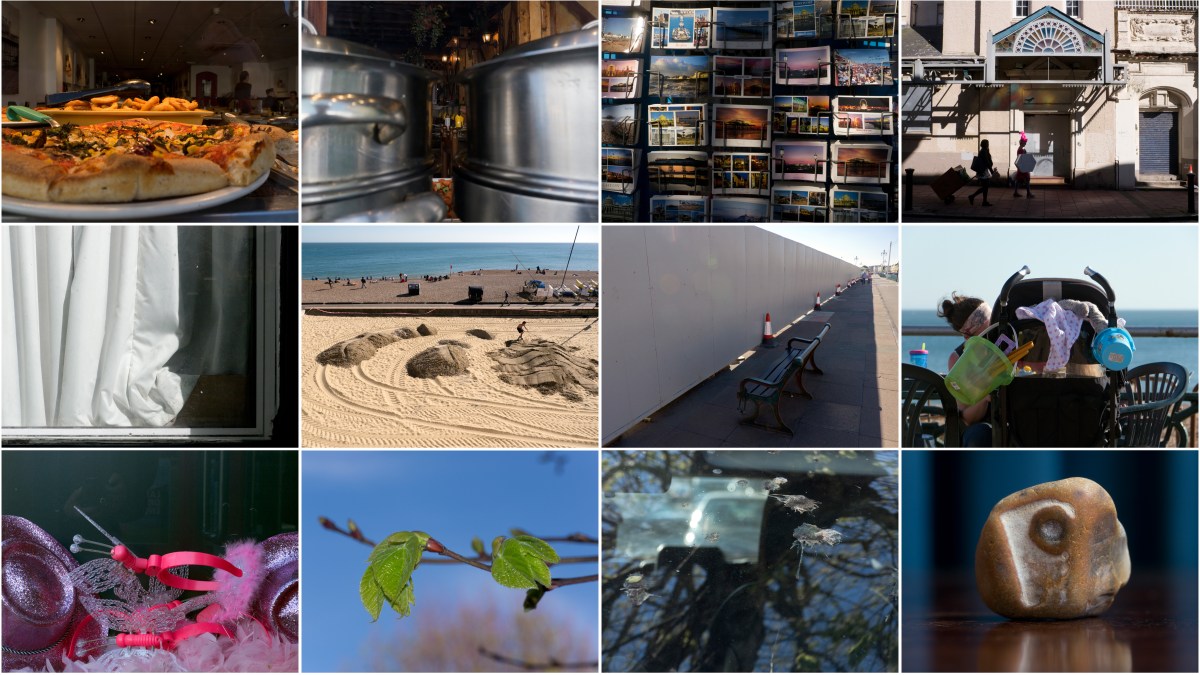
Loss – Mon 27th April

Sitting at the café, I hear an unmistakeable clunk and rattle, and know at once that someone is spreading out their treasure on one of the plastic tables nearby. Turning, I see two parents and a child. None of them are saying much. The child, a girl of about nine wearing a look of defiant sternness, gathers all the stones together in her arms and gets up from the table. Her father follows her and reaches out for the stones, but the girl hunches her shoulders and turns away from him. At once I know she has been told to put them back, and indeed you can see she is going to do so, but it’s going to be her that does it; the humiliation of having this responsibility taken away from her would be too much. She walks slowly to the ornamental railings separating the beach from the promenade and drops them one by one over the edge onto the shore. The girl does this with great deliberation while, at a watchful distance the father observes, his face set in a scowl.

Once the family has left the café, I resist the urge to look for the stones the girl has just dropped. On the one hand their worth has already been escalated hugely by their having been chosen, making them a real prize, but to retrieve something another soul had cared for, twice, once by finding, and again precisely by returning, would be disrespectful.

Covert operations – Fri 24th April

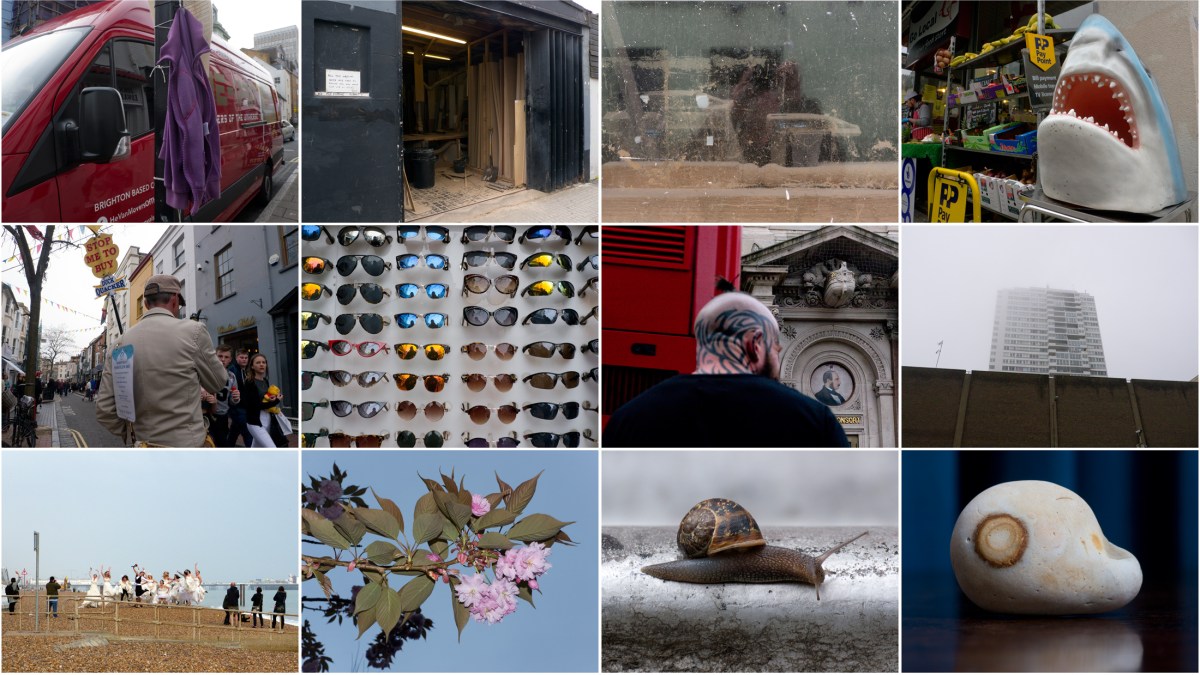
The man at the café continues in his heroic task of clearing the establishment of all birds. He’s increased his arsenal of anti-avian devices, so that now, when not sporting his favourite weapon: the long handled brush (pictured) he will have with him another, manky old brush-head with long bristles. This he carries by the hairs in readiness to hurl at any fowl seen to be encroaching on his territory. Tea at the café is thus now punctuated with a series of loud cracks and skitters as this missile hits the ground and skids across the pavement, usually followed by a flurry of wings. Sometimes if you’re quick enough you can see the makeshift projectile fly through the air and I am now wondering how long it’s going to be before he hits a tourist. Of course this could also be me, and nearly was today, but that’s a risk I’m prepared to take, the floor-show is just too good and anyway, we all need a little danger in our lives.

At first sight it would appear this assault is working, there aren’t so many birds around lately, but I don’t think this is all to do with his endeavours. Given the crows are not to be seen on the beach either (an area outside his jurisdiction) I reckon they are currently nesting, this hypothesis supported by recently seeing one of them on the lawns with a beak so full of browning grass clippings that he or she looked a dead ringer for Karl Marx. And now the derelict West Pier seems to have developed a white frosting that evaporates from time to time as whole flocks take to the air, suggesting it’s become this year’s seagull nesting site of choice.

Sadly though, the pigeon world is now a rather more nervous one. They have all taken to lurking behind table legs and, when traversing any open terrain, do so at a run, their heads bobbing frantically in syncopation with their legs until they reach better cover elsewhere. Abandoned remains of chips, butties and fried breakfasts remain unmolested for whole minutes at a time, indeed it seems like it’s taking the man longer to clear the tables than was the case when he first arrived, so maybe this is a baiting strategy?

Nevertheless, despite his apparent successes, the whole world knows this situation is only temporary and indeed as soon as he turns his back or disappears on some errand, any uneaten plates of food left behind will all at once disappear under a cloud of feathers. It’s just that now, most of the food is immediately tossed to the ground so it can be eaten under the cover of various items of café furniture.

I must admit to being curious about what will happen when, their eggs hatched, the crows and gulls need to start foraging for their chicks. Both these species have a lot more presence and are less likely to take things lying down. When they return, I don’t think it’s going to go all his way…

Stubborn – Thurs 23rd April

“Dandelion. noun… ORIGIN late middle English: from French dent-de-lion, translation of medieval Latin dens leonis ‘lion’s tooth’ (because of the jagged shape of the leaves)”

Actually I thought it was called dent-de-lion, not after the leaves but the flowers, whose petals are not only many, long and pointed (like the teeth in a lion’s mouth) but also because during the late middle ages up until the time of Shakespeare, lions teeth were thought to be yellow due to their monstrously carnivorous diet.

I’ve just been searching all over the place for some evidence of this and in particular through the play: ‘A Midsummer Night’s Dream’ because I could have sworn there was a line in it that backed up this theory, but there isn’t.

I am now really irritated and I have to ask myself: why have I wasted several hours trying to prove the Oxford English Dictionary is wrong?

I still think my version is better.

Bated – Mon 20th April

“We gather that Tarrou was agreeably impressed by a little scene that took place daily on the balcony of a house facing his window. His room at the hotel looked on to a small side street and there were always several cats sleeping in the shadow of the walls. Every day, soon after lunch, at a time when most people stayed indoors enjoying a siesta, a dapper little old man stepped out on the balcony on the other side of the street. He had a soldierly bearing, very erect, and affected a military style of dressing; his snow-white hair was always brushed to perfect smoothness. Leaning over the balcony he would call: “Pussy!Pussy!” in a voice at once haughty and endearing. The cats blinked up at him with sleep-pale eyes, but made no move as yet. He then proceeded to tear some paper into scraps and let them fall into the street; interested by the fluttering shower of white butterflies, the cats came forward, lifting tentative paws toward the last scraps of paper. Then, taking careful aim, the old man would spit vigorously at the cats and, whenever a liquid missile hit the quarry, would beam with delight.”

Albert Camus ‘The Plague’ (translated by Stuart Gilbert)

Measuring the impact of academic research – Sun 19th April

An important part of university life is the research of its teaching staff. This is what makes the place of study great and ensures that students studying there receive the best of educations. Research is judged on several criteria, including: ‘originality’ (no copying) ‘academic rigour’ (reading lots and not faking any experiments) ‘peer review’ (what other university lecturers think about what you’re doing) and ‘impact’. This last criterion is still somewhat debated across disciplines but, essentially, it’s how much what you do changes the world; the size of impact your work produces. Of course you have to be careful. Burning down the local hospital would have a great deal of impact and get you a lot of attention in the media, but not necessarily of the right kind. Besides, it would only be deemed local impact and universities want world leaders.

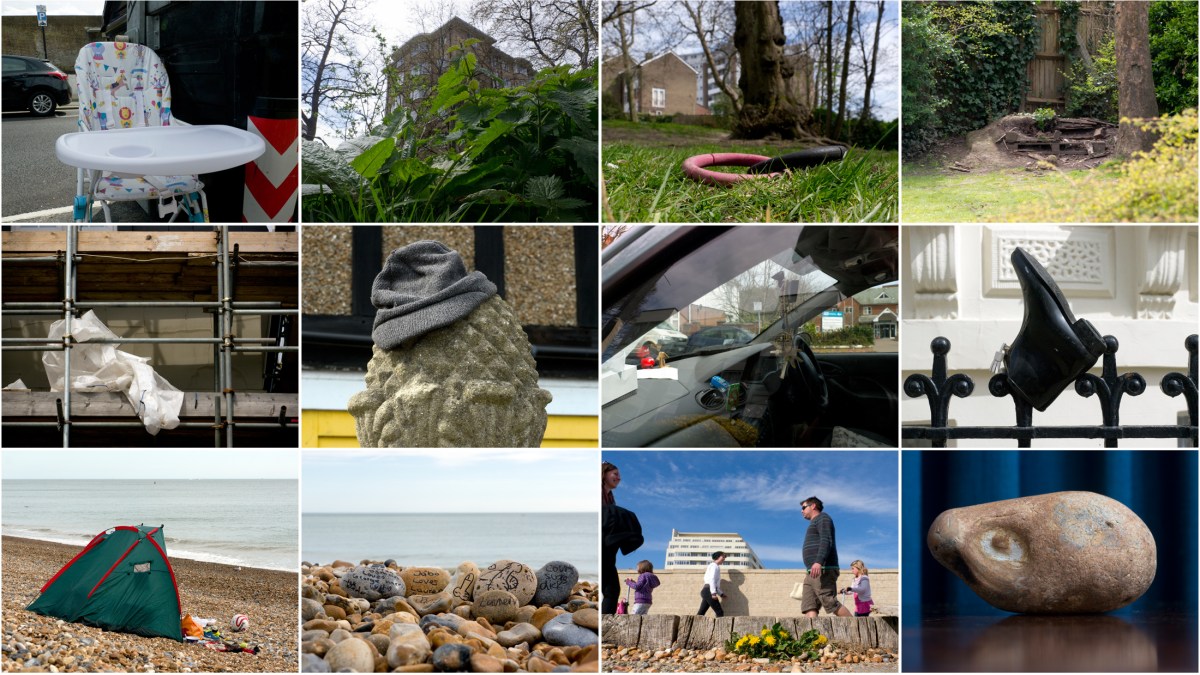
I was thinking of this subject today while on my daily walk when I came across a number of stones with some very unusual patination. On closer inspection I could see that these had not been formed entirely by natural processes; someone, or several someones judging by the different styles, had been writing and drawing on them (see picture in bottom row).

This reminded me of a successful public art initiative that had happened in the area a number of years ago. The project involved local children from all the surrounding schools going to the beach, selecting a stone, drawing a picture on it and then casting it back into the sea. I can’t actually remember what this symbolised (if anything at all) but it was deemed to be a good, indeed a poetic thing, and got a write up in the local paper.

As I mentioned, this was quite a few years ago and the children who had been involved in the event would now be teenagers. Finding today’s inscribed stones has made me wonder: were these drawings made by some of the same people who, as infants, took part in this event? Admittedly the subject matter is very different but it’d be nice to think they were connected, and that their memories of this project had prompted them to revisit the idea. If so, this would be a clear example of impact, albeit still on a local scale.

Bedtime Story – Sat 18th April

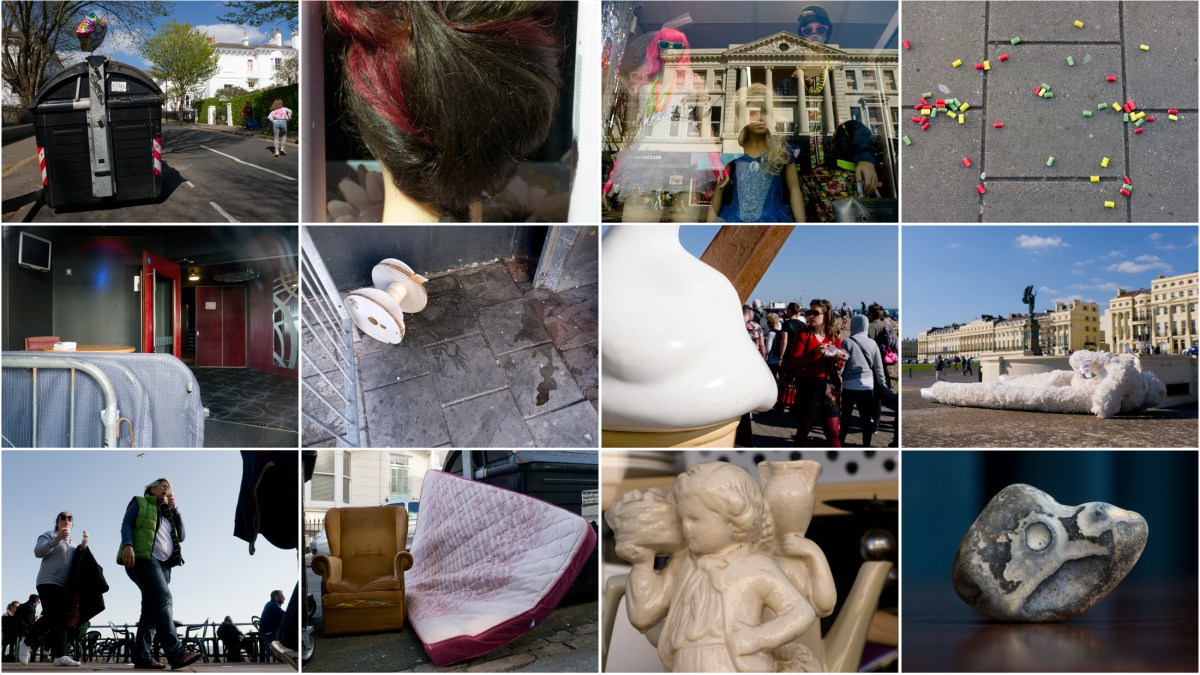
The rubbish bin in the top left picture of today’s contact sheet used to be a nine year-old girl called Clarissa. Unfortunately she was a very naughty child, much given to spiteful remarks about the other children she went to school with, many of whom would run away in tears following one of her ‘observations’. The parents of the other children tried all sorts of things to console their tender offspring, even repeating to them the rather lame rhyme beginning ‘sticks and stones…’ but it was no use, everyone knows how hurtful names are.

So, one day the parents of the other children decided to go and see the local voodoo doctor. The doctor thought about this problem for a long time and eventually decided that, just for a short while, maybe a week or two, Clarissa should be transformed into something useful but lowly to teach her a lesson. After a lot of further consideration and a few more incantations just to make sure, he decided the appropriate shape for her would be that of a municipal rubbish bin.

A lock of Clarissa’s hair was procured, the wax doll made and all was going according to plan until, having successfully completed the spell, the voodoo doctor decided to relax from his endeavours with a nice cup of tea. Halfway through his break the phone rang and, jumping up in a start, he knocked his tea all over his book of reverse spells, making the ink run on the pages so much that he could no longer read the words. With the words of the undoing spells now completely illegible, the voodoo doctor no longer knew how to turn Clarissa back into a little girl so she was now stuck in her new shape forever!

This was a pity. The voodoo priest was very sorry and had to go and see Clarissa’s parents to explain that, without the right incantation, this particular magic could not be undone. They were not happy about this but had to admit she was jolly useful now. So, to this day, Clarissa waits outside her home, hoping that another more competent voodoo doctor will pass by with the right kind of spell remover.

Every year on her birthday, her parents go into town and buy a balloon, which her little sister (pictured right) then ties to Clarissa’s lid. In this way they show her that, even though she is now a rubbish bin, they still love her very much, all things considered.

Tomorrow I will tell you the truly awful story of how Nigel Watley became a supermarket shelf.