Further thoughts on concealment – Sat 28th March

One of the many apocryphal stories about the US military relates to their attempts to develop a camouflage effective against thermal imaging devices. As you’ll probably be aware from wildlife programmes, infra-red detection can be used to identify a living being by the heat given off from its body. If the hot spots are rabbit shaped, it’s pretty likely you’re looking at a rabbit; by the same token, if they are man shaped it’ll probably be a man you’re looking at.

Anyone who’s seen ‘Predator’ will also have some idea of what infra-red vision looks like, from the shots where you see through the eyes of the alien. Unfortunately though, I have to report that smearing yourself from head to toe in river mud (in the manner employed so manfully by Mr Schwarzenegger to fool the alien) doesn’t actually work.

Millions of dollars of US government money were spent on finding a solution to the problem of infra-red visibility, leading to the development of clothing that concealed these ‘heat signatures’. Of course soldiers had to be completely covered in this special insulating fabric for it to be effective, but it looked like the defence contractors were on to something really big. Well, until, during field tests when it was discovered that, while anyone wearing these suits would be prevented from giving off any heat whatsoever, thereby making them invisible to thermal imaging devices, they would, as a result, pass out from overheating after only a few minutes and could even die if not rescued quickly.

Actually, I think they missed a trick here. If, instead of totally covering soldiers in heat insulating material, they had instead opted simply to disrupt the human outline by creating heat-transparent windows in the shape of other animals, this could have allowed the cooling necessary for the combatant to continue functioning. In addition, by presenting, in infra-red, what looks like a tower of acrobatic bunnies precariously balancing on each others backs, any sniper seeing such a spectacle would simply assume they’d been overdoing it and go away scratching their head.

You could also vary the animal-shaped windows to include koalas, marmosets, lemurs, squirrel monkeys, kittens, sloths, wombats and other small to moderately sized mammals to keep the enemy off balance.

I’ve decided to publicise this idea openly to the world rather than seeking my fortune from any particular country of military significance because I couldn’t bear the thought of having blood on my hands, whether it be human or any other small mammal that’s good at balancing acts.

28-0785a

Early example of camouflage 11/14/1917
http://research.archives.gov/description/530710
Bay – Fri 27th March

‘To hold all this together, Rauschenberg’s picture plane had to become a surface to which anything reachable-thinkable would adhere. It had to be whatever a billboard or dashboard is, and everything a projection screen is, with further affinities for anything that is flat and worked over—palimpsest, canceled plate, printer’s proof, trial blank, chart, map, aerial view. Any flat documentary surface that tabulates information is a relevant analogue of his picture plane—radically different from the transparent projection plane with its optical correspondence to man’s visual field. And it seemed at times that Rauschenberg’s work surface stood for the mind itself—dump, reservoir, switching center, abundant with concrete references freely associated as in an internal monologue—the outward symbol of the mind as a running transformer of the external world, constantly ingesting incoming unprocessed data to be mapped in an overcharged field’

Leo Steinberg
The Flatbed Picture Plane
First published in ‘Reflections on the State of Criticism’, in Artforum in March 1972; then in ‘Other Criteria’, 1972, pp.61-98

Fred and Ginger – Thurs 26th March

So there’s these two dogs playing in the sand of the volleyball court on the sea front. I can’t help it, they look too cute, Its almost like they are dancing and so I have to photograph them. Then I have a brief chat with the owners about the glorious optimism of dogs. Apparently every night the two owners take the dogs to the beach and every night the little scallywags go through the same routine, as if they’ve known each other all their lives, but also as if every night, they’ve fallen in love for the first time.

This itself is enchanting, but here’s the extraordinary thing: Moments before, while I was taking the pictures, the scraggy brown one spotted me, or rather, it spotted my camera lens, raced over to me, jumped onto the low wall surrounding the court, gave me a big woofy grin and, honest to god, it posed. This was all over in a second and I was so startled I didn’t take a picture in time before it was off again, but it really happened.

As far as I am aware, dogs do not know how cameras work or what they are used for. As for posing, I have always been under the impression that when this happens at Crufts or on youtube videos it is more to do with obedience, training or the promise of a biscuit, not that spontaneous and brilliant reaction you get with accomplished film stars from the golden age of Hollywood. So I am now wondering, is it possible that Fred Astaire and Ginger Rogers (or maybe some other screen couple: Douglas Fairbanks and Mary Pickford, Clark Gable and Carole Lombard, Spencer Tracy and Katherine Hepburn..?) have been reincarnated as dogs living in Brighton and by some amazing chance, found each other again, off screen, in a different life?

Why not? Anything’s possible. If I see them again I’m going to shout ‘Ginger!’ and see what happens.

Salvation Army – Tues 24th March

I was a bit miffed we only came 3rd in the pub quiz last night, losing points on a question I should have known the answer to about a particular patron saint. So today I spent some time engaged in hagiographical research on the web. In the process I came across several lists of saints, plus what they are patrons of. All the sites seem to be respectable, including one Catholic resource, where I have taken the following from (1), though discovering that TV, advertising and radiologists all have their own heavenly representatives did make me doubt its authenticity. Nevertheless, I suppose even the biggest religions have to move with the times, although I am now wondering who the patron saints of computer programmers and quiz show hosts might be.

The attribution of an area of human suffering, or a profession, on the whole seems to follow a simple logic. For example, St Joseph is the patron saint of carpenters, cabinet makers etc. Well he would be, wouldn’t he? Jesus’s dad was a carpenter. It turns out he was also patron of Belgium, married couples and pioneers – these other areas seem to me to be a bit more obscure, and what isn’t mentioned on any of the sites is that he is also patron saint of cuckolds (think about it for a moment and you’ll see that makes sense too).

But I had no idea that so many of these martyrs and miracle workers were such multi-taskers, and have been quite amazed by the sheer variety of what they represent. Why is Saint Peter the Martyr the patron, not only of Inquisitors. but also Midwives? Is there a link between these two professions? And then there is Saint Dymphna the patron of Family harmony, Insanity, Mental illness, Nerves and Runaways. Does this point to her having a troubled childhood?

Anyway, here’s an edited version of the list. It was quite long so I‘ve left out the obvious ones you’ll probably already know, and cut it down to my favourites. I think it’s nice that whatever your problem, there’s someone upstairs who might intercede on your behalf:

Agnes: Chastity and Girl Scouts
Anne: Grandmothers, Mothers, Women in labor and Horse riders
Anthony: Lost articles, the Poor, Amputees and Cemetery workers
Barbara: Ammunition workers, Architects, Builders, Miners, Storms and Sudden death
Bartholomew: Plasterers
Benedict: Monks and Poisoning
Bernadine: Advertising
Bernadino: Impulsive and uncontrolled gambling
Bonaventura: Bowel disorders
Bridget: Ireland and Fallen women
Catherine of Sienna: Italy, Jurors and Fire prevention
Clare of Assisi: Television
Dennis: France and Headaches
Dymphna: Family harmony, Insanity, Mental illness, Nerves and Runaways
Elizabeth: Separated spouses and Difficult marriages
Florian: Austria, Firefighters and chimney sweeps
Francis De Sales: Confessors, the Deaf, Journalists and Teachers
Genesius: Actors, Comedians, Dancers, Epilepsy and Lawyers
Gerard: Pregnant women and those Falsely accused
Joseph: Belgium, Carpenters, Married couples and Pioneers
Jude: Desperation and Hopeless causes
Maurice: Infantrymen, Cramp and Swordsmiths
Maximilian Kolbe: Drug Addiction
Michael: Battles, Germany, Grocers, Police officers, Radiologists, Seafarers
Saint Peter the Martyr: Inquisitors and Midwives
Saint Scholastica: Convulsions in Children and Rain

(1) http://www.catholic-saints.info/patron-saints/list-of-patron-saints-patronage.htm

Salomé – Mon 23rd March

‘This conception of Salomé, so haunting to artists and poets, had obsessed Des Esseintes for years. How often had he read in the old Bible of Pierre Variquet, translated by the theological doctors of the University of Louvain, the Gospel of Saint Matthew who, in brief and ingenuous phrases, recounts the beheading of the Baptist! How often had he fallen into revery, as he read these lines:

But when Herod’s birthday was kept, the daughter of Herodias danced before them, and pleased Herod. Whereupon he promised with an oath to give her whatsoever she would ask. And she, being before instructed of her mother, said: Give me here John Baptist’s head in a charger. And the king was sorry: nevertheless, for the oath’s sake, and them which sat with him at meat, he commanded it to be given her. And he sent, and beheaded John in the prison. And his head was brought in a charger, and given to the damsel: and she brought it to her mother.

But neither Saint Matthew, nor Saint Mark, nor Saint Luke, nor the other Evangelists had emphasized the maddening charms and depravities of the dancer. She remained vague and hidden, mysterious and swooning in the far­ off mist of the centuries, not to be grasped by vulgar and materialistic minds, accessible only to disordered and volcanic intellects made visionaries by their neuroticism; rebellious to painters of the flesh, to Rubens who disguised her as a butcher’s wife of Flanders; a mystery to all the writers who had never succeeded in portraying the disquieting exaltation of this dancer, the refined grandeur of this murderess.’

JK Huysmans, ‘Agains Nature’ (À Rebours)

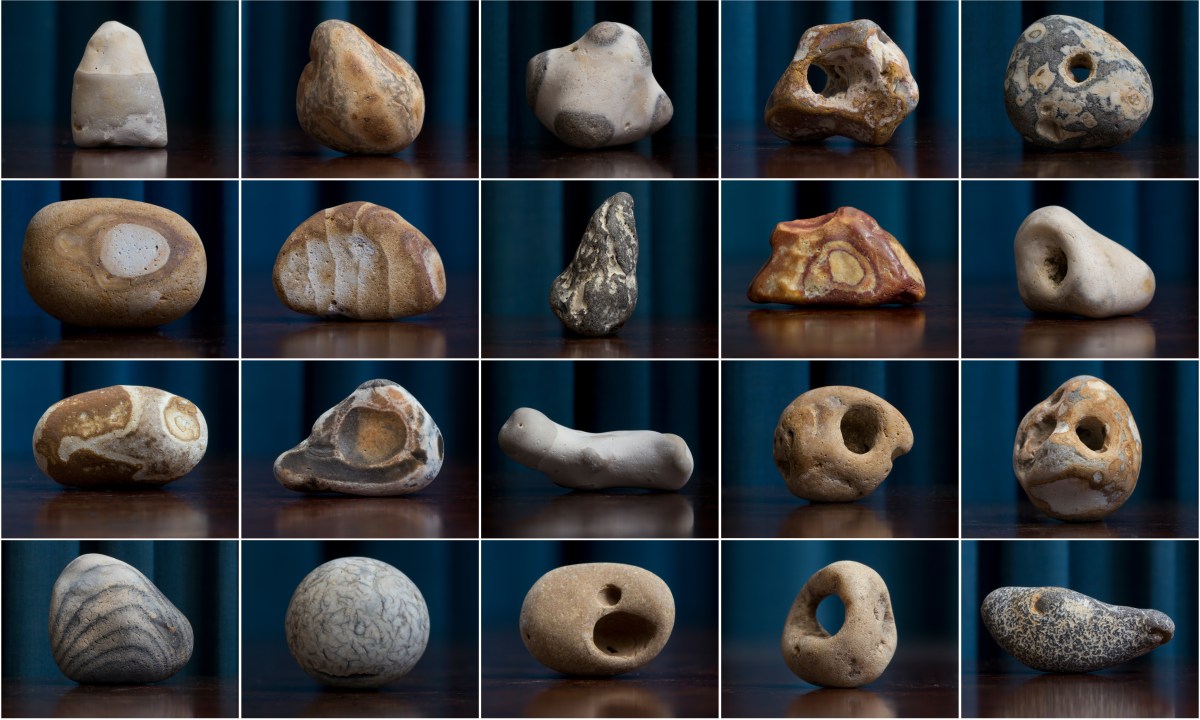
Collected Stones: Feb 2015

‘…the Thriae showed Hermes how to foretell the future from the dance of pebbles in a basin of water; and he himself invented both the game of knuckle-bones and the art of divining by them. Hades also engaged him as his herald, to summon the dying gently and eloquently, by laying the golden staff upon their eyes.’(1)

‘Among the Beng of the Ivory Coast, a regular form of divination involves the diviner’s use of black pebbles placed in a brass pan with a small amount of water. The process of consultation consists of the client informing the diviner about his/her problem and the reason for consultation. Turning the bowl in her hands, she observes how the pebbles settle in the bowl. From her observation she diagnoses the problem and prescribes an appropriate sacrifice.’(2)

(1) Robert Graves – The Greek Myths, 1955, revised 1960
(2) Jacob K Olupona, ‘Sacred Cosmos: An ethnography of African indigenous religious traditions’ in, ‘African Americans and the Bible: sacred texts and social structures’, ed Vincent L. Wimbush, Continuum International Publishing Group, New York, 2003

Vernal Equinox – Fri 20th March

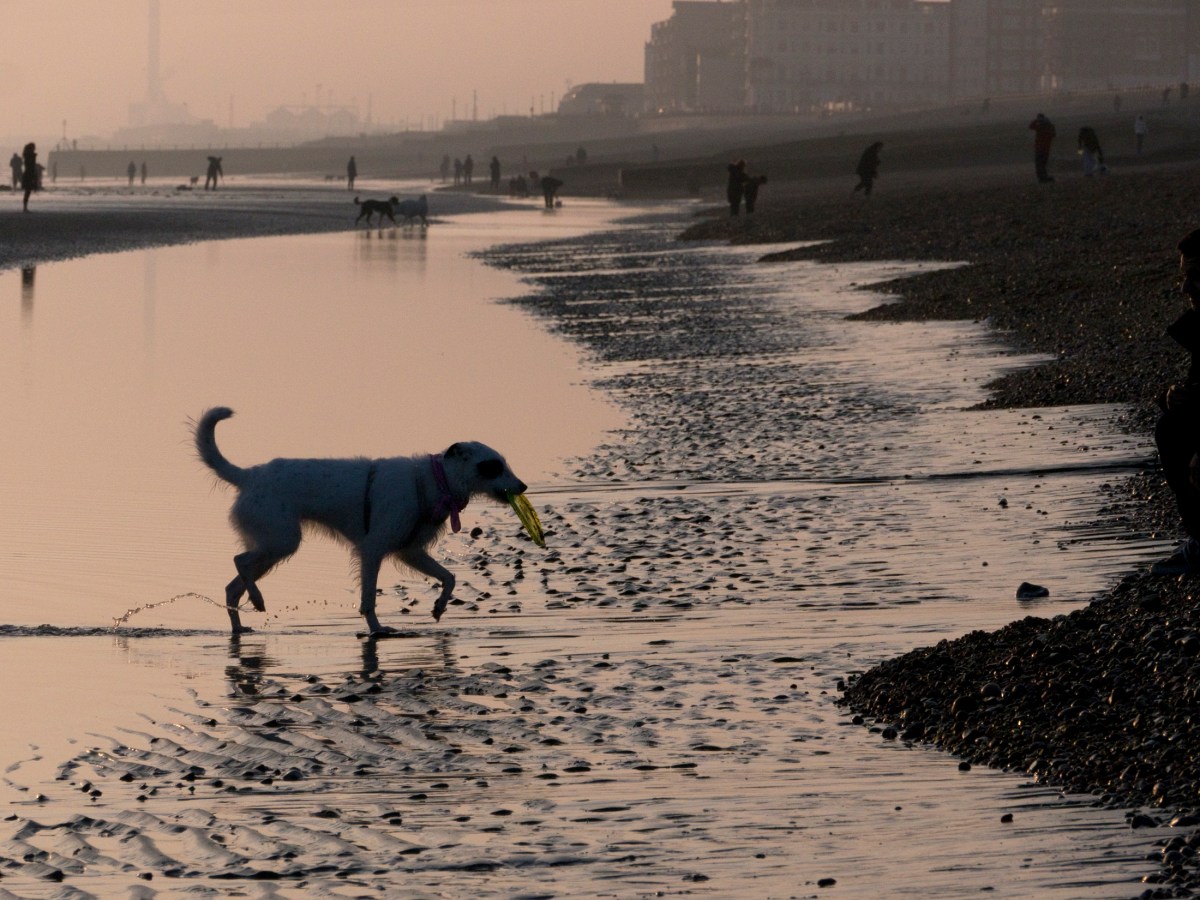
I had planned a special edition today to mark the solar eclipse, and indeed had written something witty about the great British experience of remarkable astronomical phenomena (i.e. its always bloody cloudy and you miss everything) but I’ve now decided that’s a dumb idea. This blog is about discovering the extraordinary within the everyday, not what you miss out on. So, instead, I just want to say that I’ve never seen a tide as low as the one this evening. Maybe it was because today was also the vernal equinox and, unusually, was also a very calm evening.

I wasn’t alone in this delight and as the sun set the beach was populated with a hundred dog walkers and people just out for a stroll, all discovering the joy of splashing along the sand we never knew we had in Brighton, while the tiniest of waves lapped in the distance like lace in a breeze. It doesn’t get much better than that.

Fruits de Mer – Thurs 19th March

Seafood seems to be on the menu in the bird world at the moment. Today I came across the second seagull in a week eating a starfish (yes that’s a starfish in the picture not, as on normal occasions, a gullet-full of chips). This looks quite charming, the pretty star shape held in the beak of this snowy white seaside icon, until you realise that the hapless echinoderm is probably still alive.

And then there is the additional dietary supplement of whelks. These, being heavily armoured, create something of a problem for both seagulls and crows alike. How do you get at them when they are in their shells? The answer seems to be to fly to a great height and drop them so the shells shatter when they hit the ground, then swoop down to pick through the broken pieces.

Of course doing so means that, for a few seconds, the whelk is not in your possession, meaning some other bird nearer the ground could nip in and steal these tasty morcels. Indeed this is a favourite strategy among those of a lazier, or smarter, persuasion and I have seen numerous fights break out over ownership. I had thought that this is how crows get hold of these shellfish. They certainly aren’t known for their swimming skills. But then a few weeks ago I was on the beach near the end of the day, to see the man from the whelk stall trundle across the pebbles with a huge plastic crate, which he then upturned unceremoniously, dumping a great mound of mollusc shells at the water’s edge.

At once there was a riot of flapping wings as both gulls and crows descended on this prize, first of all squabbling for the best bits, then drawing back, nonplussed, when they realised that most of the contents had been eaten. Nevertheless there were enough scraps left to warrant perseverance and I saw as many crows as gulls flying away with shells held in their beaks. It seems the crows have learned from the gulls what then to do with them. The crack when the shell hits the ground is quite distinct.

Now all I want to know is why there seem to be so few tourist injuries resulting from being hit from a great height by plummeting seashells? Is this luck, or is the tourist board hushing things up? After all Aeschylus the Ancient Greek tragedian suffered a similar fate when an eagle mistook his bald head for a rock and dropped a tortoise on him, killing him outright. Or maybe Brighton birds are smart enough to realise that killing tourists diminishes further possible food sources including bread, cake, kebabs, chips and the hot dogs I’ve mentioned in other posts?

Lost – Weds 18th March

‘The gentleman raised his eyes above his newspaper and looked curiously at Jemima–
“Madam, have you lost your way? ” said he. He had a long bushy tail which he was sitting upon, as the stump was somewhat damp.
Jemima thought him mighty civil and handsome. She explained that she had not lost her way, but that she was trying to find a convenient dry nesting-place.’

The Tale of Jemima Puddle-Duck
Beatrix Potter