Gaétan Henri Alfred Edouard Léon Marie Gatian de Clérambault was a French psychiatrist who, while perhaps less widely known than other practitioners working in the earlier part of the 20th century, was not without influence. He ‘introduced the term ‘psychological (mental) automatism’ and suggested that the mechanism of ‘mental automatism’ might be responsible for ‘hallucination experiences’’(1). He also defined the condition which became known as De Clérambault’s syndrome (aka erotomania) in which sufferers come to believe they are the object of desire for a person, usually famous or high-status, who they have usually had little or no contact with. ‘During an erotomanic episode, the patient believes that a secret admirer is declaring their affection to the patient, often by special glances, signals, telepathy, or messages through the media. Usually the patient then returns the perceived affection by means of letters, phone calls, gifts, and visits to the unwitting recipient. Even though these advances are unexpected and often unwanted, any denial of affection by the object of this delusional love is dismissed by the patient as a ploy to conceal the forbidden love from the rest of the world'(2). Jacques Lacan regarded de Clérambault as his ‘only master in psychiatry.’
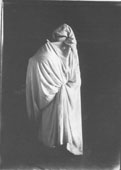
In addition to his work as a psychiatrist, de Clérambault was also an accomplished artist – for a while teaching classes on the art of the draped costume at the École nationale supérieure des Beaux-Arts in Paris – and an obsessive photographer. Between 1914 and 1918 he produced over 30,000 photographs, some of which formed part of a research project on the symptoms of hysteria, but also a sizeable body of work portraying Moroccan women under the veil. In these photographs, all of the female subjects are so elaborately and completely concealed from head to toe by swags of cloth, that it is difficult to tell that there is a human being, let alone a woman, under these garments. Yet at the same time these enigmatic and spectral figures seem to possess a quality that is both predatory and erotic.
All artists project their desires onto their surroundings. Perhaps the same is true of psychiatrists, or indeed anyone seeking to further our own (or maybe just their) abilities to make sense of the world. What interests me most about de Clérambault is the conjunction between his psychiatric practice and his private compulsion to record this singular subject.
(1) Vladimir Lerner, British Journal of Psychiatry http://bjp.rcpsych.org/content/197/5/371.short
(2) Anderson CA, Camp J, Filley CM (1998). “Erotomania after aneurysmal subarachnoid hemorrhage: case report and literature review”. J Neuropsychiatry Clin Neurosci 10 (3): 330–7







 Umbrellage