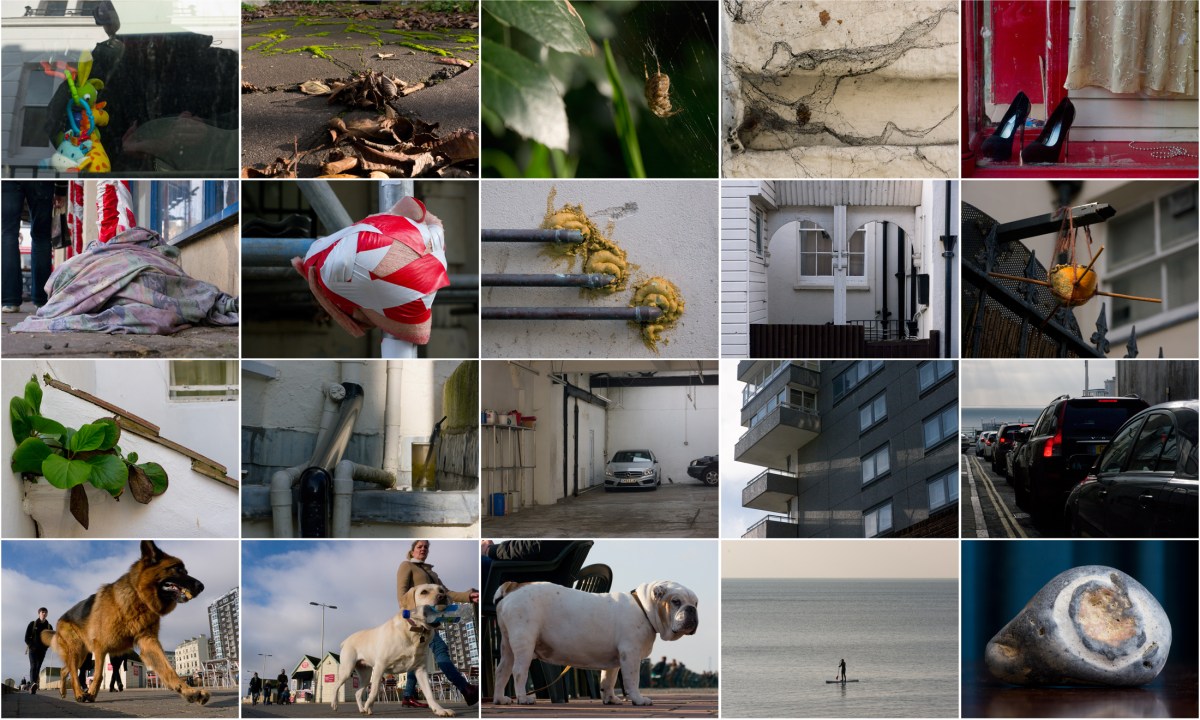
Heraclitus villas – Sun 30th Nov

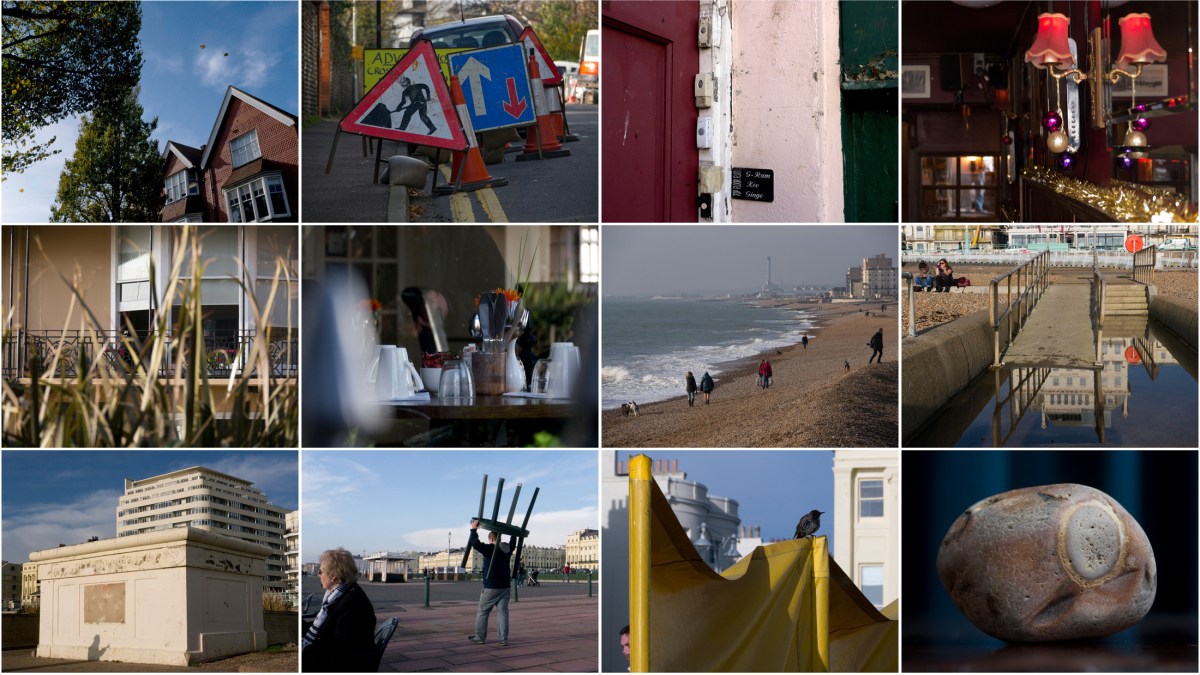
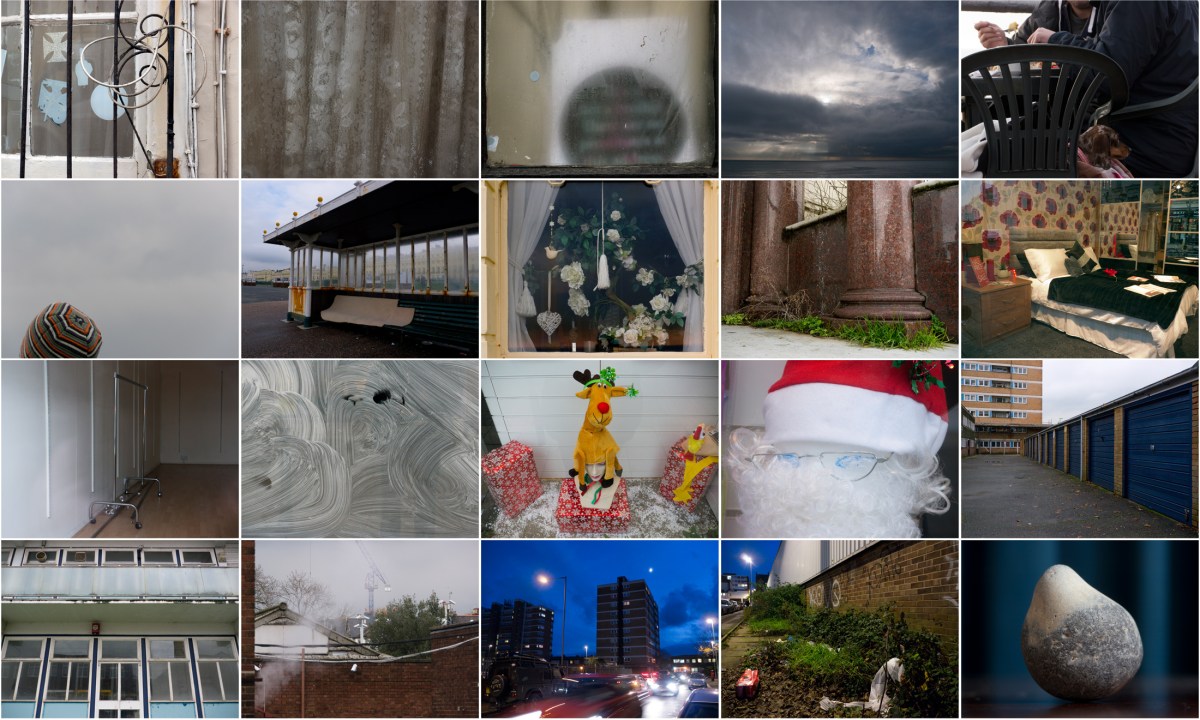
When I started this project I was worried I’d run out of things to photograph. I knew, because of the way I’d set it up as a daily journey across Brighton, and inevitably there would be time constraints, that my journeys were usually going to cover a fairly limited amount of ground. What I didn’t realise at the time was how complex these excursions would become in terms of nuance:

Walk down any street and you’ll see a certain number of things. Some of these will be unusual; others will not change much from day to day. However, walk up the same street and because you’re going in the opposite direction, you’ll see other things, plus many of the same, but quite differently; what doesn’t work from one angle, does for another. This makes you realise that if you go down the street on the other side you’ll see another new set of possibilities, and of course you’d then need to consider going in the opposite direction on that side too. Every street has now become four times as long, but in the time it takes to cover all of it, what are you missing in the next one?

Then there’s the weather. If its sunny you get shadows and reflections, picking out some things and not others, and these can make an image, but equally if it’s gloomy or raining the interiors of buildings come alive and the rain animates everything differently which can, again, make an image. Throw in some strong winds and the whole world comes alive, but of course some things are impossible to photograph when it’s windy. Different days of the week have different flavours (Sunday’s are particularly good for dogs, if it isn’t raining). While all this has been going on time has been slipping by and you’ve realised that you’ve passed through Halloween, Guy Fawkes night and now the shops are full of fake snow, shiny baubles and lights. The trees have lost most of their leaves and the sun now slants at a very low angle, lighting everything differently.

Then there are the delights of chance, not only in terms of the possibility of extraordinary events, and because we leave a trail of stuff behind ourselves all the time, but also because the first thing I see on any given journey will completely colour the rest of the walk, suggesting I look maybe up rather than down, and so I’ll notice roofs one day, and gutters the next; or really small things, or big ones. Then I’ll remember that I don’t have to hold the camera at head height but maybe try putting it on the ground, and boy does that change things…

And of course underlying all of this is you yourself. How are you feeling today? And how much of this reflects back on you from the world you are looking at? What are you looking for – even if you don’t realise you’re looking for it?

I now know I’m never going to complete this project. Suits me.
Baguettage – Sat 29th Nov

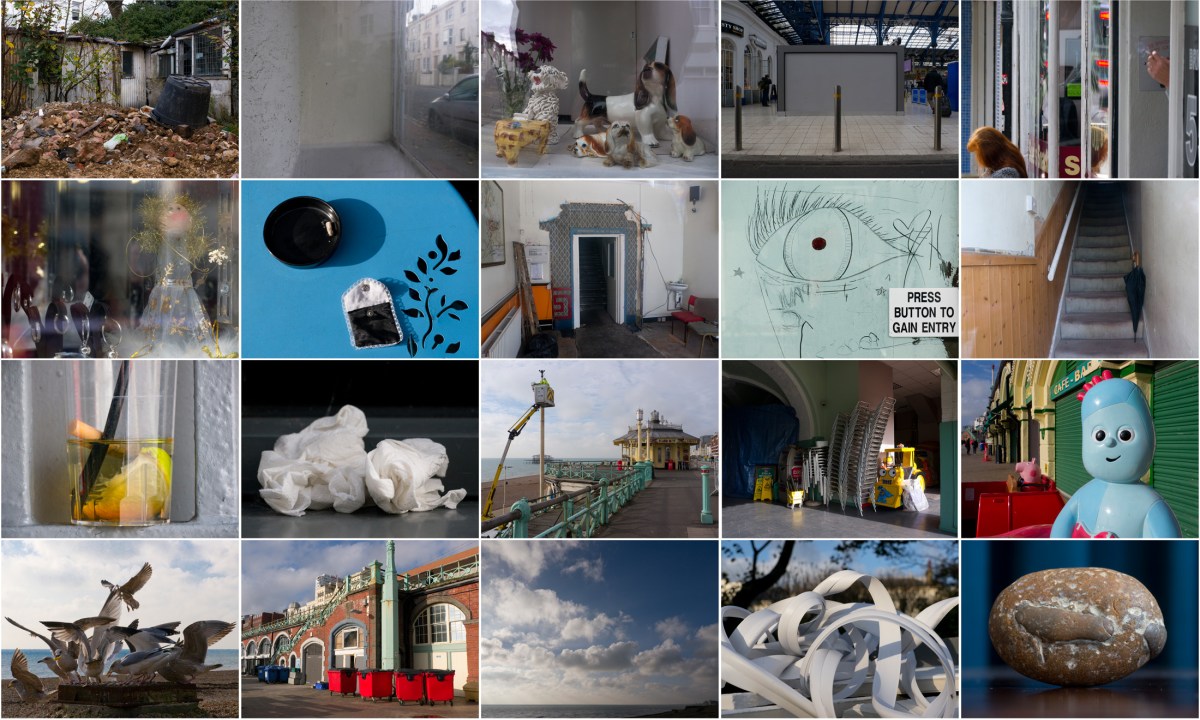
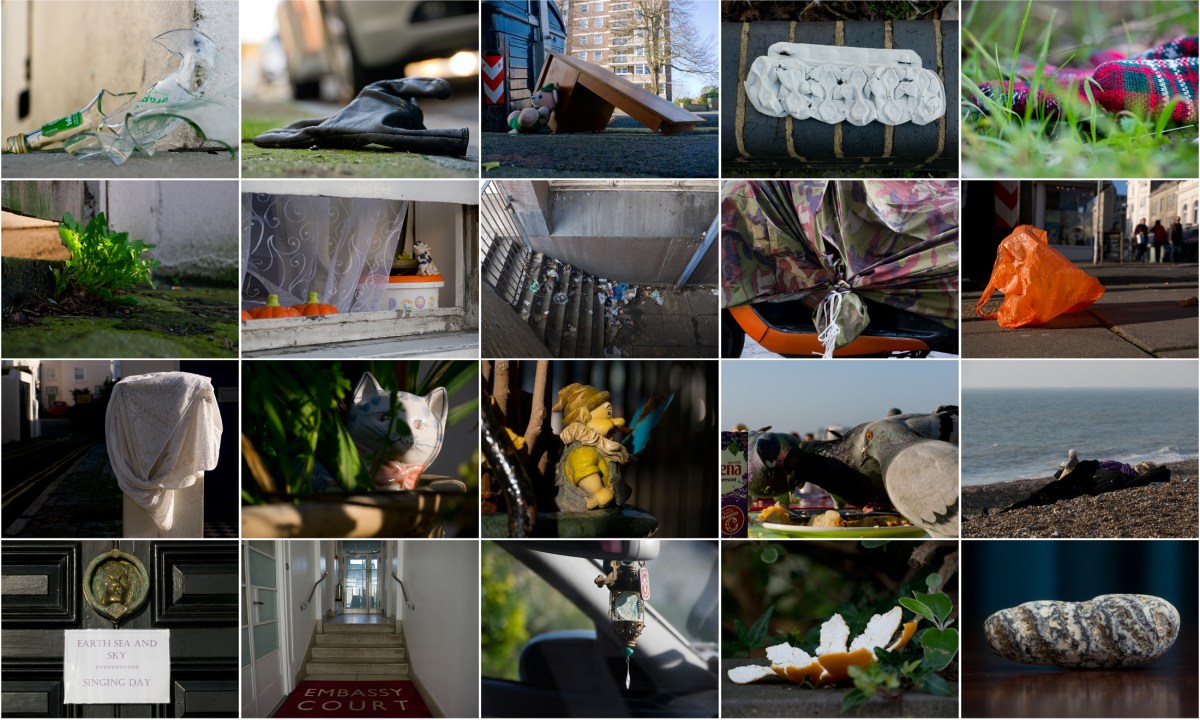
You may have read my entry about fairy loaves and my delight at finding one (if not read it now: Tues 11th Nov 2014). Well, look what I’ve found now (see last picture on today’s contact sheet): a fairy baguette! Surprisingly heavy too (must be wholemeal). I mean, only in Brighton would even the fairies make bread in the continental manner. It’s got those diagonally cut ridges and everything, and it must be a fairy loaf because its so tiny, about the size of a small cat poo… oh…

Were there cats in the cretaceous period? They’d have to be underwater cats because the geological strata that it would have emerged from would have been under water when it was laid. I mean I think it’s a fossil. I haven’t just brought an extremely hard cat poo home with me have I? Only one way to find out…

Damn. I think I’ve broken a tooth…

Etch-a-sketch – Thurs 27th November

Palimpsest is the name for a particular kind of manuscript in which a text has been erased to allow the page to be re-used for a subsequent work. The term dates from well before the introduction of paper, when scribes wrote on parchment or vellum. Because both of these kinds of surface are made from animal skins (goat or sheep) they are highly durable, allowing them to be scraped back and re-written. As a result, during times when writing surfaces were difficult to come by, or demand outstripped supply, whole books or scrolls were erased to make room for newer or (what at the time was considered) more important works. Sometimes, heretical or ‘pagan’ works were overwritten with biblical text in order to sanctify or neutralise the older writings.

Often the previous works were not completely erased, or left enough of an impression on the surface, so that scholars have since been able to decipher what was written before. In recent times archaeologists have made additional finds through the use of digital technologies, together with a range of multi-spectral photographic techniques. The study of palimpsests has led to discoveries of lost works by Euclid, Archimedes, St John Chrysostom, Cicero, Seneca… one particular Qur’anic work has been dated to within fifteen years of the death of the Prophet Muhammad.

Palimpsest seems to be one of those peculiarly archaic words destined to the dusty corners of a few highly specialised subjects, yet, in truth, we should be using this word regularly. Pretty much every piece of information we have on our computers (i.e. everything these days) is a digital, multi-layered, hyper-palimpsest: the result of information written and over-written on previously erased surfaces carried out so often that, had they needed to be physically re-prepared so many times, they would have worn transparent and disintegrated.

Every time you transfer an image from your camera, to your computer, to your iPad, to someone else’s, to… you take up space on your hard drive or memory card which you’re likely to soon delete again. The web page you’re reading now will soon be replaced by something else, even though we assume it remains ‘somewhere’. Indeed digital technology has re-written the meaning of the word original. Ask yourself, where are all the original photos you took? You probably erased them a long time ago, but you still have the originals on your computer, don’t you?

Wotton Under Edge special – November 2014

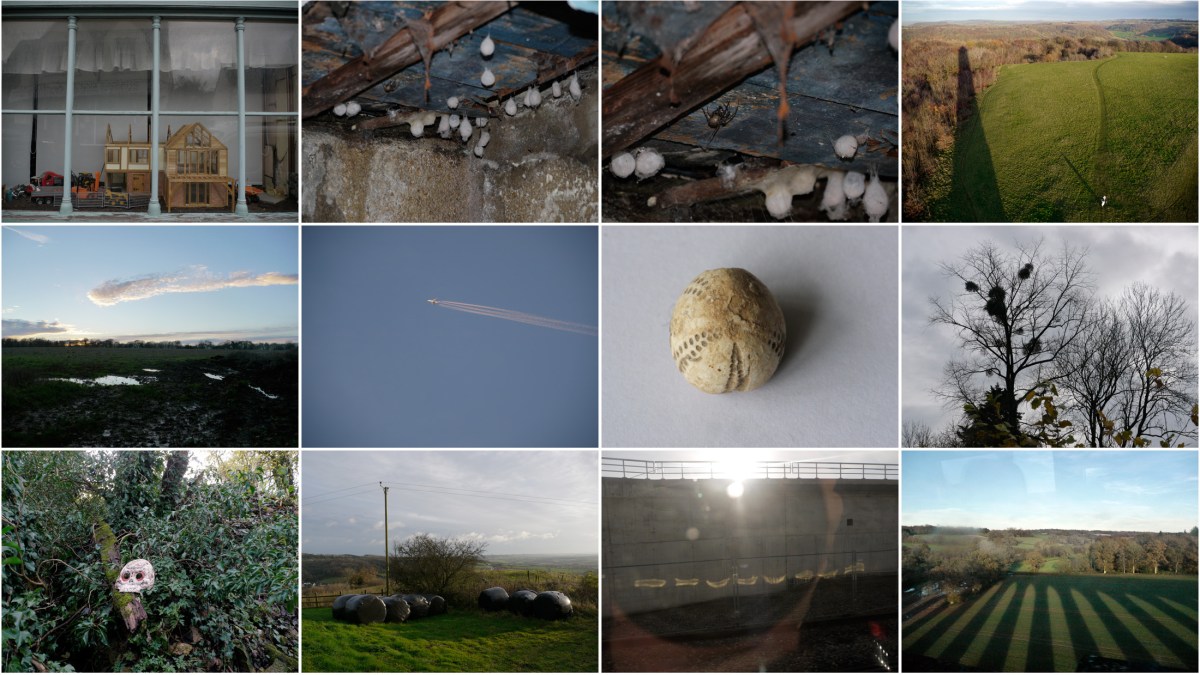
In a slight departure from the usual format, here’s a contact sheet of images of things you can do in Wotton Under Edge (where I have been for the weekend). They include (left to right, top to bottom):

  • Marvel at the ever-changing diorama in one of the windows on the way into town. The building is now well under construction, but previous displays have focused on campaigns to stop the development, complete with protesters
  • Go and see the cave spiders in Eric’s shed
  • Climb Nibley Monument and feel a bit funny when you get to the top
  • Re-create a number of Caspar David Friedrich’s wonderful high-romantic paintings, but with real mud
  • Watch airliners flying south for the winter
  • Compare fairy loaves (Rob and Judy have got one too)
  • Climb very tall trees and collect mistletoe
  • Re-enact Blair Witch Project
  • Play on the smell-o-rama bouncy castle

And then on the way home:

  • Watch a perfect string of lozenge-shaped will o the wisps keeping up with the train
  • Work out how high the viaduct is at Haywards Heath by making a mathematical calculation involving time of day, time of year, and length of the viaduct’s shadow

More from Brighton tomorrow…

Say it with fish – Weds 19th Nov

Apparently, Herring Gulls have now reached an evolutionary crossroads from which two distinct species will, in time, emerge. It seems to be all to do with diet. Traditionally, seagulls live on the coast and do the things we would expect them to do: catch and eat fish, plus crabs and so on stranded on the beach, nest in cliffs etc. However, many seagulls have found rich pickings on café tables, and in rubbish bins and dumps. These gulls nest on the tops of houses and, even if their young fallout of the nest, they are big enough to be a scary challenge for all but the most hungry of predators. Thus, urban gulls have adapted highly successfully to built up environments and their numbers grow.

The trouble is, seagull courtship rituals are centred around tasty morsels of food regurgitated during their mating displays (yes, they do a lot of regurgitating, see entry for 15th Nov) and when an advance is made between a town gull and a country gull, things go wrong. Country gulls have no idea what to do with the proffered hot dogs, buns, chips and half-eaten sandwiches that form the staple diet of urban gulls, while, frankly, town gulls are crap at fishing. The result is that there are now hardly ever any successful liaisons between the two avian branches and, while at present they remain genetically identical, in terms of behaviour, two distinct tribes have emerged with little or no chance of amorous relations in the future. Evolutionary divergence is only a matter of time.

Bummer.

Fossil Fuel – Tues 18th Nov

I’m having to modify my views on the existence of fossils on Brighton beach. True, the place is not littered with them the way you might find in other parts of the country, and what you come across is often smashed almost beyond recognition, but I’m seeing more and more of them. Apart from the Fairy Loaf I discovered a few days ago (11th Nov) other stones of the day (e.g. 26th & 29th Oct, 15th & 16th Nov) have shown telltale signs of something that couldn’t just have happened as a result of a purely geological process. After all, the Weald, not so very far away, has a reputation for turning up some remarkable pieces and the chalk cliffs all the way through the Seven Sisters are made up from the remains of countless billions of ancient shellfish.

Today’s stone of the day is a bivalve of some kind (actually you’ll have to take my word for it as it doesn’t photograph well but, seen in 3 dimensions you can much more readily discern that one end is spatulate while the other shows evidence of the suture joining the two valves; in short, it’s mussel-shaped). While its overall form suggests that it was fossilised whole, in its current condition, because of the relentless grinding caused by the tides over innumerable years, only about 50% of the shell survives, and yet these few fragments, because they are so battered, evoke as much their journey over time, as the creatures original appearance, and what is no longer there is suggested by what remains.

Giorgio de Chirico once noted that a vase only has meaning once it has been broken. There is a tradition in Vietnam of repairing ceramics with elaborate inlays of gold wire, to emphasise rather than conceal the fracture lines. We should all gild our wrinkles, but it’s easier said than done.